返回总目录
Shibli Zaman and the Abuse of Etymology
"We demolish arguments and every pretension
that sets itself up against the knowledge of God."
2 Corinthians 10:5
|
|
Competing for the "Worst Etymological Fallacy" Award?
Arguments from the Bottom of the Etymological Fallacies Pit
My main reason for writing this article is the following outrageous statement
propagated by Shibli Zaman:
The crumbs that fall from the master’s table
Now to tie this all in to my initial childhood trauma regarding dog food commercials,
in the Gospels of Matthew, Mark and Luke we find a story of a Canaanite woman
who begged Christ to heal her demon-possessed daughter. After Christ initially
shunning this Gentile woman with silence, his disciples asked him to shoo her away.
Christ obliged them telling her, "I am not sent but unto the lost sheep of the house
of Israel." Then the English text of the Gospels says, "Then came she and worshipped
him, saying, Lord, help me." It is interesting to note that in the Greek text the word
for "worshipped" here is "proskuneo" which is a contraction of "pros" meaning to
"be in the manner of" and "kuneo" (root "kuon") which is basically a dog. How the
Biblical translators understood groveling like a dog to be "worshipping" is dogmatically
baffling to say the least. To this groveling, Christ only reiterates his original
standpoint saying, "It is not meet to take the children's bread, and to cast it to dogs."
The Greek word for "dogs" in this verse is "kunarion" which is the diminutive of
"dog" from the same root as the word translated as "worship". Honestly, I don’t know
about the behavior of dogs in early 17th century England, but I, myself, have never seen
a dog pray.
(Source: Shibli Zaman, Stung from
the Same Hole Twice: Muslim-America’s Precarious Courtship with Bush and the Republican
Party, 11/24/2002)
Even a childhood trauma is no excuse for this kind of ridicule of things most
sacred to Christians, like the Holy Scriptures and the worship of our Lord
and Savior Jesus Christ.
Zaman's topic is the voting behavior of Muslims in the most recent US elections,
and he presents thoughts about future strategies so that Muslims may increase
their influence in America. Taking a stab at the Bible in this context appears
to point to an insatiable desire to attack the Christian faith even when talking
about issues that are completely unrelated to Christianity.
The first lesson any linguist or serious language student has to learn
is that the meaning of a word is determined by usage not by etymology
(let alone false etymology as in this case).
Despite the mockery that Zaman directs at them, the translators of the King
James Version (KJV, first published in 1611) were recognized scholars of
Greek in their time. They were not making up imaginary translations.
Zaman should have researched his claims better instead of just assuming that
the results of his armchair etymology are an established fact.
One of the most authoritative and most detailed dictionaries on the Greek
language is readily available online and tells us about the word proskuneo:
prosku^n-eô [list of grammatical forms omitted] :--
1. make obeisance to the gods or their images, fall down and worship, ...
2. esp. of the Oriental fashion of prostrating oneself before kings and superiors, ...
(Orig. perh. throw a kiss to the god, ...)
(Source: Henry George Liddell, Robert Scott, A Greek-English Lexicon, revised
and augmented throughout by Sir Henry Stuart Jones with the assistance of Roderick
McKenzie, Oxford, Clarendon Press, 1940; the above excerpt is quoted from the
online edition)
The first and main meaning given for the word as it occurs in ancient (pagan)
Greek texts is the worship of gods. On the other hand, the dogs fancied by Zaman
are not mentioned at all in the dictionary entry.
Let us turn to the Septuagint (LXX), the translation of the Hebrew Old Testament
into the Greek language by Jewish Rabbis about two centuries before Christ.
In the LXX, the Greek verb "proskuneo" translates the Hebrew verb "hishtachaweh"
approximately 175 times; it is used with respect to the "worship" of God (or
the Lord) or of pagan gods approximately 108 times: [Gen 22:5; 24:26; 24:48;
24:52; Exo 4:31; 12:27; 24:1; 32:8; 33:10; 34:8; 34:14; Deu 4:19; 8:19; 11:16;
17:3; 26:10; 29:25; 30:17; Jdg 7:15; 1Sa 1:3; 1:19; 15:25; 15:30; 15:31; 2Sa 12:20;
15:32; 1Ki 9:6; 9:9; 16:31; 22:54; 2Ki 5:18; 17:16; 17:36; 18:22; 19:37; 21:3;
21:21; 1Ch 16:29; 7:3; 7:19; 2Ch 7:22; 20:18; 29:28; 29:29; 29:30; 32:12; 33:3;
Neh 8:6; 9:3; 9:6; Psa 5:8; 21:28; 21:30; 28:2; 65:4; 80:10; 85:9; 94:6; 95:9;
96:7; 98:5; 98:9; 105:19; 131:7; 137:2; Job 1:20; Mic 5:12; Zep 1:5; 2:11;
Zec 14:16; 14:17; Isa 2:8; 2:20; 27:13; 37:38; 44:15; 44:17; 46:6; 49:7; 66:23;
Jer 1:16; 8:2; 13:10; 16:11; 22:9; 25:6; 33:2; Eze 8:16; 46:2; 46:3; 46:9;
Dan 3:5; 3:6; 3:7; 3:10; 3:11; 3:12; 3:14; 3:15; 3:18; 3:95 (LXX, 3:28 Heb)].
The other instances mainly involve showing homage or respect for a person
of superior cultural rank (Gen 19:1; 23:7, 12; 27:29, etc.).
For a detailed discussion of the use of the word proskuneo in the New Testament
see this article on Worship of
the Lord Jesus. In the following I want to present just a couple of pertinent
examples:
Jesus said to him, "Away from me, Satan! For it is written:
‘Worship (proskuneeseis) the Lord your God,
and serve him only.’" (Matthew 4:10, NIV)
So when Peter came in, Cornelius met him, fell at his feet,
and worshiped him (prosekuneesen). But Peter helped him up,
saying, "Stand up, I too am only a man." (Acts 10:25-26,
NET Bible)
Then the angel said to me, "Write: ‘Blessed are those who are invited
to the wedding supper of the Lamb!’" And he added, "These are
the true words of God." At this I fell at his feet to worship him (proskunesai autoo).
But he said to me, "Do not do it! I am a fellow servant with you and with
your brothers who hold to the testimony of Jesus. Worship God! (too theoo proskuneeson)
For the testimony of Jesus is the spirit of prophecy." (Revelation 19:9-10, NIV)
I, John, am the one who heard and saw these things. And when I had heard
and seen them, I fell down to worship at the feet of the angel who had been
showing them to me. But he said to me, "Do not do it! I am a fellow servant
with you and with your brothers the prophets and of all who keep the words
of this book. Worship God! (too theoo proskuneeson)" (Revelation 22:8-9, NIV)
In these verses, the act of proskuneo is to be given to God,
and it is refused by the Apostles and the angels. This shows without doubt
that the word CAN and regularly DOES refer to the worship due to God
alone.
Zaman's statement, "It is interesting to note that in the Greek text
the word for ‘worshipped’ here is ‘proskuneo’ ...", gives
the impression that a rare and strange word is used in this passage, that the meaning of
this word is either open to debate or it usually means something completely different,
and because of the root meaning of this word, Zaman is baffled how on earth the translators
ever got the idea to translate it here as "worshipped".
Nothing could be further from the truth. The term proskuneo is a very common
if not the main word used for worship in both the Greek Old and New Testaments.
(The verb is used 60 times in the Greek New Testament.)
In the above, I have offered plenty of sources and references, Zaman has offered
none to support his claims. If he wants to maintain this theory, it is now his
turn to produce biblical or pagan references in which proskuneo denotes
the behaviour of dogs. To my knowledge, neither the biblical nor classical Greek
sources support such an idea. Certainly it was not in the mind of the gospel
writers, the context does not allow it.
So far I have referred mainly to Liddell and Scott, because it is not only a standard
reference but also readily available online, and thus there is no excuse at all that
the author has not consulted this reference before making such unscholarly and
irresponsible claims.
Liddell and Scott's dictionary retains its importance to this day because of the fact
that they were classical Greek scholars and drew on a wide range of extra-biblical
materials in compiling their lexicon. However, their work has now been superseded by
the third edition of the BDAG (which draws on their work). The bibliographic reference
is: Frederick William Danker (editor), A Greek-English Lexicon of the New Testament
and Other Early Christian Literature - 3rd Edition (BDAG), Chicago: University of
Chicago Press, 2000.
It is an absolutely massive tome and valuable because for each entry it traces its uses
not only in the NT but in (a) earlier Greek materials; (b) contemporary Greek literature;
(c) later Christian writings. In short, if anyone wants to see where a Greek word
comes from and more importantly, how it was used in the first-century outside the NT,
the BDAG is the book to consult. Regarding the word proskuneo it states:
proskuneo (kuneo ‘to kiss’)
... (... Frequently used to designate the custom of prostrating oneself before persons
and kissing their feet or the hem of their garment, the ground etc.; ...) to express
in attitude or gesture one's complete dependence upon or submission to a high authority
figure, (fall down and) worship, do obeisance to, prostrate oneself before, do reverence
to, welcome respectfully, ... (p. 882)
Again, no link at all to dogs, rather BDAG identifies the word as a compound of
the preposition ‘pros’ with the verb ‘kuneo’ (= kiss).
The following quotations are taken from Johanns P. Louw & Eugene A. Nida,
Greek-English Lexicon of the New Testament Based on Semantic Domains, Volume 1
(United Bible Societies, New York 1988, 1989). In entry 53.56 for proskuneo,
the authors write:
... to express by attitude and possibly by position one's allegiance to and regard
for deity - ‘to prostrate oneself in worship, to bow down and worship,
to worship.’ eidomen gar autou ton astera en tee anatole kai eelthomen
proskunesai auto ‘for we saw his star in the east and we came to worship
him’ Mt 2.2. (p. 540)
They also have a note which states that
7 proskuneo appears to differ somewhat in meaning from seBomai,
seBazomai, and euseBeo, ‘to worship’ (53.53)
in emphasizing more the semantic component of position or attitude involved
in worship. (Ibid.)
In their entry 53.57, under proskuneetees, they write:
... (derivative of proskuneo ‘to worship,’ 53.56)
one who worships - ‘worshiper.’ hote hoi alethinoi
proskuneetai proskuneesousin to patri en pneumati kai aletheia
‘when the real worshiper will worship the Father in spirit and in truth’ Jn 4:23.
The Greek word proskuneo ordinarily means "among Orientals, esp. Persians,
to fall upon the knees and touch the ground with the forehead as an
expression of profound reverence" (Thayer's Lexicon, No. 548).
The Hebrew word "hishtachaweh" has the same meaning.
Is this not also what Muslims do when they worship Allah?
Is Zaman thinking he is "groveling like a dog" when he worships his God?
[Note: Thayer's Lexicon is a popular "layman's tool", but rather out-dated
and not considered authoritative by scholars. I only quoted from it because
of the nice formulation it provided in this case. The meaning of the word was
already established through the above quotations from scholarly references.]
Had Zaman consulted some modern scholarly translations of the Bible, or a good Bible
commentary, or asked any knowledgeable Christian about this before publishing such
nonsense, he could have saved himself this embarrassment. Even though "worship"
is regularly the meaning of proskuneo in the Old and the New Testament, and
not an odd imagination of the KJV translators, is it really the most appropriate
translation in this particular instance? Let me quote this verse together with
its footnote, as rendered in the NET Bible:
But she came and bowed down7 before him and said, "Lord, help me!"
(Matthew 15:25, NET Bible)
7 In this context the verb proskunew, which often describes worship,
probably means simply bowing down to the ground in an act of reverence or supplication.
To gain a proper understanding of the passage about Jesus and the Canaanite woman
the reader should consult a good scholarly Bible commentary. A detailed exegesis of
this text is not our topic here. [Some of my personal thoughts about Matthew 15
can be found in this article.]
Let's now turn to Zaman's atrocious etymology and examine it in detail:
Then the English text of the Gospels says, "Then came she and worshipped
him, saying, Lord, help me." It is interesting to note that in the Greek text
the word for "worshipped" here is "proskuneo" which is a contraction of "pros"
meaning to "be in the manner of" and "kuneo" (root "kuon") which is basically
a dog.
Not at all! First, pros-kuneo is a compound of two words,
not a contraction. Second, pros is not a verb and does not
mean "to be in the manner of", but a preposition best translated as "towards".
The basic usage is "in the direction of" (BDAG, pp. 873-875).
Wallace (Greek Grammar Beyond the Basics, Grand Rapids: Zondervan, 1996;
the standard advanced text book on undergraduate courses) lists six basic uses
(p. 380):
- Purpose (for, for the purpose of)
- Spatial (toward)
- Temporal (toward, for (duration))
- Result (so that, with the result that)
- Opposition (against)
- Association (with, in company with)
Zaman is utterly wrong. Indeed, he is so far off the map one has to wonder
where he got this whole idea from.
Third, kuneo is a verb meaning "to kiss", not "a dog". Fourth,
the root of kuneo is "kus" not "kuon" and has nothing at all to do with
a dog.
Zaman would only have had to consult the already mentioned and readily available
Greek-English Lexicon
by Liddell & Scott which states:
ku^neô :-- kiss, ... of pigeons, bill
The usage of the verb kuneo is documented mostly for kissing
of the head (kephale), the hand (cheir), or kissing the ground (arouran,
one's native soil, after many years of absence from home).
Again, dogs are not mentioned in the entry, and particularly the use
of this word also for pigeons and their way of billing ("kissing"),
shows that it has nothing at all to do with (the groveling of) dogs.
Furthermore, my copy of Wilhelm Gemoll's Greek-German dictionary
(Griechisch-Deutsches Schul- und Handwörterbuch) gives not only
the meaning (kiss), but also provides explicit information about
the construction of the word: kuneo, contracted from ku-ne-so,
root: kus, the root form being best seen in some of the aorist forms:
ekussa, kus(s)a.
Still, proskuneo doesn't mean ‘kiss towards’ but prostrate,
make obeisance, worship. In this case and in most cases, even if you get
the etymology right, this still doesn't get the meaning right. To investigate the meaning
of a word, look at how it is used. Its history is amusing and might educate us in
interesting ways, but is not a reliable source of evidence on its present meaning.
Etymology has its valid place in linguistic research, but the saying
"A little knowledge
is a dangerous thing" seems to be particularly true for the field
of etymology since it is so easily abused. Yes, the two words kuneo
and kuon look similar, but in nearly all languages there exist similar
looking words that are not related.
More about this shortly.
Zaman finishes his little ‘exegetical nugget’ with the punchline:
"Honestly, I don’t know about the behavior of dogs
in early 17th century England, but I, myself, have never seen a dog pray."
Now, I haven't seen any praying dogs either, and I have no intention to promote
such a theory. It is, however, rather strange to find Zaman making such a statement.
After all, he believes in Talking Ants, even though
he has never heard an ant talk. Furthermore, in Surah 27 the Qur'an presents us
with a hoopoe bird reporting about the right and wrong practice of worship:
- And he sought among the birds and said:
How is it that I see not the hoopoe, or is he among the absent?
- I verily will punish him with hard punishment or I verily will slay him,
or he verily shall bring me a plain excuse.
- But he was not long in coming, and he said:
I have found out (a thing) that thou apprehendest not,
and I come unto thee from Sheba with sure tidings.
- Lo! I found a woman ruling over them, and she hath been given
(abundance) of all things, and hers is a mighty throne.
- I found her and her people worshipping the sun instead of Allah;
and Satan maketh their works fairseeming unto them,
and debarreth them from the way (of Truth),
so that they go not aright;
- So that they worship not Allah,
Who bringeth forth the hidden in the heavens and the earth,
and knoweth what ye hide and what ye proclaim,
- Allah; there is no God save Him, the Lord of the Tremendous Throne.
Does Zaman want to tell us that a bird that knows the right worship of Allah
will not also worship him correctly? Particularly, when the Qur'an states explicitly:
Seest thou not that to Allah bow down in worship ALL things that are
in the heavens and on earth, - the sun, the moon, the stars; the hills, the trees,
the animals; and a great number among mankind? ... (Surah 22:18)
The Arabic term translated as "bow down in worship" is the word "sujud"
which means exactly the prostration before God that is expressed by the Greek
word proskuneo which Zaman chose to make the object of his mockery.
Certainly dogs are animals and included in "all things" which bow down
in worship to Allah according to the Qur'an.
Not only was Zaman's ridicule of Christianity utterly inappropriate,
and the etymology presented by him unscholarly and embarrassingly wrong,
but from an Islamic perspective Zaman's mocking conclusion constitutes
kufr (unbelief) since he is denying what the Qur'an definitely affirms.
Putting it differently: Was it not common sense that made Zaman reject the idea
of "praying dogs"? Recognizing that the Qur'an demands Muslims to believe in
worshipping dogs, it remains to be seen whether Zaman will choose to abandon
the Qur'an or his common sense.
Addendum:
For the purpose of determining the meaning of a word in the New Testament (1st
Century AD) it would be equally wrong to point to the way the word is used in
the current 21st Century AD as it is to look for its "original meaning" in
perhaps the 8th Century BC (cf. the article Languages
are NOT stagnant!). The New Testament meaning of proskuneo was
established in the references given above. Nevertheless,
it is still interesting and somewhat ironical to observe that the Muslim translation
of the Qur'an into modern Greek, ΤΟ ΙΕΡΟ
ΚΟΡΑΝΙΟ, published in Saudi Arabia
in 1998, often uses the verb proskuneo to render the Arabic verb for
prostrating. Obviously the Muslim translators didn't think there was any problem
with this word. The word is used in the Qur'an in the very same way as in the New
Testament, i.e. denoting prostration before deity as an expression of a believer's
worship. In the following I will give only a few of many examples:
| |
English (Pickthall or Yusuf Ali) |
Greek (Το Ιερο
Κορανιο) |
Transliterated Arabic |
| 22:77 |
O ye who believe! Bow down and prostrate yourselves,
and worship your Lord, and do good, that haply ye may prosper. |
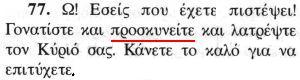 |
Ya ayyuha allatheena amanoo irkaAAoo waosjudoo
waoAAbudoo rabbakum waifAAaloo alkhayra laAAallakum tuflihoona |
| 25:60 |
And when it is said unto them: Adore the Beneficent!
they say: And what is the Beneficent? Are we to adore
whatever thou (Muhammad) biddest us? And it increaseth aversion in them. |
 |
Wa-itha qeela lahumu osjudoo lilrrahmani qaloo wama alrrahmanu
anasjudu lima ta/muruna wazadahum nufooran |
| 76:26 |
And part of the night, prostrate thyself to Him; and glorify Him a long night through. |
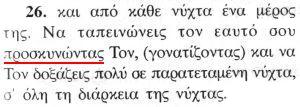 |
Wamina allayli faosjud lahu wasabbihhu laylan taweelan |
| 96:19 |
Nay, heed him not: But bow down in adoration,
and bring thyself the closer (to Allah)! |
 |
Kalla la tutiAAhu waosjud waiqtarib |
Does Zaman want to suggest that the Muslim translators of the Qur'an
deliberately chose a Greek word that means "groveling like a dog"
because this is indeed the most appropriate Greek rendering for
the Islamic expression of prayer and worship?
Linguistic Principles
Before examining further specific examples of Shibli Zaman's etymological
‘scholarship’, it will be helpful for future discussions to first
establish some general and foundational principles.
It is absolutely crucial to understand this linguistic point: A word is
a combination of meaning, phonological form, and grammatical features. Meaning lies not
in the word (alone) but the meaning is determined by the place of the word
in the sentence and even in the wider context in which it is used.
The ‘etymological fallacy’
is one of the most basic linguistic mistakes. The classic student example in English
is that of the word ‘nice’ that once meant ‘stupid’ or ‘simple’
but now means ‘pleasant’. (Cf., The Collins Concise Dictionary
[Glasgow: HarperCollins, 1995] which has under its entry for ‘nice’ the following:
"... (obsolete) A. foolish or ignorant. B. delicate. C. shy; modest. D. wanton" [p. 899]. It traces
this latter and old use of ‘nice’ to the Latin nescius, from nescire
‘to be ignorant’.) In short, ‘John is nice’ would once
have been an insult, now it is a compliment. Words change their meanings over time.
Hence rather than look backwards through time to their ‘root’ meaning
(a diachronic approach) the correct methodology is to study how they were
used at the time of the writer (a synchronic approach). The famous structural
linguist de Saussure regularly made the point that the synchronic approach must
be primary. Zaman commits the root/etymological/diachronic mistake regularly
and particularly grossly in the example of proskuneo
discussed above.
Bill Bryson is a more popular writer on the subject of language. Discussing changes
in word meanings, Bryson writes:
Surprisingly often the meaning becomes its opposite or something very like it.
Counterfeit once meant a legitimate copy. Brave once implied cowardice —
as indeed bravado still does. (Both come from the same source as depraved).
Crafty, now a disparaging term, originally was a word of praise, while enthusiasm,
which is now a word of praise, was once a term of mild abuse. Zeal has lost its original
pejorative sense, but zealot curiously has not. Garble once meant to sort out,
not to mix up. A harlot was once a boy, and a girl in Chaucer's day was any
young person, whether male or female. Manufacture, from the Latin root for hand,
once signified something made by hand; it now means virtually the opposite. Politician
was originally a sinister word (perhaps, on second thoughts, it still is), while obsequious
and notorious simply meant flexible and famous. Simeon Potter notes that when
James II first saw St. Paul's Cathedral he called it amusing, awful, and artificial, and meant
that it was pleasing to look at, deserving of awe, and full of skilful artifice.
This drift of meaning, technically called catachresis, is as widespread as it is curious.
Egregious once meant eminent or admirable. In the sixteenth century, for no reason
we know of, it began to take on the opposite sense of badness and unworthiness (it is in this
sense that Shakespeare employs it in Cymbeline) and has retained that sense since.
Now, however, it seems that people are increasingly using it in the sense not of
bad or shocking, but of simply being pointless and unconstructive.
According to Mario Pei, more than half of all words adopted into English from Latin now
have meanings quite different from the original ones. A word that shows just how
wide-ranging these changes can be is nice, which is first recorded in 1290
with the meaning of stupid and foolish. Seventy-five years later Chaucer was using it
to mean lascivious and wanton. Then at various times over the next 400 years
it came to mean extravagant, elegant, strange, slothful, unmanly, luxurious, modest,
slight, precise, thin, shy, discriminating, dainty, and – by 1769 – pleasant
and agreeable. The meaning shifted so frequently and radically that it is now often
impossible to tell in what sense it was intended, as when Jane Austen wrote to
a friend, ‘You scold me so much in a nice long letter ... which I have received from you.’
(Bill Bryson, Mother Tongue [London: Penguin, 1990], pp. 71-72)
After these entertaining quotations illustrating well the issue under discussion,
let me offer the reader what some serious linguists have to say on this point.
James Barr states in The Semantics of Biblical Language (Oxford: Oxford
University Press, 1961), THE seminal book on this subject in terms of biblical exegesis:
"The main point is that the etymology of a word is not a statement about its meaning
but about its history." (p. 109; emphasis mine)
"... the test of explanations of words is by their contexts." (p. 113)
That words change meaning over time, is not only a feature of English, but can be
observed in all languages. The following example of an anachronistic use of a word
in the Semitic language Hebrew was part of the reason to expose the Jehoash tablet
as a forgery:
1. The Jehoash Inscription uses the expression "to make repairs to the house (temple),"
wa’àas ‘et bedeq habbayit. This is fine in modern Hebrew. But in Biblical
Hebrew, as is clear from 2 Kings 12, where the story of Jehoash’s effort is related,
bedeq habbayit does not mean "repair" the "house" (the Jerusalem Temple),
but it refers to the fissures in the house that require repair! The verb in
Biblical Hebrew that does mean "repair" is hizzeq, "to fortify"—one repairs
the fissures in the foundations and walls by "fortifying" them.
In later Hebrew (apparently beginning with the Mishnah, the code of Jewish law that
was written down in the early third century C.E.), the term bedeq bayit came
to be used in the sense of "(setting) the house in order." Whoever wrote the inscription
did not understand the Biblical usage and replaced the ancient locution with a much later
one. (Source: Assessing
the Jehoash Inscription, second part: The Linguist: Hebrew Philology Spells Fake;
underline emphasis mine)
In the example of proskuneo, Zaman may have become confused because of
a similarity of the ‘root’ words behind ‘dog’ and ‘worship’
respectively. The problem is that in saying ‘Word X and Word Y look alike
therefore they mean the same thing’ one stumbles straight into another fallacy
— that of a failure to grasp the importance of homonymy and polysemy; in short,
words can mean different things. Homonymy occurs when two different words are
spelled identically. An example would the English ‘bank’ = ‘side of
a river‘ and ‘bank’ = ‘place where one keeps money’.
What we have here are two different lexemes that happen to be spelled identically.
But one cannot connect the two. Most dictionaries will list them as separate entries.
My English-German dictionary has even three entries of the word ‘bank’
with 13 and 7 submeanings respectively in the two above mentioned entries (see the
issue of polysemy which is discussed in the next paragraph). Turning just
one page, I find three separate entries for ‘bark’: bark1
(the skin of a tree), bark2 (the noise of dogs, but also four other meanings),
and bark3 (a specific kind of ship). Even though these words are spelled
identically, they are not related and one cannot derive the meaning of the one from
the other.
[Ignorance of homonymy is particular dangerous in Semitic languages, e.g., Hebrew and
Arabic where ignorant exegetes often assume that any words sharing a triconsonantal root
must therefore share meanings. But this is clearly erroneous; consider just one example:
‘bread’ and ‘war’ in Hebrew share the same root LHM (lamed, cheth, mem)
but only the ignorant would try to connect the two (cf. Barr, Semantics, p. 102).]
Polysemy, on the other hand, occurs when one lexeme has two or more related
meanings — for example ‘bank’ = funds held by a dealer in a card game
and ‘bank’ = a particular building in a high street (holding / administering
the savings / funds of many people), etc. In short, words are much more complicated things
than Zaman gives them credit for. (See John Lyons, Language, Meaning and Context,
London: Fontana Paperbacks, 1981, chapter 5)
Peter Cotterell (a fellow of the Institute of Linguistics) & Max Turner have
the following point to make:
"The history of a word (a diachronic study of its use) may explain
how a word came to be used with some particular sense at a specified time,
but in order to find out what a lexeme means at that particular time
we have only to look at the contemporary usage ... Appeal to etymology,
and to word formation, is therefore always dangerous. Even if a word did originally
mean what etymology and word formation suggest, there is no guarantee whatever
that the word has not changed meaning by the time a particular biblical writer
comes to use it ..." (Peter Cotterell & Max Turner, Linguistics and
Biblical Interpretation, London: SPCK, 1989, p. 133; emphasis theirs)
J. P. Louw (Semantics of New Testament Greek,
Philadelphia: Fortress Press, 1982) says:
"It is a basic principle of modern semantic theory that we cannot progress from
the form of a word to its meaning." (p. 29)
This point cannot be stressed too strongly.
It is a common exegetical error to break a word into its component parts
in order to determine meaning. Imagine someone doing that with English
a couple of thousand years from now with the word chilidog ... Instead
of a bean-covered, composite meat that goes well with an ice-cold drink,
they might come up with a small mammal that is in need of more warmth.
Rather than breaking it into its component parts, one must take a word
on its own merit and understand its meaning from common usage and context.
Context is very important – it doesn't matter what a word means
in a thousand other places if that's not how the author is using it
in the particular instance that you are studying.
Zaman would be well advised to give up his abuse of etymology,
but he would not even be able to understand this very sentence, if he
tried to determine the meaning of the compound verb give up by
an etymological approach (give = an object is transferred from
one person to another, up = a movement from a lower to a higher
place).
It seems that Zaman has never seriously studied linguistics as the etymological
fallacy and the importance of a synchronic rather than diachronic approach
to language use is not a new thing. It goes back at least as far as
de Saussure (1857-1913), who is more or less regarded as the father
of modern linguistics.
This would be less serious if it were obvious that these statements are
just a personal opinion of an average Muslim polemicist. They would be
as insignificant as they are wrong and then be discarded as such.
Shibli Zaman, however, expects to be taken seriously as a researcher
and scholar of linguistics and publishes his articles on a website
called "Near Eastern and Semitic Studies Institute of America".
Thus he will have to accept that his publications are evaluated based
on this standard that he has set for himself.
In conclusion, the above observations seem to lead to the following
alternatives:
- If Zaman has indeed never read any serious linguistics text book,
then much of what he publishes on his site is nothing but pretense.
In this case, even calling his website by such an impressive name as
"Near Eastern and Semitic Studies Institute of America" will not help him.
It will only add to the suspicion that there is just ignorance seeking
attention by eloquent rhetoric without actual substance. Nothing but
"hot air".
- If Zaman has actually studied linguistics and already knows all
these principles that I have explained in the above, then it will be hard
to avoid the conclusion that he is deliberately and intentionally publishing
wrong arguments for the sake of polemical attack on the Christian faith.
These are harsh words, but is there a third alternative? I do not have
enough information about the actual knowledge and/or motivation of
Shibli Zaman. I observe his publications, and am ready to revise my
evaluation of them should their quality change in the future. So far,
however, the substance of his publications do not match his claims.
Etymological arguments are (nearly) always wrong
So far I have mainly quoted linguists. Let me point to a thesis discussing logical
aspects regarding the use of etymology in an argument. The following result should
not come as a surprise to anyone who has understood the above discussion of
linguistic principles.
‘Essentially, what you do in parliament is talking. Parliament.
Look at the French word parler - to talk. There you have it.’ ...
What the speaker above has forwarded will be termed an etymological argument.
The standpoint 'Essentially, what you do in parliament is talking' is linked to
an argument in which the French term parler and its meaning to talk are presumed
to support the standpoint.
From a Pragma-Dialectical perspective, the example constitutes a use of
etymology as an argument. The practical question is: What can I justifiably do
with an etymology in an argumentative situation? The theoretical questions is [sic]:
What is the general form and what are the criteria for evaluating the soundness
of an etymological argument?
The questions are obviously related: If criteria for fallaciousness are
distilled, these can be used to classify uses of etymology as constituting sound
and fallacious discussion moves. Good criteria will only be found if there is a
principled reason for the exclusion of certain uses and the exclusion, then,
takes place because and only because of this reason. Hence, we are looking
for what goes wrong in particular variants of what, at this point, is still an
undifferentiated notion of the etymological argument.
Both questions find their answer in this thesis. It is an answer that rejects
etymology as a function of what is de facto done in using etymology in a
discussion. Precisely, the use of etymology as a method will show to be
fallacious in the context of a critical discussion if this method is employed
for the purpose of giving a definition of the term that features in the etymology.
(Frank Zenker, The Etymological Argument:
Fallacy or Sound Move?, M.A. Thesis in Discourse and Argumentation
Studies, University of Amsterdam, August 2002; quoted from the Introduction,
online
source; bold emphasis mine; later discovered: this thesis is also available
in full at Frank Zenker's own site)
This thesis confirms again that the appeal to etymology in an argument
in order to establish the meaning of a word is a logical fallacy.
Zaman's favorite methodology for arguing is bad linguistics
and bad logic.
Zaman and Aramaic Etymology
Zaman has published already twice on the alleged Ossuary
of James (the brother of Jesus), an archaeological issue that made
headlines ever so often during the last year.
In the second article
Zaman stated:
Nonetheless, I analyzed all the data available regarding the box and its puzzling
inscription with an open mind. Almost immediately I believed the inscription was
a forgery because anyone who knows Aramaic would immediately spot a serious
grammatical error therein. Forgers are good at their craft but they are
terrible etymologists.
Is Zaman the scholar of linguistics which he seemingly wants to present himself as?
Is he knowledgeable in etymology and applying the results of this branch of
linguistics responsibly? The people (or person) who put the inscription on
the ossuary (whether in ancient times or recently) may have been bad etymologists,
but based on the observations already presented in this article (and more is
found below), Zaman has hardly a reason to feel ever so superior in comparison
to them.
In fact, he seems not even to be able to use the word correctly. Grammar
has very little to do with etymology. Grammar is about the place of words
within a sentence, about the relationship between words and about the changes
that words undergo depending on case, number, tense, etc. Grammar is about
the use of words within a sentence structure.
Etymology is the study of the derivation of words, of the historical
development of words, their forms and meanings. In the example discussed
above: Etymology (together with morphology) yields that proskuneo
is a composite of pros and kuneo (i.e. dividing words into
the correct parts, not as pro and skuneo), and etymology
informs us when these words were first used. Etymology tells us that pros
is a contraction of the older form proti. Etymology helps to determine
that the root of kuneo is kus, and that the word has the meaning
kiss. Etymology may even tell us that the English verb kiss,
the German küssen, and the Greek kuneo are not accidentally
looking similar, but are actually closely related within the Indo-European
language family. Etymology will also tell us that the Greek kuon, kunos
(nominative, genitive case) is related to the Latin canis which also
means dog, and entered the English language as the adjective canine.
Grammar on the other hand is concerned about case endings in nouns, singular
or plural, and regarding verbs about past, present or future tense,
active or passive, indicative or imperative forms, etc.
Since Zaman (incorrectly) puts his main argument against the hotly debated
"Ossuary of James" into the category "etymology", I had to mention this issue
in the present article as well. An evaluation of and a partial response to
the arguments listed in his two articles on the ossuary does not belong here
and is found in this separate article.
The next and quite considerable etymological blunder that I want to discuss is found
in Zaman's article "Talking Ants in the Qur'an?"
In his discussion of the verse, "Till, when they reached the Valley of the Ants,
an ant (naml) said: O ants! ..." (Surah 27:18), Zaman makes the following
statement:
First of all we have the word "naml" in Arabic which is a word for
ants as well as termites in the Arabic language. Ants [sic] are usually
called in Arabic "an-Naml al-Abyad" meaning "the white ant".
Note: Zaman wrote Ants but clearly meant Termites.
[To see the context of Zaman's statement, and the reason why he would want to make
such an argument in the first place, see my full
response to his article.]
Etymology can be great fun. I certainly enjoyed playing the ‘etymology game’
and searching out the examples that will be presented below in order to illustrate
that this kind of etymological argument is nearly always wrong.
Whether a specific etymological argument is correct or incorrect in the final analysis,
one usually works with the words that are present in a given text, takes them
apart and analyzes the component parts. The above instance of the etymological fallacy
is particularly curious, since Zaman did not content himself with the words that are
there in the verse, but first adds a new word (al-Abyad) before he then,
in a second step, performs a bad etymological argument on his home-made expression.
Frankly, it doesn't matter what the expression "an-Naml al-Abyad"
means since the verse only has only the word naml, and there is no doubt that
naml by itself means ant and not termite. This is proven and all
further linguistic and scientific issues relevant to the interpretation of Surah 27:18
are discussed in detail in the article Talking
Ants in the Qur'an?
The Arabic name for termite is a composite expression that contains
as one part the word naml which means ant (when standing alone), but
the word naml by itself is not a word that covers both ants and termites.
Linguistically, this is absolute nonsense.
If such a deduction would be valid, then the word "cat" in English is a word for
cats as well as rain drops, since the English say "it is raining cats and dogs"
when they speak of a heavy rain. Certainly, this is an extreme example, but it
illustrates that composite words and idiomatic expressions cannot usually be
disected and their meaning deduced from the parts.
The linguistic principles listed above and the examples
given there already settle the case, but nothing drives this home better than
a good number of drastic illustrations that make it clear that one cannot deduce
the meaning of the composite from its parts. A number of examples were already given
in my Talking Ants rebuttal.
As an everyday example, one could observe that an eye lash is not a kind
of lash. The following illustrations will be from the botanical or zoological world,
since these are more similar to the "white ant" mistake of Zaman:
In reality, wild rice is a grass, not rice. The stalks can grow to be
9 feet tall. The rice is in the head of the stalk. Initially, it was harvested
by bending the stalks into a boat and beating the "rice" from the heads.
Today, most rice is planted and harvested mechanically.
Northern wild rice is an annual which means each plant only lives one year.
The plant drops seeds from its head to ensure next years crop.
It belongs to the family Poaceae and is classified as zizania aquatica.
(Source)
Wild rice is actually a cereal grain. A tall, aquatic plant of the grass family
[with] a genus that is completely separate from that of rice. This annual
grass grows in shallow water (up to 4 feet) in slow streams and rivers and even along
the shores of certain lakes. It is the seeds of this plant that we call wild rice.
(Source)
Wild rice is not rice nor is it wild. It is a grass, which is native to North America.
It used to be just a natural grass found in shallow lakes and waterways, but it is now
grown commercially in the U.S. (Source)
Browsing through Websters Unabridged Dictionary and looking up a number of colors,
yields plenty of examples:
A greenhorn is an inexperienced person,
but has neither green skin nor a horn of any color.
The white miller denotes the common clothes moth,
not a miller who is Caucasian in his ethnic origin.
The red horse denotes any large American red fresh-water sucker,
especially Moxostoma macrolepidotum and allied species.
The red spider is not a spider but a small web-spinning mite
(Tetranychus telarius) which infests, and often destroys,
plants of various kinds, especially those cultivated in houses and
conservatories. It feeds mostly on the under side of the leaves,
and causes them to turn yellow and die. The adult insects are
usually pale red.
There are a number of species that are called by the popular name glowworm
(see these webpages: *,
*,
*,
*,
*),
even though a glowworm is not a worm but an insect. Interestingly, similar
to the expression "white ant" for termites,
this etymological misnomer is present in many languages, e.g. glowworm (English),
Glühwürmchen (German), kerme shab tab (Persian, literally night
light worm), and similar terminology exists without doubt in further languages.
A hog is a pig, but a hedgehog is not a pig that is hiding in the woods.
The Persian name for the hedgehog is joujeh tighi which literally means
something like "thorny chick" even though nobody would ever think that this
animal is a kind of bird.
Leek is an onion-like vegetable but a green leek
is a certain type of parrot (bird).
Conclusion
The word "horse" does not cover all species that have the component horse
in their name (seahorse, red horse). The word "spider" does not
denote spiders and mites even though there is a species of mites that is
called "red spider". The word "worm" is not a word for worms and for insects,
even though there are some insects named "glowworm".
"Leek" is not a word for vegetables and for birds, even though there is a bird
with the name "green leek". And finally, "ant" is not a word for ants and for
termites, despite the fact that termites are also called "white ants" in several
languages. This principle is true for Arabic just as well as for English.
Hisan al-bahr (literally: sea mare) is the Arabic name for the seahorse.
The plant hop (used to brew beer) is called hashishet ad-dinar
(hashish = grass; Dinar = a coin / currency in some Arabic countries),
i.e. it is called "dinar grass", but it is neither a grass nor will you ever
find real dinars growing on it.
The mantis is called in Arabic faras an-nabi (the prophet's horse),
the jellyfish is kandil al-bahr (sea lantern),
the chameleon has the colloquial name umm al-bakht (fortune mother),
and lastly, to have another example with a color involved,
zarqaa al-yamama (Yamama's Blue, or the Yamamanian Blue): Yamama is
a geographic area, zarqaa is the color blue, but "the yamamanian blue" denotes
a legendary pre-Islamic figure, a woman from a certain Arabian tribe who supposedly
had the ability to see objects from a distance of a 3 days walk.
These examples should be sufficient to expose Zaman's argument as the linguistic
nonsense that it is.
Jochen Katz
[ P.S.: Although this has no direct bearing on our discussion, the article
Spotlight on... ants
has some delightful comments about the etymology of the English word "ant". ]
Mr. Zaman decided to disagree and published a response to the above article.
Our subsequent discussion is documented in this article.
Responses to Shibli Zaman
Answering Islam Home Page