Laws Against Blasphemy, Apostasy
and Defamation of Religion
Navigate this page:
Restrictions
on religious beliefs and practices occur in a variety of circumstances, but
this study finds that they are particularly common in countries that prohibit
blasphemy, apostasy or defamation of religion. While such laws are sometimes
promoted as a way to protect religion and reduce social hostilities involving
religion, in practice they often serve to punish religious minorities whose
beliefs are deemed unorthodox or heretical, and who therefore are seen as
threatening religious harmony in the country.
 As
of mid-2009, 59 countries (30%) had a law, rule or policy at some level of
government forbidding blasphemy (remarks or writings considered to be
contemptuous of God), apostasy (abandoning one’s faith) or defamation
(disparagement or criticism) of particular religions or religion in general.
Penalties for violating these laws, ranging from fines to imprisonment to
death, were enforced in 44 of the 59 countries.
As
of mid-2009, 59 countries (30%) had a law, rule or policy at some level of
government forbidding blasphemy (remarks or writings considered to be
contemptuous of God), apostasy (abandoning one’s faith) or defamation
(disparagement or criticism) of particular religions or religion in general.
Penalties for violating these laws, ranging from fines to imprisonment to
death, were enforced in 44 of the 59 countries.
This
is the first time the Pew Forum has included laws against blasphemy, apostasy
or defamation of religion in its ongoing study of global restrictions on
religion. For consistency’s sake, the
results are not incorporated into the scores for each country on the Government
Restrictions Index or the Social Hostilities Index. Instead, the newly
collected data are analyzed separately here.
Globally,
countries that have laws against blasphemy, apostasy or defamation of religion
were more likely to have high government restrictions or social hostilities
than countries that do not have such laws. A solid majority (59%) of countries
that enforce such laws had high or very high restrictions on religion
(government or social) as of mid-2009. Among countries that do not have such
laws, by contrast, 58% had low restrictions or hostilities.
Not
only were government restrictions and social hostilities involving religion
generally higher in countries with laws against blasphemy, apostasy or
defamation of religion, but restrictions also rose in many of these countries.
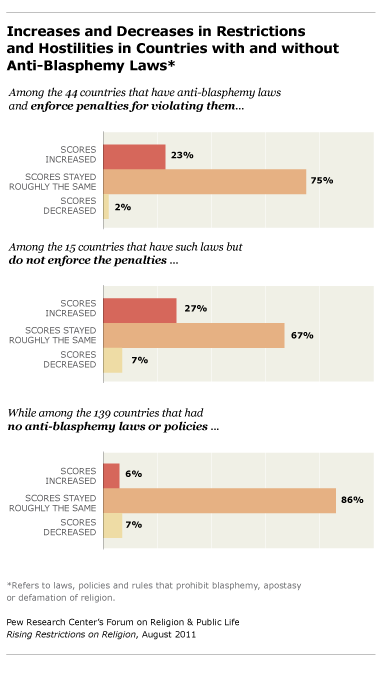
From mid-2006 to mid-2009, restrictions or hostilities increased substantially
in 10 (23%) of the 44 countries where governments actively enforce penalties
for blasphemy, apostasy or defamation of religion; restrictions or hostilities
decreased substantially in just one country in that category (2%).26 In the 15 countries where such laws are on the books
but are not actively enforced, restrictions or hostilities increased
substantially in four (27%) and decreased substantially in just one (7%). By
contrast, among the 139 countries that do not have laws against blasphemy,
apostasy or defamation of religion, restrictions or hostilities rose in nine
(6%) and fell in 10 (7%). (See graphic on facing page.)
These
findings do not mean that laws against blasphemy, apostasy or defamation of
religion necessarily cause higher restrictions on religion. But they do suggest
that the two phenomena often go hand-in-hand: governments that impose laws
against blasphemy, apostasy or defamation of religion also tend to have higher
restrictions on religion.
Government Restrictions on ReligionÂ
As of mid-2009, government restrictions on religion were
high or very high in 23 (52%) of the 44 countries that enforce laws against
blasphemy, apostasy or defamation of religion and six (40%) of the 15 countries
that have such laws but do not enforce them. Among the 139 countries that do
not have such laws, restrictions were high or very high in 13 (9%).
 Government restrictions on religion increased
substantially in seven (16%) of the 44 countries where some level of government
penalizes blasphemy, apostasy or defamation of religion and in two (13%) of the
15 countries where such laws exist but are not enforced. In contrast,
restrictions rose substantially in five (4%) of the 139 countries with no
penalties. Government restrictions on religion decreased substantially in seven
(5%) of the 139 countries with no laws against blasphemy, apostasy or
defamation of religion and in one (2%) of the 44 countries that enforce such
laws.
Government restrictions on religion increased
substantially in seven (16%) of the 44 countries where some level of government
penalizes blasphemy, apostasy or defamation of religion and in two (13%) of the
15 countries where such laws exist but are not enforced. In contrast,
restrictions rose substantially in five (4%) of the 139 countries with no
penalties. Government restrictions on religion decreased substantially in seven
(5%) of the 139 countries with no laws against blasphemy, apostasy or
defamation of religion and in one (2%) of the 44 countries that enforce such
laws.
Governments
in countries that actively enforce such laws engaged in a variety of practices
that demonstrated hostility toward religious groups. This included harassment
of religious groups and the use of force against religious groups, including
actions that resulted in individuals being killed, physically abused,
imprisoned, detained or displaced from their homes.
During
the two-year period from mid-2007 to mid-2009, governments in 37 (84%) of the
44 countries that actively enforce laws against blasphemy, apostasy or
defamation of religion engaged in actions classified as harassment in this
report.27 The share of governments engaging in harassment was even higher (93%) in the 15
countries that have but do not actively enforce such laws. In three-fourths of
the 44 countries that enforce these laws (33 of the 44), government at some
level used force against religious groups. Harassment and the use of force were
less common in the 139 countries that do not have such laws; 60 (43%) of the
countries in that category used force against religious groups and 76 (55%)
harassed religious groups.
Similar
patterns were seen for other types of government restrictions on religion. For
example, the share of national governments that showed hostility toward
minority religions involving physical violence was much higher in countries
where laws against blasphemy, apostasy or defamation of religion are actively
enforced than in countries without such laws (55% versus 22%). A similar gap is
seen among governments that characterized one or more religious groups as
dangerous “cults� or “sects.� In countries that enforce such laws, nearly a
quarter of the governments (23%) characterized certain religions as “cults.� In
countries without such laws, 9% of governments engaged in this practice.
A
similar difference occurred among countries where the national government
attempted to eliminate an entire religious group’s presence. Countries that
enforce laws against blasphemy, apostasy or defamation of religion were more
than five times as likely to engage in such attempts as those that do not have
such laws (32% vs. 6%).
Social Hostilities Involving ReligionÂ
As
of mid-2009, social hostilities involving religion were high or very high in 19
(43%) of the 44 countries that enforce laws against blasphemy, apostasy or
defamation of religion and four (27%) of the 15 countries that have such laws
but do not enforce them. Among the 139 countries that do not have such laws,
social hostilities were high or very high in 17 (12%).
This
pattern generally held true for different indicators of social hostilities. For
example, mob violence related to religion occurred in a greater share of
countries that enforce penalties for blasphemy, apostasy or defamation of
religion than in countries where there are no such laws (45% vs. 19%). The
share of countries in which women were harassed for violating religious dress
codes was considerably higher among those that enforce such laws (48%) than
among those without such laws (6%).
Social
hostilities involving religion increased substantially in three (7%) of the 44
countries that enforce laws against blasphemy, apostasy or defamation of
religion and in two (13%) of the 15 where such laws exist but are not actively
enforced. In contrast, social hostilities increased substantially in five (4%)
of the 139 countries with no such laws.
Regional Patterns Â
Eight-in-ten
countries in the Middle East-North Africa region have laws against blasphemy,
apostasy or defamation of religion, the highest share of any region. These penalties are enforced in 60% of the
countries in the region. In Europe, nearly four-in-ten countries (38%) have
such laws and nearly a third (31%) actively enforces them. Nearly three-in-ten
countries in the Asia-Pacific region have such laws and about a quarter (24%)
enforces the penalties. Relatively few countries in sub-Saharan Africa (15%) or
the Americas (11%) have such laws or policies.Â
In the United States, a few state legal codes still contain
anti-blasphemy laws, but they generally are not enforced.

Footnotes:Â
26 This
report refers to a change in a country’s score on either the Government
Restrictions Index or Social Hostilities Index as “substantial� only if it is
at least 1.5 standard deviations above or below the mean amount of change among
all 198 countries or territories. The change also had to be in the same
direction over the two periods studied, meaning that it had to rise or fall
both in the period from mid-2006 to mid-2008 and in the overlapping period from
mid-2007 to mid-2009. See Methodology for more details. (return to text)Â
27 Harassment and intimidation take many
forms, including physical assaults, arrests and detentions, the desecration of
holy sites and discrimination against religious groups. Harassment and
intimidation also include such things as verbal assaults on the members of one
religious group by other groups or individuals in society. (return to text)Â