|
Attention: Year 2009 is here
Wishing a very Happy New Year to all members of FFI. Our new and improved site is ready. To visit main site, click at faithfreedom.org and to visit our new forum, click at forum09.faithfreedom.org and register again. Do not worry about your old forum posts and PM, everything is saved here till 31st December, 2008 for future references.
|
| View previous topic :: View next topic |
| Author |
Message |
Hector

Joined: 24 May 2004
Posts: 7144
Location: Astroistan
|
 Posted: Tue Jun 27, 2006 3:55 pm Post subject: Posted: Tue Jun 27, 2006 3:55 pm Post subject: |
 |
|
DEBUNKING ABDURRAHMAN SQUIRES
This is an interesting article from the mereislam.info site. http://www.mereislam.info/
| Abdurrahman Squires wrote: |
Sunday, June 25, 2006
More on the Young Marriage of 'Aishah
A comment, posted in response to Bani Qurayza, Marriage at Puberty and the Tacit Approval of Jesus, has prompted me to post some various articles and other material related to the marriage of 'Aishah—radi Allahu 'anha. I've had some of this evidence since shortly after writing my article The Young Marriage of 'Aishah several years ago, but just never got around to posting it.
Essentially, these materials address two different sub-issues related to this debate: 1) The reservations of apologetic modernist Muslims who, in their zeal to remove anything from Islam that those who adhere to modern Western values might find offensive, continue to quibble over whether 'Aishah—radi Allahu 'anha—was only nine years old when the Prophet—salla Allahu 'alayhi wa salam—consummated his marriage with her; and 2) The attempts by anti-Islamic polemicists to demonstrate that 'Aishah—radi Allahu 'anha—had not reached puberty (i.e. was prepubescent) at the time of her marriage to the Prophet—salla Allahu 'alayhi wa salam. |
It is the second issue I will be concerned with as it will become apparent that Abdurrahman Squires, like almost all Islamist polemicists, does not provide any evidence that Aisha had reached puberty (i.e. the Islamic concept of puberty which relates to the Western concept of menarche) at the time of her marriage to Muhammad.
The first issue of 'Aisha was not nine' has been shown by Muslim scholars to be untrue. None of the 'Aisha was not nine' apologetics are hadiths, being merely recalculations from events of spurious dating, outright untruths, or misquotations. These apologetics are frequently contradictory and thus cannot possibly be true.
| Abdurrahman Squires wrote: |
In regards to the first sub-issue, I've posted two articles by Shaykh Gibril F. Haddad, which are entitled 'A'isha's Age at the Time of Her Marriage and More on 'A'isha's Age at the Time of Her Marriage. However, it's really the latter article that directly addresses the various points which are brought forward by apologetic Muslims, which in this case is one who goes by the nom de plume "The Learner". In regard to his strained, feeble and sometimes dishonest use of evidence, which he employs in a futile attempt to shore up his case, "The Learner" is rather typical of most apologists on this subject, so Shaykh Gibril's complete deconstruction of him pretty much undermines all of the arguments that I've heard surrounding this particular issue.
I feel that I should mention that I lost all intellectual respect for "The Learner" when he contacted me soon after I first wrote The Young Marriage of 'Aishah—radi Allahu 'anha. The essential reason behind this, and my subsequent decision not to waste my time trying to reason with someone who was so obviously sunk in gross intellectual dishonesty (if not complete self-delusion), was one of his statements in his article entitled More on Ayesha's Age. In this article, "The Learner" made the following statement in response to my article:
"But even then, the narratives describing Ayesha's (ra) age at the time of her marriage do not fall under the scope of Sunnah. Obviously, the narrative of Ayesha's (ra) age at the time of her marriage is not a part of "the sayings of the Prophet, (peace be upon him)", it cannot be termed as the Prophet's "practices" and neither can it be included in the "actions which gained his approval". The narrative of Ayesha's age is just a narrative of a historical event. Just because it has been reported by Bukhari and Muslim, does not change its status from being a narrative of a historical event to a Sunnah. Because of this fact, this narrative should be seen in the light of all other narratives of historical events which have been reported by Bukhari, Muslim and other historians of Islam."
Well beside the rather ironic fact that "The Learner", in spite of his above appeals to the authority of "Bukhari, Muslim and other historians of Islam", repeatedly demonstrates throughout his writing that he essentially has very little respect for their skills as masters of the sciences of hadith (thus they're downgraded to simply being "...historians of Islam"), his reasoning here is absolutely ridiculous. This is because he misses the rather glaring point that the hadiths in questions clearly mention the actions of the Prophet—salla Allahu 'alayhi wa salam!!! Indeed, the various narrations in both the collections of al-Bukhari and Muslim essentially state that "he betrothed (zawaj) her when she was six years old and he consummated (nikah) his marriage when she was nine years old"...thus there's no doubt that these were "practices" of the Prophet—salla Allahu 'alayhi wa salam—thus part of his Sunnah. Only a person willing to engage in outright dishonesty could deny this...although this is what "The Learner" is seemingly willing to do in this case.
To add insult to injury, his quibble that 'Aishah's age at the time of her marriage is just "a narrative of a historical event" is simply inconsequential to the point he's so desperately trying to make. This is because any hadith that conveys anything that the Prophet—salla Allahu 'alayhi wa salam—said, did or tacitly approved is essentially, at a certain level, "a narrative of a historical event"!!! Thus "The Learner" just further demonstrates that he's really missing the point when he states that, "Just because it has been reported by Bukhari and Muslim, does not change its status from being a narrative of a historical event to a Sunnah", because what makes something a Sunnah is the fact that it's authentically reported that he—salla Allahu 'alayhi wa salam-did such an action. There's no need for some desperately imagined need to "change its status", since if it's reported on both al-Bukhari and Muslim that the Prophet—salla Allahu 'alayhi wa salam—did such-and-such an action, then this action is both part of his Sunnah as well as being a "narrative of an historical event"—although this latter portion simply restates the obvious and doesn't add any value. |
The world awaits Moiz Amjad (aka The Learner) in rebutting Shaykh Gibril Haddad’s demolition of Amjad’s “Aisha was not nine years old” apologetics. The fact that it has been several years since Shaykh Haddad rebutted Amjad is interesting.
| Abdurrahman Squires wrote: |
| Now that I've addressed "The Learner's" dishonest little game of horse hockey— a monumental contribution to poor polemics if there ever was one—I'll move on to addressing the issue which a comment from a previous post recently mentioned—and that's the arguments put forward by "anti-Muslim atheists" who challenge the "assumption" that 'Aishah—radi Allahu 'anha—had not reached puberty at the time of her marriage. |
It is the Islamists who assume that Aisha had reached puberty at the time of her marriage. No evidence is ever provided by Islamists to support their claims that she had achieved puberty by that time.
| Abdurrahman Squires wrote: |
| Before demonstrating that in order to adhere to such a position, one would have to have to be laboring under some assumptions as well, I'd like to point out that the mere fact that these hate-mongers have attempted to shift the focus of this debate clearly seems to indicate that they have acquiesced to the fact that marriage at puberty, based on historical evidence which documented the norms of various human societies, has widely and often been considered morally acceptable. |
Pedophilia is not a modern phenomenon, despite the modern coinage of the term and its scientific study. However, it would seem strange, not to mention reprehensible (to non-Muslim observers), that a man who claimed to be the prophet of God, and the uswa hasana (the model for humanity for all time), and the al-insan al-kamil (the perfect human being) would commit pedophilia, irrespective of the cultural context or the era in which he lived.
The fact that certain behaviors are culturally acceptable in the distant past does not excuse their immorality. After all, prophets should possess superior morality than the average person, especially for prophets who claim relevancy today. Using the Islamist’s reasoning one might argue that there is no morally unacceptable behavior at all, since cannibalism, slavery, rape, genocide, banditry and even murder were “morally acceptable” in certain cultures in the distant past.
Even if pedophilia was morally and culturally acceptable, a strong case can be made that a prophet of God should possess the moral fiber to identify it as an immoral act even for the savage 7th century Arabian desert and outlaw such behavior, rather than enshrining it as an acceptable, nay even moral, act to emulate forever.
In short, there must be an expectation among rational moral human beings that their prophets should be better human beings than themselves so they may model their own behavior after the examples of their prophets. If such examples fall short of expectations or are clearly obsolete, then it stands to reason that the teachings of the prophet also fall short of expectations and are obsolete as well. Thus, claiming that Muhammad’s pedophilia was acceptable in his day is tantamount to admitting that Islam is obsolete.
| Abdurrahman Squires wrote: |
| Indeed, since it has already been clearly and effectively demonstrated [(1)(2)]—at least to any honest and fair-minded person—that there was nothing wrong with marrying a woman at puberty in the society in which 'Aishah—radi Allahu 'anha—lived, it seems that the Islamophobes have abandoned their initial arguments and tried to move the debate on this issue into a second phase...and this is what I'll now address. |
Apart from tu quoque against the ancient Jews, a citation of Karen Armstrong misquoting Tabari, and the unsubstantiated claim that Aisha had already reached puberty when she married Muhammad, the Islamist has proven nothing useful.
There is little point in telling readers that some girls reach puberty at the age of nine or younger. This is indisputable scientific fact. What remains to be proven is whether Aisha was one of these girls. The Islamist has conspicuously failed to demonstrate this point.
| Abdurrahman Squires wrote: |
There's considerable evidence—both textual, logical and circumstantial—which, when considered as an integral whole, demonstrates that 'Aishah—radi Allahu 'anha—had reached puberty at the time of her marriage. This evidence includes:
The fact that Muslim scholars overwhelmingly agree that the minimum age of marriage is puberty. This can be clearly seen in the Qur'anic exegesis of the phrase "they reach the (age of) marriage" found in Surat al-Nisa' 4; 6. In regards to this, four of the well-known classical commentators have the following to say [Click here to view an image of the following statements in the original Arabic]:
Tafsir al-Tabari: Clearly states that "And when He said 'they reach the (age of) marriage' then He means they reached puberty (al-hulum)"—and he lists numerous references.
Tafsir al-Qurtubi: In regards to the statement "until they reach the (age of) marriage", Imam al-Qurtubi says, "meaning puberty (al-hulum). And said the Most High, 'When children reach puberty' (al-Nur 59),meaning puberty (al-balugh) and state of marriage (wa hal al-nikah)."
Tafsir Ibn Kathir: In explaining, "until they reach the (age of) marriage", he states that "Mujahid said meaning puberty (al-hulum)".
Tafsir al-Jalalayn: Contains the explanation that: "'And Challenge' test 'the orphans' before they reach puberty in their religion and their conduct 'until they reach the (age of) marriage', meaning they reach puberty or the age of fifteen years old according to the Shafi'is".
The above ruling regarding the age of marriage is mutually supported by an authentic (hassan) narration in Sunan al-Tirmidhi's Kitab al-Nikah,where 'Aishah herself says: "When the girl reaches nine years of age she is a woman". Reason dictates that this is because she was referring to her own experience in which she reached puberty at the age of nine. If this wasn't the case, all of the just mentioned tafsirs would seemingly need to state that "until they reach the (age of) marriage" means "nine" and not "puberty". |
This is mere polemics that is beside the point. Surah 4;6 merely talks about the property rights of minors and how their guardians are required to turn over the property of the minors once they reach the age of marriage. It does not talk about the permissibility of marriage or otherwise to girls below the age of puberty.
The Quran makes it clear that it is permissible for a Muslim to divorce a female below the age of puberty. This is seen in ayat 65; 4. Since one cannot divorce without first marrying, it stands to reason that the Quran permits Muslims to marry pre-pubertal girls.
Shakir: And (as for) those of your women who have despaired of menstruation, if you have a doubt, their prescribed time shall be three months, and of those too who have not had their courses; and (as for) the pregnant women, their prescribed time is that they lay down their burden; and whoever is careful of (his duty to) Allah He will make easy for him his affair.
This interpretation is supported by the authoritative tafsirs, for example that of Ibn Kathir.
The `Iddah of Those in Menopause and Those Who do not have Menses
Allah the Exalted clarifies the waiting period of the woman in menopause. And that is the one whose menstruation has stopped due to her older age. Her `Iddah is three months instead of the three monthly cycles for those who menstruate, which is based upon the Ayah in (Surat) Al-Baqarah. [see 2:228] The same for the young, who have not reached the years of menstruation. Their `Iddah is three months like those in menopause. This is the meaning of His saying;
[وَاللَّـتِي لَمْ يَحِضْنَ]
(and for those who have no courses...) as for His saying;
[إِنِ ارْتَبْتُمْ]
(if you have doubt...) There are two opinions: First, is the saying of a group of the Salaf, like Mujahid, Az-Zuhri and Ibn Zayd. That is, if they see blood and there is doubt if it was menstrual blood or not. The second, is that if you do not know the ruling in this case, then know that their `Iddah is three months. This has been reported from Sa`id bin Jubayr and it is the view preferred by Ibn Jarir. And this is the more obvious meaning. Supporting this view is what is reported from Ubay bin Ka`b that he said, "O Allah's Messenger! Some women were not mentioned in the Qur'an, the young, the old and the pregnant.'' Allah the Exalted and Most Honored sent down this Ayah,
[وَاللاَّئِى يَئِسْنَ مِنَ الْمَحِيضِ مِن نِّسَآئِكُمْ إِنِ ارْتَبْتُمْ فَعِدَّتُهُنَّ ثَلَـثَةُ أَشْهُرٍ وَاللَّـتِي لَمْ يَحِضْنَ وَأُوْلَـتُ الاٌّحْمَالِ أَجَلُهُنَّ أَن يَضَعْنَ حَمْلَهُنَّ]
(Those in menopause among your women, for them the `Iddah, if you have doubt, is three months; and for those who have no courses. And for those who are pregnant, their `Iddah is until they lay down their burden.) Ibn Abi Hatim recorded a simpler narration than this one from Ubay bin Ka`b who said, "O Allah's Messenger! When the Ayah in Surat Al-Baqarah was revealed prescribing the `Iddah of divorce, some people in Al-Madinah said, `There are still some women whose `Iddah has not been mentioned in the Qur'an. There are the young, the old whose menstruation is discontinued, and the pregnant.' Later on, this Ayah was revealed,
[وَاللاَّئِى يَئِسْنَ مِنَ الْمَحِيضِ مِن نِّسَآئِكُمْ إِنِ ارْتَبْتُمْ فَعِدَّتُهُنَّ ثَلَـثَةُ أَشْهُرٍ وَاللَّـتِي لَمْ يَحِضْنَ]
(Those in menopause among your women, for them the `Iddah, if you have doubt, is three months; and for those who have no courses.)''
Thus, it is clear that according to Ibn Kathir, the Quran permits marriage to pre-pubertal females.
Other tafsirs supporting Ibn Kathir include:
Tafsîr Ibn ‘Abbâs
(And for such of your women as despair of menstruation) because of old age, (if ye doubt) about their waiting period, (their period (of waiting) shall be three months) upon which another man asked: “O Messenger of Allah! What about the waiting period of those who do not have menstruation because they are too young?” (along with those who have it not) because of young age, their waiting period is three months. Another man asked: “what is the waiting period for those women who are pregnant?” (And for those with child) i.e. those who are pregnant, (their period) their waiting period (shall be till they bring forth their burden) their child. (And whosoever keepeth his duty to Allah) and whoever fears Allah regarding what he commands him, (He maketh his course easy for him) He makes his matter easy; and it is also said this means: He will help him to worship Him well.
Tafsir al-Jalalayn
And [as for] those of your women who (read allā'ī or allā'i in both instances) no longer expect to menstruate, if you have any doubts, about their waiting period, their prescribed [waiting] period shall be three months, and [also for] those who have not yet menstruated, because of their young age, their period shall [also] be three months - both cases apply to other than those whose spouses have died; for these [latter] their period is prescribed in the verse: they shall wait by themselves for four months and ten [days] [Q. 2:234]. And those who are pregnant, their term, the conclusion of their prescribed [waiting] period if divorced or if their spouses be dead, shall be when they deliver. And whoever fears God, He will make matters ease for him, in this world and in the Hereafter.
These exegeses are supported by the sahih hadith (Sahih Bukari Volume 7, Book 62, Number 63).
Narrated Sahl bin Sad: While we were sitting in the company of the Prophet a woman came to him and presented herself (for marriage) to him. The Prophet looked at her, lowering his eyes and raising them, but did not give a reply. One of his companions said, "Marry her to me O Allah's Apostle!" The Prophet asked (him), "Have you got anything?" He said, "I have got nothing." The Prophet said, "Not even an iron ring?" He Sad, "Not even an iron ring, but I will tear my garment into two halves and give her one half and keep the other half." The Prophet; said, "No. Do you know some of the Quran (by heart)?" He said, "Yes." The Prophet said, "Go, I have agreed to marry her to you with what you know of the Qur'an (as her Mahr)." 'And for those who have no courses (i.e. they are still immature). (65.4) And the 'Iddat for the girl before puberty is three months (in the above Verse).[/quote]
This sahih hadith proves conclusively that the phrase, ‘those who have no courses’ refer to pre-pubescent females as the second part of the hadith clearly states that the ‘Iddat for the ‘girl before puberty’ is three months.
The part about the "iddat for the girl before puberty is three months" in the Bukhari hadith was made in reference to Aisha:
"XXXIX. A man giving his young children in marriage
By the words of Allah, "that also applies to those who have not yet menstruated" (65:4) and He made the 'idda of a girl before puberty three months.
4840. It is related from 'A'isha that the Prophet, may Allah bless him and grant him peace, married her when she was six years old and consummated it when she was nine, and she was his wife for nine years. (Aisha Bewley, The Sahih Collection of Al-Bukhari, Chapter 70. Book of Marriage: http://bewley.virtualave.net/bukhari35.html)"
It is unclear whether the iddat applied to Aisha when she was six years old or nine years old. What it does prove is that the Quran permits Muslims to divorce pre-pubertal girls (and hence to marry them in the first place).
| Abdurrahman Squires wrote: |
| In steadfast consistence with the above points, Surat al-Nur 24:59, clearly shows that children are considered adults when they reach puberty, since it says "And when the children among you come to puberty (al-hulum), then let them (also) ask for permission, as do those senior to them (in age)". Indeed, this is a clear Qur'anic reference that the age of discretion (i.e. adulthood) was identified with the onset of puberty. |
This does not prove Aisha had reached puberty. In fact, it proves Aisha had not reached puberty when she was nine years old. There are various sahih hadiths that tell us that Aisha was a ‘young girl’, a ‘little girl’, of ‘immature age’, sometimes years after she married Muhammad. These do not suggest Aisha had reached puberty. Using Abdurrahman Squire’s reasoning regarding ayat 24;59 it in fact proves she had NOT reached puberty as late as the raid on the B. Mustaliq when she was around 13 years old.
Sahih Bukhari Volume 3, Book 48, Number 805: … Buraira said, "I cannot accuse her of any defect except that she is still a YOUNG GIRL who sleeps, neglecting her family's dough which the domestic goats come to eat…
Sahih Bukhari Volume 7, Book 62, Number 163: Narrated 'Aisha: The Prophet was screening me with his Rida' (garment covering the upper part of the body) while I was looking at the Ethiopians who were playing in the courtyard of the mosque. (I continued watching) till I was satisfied. So you may deduce from this event how a LITTLE GIRL (who has not reached the age of puberty) who is eager to enjoy amusement should be treated in this respect. {note the translator Dr Muhsin Khan interpreted the Arabic for “little girl” to mean one who has not reached the age of puberty. Also note that this event probably occurred in Medinah from other hadiths narrating the same incident.}
Sahih Bukhari Volume 3, Book 48, Number 829: …Buraira said: …SHE IS A GIRL OF IMMATURE AGE… {see also Volume 6, Book 60, Number 274}
Sahih Muslim Book 037, Number 6673: Aisha said:… I was a YOUNG GIRL at that time… Buraira said… she is a YOUNG GIRL.
The raid on the B. Mustaliq is traditionally thought to have occurred in 5AH, thus making Aisha around 13 years old at the time.
| Abdurrahman Squires wrote: |
| The fact that the various hadiths clearly state that 'Aishah—radi Allahu 'anha—was "betrothed (zawaj)" when she was "six years old" and "consummated (nikah)" her marriage when she was "nine years old", clearly begs the question: "What, pray tell, were her parents waiting for?" Well the obvious answer to why they waited some three years between the betrothal and the consummation of the marriage is that they were waiting for their daughter to reach adulthood—which is, as already demonstrated above, clearly defined as puberty. |
This is mere conjecture that is disproved by the facts from the sahih hadiths that show Aisha to be a young girl, a little girl (who had not reached the age of puberty), and of immature age. These terms do not suggest adulthood.
Secondly, the understanding that zawaj means betrothal and nikah means marriage is not supported by the usage in the Quran which uses both terms interchangeably as synonyms.
Thirdly, the ‘consummation of marriage’ hadiths use the terms, zawaj (when she was six) and udkhilath alaihi (when she was nine), not nikah.
For example: Sahih Bukhari Volume 7, Book 62, Number 64: Narrated 'Aisha: that the Prophet married her when she was six years old and he consummated his marriage when she was nine years old.
An Ayeshath Radhiyallahu Anha: AnnaNnabiyya Sallallahu Alaihi Vasallama Thazawwajaha vahiya binthu sitha sineen, va udkhilath alaihi vahiya binthu this’in.[/i]
The Arabic udkhilath means penetrate, enter, sexual intercourse. http://www.faithfreedom.org/forum/viewtopic.php?t=13401
| Abdurrahman Squires wrote: |
| The above question is answered directly and unambiguously on page 128 of The History of al-Tabari — Volume IX, where it states that "As for 'A'ishah, when he married her she was very young and not yet ready for consummation"—which clearly proves that they were waiting for her to reach puberty (i.e. to be biologically "ready"). Likewise, the statement that 'A'ishah—radi Allahu 'anha—was "not yet ready for consummation" would undoubtedly be nonsensical in a social context where marriage to prepubescent children was allowed. Thus it both severely undermines the merely circumstantial evidence which has been brought forward in an ineffectual attempt to prove the contrary, and serves as strong proof that the marriage in question certainly did not involve a prepubescent girl. |
What we do know from the Tabari quote is that Aisha was not ready for consummation at the age of six. The quote does not say that she was then ready for consummation at the age of nine – which is again mere conjecture on the part of the Islamist. A female who is ready for consummation (i.e. sex) is not a YOUNG girl, nor a LITTLE girl (who has not reached the age of puberty), nor of IMMATURE AGE.
| Abdurrahman Squires wrote: |
| The honest conclusion after considering all of the above mutually supporting evidence as a whole, including a statement from 'Aishah herself, is that the marriage took place when 'Aishah—radi Allahu 'anha—had become a "woman"—meaning that she had reached puberty. |
According to Tirmidhi, Aisha said, "When the girl reaches nine years of age she is a woman". Note that this is the general case for all girls. Puberty cannot be mandated by age. It is a natural biological process that determines its onset and progress. Thus, this report seems absurd, if not contradictory. In sahih hadiths, Aisha claimed she was a young girl (of immature age) when she was 13. This weak hadith of her supposed claim that she was a woman at 9 cannot be supported in the light of contradiction with the sahih hadiths.
| Abdurrahman Squires wrote: |
| Now in regards to the various hadiths ([1][2][3][4]) that anti-Islamic apologists have employed in an attempt to prove that 'Aishah—radi Allahu 'anha—was still a young girl who was playing with dolls at the time of her marriage. Well unfortunately for them, they've jumped to some hasty conclusions since none of these hadiths ([1][2][3][4]) explicitly indicate whether the marriage had been consummated at this time. Rather, one could just as easily conclude—especially in light of the evidence I've presented above—that the incidents in which 'Aishah—radi Allahu 'anha—was playing with dolls along with her young friends occurred at a time when she was still living with her parents (i.e. after the betrothal and prior to the consummation). Actually, based on the fact that the Prophet—salla Allahu 'alayhi wa salam—was known to regularly visit 'Aishah's father Abu Bakr—radi Allahu 'anhu, these events could have taken place anytime during 'Aishah's childhood—radi Allahu 'anha. |
This is why these hadiths are not the primary evidence for Muhammad’s pedophilia.
| Abdurrahman Squires wrote: |
| As for the hadith which states that 'Aishah—radi Allahu 'anha—still had dolls even at the time of either the battle of Khaybar (Muharram-Safar 7 A.H.) or the siege of Tabuk (Rajab 9 A.H.), at which time she would have been between 13 and 15 years old, well it doesn't disprove my point either. This is because one purpose behind 'Aishah's statement was seemingly to bring attention to the surprise of the Prophet—salla Allahu 'alayhi wa salam—in discovering that she still had her dolls at such a late age. Indeed, since the other hadiths [(1)(2)(3)] make it abundantly clear that the Prophet—salla Allahu 'alayhi wa salam—already knew that 'Aishah played with dolls when she was younger, his exclamatory statement "What is this?" simply shows that he was surprised that she still had them in her store room—and there's nothing to suggest that she was actively playing with them. Indeed, at least one of the narrations clearly states: "...saw some dolls with which 'Aishah used to play". Consequently, to take this as evidence that 'Aishah—radi Allahu 'anha—had not reached puberty at this time (i.e. the relatively late age of 13-15) simply to avoid the dilemma of her having in her possession (allegedly) forbidden dolls—even though there's no explicit evidence that such toys were inherently unlawful to keep in a community that was teeming with young children—seems rather extreme. Rather, a more balanced approach would be to consider all of the evidence, including the substantial point that the Prophet's statement "What is this?" seems to clearly indicates that he was surprised that 'Aishah—radi Allahu 'anha—was still saving her dolls after so many years. |
This is mere word play. Even owning dolls was considered detestable if by an adult Muslim at the time. The fact that Muhammad not only permitted Aisha to own dolls but even laughed shows she couldn’t have committed even a detestable act (for an adult) and therefore she must have been below the age of puberty.
This is what Ibn Hajar wrote in Fath al-Baaree, no. 6130, Kitaab: al-Adab, Baab: al-Inbisaat ilaa an-Naas: "This Hadith has been used as a proof for the permissibility of possessing (suwar - of) dolls and toys for the purpose of the little girls playing with them. This has been especially exempted from the general prohibition of possession of images (suwar)."
Thus it was even prohibited for an adult to possess dolls.
| Abdurrahman Squires wrote: |
| Ultimately, Hafiz Ibn Hajr al-Asqalani concludes that: "To say with certainty 'that she was not yet at the age of puberty' is questionable"—and even this view is seemingly based on considering this hadith in isolation without taking textual evidence from other sources in account...but Allahu 'alim. Thus in the final analysis, the so-called "evidence" and "proof" that this hadith provides to those trying to spin a case of prepubescent marriage is "questionable" and anything but decisive. |
This is a partial quotation. Ibn Hajar conceded that Aisha had not reached the age of puberty at the time of Khaibar due to the need to avoid contradiction in the hadiths. This is what he said in Fateh al-Bari:
"To say with certainty, (that she was not yet at the age of puberty) is questionable, though it might possibly be so. This, because Aisha (RA) was a fourteen year old girl at the time of the battle of Khaibar, either exactly fourteen years old, or having just passed her fourteenth year (and entering into the fifteenth year), or approaching it (the fourteenth year).
As for her age at the time of the Battle of Tabook, she had by then definitely reached the age of puberty. Therefore, the strongest view is that of those who said: "It was in Khaibar" (i.e., when she was not yet at the age of puberty), and made reconciliation (jam') [between the apparent contradictory rulings, of permissibility of dolls, in particular, and the prohibition of images, in general] with what al-Khattaabee said (all young girls). This, because to reconcile (make jam') is better than to assume the ahaadith to be in contradiction (at-ta'aarud)."
The context of why Ibn Hajar considered it questionable to say with certainty that Aisha had not yet reached the age of puberty when she was 14 was solely on the basis of her age. We now know that girls often do not reach puberty at that age. Scientific studies have also proven that the average age of menarche was older in earlier times compared to present. The evidence is that about 20% of all girls (today) reach puberty at the age of 14 or older.

{see also http://pediatrics.aappublications.org/cgi/content/full/107/6/1493 PEDIATRICS Vol. 107 No. 6 June 2001, pp. 1493 Peter A. Lee, Howard E. Kulin, and Shumei S. Guo -Age of Puberty Among Girls and the Diagnosis of Precocious Puberty in Pediatrics 2001; 107: 1493.}
We also know that the mean age of menarche is presently around 13-14 years.
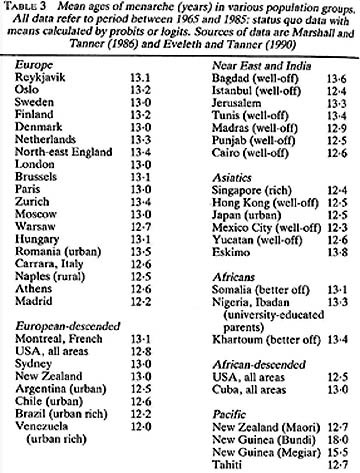
Hence it is of no surprise that Aisha had not reached the (Islamic) age of puberty (i.e. menarche) when she was 14 years old. Ibn Hajar was taken aback that the evidence shows this to be the case because of her age, but we know from modern scientific studies that this is nothing unusual.
| Abdurrahman Squires wrote: |
| In conclusion, I think all of this demonstrates that the mainstream Islamic position on the marriage of 'Aishah—radi Allahu 'anha—still stands. Indeed, the articles and other evidence presented above has exposed the strained, dishonest and weak arguments of Westoxicated apologetic Muslims who—with their "Undermine Islam In Order To Save It" approach—seem dead set on proving that 'Aishah—radi Allahu 'anha—was older than nine at the time of her marriage, regardless of how many upright scholars and reputable hadith narrators they have to slander. At the other extreme, we've shown that that anti-Islamic polemicists—the ones who seek to degrade the religion of Islam by claiming that 'Aishah—radi Allahu 'anha—was prepubescent at the time of her marriage—have, with their pre-conceived notions conveniently in place, selectively built their case on circumstantial evidence that neither stands up to scrutiny nor takes all of the evidence into consideration...wa Allahu 'alim. |
There is nothing selective about the evidence that Aisha had not reached the age of puberty when she married Muhammad at the age of nine. The evidence is not merely circumstantial but also direct reports of Aisha’s youth and immaturity. Two streams of mutually supportive evidence prove this to be the case:
1) the various sahih hadiths that tell us she was a young girl, a little girl (who had not reached the age of puberty), and of immature age. These descriptions do not suggest a mature woman but a girl below the age of puberty.
2) Ibn Hajar’s doll-exegesis which proves Aisha was below the age of puberty when she was 14 (at the time of Khaibar). Ibn Hajar questioned the evidence solely on the basis of her age of 14. Today we know that it is not unusual for girls to reach puberty only after the age of 14, thus the ‘questionability’ of Aisha being below the age of puberty when she was 14 does not exist.
Further, it seems strange that Abdurrahman Squires would accuse critics of not taking all the evidence into consider when he himself does not provide a scrap of evidence that Aisha had reached the age of puberty when she was nine years old. All he provided was conjecture as to why Muhammad waited three years to (udkhilath) have sex with her. Conjecture is not evidence. We know from Muhammad’s biography that it was a highly unsettled time for him. Perhaps that might be a more plausible explanation since it does not contradict any of the sahih hadiths.
_________________
What sort of man would f*ck a sweet little prepubescent nine-year-old child who liked playing with dolls and swings? Mo the demon Pedophile. |
|
| Back to top |
|
 |
peaceforever
Joined: 20 Nov 2005
Posts: 1312
Location: India
|
| Posted: Mon Jul 10, 2006 1:58 pm Post subject: |
|
|
THE DEFENSE "JERMIN SAVORY" & HIS AIDE "MUSLIM-ANSWERS.ORG" (Abdurrahman R. Squires) ON MUHAMMAD'S PEDOPHILIC ACTIONS, ANSWERED
INTRODUCTION:
One of our Muslim friends Jermin Savory, In an attempt to brush aside the allegations of pedophilia against Muhammad are baseless and hypocritical. Pointed me to faithfreedom.com witch in turn pointed me to muslim-answers.org’s lengthy article written by Abdurrahman R. Squires, though it contains little substance given its length is another matter. I have answered to this article found at http://www.muslim-answers.org/Polemics-Rebuttals/aishah.htm and to some points raised by Jermin Savory too! Lets begin with www.muslim-answers.org.
| Muslim-answers.org wrote: |
The marriage of the Prophet Muhammad May the Peace and Blessings of God be upon him to 'Aishah bint Abu Bakr when she was at quite a young age has been the focus of quite a bit of criticism in the West. Unfortunately, in our increasingly nihilistic age of same-sex marriage, widespread pornography and seemingly ubiquitous sexual promiscuity, even some of those who profess to be Muslims have themselves become critics. Many Muslims, faced with the juggernaut of allegedly "universal" Western liberal values that have permeated almost everyone around them, sheepishly avoid discussion of such "embarrassing" Islamic issues. It is a keenly true observation that even though the European powers have pulled their colonial armies out of Muslim lands and granted them "independence", an even worse plague continues. This curse is "Colonialism of the Mind" and it is more dangerous since it is much more subtle. Insha'llah, this article will be a contribution to making both Muslims and non-Muslims aware of not only the objective facts regarding the Prophet's May the Peace and Blessings of God be upon him marriage to 'Aishah, but how to understand it in light of Islam and life in the "modern" world.
Regrettably, for those of us trying to spread the truth of Islam in the West, we often have to agree with the Orientalist W. Montgomery Watt when he wrote: "Of all the world's great men none has been so much maligned as Muhammad."1 But here, for a change, were are dealing with something that is an authentic part of Islamic history, not an apocryphal or fabricated event that Westerners have been duped into believing is authentic, such as the so-called "Satanic Verses" incident. That a man in his fifties would marry such a young girl-especially a man who is supposed to be a living example of piety-is not only difficult for many "modern" Westerners to come to terms with, but it has even gone so far as to stir up disgusting "sexual misconduct" charges amongst them. In the face of such criticism, Muslims have not always reacted well. In the past century, when so many Muslims were so "Westoxicated" and ready to monkey Europeans in almost anything, the usual reaction was to deny the sources that reported the alleged "embarrassing problem". To Muslim "modernists", who argued that ONLY a legal ruling found in the Qur'an was Islamically valid, brushing aside this aspect of the Prophet's life was rather easy. They simply denied that it had occurred and attacked the sources which reported it. Fortunately for Muslims, the apologetics of these "Uncle Toms of Islam" has faded into the periphery to a large extent. However, there are still many Muslims out there who try to get around what they see as a problem by ignoring authentic Islamic sources while claiming to be followers of the Ahl as-Sunnah. (which basically means "orthodox Sunni" Muslims, for those unfamiliar Islamic terminology). Many other Muslims possibly wonder whether the story is authentic and how to understand it if it is.
|
What a way to start of? How in the hell does this defend Muhammad?
This guy talks a lot about the problems of west, and other bla bla…. which unfortunately leads us to nothing. What he actually is doing is tu-quoque, what is the link between problems of the west and the problem at hand?
I have seen a number of muslims attempting to shed the issue off, by denying the obvious
And stating that Aisha must have been older, or deny the hadiths completely! Like Mr.Rizzwan, we have in our own forum. Seemingly ashamed with Muhammad’s pedophilic actions but the author here isn’t any different, he too is ashamed by his prophet but tries desperately to hide it by attacking the bible, the west…. Now the generalization is too hard digest accusing the west (as if every single person does these things) with pornography, homosexuality… and what not? This is nothing but Tu-Quoque. How does the malice of west acquit Muhammad of the charges against him? Every society has a people who are depraved be it the west, Islamic,… or what ever. But Is that the yard-stick with which you compare a prophet? A hooligan did some nonsense, so, Muhammad can do so? banal logic! When you go on to divert the issues to the malice of the west you are doing nothing but trying to draw a comparison between outright morally depraved people to a so called prophet, is that how you highlight a prophet? Then surely I am a prophet.
Even if the west is totally depraved and the Bible is "pornographic", this does not excuse Muhammad of his actions nor does it immunize him against criticism.
Would you imagine that there are many fathers in the modern Arabian/Islamic world who would allow their six year old daughters to marry 50 year old men? If you had a six year old daughter, would you allow such a thing or would you apply the "double standard"?
| Quote: |
Due to the apparent ignorance of many Muslims, possibly due to reading "modernist" apologetic literature like that mentioned above, a look at what the authentic sources of Islam say about the age at which 'Aishah married the Prophet is in order. This way, before we move on to an analysis of the facts, we will first establish what the authentic Islamic facts are. At this point, it should be mentioned that it is absolutely pointless from an Islamic standpoint to say that the age of 'Aishah is "not found in the Qur'an", since the textual sources of Islam are made up of BOTH the Qur'an and the Sunnah - and the Qur'an tells us that. For those wanting (or needing) to learn more about the status of the Sunnah in Islam, please read The Meaning of Sunna and Probativeness of Sunna (Parts: [1][2][3][4][5][6][7]). Now in regards to what the authentic Islamic sources actually say, it may come as a disappointment to some "modern" and "cultured" Muslims that there are four ahadith in Saheeh al-Bukhari and three ahadith in Saheeh Muslim which clearly state that 'Aishah was "nine years old" at the time that her marriage was consummated with the Prophet . These ahadith, with only slight variation, read as follows:
'Aishah, may God be pleased with her, narrated that the Prophet was betrothed (zawaj) to her when she was six years old and he consummated (nikah) his marriage when she was nine years old, and then she remained with him for nine years. (Saheeh al-Bukhari, Volume 7, Book 62, Number 64)
Of the four ahadith in Saheeh al-Bukhari, two were narrated from 'Aishah (7 4 and 75), one from Abu Hishaam (5:236) and one via 'Ursa (7:8 4 and 75), one from Abu Hishaam (5:236) and one via 'Ursa (7:8 . All three of the ahadith in Saheeh Muslim have 'Aishah as a narrator. Additionally, all of the ahadith in both books agree that the marriage betrothal contract took place when 'Aishah was "six years old", but was not consummated until she was "nine years old". Additionally, a hadeeth with basically the same text (matn) is reported in Sunan Abu Dawood. Needless to say, this evidence is-Islamically speaking-overwhelmingly strong and Muslims who deny it do so only by sacrificing their intellectual honesty, pure faith or both. . All three of the ahadith in Saheeh Muslim have 'Aishah as a narrator. Additionally, all of the ahadith in both books agree that the marriage betrothal contract took place when 'Aishah was "six years old", but was not consummated until she was "nine years old". Additionally, a hadeeth with basically the same text (matn) is reported in Sunan Abu Dawood. Needless to say, this evidence is-Islamically speaking-overwhelmingly strong and Muslims who deny it do so only by sacrificing their intellectual honesty, pure faith or both.
This evidence having been established, there doesn't seem much room for debate about 'Aishah's age amongst believing Muslims. Until someone proves that in the Arabic language "nine years old" means something other than "nine years old", then we should all be firm in our belief that she was "nine years old" (as if there's a reason or need to believe otherwise!?!). In spite of these facts, there are still some Muslim authors that have somehow (?) managed to push 'Aishah's age out to as far as "fourteen or fifteen years old" at the time of her marriage to the Prophet . It should come as no surprise, however, that none of them ever offer any proof, evidence or references for their opinions. This can be said with the utmost confidence, since certainly none of them can produce sources more authentic than the hadeeth collections of Imams al-Bukhari and Muslim! Based on the research that I've done, I feel that there is a common source for those who claim that 'Aishah's age was "fourteen or fifteen years old" at the time of the marriage. This source is "The Biographies of Prominent Muslims" which is published in book form, on CD-ROM and is posted in several places on the Internet. Just another example of why going to the sources is important . . .
|
None of the above is a problem to us! Rather it’s a problem to your fellow Muslims like Rizzwan, who can’t digest the fact that his prophet in fact married a 6 yr old girl!
RIZZWAN, I actually posted the same stuff as an evidence for u read, and here it is again attested by ur fellow muslim(s).
| Muslim-answers.org wrote: |
To put all of this in perspective-hopefully without undue apologetics-the first thing that one should be aware of is that 'Aishah was the third wife of the Prophet May the Peace and Blessings of God be upon him, not the first. Prior to this, the Prophet's May the Peace and Blessings of God be upon him first and only wife for twenty-four years was Khadijah bint al-Khuwaylid, who was about nineteen years older than him. He married Khadijah when she was forty and he was twenty-one-which might be called the years of a male's "sexual prime"-and stayed married ONLY to her until her death. Just after Khadijah's death, when he was round forty-six years old, the Prophet May the Peace and Blessings of God be upon him married his second wife Sawdah bint Zam'ah. It was after this second marriage that the Prophet May the Peace and Blessings of God be upon him became betrothed to 'Aishah, may God be pleased with her. She was the daughter of Abu Bakr, one of the Prophet's closest friends and devoted followers. Abu Bakr, may God be pleased with him, was one of the earliest converts to Islam and hoped to solidify the deep love that existed between himself and the Prophet May the Peace and Blessings of God be upon him by uniting their families in marriage. The betrothal of Abu Bakr's daughter 'Aishah to Muhammad May the Peace and Blessings of God be upon him, took place in the eleventh year of Muhammad's prophethood, which was about a year after he had married Sawdah bint Zam'ah and before he made his hijra (migration) to al-Madinah (Yathrib). As mentioned above, the marriage with 'Aishah bint Abu Bakr was consummated in Shawwal, which came seven months after the Prophet's hijra from Makkah to al-Medinah. At the time of his marriage to ''Aishah, the Prophet May the Peace and Blessings of God be upon him was over fifty years old.
|
Khadijah was a wealthy woman and the Prophet was a poor employee of her. Marrying a wealthy woman for him was climbing the ladder of social status. At that age, he was an orphan boy with little ambitions. Being a poor young man, no one paid attention to him. Kadijah was to him a boon. She gave him the comfort and the ease of mind from financial worries. Now he could afford to retreat to his cave and let his imagination fly; meet Jinns, battle with Satan, converse with Gabriel, and other creatures that haunted his feeble mind.
The fact that he remained faithful to Khadijah was not due to his chastity or loyalty but because she was a powerful woman and would not have tolerated infidelity from him. At that time Muhammad had no followers and he would have lost everything if he had offended his wealthy wife. That would have destroyed him completely.
However, he showed his true colors when he came to power and virtually nothing could stop him from doing what he pleased. It was then that he broke all the norms of the decency by the leave of his Allah. And the fact that many of his wives where comparatively old also doesn’t acquit Muhammad of pedophilia. A pedophile might not necessarily always want to have sex with children. But of course prefers children to normal women. Here is a great work done by hector showing how Muhammad actions matches with criterion for Pedophile according to the Introductory Textbook of Psychiatry Second Edition published by the APA.
http://www.faithfreedom.org/forum/viewtopic.php?t=10197&postdays=0&postorder=asc&start=0
And to add to the information provided above here are some hadiths showing that Muhammad’s attractions towards Aisha, rather than his other wives which leads to even jealous and strife!
Renowned Sunni commentator Ibn Kathir wrote regarding this Sura:
| Quote: |
Making peace is better than separation. An example of such peace can be felt in the story of Sawdah bint Zam’ah who WHEN SHE BECAME AGED, THE PROPHET WANTED TO DIVORCE HER, but she made peace with him by offering the night he used to spend with her to A'isha so that he would keep her. The Prophet accepted such terms and kept her.
Abu Dawud At-Tayalisi recorded that Ibn ‘Abbas said, "Sawdah feared that the Messenger of Allah might divorce her and she said, ‘O Messenger of Allah! Do not divorce me; give my day to ‘A'ishah.’ And he did…
In the Two Sahihs, it is recorded that ‘A’ishah said that when Sawdah bint Zam'ah BECAME OLD, she forfeited her day to ‘A’ishah and the Prophet used to spend Sawdah's night with 'A'ishah…
And making peace is better. IT REFERS TO THE WIFE RELINQUISHING SOME OF HER MARITAL RIGHTS and his acceptance of the offer. Such compromise is better than total divorce, as the Prophet did when retained Sawdah bint Zam'ah. By doing so, the Prophet set an example for his Ummah to follow as it is a lawful act ... (the preceding citation taken and adapted from Tafsir Ibn Kathir - Abridged, Volume 2, Parts 3, 4 & 5, Surat Al-Baqarah, Verse 253, to Surat An-Nisa, Verse 147 [Darussalam Publishers & Distributors, Riyadh, Houston, New York, Lahore; first edition March 2000], pp. 599-601, and Tafsir Ibn Kathir, Part 5, Sura An-Nisa, ayat 24-147, abridged by Sheikh Muhammad Nasib Ar-Rafa’i [Al-Firdous Ltd., London, 2000 first edition], pp. 193-194)
|
Commentator Al-Tabari stated that:
| Quote: |
Umra bin Ali & Zaid bin Ahram said: second by Abu Dawud, said: second by Sulaiman bin Mu'ath, from Simak bin Harb, from Ikrimah, from Ibn Abbas, said: Saudah feared divorce by the messenger of Allah, so she said: Do not divorce me, and do not share with me! And he did, and this verse was revealed: And if a woman fears ill usage or desertion on the part of her husband.
Muhammad bin Husain said: He claimed that this verse came down in reference to the messenger of Allah, and Saudah bint Zama'h who became old, then the messenger of Allah wanted to divorce her, but they agreed that he will keep her but give her day to Ai'sha. (Arabic source; translated by Mutee’a Al-Fadi)
|
Al-Qurtubi wrote:
| Quote: |
In this verse there are four issues: the first, Al-Tirmidhi told that Ibn Abbas said: Saudah feared that the messenger of Allah will divorce her so she said, "Do not divorce me and keep me, and give my day with you to Ai'sha." He did and this verse came down: "there is no blame on them, if they effect a reconciliation between them, and reconciliation is better." He said: this is a good and strange hadith. (Arabic source; translated by Mutee’a Al-Fadi)
|
The two Sahih collections provide additional corroboration for Sauda relinquishing her day to Aisha:
| Quote: |
Narrated Aisha:
Whenever Allah’s Apostle wanted to go on a journey, he would draw lots as to which of his wives would accompany him. He would take her whose name came out. He used to fix for each of them a day and a night. But Sauda bint Zam’a gave up her (turn) day and night to ‘Aisha, the wife of the Prophet in order to seek the pleasure of Allah's Apostle (by that action). (Sahih al-Bukhari, Volume 3, Book 47, Number 766)
‘A’isha (Allah be pleased with her) reported: Never did I find any woman more loving to me than Sauda bint Zam'a. I wished I could be exactly like her who was passionate. As she became old, she had made over her day (which she had to spend) with Allah's Messenger (may peace be upon him) to ‘A’isha. She said: I have made over my day with you to ‘A’isha. So Allah's Messenger (may peace be upon him) allotted TWO DAYS to ‘A’isha, her own day (when it was her turn) and that of Sauda. (Sahih Muslim, Book 008, Number 3451)
|
| Quote: |
It is related that the Prophet (refrained from sexual intercourse and) put off temporarily the following wives: Sauda, Juwairiya. Safiyya, Maimuna, and Umm Habiba. In so doing he used to grant them a share (of sexual intercourse) according TO HIS WISH. Among the wives whom the Prophet preferred to take to himself belong ‘A’isha, Hafsa, Umm Salama, and Zainab (bint Jash). Thus, he used to put five off temporarily in order to take four to himself. (On the other hand) it is related that, disregarding divorce and the selection concerned with it, the Prophet treated (all his wives) the same, with the exception of Sauda, who relinquished the night belonging to her to ‘A’isha and said (to the Prophet): ‘Do not divorce me but let me remain in the company of your wives!’… (Helmut Gätje, The Qur'an and Its Exegesis, translated and edited by Alford T. Welch [Oneworld Publications, Oxford England], pp. 90-91)
|
Even the wives were aware Muhammad’s partial and unfair treatment, being clearly aware that he loved one particular wife more than the others. This moved them to jealousy and strife:
| Quote: |
Narrated ‘Urwa from ‘Aisha:
The wives of Allah's Apostle were in two groups. One group consisted of 'Aisha, Hafsa, Safiyya and Sauda; and the other group consisted of Um Salama and the other wives of Allah's Apostle. The Muslims knew that Allah’s Apostle loved ‘Aisha, so if any of them had a gift and wished to give to Allah's Apostle, he would delay it, till Allah’s Apostle had come to ‘Aisha's home and then he would send his gift to Allah’s Apostle in her home. The group of Um Salama discussed the matter together and decided that Um Salama should request Allah's Apostle to tell the people to send their gifts to him in whatever wife’s house he was. Um Salama told Allah’s Apostle of what they had said, but he did not reply. Then they (those wives) asked Um Salama about it. She said, "He did not say anything to me." They asked her to talk to him again. She talked to him again when she met him on her day, but he gave no reply. When they asked her, she replied that he had given no reply. They said to her, "Talk to him till he gives you a reply." When it was her turn, she talked to him again. He then said to her, "Do not hurt me regarding Aisha, AS THE DIVINE INSPIRATIONS DO NOT COME TO ME ON ANY OF THE BEDS EXCEPT THAT OF AISHA." On that Um Salama said, "I repent to Allah for hurting you." Then the group of Um Salama called Fatima, the daughter of Allah’s Apostle and sent her to Allah’s Apostle to say to him, "Your wives request to treat them and the daughter of Abu Bakr ON EQUAL TERMS." Then Fatima conveyed the message to him. The Prophet said, "O my daughter! Don’t you love whom I love?" She replied in the affirmative and returned and told them of the situation. They requested her to go to him again but she refused. They then sent Zainab bint Jahsh who went to him AND USED HARSH WORDS SAYING, "Your wives request you TO TREAT THEM and the daughter of Ibn Abu Quhafa ON EQUAL TERMS." On that she raised her voice AND ABUSED ‘Aisha TO HER FACE so much so that Allah’s Apostle looked at ‘Aisha to see whether she would retort. ‘Aisha started replying to Zainab till she silenced her. The Prophet then looked at ‘Aisha and said, "She is really the daughter of Abu Bakr." (Sahih al-Bukhari, Volume 3, Book 47, Number 755) |
Umar gave this advice to his daughter Hafsa, one of Muhammad’s wives:
| Quote: |
… Then ‘Umar went on relating the narration and said. "I and an Ansari neighbor of mine from Bani Umaiya bin Zaid who used to live in ‘Awali Al-Medina, used to visit the Prophet in turns. He used to go one day, and I another day. When I went I would bring him the news of what had happened that day regarding the instructions and orders and when he went, he used to do the same for me. We, the people of Quraish, used to have authority over women, but when we came to live with the Ansar, we noticed that the Ansari women had the upper hand over their men, so our women started acquiring the habits of the Ansari women. Once I shouted at my wife and she paid me back in my coin and I disliked that she should answer me back. She said, ‘Why do you take it ill that I retort upon you? By Allah, the wives of the Prophet retort upon him, and some of them may not speak with him for the whole day till night.’ What she said scared me and I said to her, ‘Whoever amongst them does so, will be a great loser.’ Then I dressed myself and went to Hafsa and asked her, ‘Does any of you keep Allah’s Apostle angry all the day long till night?’ She replied in the affirmative. I said, ‘She is a ruined losing person (and will never have success)! Doesn’t she fear that Allah may get angry for the anger of Allah's Apostle and thus she will be ruined? Don’t ask Allah’s Apostle too many things, and don't retort upon him in any case, and don't desert him. Demand from me whatever you like, and don’t be tempted to imitate your neighbor (i.e. ‘Aisha) in her behavior towards the Prophet), for she (i.e. Aisha) IS MORE BEAUTIFUL THAN YOU, AND MORE BELOVED to Allah’s Apostle. (Sahih al-Bukhari, Volume 3, Book 43, Number 648)
Narrated Ibn ‘Abbas:
that ‘Umar entered upon Hafsa and said, "O my daughter! Do not be misled by the manners of her who is proud of her beauty because of the love of Allah’s Apostle for her." By ‘her’ he meant ‘Aisha. ‘Umar added, "Then I told that to Allah’s Apostle and he smiled (on hearing that)." (Sahih al-Bukhari, Volume 7, Book 62, Number 145)
|
these are appalling evidences along with a striking similarity to the APA definitions, provided by hector that proves beyond doubt Muhammad was a pedophile
And now back to what was written by muslim-answers.org, there is an outright lie in this passage!
| Muslim-answers.org wrote: |
Abu Bakr, may God be pleased with him, was one of the earliest converts to Islam and hoped to solidify the deep love that existed between himself and the Prophet May the Peace and Blessings of God be upon him by uniting their families in marriage.
|
Abu bakr, never proposed this marriage and was shocked and tried to avoid the marriage by saying that he was Muhammad’s brother.
| Quote: |
Sahih Bukhari 7.18
Narrated 'Ursa:
The Prophet asked Abu Bakr for 'Aisha's hand in marriage. Abu Bakr said "But I am your brother." The Prophet said, "You are my brother in Allah's religion and His Book, but she (Aisha) is lawful for me to marry."
|
Abu Bakr and Muhammad had pledged to each other to be brothers. So according to their costumes Ayesha was supposed to be like a niece to the Holy Prophet. Yet that did not stop him to ask her hand even when she was only six years old.
But this moral relativist Prophet would use the same excuse to reject the daughter of Hamza who was also a foster brother to the Prophet because she was not very pretty.
| Quote: |
Sahih Bukhari V.7, B62, N. 37
Narrated Ibn 'Abbas:
It was said to the Prophet, "Won't you marry the daughter of Hamza?" He said, "She is my foster niece (brother's daughter). "
|
| Muslim-answers.org wrote: |
It should be noted that the Prophet's marriage to 'Aishah was an exceedingly happy one for both parties, as the hadeeth literature attests. 'Aishah, may God be please with her, was his favourite wife and the only virgin that he ever married. After emigrating to al-Madinah, Muhammad married numerous other wives, eventually totalling fifteen in his lifetime. Even though we do not have time to go into the details of each one of them here, each of these marriages was done either for political reasons, to strengthen the ties of kinship or to help a woman in need. Quite a few of the wives were widows, older women or had been abandoned and thus were in need of a home. Additionally, it should be mentioned that the same collection of Muslim hadeeth literature that tells us that 'Aishah was only nine years old at the time of the marriage tells us that the marriage was Divinely ordained:
Narrated 'Aishah, may God be pleased with her: The Messenger of God said (to me): "You have been shown to me twice in (my) dreams. A man was carrying you in a silken cloth and said to me, 'This is your wife.' I uncovered it; and behold, it was you. I said to myself, 'If this dream is from God, He will cause it to come true.'" (Saheeh Bukhari, Volume 7, Book 62, Number 15)
Thus like everything that the Prophet did, there was wisdom behind it and lessons to be learned from it. The wisdom behind such incidents provides us guidance on the basis of human morality, exposes the double standards of misguided hypocrites from other religions that criticize Islam and much more. But more on that subject below. . .
|
What "lesson" is to be learned here? Read what the Hadith says and think about it! Here is a man in his 50's having an erotic dream about a 4 or 5 year old girl! All of the " double standards of misguided hypocrites from other religions" combined DO NOT dismiss the fact that these fantasies are ABNORMAL!
There are several Hadith which discuss this marriage and NONE OF THEM say that Aishah was pubescent! NONE! The reason that Muhammad waited was probably due to the fact that Aishah's had contracted some disease, in which she, temporarily lost her hair.
| Quote: |
Narrated Aishah:
The Prophet engaged me when I was a girl of six (years). We went to Medina and stayed at the home of Bani-al-Harith bin Khazraj. Then I got ill and my hair fell down. Later on my hair grew (again) and my mother, Um Ruman, came to me while I was playing in a swing with some of my girl friends. She called me, and I went to her, not knowing what she wanted to do to me. She caught me by the hand and made me stand at the door of the house. I was breathless then, and when my breathing became Allright, she took some water and rubbed my face and head with it. Then she took me into the house. There in the house I saw some Ansari women who said, "Best wishes and Allah's Blessing and a good luck." Then she entrusted me to them and they prepared me (for the marriage). Unexpectedly Allah's Apostle came to me in the forenoon and my mother handed me over to him, and at that time I was a girl of nine years of age. (Sahih Bukhari 5.234)
|
In terms of both physical and mental development, Aishah's was still a
child. She played with dolls and was completely unaware of what was happening around her. To make Mr. Squire's (the author of muslim-anwers.com's article) case even weaker, Aishah's's playmates behaved as children would behave today:
| Quote: |
Narrated 'Aishah:
I used to play with the dolls in the presence of the Prophet, and my girl friends also used to play with me. When Allah's Apostle used to enter (my dwelling place) they used to hide themselves, but the Prophet would call them to join and play with me.(Volume 8, Book 73, Number 151)
The playing with the dolls and similar images is forbidden, but it was allowed for 'Aishah's at that time, as she was a little girl, not yet reached the age of puberty. (Fateh-al-Bari page 143, Vol.13)
|
Aisha was actually surprised by Muhammad’s act, no normal women would be surprised if her husband’s approaches to her.
| Quote: |
Sahih Bukhari Volume 7, Book 62, Number 90
Narrated Aisha:
When the Prophet married me, my mother came to me and made me enter the house (of the Prophet) and NOTHING SURPRISED ME BUT THE COMING OF ALLAH'S APOSTLE TO ME IN THE FORENOON.
|
| Muslim-answers.org wrote: |
Myself and many other Muslims should no longer be surprised by the double standards that Christians display when they criticize the conduct of Prophet Muhammad May the Peace and Blessings of God be upon him , since we've heard it for so long. To have an atheist, agnostic-or anyone else who does not believe in a Divinely revealed basis for morality-criticize something that is "politically incorrect" by today's moral standards comes as no surprise. Such people will always find something to criticize, since they simply have a bone to pick with "religion" in general. All of this "absolute morality" talk gets in the way of them having a good time, so they want to mock it, discredit it and do away with it. The criticism of Christians, however, is another matter. While it is true that Christians speak out against the "moral relativity" which is spreading amongst the increasingly secular society today, they too are unconscious victims of it. The values of most Christians today come from the humanist values of Western Europe (or, at a minimum, are heavily influenced by them). Their values DO NOT come straight out of the Bible-in theory or in practice-regardless of what they may claim. That Christians today try to take credit for the so-called "Freedom", "Human Rights", "Democracy" and "Women's Rights" in Europe and America is nothing short of a joke. It may impress uneducated people in so-called Third World countries, but anyone who has studied history knows that these things came about in spite of the Church, not because of it. The way in which many Christians uncritically mix non-Christian values with (allegedly) Biblical values has always fascinated me. One interesting example of this is how nationalism and patriotism are supported amongst the majority of Evangelical Protestant (and even other) Christians in the United States. In America, good Christians are flag wavers. Few, if any, of these fiercely patriotic minds ever seem to realize that narrow-minded patriotism is, at its core, both selfish and non-universal. That patriotism and Christianity go hand-in-hand in the minds of many people is just an example of how we can be blindly sucked into "moral relativism" without even realizing it.
According to Judaism, Christianity and Islam, right and wrong are ordained by Almighty God. As such, morality does not change over time based on our whims, desires or cultural sensitivities. In cultures where there is no Divinely revealed ruling on an issue, what is right and what is wrong is determined by cultural norms. In such cases, a person would only be considered "immoral" if they violated the accepted norms of their society. As we will demonstrate, the Prophet Muhammad's May the Peace and Blessings of God be upon him marriage to 'Aishah, viewed both in the light of Absolute Morality and the cultural norms of his time, was not an immoral act, but was an act containing valuable lessons for generations to come. Additionally, this marriage followed the norms for all Semitic peoples, including those of Biblical times. Based on this, and other information that we will provide below, it is grossly hypocritical for Christians to criticise the Prophet's May the Peace and Blessings of God be upon him marriage to 'Aishah at such a young age. In case Christian readers are under the false impression that their values today are timeless and somehow reflect those of Biblical times, please consider the following points which are directly related to the question of at what age a person is properly ready to be married:
* Keeping in mind the ideas of "political correctness" and "absolute morality", in Biblical times the age at which a girl could marry was puberty. However, during the Middle Ages it was usually twelve years old. Now in most "Christian" countries it is between fourteen and sixteen years old. I live in country where some states allow partners of the same sex to legally marry, but consider an eighteen year old boy who sleeps with a sixteen year old girl a "statutory rapist". So even though Christians might disagree with much of what is becoming all too prevalent in Western society today-whether it be drug abuse, gay marriages or abortion-they too have been swallowed up (possibly unknowingly) by the ugly monster of "moral relativism". Certainly, they might be giving in less quickly than people who do not believe in a Divine basis for morality, but they're giving in nonetheless.
* Historically, the age at which a girl was considered ready to be married has been puberty. This was the case in Biblical times, as we will discuss below, and is still used to determine the age of marriage in what the culturally arrogant West calls "primitive societies" throughout the world. As the ahadith about 'Aishah's age show, her betrothal took place at least three years before the consummation of the marriage. The reason for this was that they were waiting for her to come of age (i.e. to have her first menstrual period). Puberty is a biological sign which shows that a women is capable of bearing children. Can anyone logically deny this? Part of the wisdom behind the Prophet's Muhammad's May the Peace and Blessings of God be upon him marriage to 'Aishah just after she reached puberty is to firmly establish this as a point of Islamic Law, even though it was already cultural norm in all Semitic societies (including the one Jesus grew up in). The large majority of Islamic jurists say that the earliest time which a marriage can be consummated is at the onset of sexual maturity (bulugh), meaning puberty. Since this was the norm of all Semitic cultures and it still is the norm of many cultures today-it is certainly not something that Islam invented. However, widespread opposition to such a Divinely revealed and accepted historical norm is certainly something that is relatively new!
* The criticism of Muhammad's May the Peace and Blessings of God be upon him marriage to 'Aishah is something relatively new in that it grew up out of the values of "Post Enlightenment" Europe. This was a Europe that had abandoned (or at least modified) its religious morality for a new set of humanist values where people used their own opinions to determine what was right and wrong. It is interesting to note that Christians from a very early time criticized (again hypocritically) the Prophet's practice May the Peace and Blessings of God be upon him of polygamy, but not the marriage to 'Aishah. Certainly, those from a Middle Eastern Semitic background would not have found anything to criticize, since nothing abnormal or immoral took place. It was European Christians who began to criticize Muhammad on this point, not ones who were in touch with their Semitic roots.
* It is upon reaching the age of puberty that a person, man or woman, becomes legally responsible under Islamic Law. At this point, they are allowed to make their own decisions and are held accountable for their actions. It should also be mentioned that in Islam, it is unlawful to force someone to marry someone that they do not want to marry. The evidence shows that 'Aishah's marriage to the Prophet Muhammad May the Peace and Blessings of God be upon him was one which both parties and their families agreed upon. Based on the culture at that time, no one saw anything wrong with it. On the contrary, they were all happy about it.
* None of the Muslim sources report that anyone from the society at that time criticized this marriage due to 'Aishah's young age. On the contrary, the marriage of 'Aishah to the Prophet May the Peace and Blessings of God be upon him was encouraged by 'Aishah's father, Abu Bakr, and was welcomed by the community at large. It is reported that women who wanted to help the Prophet May the Peace and Blessings of God be upon him, such as Khawlah bint al-Hakeem, encouraged him to marry the young 'Aishah. Due to the Semitic culture in which they lived, they certainly saw nothing wrong with such a marriage.
* Society's ideas of love, family and marriage are much different in the so-called "modern" and "civilized" West of today than they were in Biblical or Qur'anic times. Unfortunately, many of us carry the baggage of "romantic love" and ideas about sex that have managed to poison our minds since the Europeans (and their ideas) came to dominate the globe. These ideas have not only penetrated into the minds of Muslims, but actually permeate many of them. The European colonial powers have pulled out of almost all Muslim lands, but the colonization of the minds continues! As we mentioned above, the sad part is that most people do not even realize that they are under such un-Godly influences. Just to reference the way things have changed, a statement in The New Encyclopaedia Britannica makes it clear that values regarding the proper age of marriage have been changing over the years: ". . . in the United States and parts of Europe the association of adult status with sexual maturity as expressed in the term puberty rites has been unwelcome".2
* The significance that sex and sexuality are thought to play in human psychology has its roots in Freudian thought. Even though many of Freud's ideas are being heavily challenged today, many of his ideas still play a role in the thinking of many people. Sigmund Freud (1856-1939) taught that humans are basically "sexual beings" whose childhood sexual urges are the key to understanding their behaviour. He developed the methodology of psychoanalysis and his ideas on sex, repressed guilt and sexuality, the subconscious sex drive, the Oedipus complex and other ideas have come to almost haunt the Western view of sexuality (almost as much as the repressive views of the Roman Catholic Church). Needless to say, Freud's ideas have been criticized by believing Jews, Christians and Muslims since they basically deny human moral responsibility. In Freud's view of things, human beings are prisoners to the effects of unconscious forces and their sex drive. Such ideas are always welcomed by "liberals", "humanists" and others like them. The point of all this in regards to young marriage, however, might be less clear. What needs to be pointed out is the contradictory "modern" Western view of sexuality. They are taken aback by the thought of marriage at the age of puberty, even though it's an age old custom. However, they have junior high schools where sex education is taught and a society where sexually permiscuous "dating" is considered the norm. Sometime sex is simply a natural pleasure to be enjoyed, but at other times it is a psychological demon of far reaching consequences. In short, everything from their private lives to their court systems, have fallen victim to the moral relativity of the psychiatrists and psychologists. The attitude that any experience in life can be seen as some sort of "trauma" is very widespread. Many people go through life constantly obsessed about what sort of "complex" they may be suffering from due to experiences they've had in their relatively normal life. The morality which is produced by such attitudes all but does away with human responsibility. People who are guilty of serious crimes, instead of being held responsible for their actions, are themselves considered "victims", since they are only doing what their psychological makeup causes them to do.
|
Most of the answer of this Muslim is centered on bashing the Bible, which has no importance to me or the issue. Muslims reject the bible as a corrupted one. now bringing the same bible as an yardstick to judge Muhammads actions is nothing more than a joke! Anyway, quoting Ali Sina, “I agree that primitive societies had some customs that are shocking to our modern sensitivity. Primitive people did a lot of things that appall us today. They had, human and animal sacrifices; practiced gender discrimination, slavery and many forms of abuses of human rights. I am not condemning primitive societies for they did not know better. I am condemning modern people who follow those primitive societies by following the examples of a man who was just a product of his primitive society. I am condemning a man who called himself the Prophet of Allah, the “Mercy of God in the worlds” Rahmatu’llah lil Alamin” and the example for all mankind, who instead of setting the example of morality and rectitude followed the customs of his primitive society and thus reaffirmed them and perpetuated them as something to emulate. I am condemning a society that has forgotten its own past splendor and glory and is now trying to copy the customs of a primitive society and wants to establish their primeval precepts by following their prophet who had nothing new to add to that primitive society bur was a product of it.
Yes, we should not compare the customs of the primitive and tribal societies with the customs of the modern and advanced societies of today. But why should we emulate them? Why should we follow them? Why should we accept their prophet who was incapable to break away from that primitiveness, barbarity and savagery?
If the Prophet was truly a prophet, he would have acted differently. He would have not followed the customs of his primitive society but would have set a new standard. If he followed the example of his primitive society why are we following him? On one hand the Muslims of the world study Muhammad’s life meticulously, try to imitate him in everything he did. They dress like him, shave like him, walk like him and talk like him, do as he did and live as he lived. They believe everything he did, was ordained by God and he was sent to be the example to all humanity. Yet you say that he did just what his ignorant and primitive society used to do and we should forgive his sins because he was just a victim of that society. How pitiful are we who have not seen this yet. Look what has befallen to our mighty nation that has forsaken its own past glory and is now blindly following a man who followed the customs of his primitive society. Could we sink deeper than this? Is there any humiliation more denigrating than this?”
Now going on to deal with certain important points the needs to be addressed.
| Muslim-answers.org wrote: |
# Historically, the age at which a girl was considered ready to be married has been puberty. This was the case in Biblical times, as we will discuss below, and is still used to determine the age of marriage in what the culturally arrogant West calls "primitive societies" throughout the world. As the ahadith about 'Aishah's age show, her betrothal took place at least three years before the consummation of the marriage. The reason for this was that they were waiting for her to come of age (i.e. to have her first menstrual period). Puberty is a biological sign which shows that a women is capable of bearing children. Can anyone logically deny this? Part of the wisdom behind the Prophet's Muhammad's May the Peace and Blessings of God be upon him marriage to 'Aishah just after she reached puberty is to firmly establish this as a point of Islamic Law, even though it was already cultural norm in all Semitic societies (including the one Jesus grew up in). The large majority of Islamic jurists say that the earliest time which a marriage can be consummated is at the onset of sexual maturity (bulugh), meaning puberty. Since this was the norm of all Semitic cultures and it still is the norm of many cultures today-it is certainly not something that Islam invented. However, widespread opposition to such a Divinely revealed and accepted historical norm is certainly something that is relatively new!
|
As said earlier a prophet must bring in new laws overruling the misdoing of ignorant humans and not follow what was being already done without foresight. The author here starts to speak as banal as he could be.
| Muslim-answers.org wrote: |
Puberty is a biological sign which shows that a women is capable of bearing children. Can anyone logically deny this?
|
Yes, my dear Muslim! You just proved you muslims will go to any extent for defending their pedophile prophet!
These scientifically well versed muslims will make rhetoric statements regarding the diseases that occur due to pork and call it a filthy animal and hence forth it is haram in Islam to eat pork, similarly they bash dogs citing medical reasons, defending their prophet’s superstitious behavior, but in reality, none of this has any validity and millions around the world today eat pork and keep dogs as pets without any harm to their health, but when it comes to this Issue, our muslim friends all of a sudden forget their health consciousness and make banal statements like this to defend their prophet.
Girls aren’t child bearing machines my dear muslims and puberty doesn’t mean she is fit enough to bear a child!
Here are some evidiences:
| Quote: |
UN says
Principle II
Member States shall take legislative action to specify a minimum age for marriage, which in any case shall not be less than fifteen years of age; no marriage shall be legally entered into by any person under this age, except where a competent authority has granted a dispensation as to age, for serious reasons, in the interest of the intending spouses.
http://www.unhchr.ch/html/menu3/b/64.htm
|
Have you muslims ever wondered why?
| Quote: |
WHAT ARE THE CONSEQUENCES OR RESULTS OF EARLY MARRIAGE?
There tends to be a relationship between age of marriage, level of education, poverty, and health: poorer, less educated girls tend to marry earlier and tend also to have poorer health. The following consequences tend to flow from early marriage: º Poor health including poor reproductive health: girls who marry young are at risk of earlier exposure to risk of sexually transmitted diseases and HIV/AIDS. They also risk diseases such as vesico-vaginal fistulae (VVF) or leakages from the bladder into the vagina caused by the birthing process.
• High maternal mortality rates: young women who give birth between 15 and 19 years of age are twice as likely to die in childbirth than women who are over 20 years of age. Early marriage also tends to mean increased pregnancies which further increases the chance of death.
http://www.law-lib.utoronto.ca/Diana/age.htm
|
| Quote: |
Child marriage undermines reproductive health
Because many married adolescents are pulled out of school at an early age, they may be unfamiliar with basic reproductive health issues, including the risk of HIV. Despite the large number of married girls, policies and programmes often fail to address their vulnerability to HIV or other reproductive health needs.
Isolation and powerlessness pose additional reproductive health risks: Young wives often have limited autonomy or freedom of movement. They may be unable to obtain health care because of distance, expense or the need for permission from a spouse or in-laws. These barriers can aggravate the risks of maternal mortality and morbidity for pregnant adolescents.
Married adolescents often face familial and societal expectations to have children as soon as they are married. Even if contraceptive services are available, married adolescent girls may lack the power to use them.

Source: UNICEF. 2005. Early Marriage: A Harmful Traditional Practice. New York: United Nations.
Likelihood of having unprotected sexual relations

Source: UNFPA. 2004. Child Marriage Advocacy Package
As first-time young mothers, girls face high risks in their pregnancies including obstructed labour leading to obstetric fistula.
There is a strong correlation between the age of the mother and maternal mortality and morbidity. Girls ages l0-14 are five times more likely to die in pregnancy or childbirth than women aged 20-24. 10 Girls ages 15-19 are twice as likely to die. The vast majority of these deaths take place within marriage. 11
In Cameroon, Ethiopia and Nigeria, maternal mortality among adolescents under 16 was found to be six times higher than for young women aged 20-24. 12
Child Marriage & Maternal Mortality: Maternal Mortality by Age

Parents may consider early marriage as a strategy to safeguard their daughters from HIV infection, but it often has the opposite effect. Studies in parts of Kenya and Zambia show that teenage brides are contracting HIV at a faster rate than sexually active single girls in the same locales. 13
* Further evidence indicates that about 17-22 per cent of girls between 15-19 years in sub-Saharan Africa are already living with HIV, compared to 3-7 per cent of boys on the same age. 14
* Studies in Kisumu, Kenya and in Ndola, Zambia, show higher rates of HIV infection in some groups of married adolescent girls compared with unmarried, sexually active counterparts. 15
|
| Quote: |
http://www.safemotherhood.org/facts_and_figures/adolescent_sexuality.htm
Adolescent pregnancy is alarmingly common in many countries. Every year, adolescents* give birth to 15 million infants.1 These young girls face considerable health risks during pregnancy and childbirth. Girls aged 15-19 are twice as likely to die from childbirth as women in their twenties; those under age 15 are five times as likely to die.2 Because early childbearing is so frequent, and carries so many health risks, pregnancy-related complications are the main cause of death for 15–19 year old girls worldwide.3
* The World Health Organization defines adolescence as the period of life between ages 10 and 19.
Sexual Behaviour and Childbearing
• Globally, most people become sexually active during adolescence. Rates are highest in sub-Saharan Africa, where more than half of girls aged 15–19 in seven countries are sexually experienced.4
• Millions of adolescents are bearing children. In sub-Saharan Africa, more than half of women give birth before age 20. In Latin America and the Caribbean, this figure drops to one third.5

Why Is Adolescent Pregnancy So Common?
• A lack of information and services: Adolescents often have poor information about reproduction and sexuality, and little access to family planning and reproductive health services.
In Sri Lanka, one-third of young adults age 16–24 did not know the duration of a normal pregnancy. Fewer than 5% had discussed reproductive health with their parents.3
• Cultural values: In many developing countries, female status is equated with marriage and motherhood. Adolescents often marry early; more than 50 countries allow marriage at age 16 or below, and seven allow marriage as early as age 12. 6 Even the youngest brides face immediate pressure to prove that they are fertile.7
Health Risks
Reproductive health problems and deaths are more common among sexually active adolescents than among women in their 20’s and early 30’s.4 Physiologically and socially, adolescents are more vulnerable to:
• Maternal death: Girls age 15–19 are up to twice as likely to die during pregnancy or delivery as women age 20–34.4
• Infant and child mortality: Children born to adolescents are more likely to die during their first five years of life than those born to women age 20–29.9
• Sexually transmitted diseases (STDs): Each year, 1 in 20 adolescents worldwide contracts an STD (including HIV/AIDS).3
At Kenyatta Hospital in Nairobi, one-quarter of girls age 15-19 seeking antenatal care had an STD (gonorrhoea, chlamydia or herpes).10
• Violence/sexual abuse: Adolescent girls may lack the confidence and decision-making skills to refuse unwanted sex. Girls who are subject to sexual abuse and rape can suffer serious, life-long physical and emotional consequences.
In interviews with adolescents in Peru and Colombia, 60% said they had been sexually abused within the previous year.11
• Unsafe abortion: Each year, girls age 15-19 undergo at least five million induced abortions.12 Because abortion is legally restricted in many countries, adolescents often resort to unsafe procedures by unskilled providers. Adolescent girls therefore suffer a significant – and disproportionate – share of death and disability from unsafe abortion.13

|
Is this enough my dear ignorant muslims? Puberty doesn’t mean one is ready for sex, and childbearing! and the temprature doesn't help mush either as most of this effects are found even in girls living in sahran regions!
| Muslim-answers.org wrote: |
• It is upon reaching the age of puberty that a person, man or woman, becomes legally responsible under Islamic Law. At this point, they are allowed to make their own decisions and are held accountable for their actions. It should also be mentioned that in Islam, it is unlawful to force someone to marry someone that they do not want to marry. The evidence shows that 'Aishah's marriage to the Prophet Muhammad May the Peace and Blessings of God be upon him was one which both parties and their families agreed upon. Based on the culture at that time, no one saw anything wrong with it. On the contrary, they were all happy about it.
|
Now the problem, did aisha accept this marriage, even if she did how mature are 6 yr old girls to decide about their marriage? When they don’t even know what the responsibilities of marriage are?
Another problem is, this muslim says, only after that the man and woman after reaching their puberty are allowed to make a decision regarding their marriage, which itself is wrong because puberty doesn’t mean one is mentally mature enough to decide about marriage! But in this case did Aisha decide about her mairrage after she reached her puberty? Her marriage was performed when she was 6, still 3 yrs away from the age of nine when she is supposed to have reached her puberty accoriding to this muslim, even though there is very little or no evidence for this claim too. So even according to Islamic Law what the marriage isn’t legal. This muslim has fallen in his own trap!
Doesn’t Islam allow pedophilia? It does!
| Quote: |
O Prophet, when you divorce women, divorce them when they have reached their period. Count the period, and fear God your Lord. Do not expel them from their houses, nor let them go forth, except when they commit a flagrant indecency. Those are God's bounds; whosoever trespasses the bounds of God has done wrong to himself. Thou knowest not, perchance after that God will bring something new to pass… As for your women who have despaired of further menstruating, if you are in doubt, their period shall be three months; and those who have not menstruated as yet. And those who are with child, their term is when they bring forth their burden. Whoso fears God, God will appoint for him, of His command, easiness. S. 65:1, 4 Arberry
|
The waiting period for the divorcing of women who haven’t even menstruated is three months. This means that these women aren’t even women (they haven’t attained womanhood) but are in fact young girls who haven’t even attained puberty! Now a woman can only be divorced if she was first married, so it is clear that this injunction assumes that young girls can be married and divorced and remarry before they reach puberty. Even more, the purpose of this waiting period is to ensure that the wife who is about to be divorced is not pregnant, or if she is to make sure that the true father is known, i.e. that the child is from the current husband, and not a next husband that she may marry afterwards. Thus, this verse presupposes that the Muslim men who are married to prepubescent girls have sexual intercourse with them.
The renowned Muslim commentator Abu-Ala’ Maududi, in his six volume commentary on the Quran, confirms this by stating the following regarding this passage:
| Quote: |
"Therefore, making mention of the waiting-period for girls who have not yet menstruated, clearly proves that it is not only permissible to give away the girl at this age but it is permissible for the husband to consummate marriage with her. Now, obviously no Muslim has the right to forbid a thing which the Qur’an has held as permissible." (Maududi, volume 5, p. 620, note 13)
|
The collector of the so-called sound narrations, Imam al-Bukahri narrated:
| Quote: |
Narrated Sahl bin Sad:
While we were sitting in the company of the Prophet a woman came to him and presented herself (for marriage) to him. The Prophet looked at her, lowering his eyes and raising them, but did not give a reply. One of his companions said, "Marry her to me O Allah's Apostle!" The Prophet asked (him), "Have you got anything?" He said, "I have got nothing." The Prophet said, "Not even an iron ring?" He said, "Not even an iron ring, but I will tear my garment into two halves and give her one half and keep the other half." The Prophet; said, "No. Do you know some of the Quran (by heart)?" He said, "Yes." The Prophet said, "Go, I have agreed to marry her to you with what you know of the Qur'an (as her Mahr)." 'And for those who have no courses (i.e. they are still immature). (65.4) And the 'Iddat for the girl BEFORE PUBERTY is three months (in the above Verse). (Sahih Al-Bukhari, Volume 7, Book 62, Number 63)
|
It is important to note that the Quran teaches that there is no waiting period for marriages that have not been consummated:
| Quote: |
O you who believe: When you marry believing women and then divorce them before you have touched them, no period of idda (waiting) have you to count in respect of them: so give them a present and set them free in a graceful manner. S. 33:49
|
What this shows is that the waiting period only applies in the case of a prepubescent if her husband has actually slept with her. In other words, Islam is allowing men to have sex with minors, legally sanctioning pedophilia!
[quote="Muslim-answers.org"]
PUBERTY = MATURITY = MARRIAGE
The above points having been presented, some additional details on a few of them is worthwhile. An interesting article on the age at which people married in Biblical times is Ancient Israelite Marriage Customs, by Jim West, ThD-a Baptist minister. This article states that:
"The wife was to be taken from within the larger family circle (usually at the outset of puberty or around the age of 13) in order to maintain the purity of the family line;"
This is just one reference to the fact that the onset of puberty was considered the age at which young people could marry. That people in Biblical times married at an early age is widely endorsed. While discussing the meaning of the word 'almah, which is the Hebrew word for "young woman" or "adolescent female", Gerald Segal says:
"It should be noted, however, that in biblical times females married at an early age".3
In spite of its somewhat arrogant Western talk of "primitive cultures", An Overvi
_________________
Thanks
peaceforever
Last edited by peaceforever on Fri Jul 28, 2006 1:06 pm; edited 1 time in total |
|
| Back to top |
|
|
peaceforever
Joined: 20 Nov 2005
Posts: 1312
Location: India
|
| Posted: Mon Jul 10, 2006 2:55 pm Post subject: |
|
|
| Muslim-answers.org wrote: |
PUBERTY = MATURITY = MARRIAGE
The above points having been presented, some additional details on a few of them is worthwhile. An interesting article on the age at which people married in Biblical times is Ancient Israelite Marriage Customs, by Jim West, ThD-a Baptist minister. This article states that:
"The wife was to be taken from within the larger family circle (usually at the outset of puberty or around the age of 13) in order to maintain the purity of the family line;"
This is just one reference to the fact that the onset of puberty was considered the age at which young people could marry. That people in Biblical times married at an early age is widely endorsed. While discussing the meaning of the word 'almah, which is the Hebrew word for "young woman" or "adolescent female", Gerald Segal says:
"It should be noted, however, that in biblical times females married at an early age".3
In spite of its somewhat arrogant Western talk of "primitive cultures", An Overview of the World's Religions makes it clear that puberty is an age old symbol of adulthood:
"Almost all primitive cultures pay attention to puberty and marriage rituals, although there is a general tendency to pay more attention to the puberty rites of males than of females. Because puberty and marriage symbolize the fact that children are acquiring adult roles, most primitive cultures consider the rituals surrounding these events very important. Puberty rituals are often accompanied with ceremonial circumcision or some other operation on the male genitals. Female circumcision is less common, although it occurs in several cultures. Female puberty rites are more often related to the commencement of the menstrual cycle in young girls."
Some female authors agree:
"Puberty is defined as the age or period at which a person is first capable of sexual reproduction, in other eras of history, a rite or celebration of this landmark event was a part of the culture." (Rites of Passage: Puberty, by Sue Curewitz Arthen)
"Getting your period" marks a rite of passage for young girls entering womanhood (From the Women's Resource Center)
Another contemporary reference relating marriage age to puberty is an article on Central Africa, which says: ". . . women marry soon after puberty"4. The previous quotations, and plenty of others which were not used, should prove to any intelligent person what anthropologists and historians already know: in centuries past, people were considered ready for marriage when they reached puberty.
It should be mentioned that from an Islamic point of view, many problems in society today can be traced back to the abandonment of early marriage. Due to the way that Almighty God has created man and woman, i.e. with strong sexual desires, people should marry young. In the past, this was even more true since life expectancy was very low (i.e. you were considered "old" if you made it to 40!). Not only does marriage provide a legal outlet for people with strong sexual desires, but it usually produces more children. One of the main purposes of marriage is to produce children-"be fruitful and multiply" as the Bible says (Genesis 8:17). This was especially important in the past, when people did not live for as long as they do now and the infant morality rate was much higher.
|
Its is nothing short of funny, If anyone has to come to sense what this muslim has presented here!
He says:
| Quote: |
PUBERTY = MATURITY = MARRIAGE
|
Which has already taken a bashing in the light of all the data I have presented above, stating how puberty doesn’t mean a girl is ready for Mairrage! But what makes this even funny is this muslim brings up quotes from historians and cultural books to prove his point rather than medical books that say so! How much weight does this hold? Does he mean to say that those in the ancient period were aware of the right age to marry and we aren’t?
Your quotes proved nothing rather than emphasizing again that, in history “child marriage was practiced” a fact which I have already accepted, but what must an all knowing prophet do in such a case? Blindly follow that without knowing the ill effects of child mairrage?
| Muslim-answers.org wrote: |
Even though we have established that puberty has been the historical, cultural and religious norm for indicating readiness for marriage, some may wonder at which age puberty normally takes place. This is somewhat meaningless in regards to our specific discussion of Muhammad and 'Aishah, since the hadith literature makes it clear that she had reached puberty.
|
Where have you presented the hadiths?
| Muslim-answers.org wrote: |
However, in regards to puberty and at what age most girls have their first menstrual cycle, 'Abdul-Hamid Siddiqi says:
Islam has laid down no age limit for puberty for it varies with countries and races due to the climate, hereditary, physical and social conditions. Those who live in cold regions attain puberty at a much later age as compared with those living in hot regions where both male and female attain it at a quite early age. "The average temperature of the country or province," say the well-known authors of the book Woman, "is considered the chief factor here, not only with regard to menstruation but as regards the whole of sexual development at puberty."5 Raciborski, Jaubert, Routh and many others have collected and collated statistics on the subject to which readers are referred. Marie Espino has summarised some of these data as follows: (a) The limit of age for the first appearance of menstruation is between nine and twenty-four in the temperate-zone; (b) The average age varies widely and it ay be accepted as established that the nearer the Equator, the earlier the average age for menstruation.6
Additionally, an article entitled Puberty in Girls by an Australian government Public Health organization, says: "The first sign of puberty is usually a surge of growth: you become taller; your breasts develop; hair begins to grow in the pubic area and under the arms. This may start from 10 years to 14 years - even earlier for some and later for others." An article Physical Changes in Girls During Puberty has this to say:
"During puberty, a girl's body changes, inside and out, into the body of a woman. The changes don't come all at once, and they don't happen at the same time for everybody. Most girls start showing physical changes around age 11, but everyone has her own internal schedule for development. It's normal for changes to start as early as 8 or 9 years of age, or not until 13 or 14. Even if nothing looks or feels different yet, the changes may have already begun inside your body."
|
I accept that women tend to reach puberty early sometimes, but what this doesn’t prove is did Aisha reached puberty at nine! There is also historical evidence that directly contradicts this stats provided.
| Quote: |
http://muse.jhu.edu/demo/human_biology/v073/73.2thomas.pdf
International Variability of Ages at Menarche and Menopause:
Patterns and Main Determinants
FRÉDÉRIC THOMAS,1 FRANÇOIS RENAUD,1 ERIC BENEFICE,2 THIERRY DE MEEÜS,1
AND JEAN-FRANÇOIS GUEGAN1
Mean Age at Menarche and References
Algeria 14.3 Grassivaro-
Egypt 13.2 Attallah (1978)
Morocco 13.75* Loukid et al.
Sudan 13.75 Attallah et al. (1983) — —
Yemen 14.4 Yemen Arab Republic Fertility
Cameroon 14.61 Biyong et al.
Congo-Brazza 12.0 Samba (1982)
Congo-Kinshasa 13.83 Rashid-Tozin
Ghana 13.98 Adadevoh et
Kenya 14.4 Rogo et al. (1987)
Nigeria 15.0* Morabia et al.
Senegal 16.1 Simondon et al. (1997) — —
Somalia 14.78 Gallo (1975) — —
Sudan 13.75 Attallah et al. (1983) — —
Tanzania 15.21 Hautvast (1971) — —
Zambia 13.7 Katzarski et al. (1980) — —
Zimbabwe 13.5 Mbizvo et al. (1995) — —
USA 12.8 Malina and Bouchard (1991)
Britain 13.3 Mascie-Taylor
Table 1. Mean (or Median*) Age at Menarche and
Country
Age at
Menarche
(in Years)
Algeria 14.3 Grassivaro-
Argentina 12.59 Zurlo de Mirotti
Australia 13.0* Morabia et
Bangladesh 15.8 Riley and Khan
Belgium 13.0* Vercauteren
Britain 13.3 Mascie-Taylor
Cameroon 14.61 Biyong et al.
Canary Islands — —
Chile 13.0* Morabia et
China 12.38* Huen et al.
Colombia 12.8 Pardo and Uriza
Congo-Brazza 12.0 Samba (1982)
Congo-Kinshasa 13.83 Rashid-Tozin
Cuba 13.01 Jordan-Rodriguez
Czechoslovkia 14.6 Magursky et
Denmark 13.0 Helm and Grolund
Dominican Rep. 12.6 Mancebo (1990)
Egypt 13.2 Attallah (1978)
Finland 13.2 Dahlstrom
France 13.05* Crognier and
(1979)
Age Variability at Menarche and Menopause / 275
East Germany 14.0* Morabia et al.
Ghana 13.98 Adadevoh et
Greece 12.0 Pentzos-Daponte
Peters (1984)
Guatemala 13.75 Khan et al. (1995)
Haiti 15.37 Barnes-Josiah
Hungary 12.9 Dober and Kiralyfalvi
Iceland 13.06 Macgusson (
India (Punjab) 14.31 Singh and Ahuja
Indonesia 13.0 Samsudin (1990)
Ireland 13.52 Hoey et al. (1986)
Israel 13.29 Belmaker (1982)
Italia 12.2 Zoppi (1992)
Jamaica 13.1 Jamaica National
(1988)
Japan 12.5 Nakamura et
Kenya 14.4 Rogo et al. (1987)
Malaysia 14.2 Wilson (1985)
Mexico 12.4 Garcia-Baltazar
Morocco 13.75* Loukid et al.
Nepal (high altitude) 16.2* Beall (1983)
New-Zealand 12.9 St George et
Nicaragua 14.0 Guido et al. (
Nigeria 15.0* Morabia et al.
Norway 13.2* Nafstad et al.
Papua New Guinea 15.8 Groos and Smith
Peru 13.23 Soto-Caceres
Servigon (
Philippines 13.6 Zablan (1988)
Poland 13.06 Laska-Mierzejewska et al. (1982) — —
Roumania 13.47 Stukovsky et al. (1967) — —
Russia 13.0 Iampol’skaia (1997) 49.0 Balan (1995)
Sardinia 12.78* Floris et al. (1987) — —
Senegal 16.1 Simondon et al. (1997) — —
Somalia 14.78 Gallo (1975) — —
South Africa (black women) — — 49.2 Walker et al. (1984)
Southern Korea 13.9 Kim et al. (1986) — —
Spain 12.31 de la Puente et al. (1997) — —
Sri Lanka 13.5 Balasuriya and Fernando (1983) — —
Sudan 13.75 Attallah et al. (1983) — —
Sweden 13.09 Furu (1976) 50.9* Hagstad (1988)
Switzerland 13.0 Morabia et al. (1996) 50.0 Morabia et al. (1996)
Tahiti 12.75* Ducros and Ducros (1987) — —
Taiwan 13.6 Chow et al. (1997) 49.5 Chow et al. (1997)
Tanzania 15.21 Hautvast (1971) — —
Thailand 12.3 Piya-Anant et al. (1997) 50.3 Tungphaisal et al. (1991)
Turkey 13.28 Vicdan et al. (1996) 47.8 Carda et al. (1998)
United Arab Emirates — — 47.3 Rizk et al. (1998)
USA 12.8 Malina and Bouchard (1991) 51.3* Kato et al. (1998)
Venezuela 12.68* Farid-Coupal et al. (1981) — —
Yemen 14.4 Yemen Arab Republic Fertility
Survey (1979)
— —
Zambia 13.7 Katzarski et al. (1980) — —
Zimbabwe 13.5 Mbizvo et al. (1995) — —
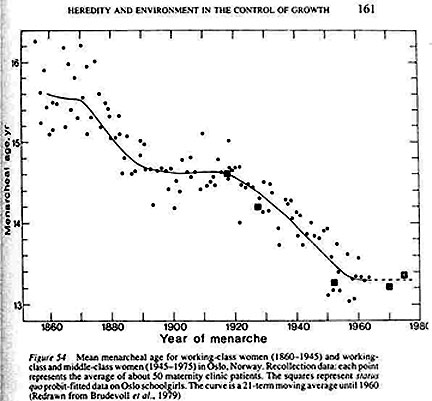
http://www.mum.org/menarage.htm

http://pediatrics.aappublications.org/cgi/content/full/107/6/1493
|
| Quote: |
SCIENCE AND PUBERTY
How do the biological sciences address the topic of female puberty? Here are quotes from several college level text books, and the World Book Encyclopedia. There is a great deal of info presented, but it is necessary to provide scientific details to fully understand puberty.
From "Adolescence", by L. Steinberg, pub. by McGraw Hill, 1993.
page 22: "Puberty derives from the Latin word "pubertas", which means "adult". Technically, the term refers to the period during which an individual becomes capable of sexual reproduction, that is, it denotes the series of biological changes leading up to reproductive capability. More broadly speaking, however, puberty is used as a collective term to refer to all the physical changes that occur in the growing girl or boy as the individual passes from childhood into adulthood."
page 23: "Puberty may appear to be rather sudden, judging from its external signs, but in fact it is part of a gradual process that begins at conception. (Petersen and Taylor, 1980). You may be surprised to learn that no new hormones are produced and no new bodily systems develop at puberty. Rather, some hormones that have been present since before birth increase, and other decrease."
page 26: "The effects of the endocrinological changes of puberty on the adolescent's body are remarkable. Consider the dramatic changes in physical appearance that occur during the short span of early adolescence. One enters puberty looking like a child and within FOUR years or so has the physical appearance of a young adult."
page 32: [This page shows a chart depicting that puberty lasts about 4 years in girls].
"Generally, full reproduction function does not occur until several years after menarche, and regular ovulation follows menarche by about two years (Hafetz, 1976)....
The onset of puberty can occur as early as 8 years in girls and 9.5 in boys, or as late as 13 in girls and 13.5 in boys. In girls, the interval between the first sign of puberty and complete physical maturation can be as short as one and one-half years or as long as six years....In more concrete terms, it is possible for an early-maturing, fast-maturing youngster to complete pubertal maturation by the age of 10 or 11 - two years before a late-maturing youngster has even begun puberty."
page 36 - 37: "(Although menarche does not signal the onset of puberty....) .....the average age at menarche generally is lower in those countries where individuals are less likely to be malnourished or suffer from chronic disease. For example, in western Europe and in the United States, the median menarcheal age ranges from about 12.5 years to 13.5 years. In Africa, however, the median menarcheal age ranges from 14 years to 17 years."
page 66: [There is a table depicting the four stages of cognitive development according to Piaget. It shows that the brain develops mature cognitive ability after age 11].
page 73: [On page 73 he presents a table showing that the brain is not fully mature until about the age of 16. From this table, so it one could estimate that at age 9, the maturation of the brain is between 50 to 60%.].
From "Adolescent Life Experiences", by G. Adams and T. Gullotta, pub. by Brooks / Cole, 1983:
page 89: "The onset of puberty is not a single, sudden event but a complex, gradual process. In perhaps oversimplified terms, puberty is characterized by (1) a spurt in physical growth, (2) maturation of physiological mechanisms, and (3) the appearance of secondary sex characteristics (for example, pubic hair or breast development). The onset of puberty is basically regulated by endocrine glands, important organs that create body changes through the secretion of chemicals into the bloodstream or lymphatic system.
page 92: "Although changes in height and breadth are important in adolescent development, society is more inclined to recognize the rapid maturation of the reproductive system during this period (D. D. Logan, Calder, & Cohen, 1980). The major stages in sexual maturation are (1) the initiation of puberty, which occurs approximately six months earlier in girls than in boys, 92) the development of secondary sex characteristics, which takes approximately four years; and (3) menarche, which occurs approximately two years after the onset of pubertal change (Marshall & Tanner, 1969, 1970).
page 101: "DEVELOPMENTAL DISORDERS
When the gonads become sexually mature and active before age 8 in girls or before age 9 in boys, pediatricians are inclined to diagnose "precocious puberty". When this condition occurs, the pubertal process is generally complete within two years."
|
---------------------------------------------------------------------------
| Quote: |
FROM "ADOLESCENCE - TRANSITION FROM CHILDHOOD TO MATURITY", by Lambert, Rothschild, Altland, & Green, pub. by Brooks / Cole, 1978:
page 106: "The process of physical development that results in the end of childhood and the beginning of adolescence involves three overlapping stages: Prepuberty, pubescence, and puberty. Although this sequence is the same for all individuals, the times of onset and the lengths of these periods differ from one person to another (Thornburg, 1975).
Prepuberty begins at the end of childhood with a rapid rise in hormone levels... It is also a period in which a rapid growth spurt begins and the secondary sex characteristics, such as the budding of the breast in girls and the enlargement of the testes and penis in boys, start to develop. Generally, girls experience theses changes two years before boys; the average age of onset of this stage is 10 for females, 12 for males (Tanner, 1975).
Pubescence, the second stage, is characterized by the proliferation of sex cells and near completion of the secondary sex characteristics (Thornburg, 1975). Pubescence begins with the menarche, or first menstruation, in girls.... The appearance of these characteristics, however, does not necessarily indicate that the reproductive system is complete. It may be a matter of months or even years before the body is capable of reproduction.
It is only with the third phase, puberty, that girls develop regular ovulatory menstrual cycles and the capability for procreation....This period generally spans about two years for girls and about three years for boys, ending when all of the secondary sex characteristics have fully appeared and reproductive ability has been reached. Most boys are well into puberty by age 14 (Marshall, 1975), most girls by the age of 15-16."
page 108: "...the gradual decrease in the average age at which menarche has been occurring among Western European girls and apparently among girls of the United States and Canada as well (Botstein & McArthus, 1976)....The fact that research has indicated that this trend is just as evident among girls in temperate climates as among girls in warm climates would also tend to destroy the myth that girls mature earlier in warm climates than in more moderate ones."
page 111: "Abnormal growth and delayed or precocious puberty are usually associated with disorders in hypothalamic hormonal changes (Schonberg, 1075; Sizonenko, 1975)."
page 115 - 117: "In girls there initially appears a budding of the breasts, then the appearance of pubic hair, then the menarche, and finally ovulation. ...Breast development and pubic hair first become visible at about 10-11 years of age, whereas the menarche occurs, on the average, in the range of 11-13 years, or approximately two years after initial breast development. Menstruation during pubescence is generally irregular, partly due to factors of emotion, tension, and nutrition. Reproductive maturity is usually attained from one to two years after the first menstruation, with maximum fertility developing in the early 20s (Lamburg et al., 1973)....
The average age at menarche is 12.5 to 13. However, some normal girls may begin to menstruate as early as 9, while others may not start until the age of 16 (Offer & Offer, 1968)....
Genital growth is usually not complete when menstruation begins, and this growth continues slowly for several more years. The menarche is frequently followed by a period of sterility, which lasts until a regular ovulatory menstrual cycle is established. The duration of this period varies considerable; the first ovulation (the discharge of the first egg from the ovaries) may occur at menarche, or it may not take place until years later....
For several months following the menarche, there is usually a lack of regularity in the extent and timing of the menstrual flow."
|
---------------------------------------------------------------------------
| Quote: |
From "Child Adolescent Development", by J. Brunk, pub by Wiley, 1975:
page 70: "Precocious puberty is the extreme opposite of delayed sexual maturation. In this condition, a girl may develop secondary sexual characteristics before the age of 8, or a boy before he is 10. This clearly can produce severe psychological problems for the affected child."
|
---------------------------------------------------------------------------
| Quote: |
AN EDITOR FROM "PSYCHOLOGY TODAY", states that:
"Most research of which I'm aware shows that young people reach full intellectual maturity by age 11 or 12, whether or not they have achieved the physical changes of puberty."
|
---------------------------------------------------------------------------
From the World Book Ency. under "Sex" on page 333 regarding puberty:
| Quote: |
"Puberty is the period of rapid growth that marks the end of childhood and the beginning of physical and sexual maturity (full development).
From the World Book Ency. under "Adolescent", page 61:
"Most girls start puberty at about age 11. Most boys start at about age 13. Puberty ends when a girl or boy reaches sexual maturity - that is, becomes capable of reproduction. Most adolescents are sexually mature TWO OR THREE YEARS AFTER they start puberty." |
---------------------------------------------------------------------------
WHAT ARE THE BIOLOGICAL SCIENCES TELLING US ABOUT PUBERTY?
To begin with, puberty does not begin with a girl's menarche. It begins about a year or two earlier. Islam missed the mark on this. Islam considers that puberty and adulthood begin with the menarche.
Further, science teaches that puberty does not end with menarche. It takes at least 2 more years for a child to sexually mature. Islam also missed the mark on this end. Science shows that usually the female body still has a ways to go from the time a girl has her menarche to the time she is sexually able to reproduce, or is considered to have an adult body.
Science further documents that there are times when a child may have "precocious puberty" and have menarche as early as age 8. This is usually due to a dysfunction or disorder within the child. Aisha may have had precocious puberty. Although it happens, it is very rare that young children experience menarche at age 9. Aisha had been very sick prior to her "marriage" to Muhammad. She had even lost some of her hair during her illness. Physically, she was having severe problems. Perhaps she was having some type of sickness that triggered her menarche, or she was experiencing some disorder that also caused the menarche. Either way, having menses at age 9 does not signify adulthood and justify marriage and engaging in sexual activities.
---------------------------------------------------------------------------
PUBERTY, MENARCHE, AND REPRODUCTION
There is a mis-conception that when a young girl has her first menarche, she is capable of getting pregnant. Many primitive cultures believed that a girl can become pregnant following menarche; Muhammad's culture probably believed this as well. However, science tells us this is very rare. Instead, the average time for a girl to become pregnant following menarche is one to two years. Clearly then, girls are not "mature" following their menarche. There are no biological grounds to marry and engage post-menarcheal girls in sexual activity; they cannot conceive children yet. Puberty does not equal maturity, and therefore this misconception should not lead to marriage.
Logically then, menarche is not a sign of a female being able to bear children. Only at the end of puberty can a girl conceive, not at the beginning, not at the middle. Puberty usually takes several years to complete.
Muhammad erred in establishing Islamic grounds allowing men to marry post-menarcheal girls. The girls are not sexually mature, they are not mentally mature, and they are not physically mature. Muhammad's precedent (Sunnah) is a blight upon the children of the Muslim world.
DAMAGE TO YOUNG GIRLS
SCIENCE AND OTHER EFFECTS OF EARLY SEXUAL ACTIVITY
Besides the documented assessment of growth and puberty above, other scientific and research groups have specifically addressed the effects of teen pregnancy. This of course reflects upon Islam, since Muhammad took a child bride, and taught it was okay for others to do as well. Here are some excerpts from webpages that address this issue.
from the American Academy of Pediatrics, at:
http://www.aap.org/policy/02325.html
| Quote: |
"...Improvements in prenatal care have resulted in decreases in medical complications among babies born to teenage mothers, but mothers aged 14 years and younger continue to experience unacceptably high rates of adverse outcomes. The most significant medical risks for infants of teenage mothers are likely related to the parental care those infants receive after the first year of life. Infants born to younger teenage mothers have a higher rate of mortality by their second birthday than infants of older adolescents and adults. [3] The incidence of prenatal mortality and low birth weight increases with subsequent pregnancies in adolescents. [4] The morbidity experienced by the infants of young mothers is more subtle to define but has been reported to include increased rates of hospitalization and increased risks of accidents, poisonings, burns, and superficial injuries. [5]...
...In several studies the cognitive levels of infants of younger v older mothers have been compared, and the results indicate lower cognition among the infants of younger mothers...
|
---------------------------------------------------------------------------
FROM THE UNITED WAY - MARCH OF DIMES BIRTH DEFECTS FOUNDATION: TEENFACTS
http://babynet.ddwi.com/tlc/pregnancy/teenfact.html
| Quote: |
"Health Risks to the Mother"
"A teenage mother is more at risk of pregnancy complications such as premature or prolonged labor, anemia and high blood pressure. These risks are even greater for teens who are less than 15 years old.(3)"
"Health Risks to the Baby"
"A baby born to a teenage mother is more at risk than a baby born to an older mother.
"Nine percent of teenage girls have low-birthweight babies (under 5.5 lbs.), compared to 7 percent of all mothers nationally.(1)"
"Low-birthweight babies may have organs that are not fully developed. This can lead to lung problems such as respiratory distress syndrome, or bleeding in the brain."
"Low-birthweight babies are 40 times more likely to die in their first month of life than normal-weight babies."
PSYCHOLOGICAL DAMAGE TO YOUNG GIRLS
There have been several studies done on females who were married at a very young age, and then taken into sexual intercourse. Following is a citation from two of them.
"Sexual contact between children and adults: A life course perspective."
Browning, Christopher R; Laumann, Edward O
Citation: American Sociological Review, v62n4, pp.540-560, Aug 1997
Number: 03374356 Features: Table; Illustration; References
Copyright: American Sociological Association 1997
"Research interest in the long-term effects of sexual contact between female children and adults has increased dramatically in the last two decades. Two sets of issues have driven this enhanced attention. The first concerns the nature and extent of the impact these experiences have on subsequent well-being in adulthood. Empirical research has offered evidence of the severe and wide ranging effects of adult-child sex by documenting its associations with a host of later "symptoms," such as low self-esteem, depression, anxiety, and sexual dysfunction."
"In each reduced model (Model 1), we see that adult-child sexual contact is significantly associated with the outcome considered. Women who experienced adult-child sexual contact were 1.6 times as likely to report sexual desire dysfunction, 2.1 times as likely to report sexual response dysfunction, 2.4 times as likely to report high dysfunction, 1.6 times as likely to report low overall well being, 1.7 times as likely to report low relationship satisfaction, and had more sexual activities that they found appealing compared with those who had no coupled sexual experiences as children. For every outcome except high dysfunction and number of sex acts found appealing, the introduction of the sexual trajectory variables (Models 2 and 3) renders the adult-child sexual contact coefficient insignificant, indicating that the effects of adult-child sex on adult outcomes are largely indirect, mediated through sexual trajectories."
Another such study was done by Peter O. Ebigbo. In the German periodical for Psychosomatic Medicine and Psychoanalysis his work was published. The abstract reads,
"Presents data on disturbed female clients whose marriages were arranged at age 9-13 years. When husbands had paid the dowry and fulfilled marriage customs, they were entitled to have sexual intercourse with their wives. Early sexual experience, mostly against the will of the underage girls, precipitated positive or negative reactions. In positive reaction cases, an imprinting fixation on the man took place. If the man died or rejected the young women, a disorientation took place, resulting mostly in an inability to have sexual relationships with other men. If the reaction was negative, the women did all she could to prevent sexual relationships with her husband through a variety of symptoms such as frequent pregnancies and secret love affairs."
|
| Muslim-answers.org wrote: |
Many will readily agree with the information above, but still may harbour reservations about whether a marriage to an older man could be happy for such a young girl. Putting aside the modern Western notions of "happiness" for a moment, the marriage of 'Aishah and the Prophet May the Peace and Blessings of God be upon him was a mutually happy and loving one as in expressed in numerous hadeeth and seerah books. That happy marriages occur between people with a fairly large difference in ages is known among psychologists:
"When the differences (in ages) is great, e.g. exceeds fifteen to twenty years, the results may be happier. The marriage of an elderly (senescent) not, of course, an old (senile) man to a quite young girl, is often very successful and harmonious. The bride is immediately introduced and accustomed to moderate sexual intercourse"
|
I don’t know what kind of a psychologist this man is, or he has been misquoted, but evidences give a contrary view:
Here are some quotes of how it affects the relationship
| Quote: |
Greater risk of domestic violence: young girls are often married to men who are much older than themselves. The age difference tends to reinforce the powerlessness of the girl, who is thus at greater risk of abuse and less likely to assert herself
http://www.law-lib.utoronto.ca/Diana/age.htm
Disparities in age and power
Teenage brides with much older husbands often have limited capacity to negotiate sexual relations, contraception and childbearing, as well as other aspects of domestic life.
Data on spousal age differences show that adolescent girls' husbands are often considerably older. Research from 16 countries in sub-Saharan Africa indicates husbands of 15-19-year-o1d-girls are on average at least l0 years older than their wives. 16
The younger the bride, the larger the spousal age difference

Source: Mensch, B. 2003. “Trends in the timing of first marriage,” presentation at the WHO/UNFPA/ Population Council Technical Consultation on Married Adolescents, Geneva, 9–12 December. Cited in
UNFPA. 2004. Child Marriage Advocacy Packet. 2004.
Women who marry younger are more likely to be beaten or threatened, and more likely to believe that a husband might sometimes be justified in beating his wife. 17 India has the highest levels of domestic violence among women married by 18 (see figure below). 18
Proportion of women married by the exact age of 18, by experience of violence

Source: UNICEF. 2005. Early Marriage: A Harmful Traditional Practice. New York: United Nations.
http://www.unfpa.org/swp/2005/presskit/factsheets/facts_child_marriage.htm
|
Whoever this psychologist is his assumptions hold no validity in ground! But the age difference he gave was 15-20, which is not the case here, by the Authors own words, Muhammad was 50 when the marriage took place that leaves us an age difference of 44 (50-6) and not 15-20 but nearly twice more than that, and hence has no validity!
| Muslim-answers.org wrote: |
In his comments on the ahadith in Sahih Muslim which mention 'Aishah's young marriage to the Prophet May the Peace and Blessings of God be upon him, 'Abdul-Hamid Siddiqi shows points three other reasons for this marriage:
# 'Aishah's marriage to the Prophet Muhammad May the Peace and Blessings of God be upon him at an early age allowed her to be an eye witness to the personal details of his life and carry them on the succeeding generations. By being both spiritually and physically near to the Prophet May the Peace and Blessings of God be upon him , the marriage prepared 'Aishah to be an example to all Muslims, especially women, for all times. She developed into a spiritual, teacher and scholar, since she was remarkably intelligent and wise. Her qualities helped support the Prophet's work and further the cause of Islam. 'Aishah, the Mother of the Believers, was not only a model for wives and mothers, but she was also a commentator on the Qur'an, an authority on hadeeth and knowledgeable in Islamic Law. She narrated at least 2,210 ahadith that give Muslims valuable insights into the Final Prophet's daily life and behaviour, thus preserving the Sunnah of Muhammad May the Peace and Blessings of God be upon him.
|
Again, this has no validity, there were a lot of unsuspecting people around Muhammad who where will to do anything for Muhammad surely, they would have done this at his very instance to do so rather than marrying a young girl! Muhammadcould have adopted her as his daughter if he had thought so rather than marrying her, no one can accept the fact that he had sex with a small child and preferred her more, he could have waited for her to have become a normal women before having sex with her, this qualifies him as a phedophile, if the intention of Muhammad was that of the above he wouldn’t have done that!
| Muslim-answers.org wrote: |
# At that time, this marriage refuted the notion that a man could not marry the daughter of a man who he had declared to be his "brother" (even in the religious sense). Since the Prophet May the Peace and Blessings of God be upon him and Abu Bakr had declared each other to be "brothers", this notion was done away with. This is demonstrated in the following hadeeth:
Narrated 'Ursa: The Prophet May the Peace and Blessings of God be upon him asked Abu Bakr for 'Aishah's hand in marriage. Abu Bakr said, "But I am your brother." The Prophet May the Peace and Blessings of God be upon him said, "You are my brother in God's religion and His Book, but she ('Aishah) is lawful for me to marry." (Saheeh al-Bukhari, Volume 7, Book 62, Number 1
|
I am sorry my dear muslim, this reason also fails. Because your prophet still rejected to Marry Hamza, stating the same practice you told he was trying to abolish because she wasn’t pretty.
Sahih Bukhari V.7, B62, N. 37
Narrated Ibn 'Abbas:
It was said to the Prophet, "Won't you marry the daughter of Hamza?" He said, "She is my foster niece (brother's daughter). "
this show he had no intention do that but was hypocritical according to his needs!
| Muslim-answers.org wrote: |
# The marriage did away with the pagan Arab superstition that it was a bad omen to be married in the month of Shawwal. They thought that the month carried this omen since the word Shawwal was derived from Shaala, which itself was believed to carry a bad omen. The authentic ahadith indicate that the Prophet May the Peace and Blessings of God be upon him and 'Aishah were married in this lunar month.
|
This is a most idiotic reason ever given, was it necessary to marry a child to remove such a simple superstition, Muhammad married some 30 plus wives, he could have married any one of them in this month. This superstition is no big problem that he has to commit a pedophilic act to abolish this superstition and set a more worse example to this world!
| Muslim-answers.org wrote: |
Above, we established that fact that getting married at puberty was an accepted practice amongst not only today's "primitive cultures", but specifically amongst the Semitic (i.e. Hebrew, Arab, Syriac, etc.) peoples of the Middle East. In order to provide additional proof that Muhammad's May the Peace and Blessings of God be upon him marriage to 'Aishah did not raise any eyebrows at that time, I here submit quotations from two Western female scholars who have studied Islam in detail:
"It is not clear just when the marriage actually took place. According to some versions, it was in the month of Shawwal of the Year 1, that is, some seven or eight months after the arrival at Medina; but, according to others, it was not until after the Battle of Badr, that is, in Shawwal of the second year of the Hijrah. In no version is there any comment made on the disparity of the ages between Mohammed and Aishah or on the tender age of the bride who, at the most, could not have been over ten years old and who was still much enamoured with her play."8
In the above quotation, the sources which are given for the latter date are "Nawawi" and "Tabari". Both Imams al-Nawawi and al-Tabari were great Muslim scholars, but their works contain material that is less than authentic by Islamic standards, which is probably the reason over her questioning which date is authentic. This is all beside the point, since we've already shown that authentic Islamic sources state that 'Aishah, may God be pleased with her, was "nine years old". The main point to note is that in "no version" was any comment made on their age difference or on 'Aishah's young age. Why? Such an early marriage was normal in all Semitic societies - such as the ones that Abraham, Moses, Jesus and Muhammad grew up in!
Another author, Karen Armstrong, has this to add: "Tabari says that she was so young that she stayed in her parents' home and the marriage was consummated there later when she had reached puberty".9 This further establishes that the marriage took place at puberty and that, as such, no eyebrows were raised. "Tabari", it should be mentioned, refers to Abu Jafar Muhammad ibn Jareer al-Tabari (225-310 AH / 839-923 CE), who was a great Muslim scholar who is well known in the West for his Qur'anic commentary and history of the world.
It is no surprise that both of the above authors agree on the fact that the marriage of 'Aishah and Muhammad May the Peace and Blessings of God be upon him took place when the former had reached puberty and that this was normal at the time. This is no surprise, since anyone who studies the Muslim sources and Semitic culture would be forced to come to the same conclusion, since it is simply a historical fact. It should be pointed out that both of the above quoted female authors do not hesitate to misrepresent Islam (intentionally or unintentionally) in their other writings. Suffice it to say that if there was some other "damaging" information available, they would not hesistate to bring it to light. Nabia Abbott, who has done some useful research on Islam in some areas, was basically an "Orientalist" in the classic sense. Her book which was quoted above, Aishah-The Beloved of Mohammed, is actually nothing but a disgusting second-guessing of 'Aishah's life. If a book with a similar mix of speculation and inauthentic sources were written about someone of significance in the West, it certainly would not be sitting on scholarly bookshelves. It's has long been established that Orientalists with a bone to pick with Islam liked to decide on the authenticity of a story based on their pre-conceived notions. If an inauthentic story seemed to belittle the Prophet of Islam, it became oft quoted. However, any authentic material that contradicted their theories was simply ignored. It's analogous to writing a historical biography of Jesus and using quotations from apocryphal gospels to override the Canonical ones whenever whimsically deemed appropriate. This is how Orientalists and Christian missionaries have been treating Muhammad May the Peace and Blessings of God be upon him for centuries. For those who want to know more about this, please read our article Orientalism, Misinformation and Islam.
|
No not again, the same rhetoric claim that it was common in that time to do so, we have seen this reasoning comes no where close to solve the problem.
And where does TABARI state Aisha had reached puberty when her marriage was consummated? Why doesn’t he give a direct reference to Tabari rather than pointing out to a third author? This is because tabari doesn’t state so! Please produce the actual qoute of TABARI rather than pointing out to a third person!
Here is the evidence that Aisha still hadn’t reached her puberty even at the age of 13-14, another nail in the cofin for Islamic apoligists produced by hector!
http://www.faithfreedom.org/forum/viewtopic.php?t=10197&postdays=0&postorder=asc&start=15
| Jermin Savory wrote: |
This is very easy, at that time, this was the norm ammongst the cultures that existed back then, the young boys back then didn't have the same maturity as the young boys today. In many situations young boys by the ages of 14-17 (who were really mature) were sent out to battle and for provision for the family.
|
This has nothing to do with the problem at hand, yet I don't see Muhammad being sent to war at that age, but suerly muslim boys did because stealing others life was the stuff on which Islam thrived!
| Jermin Savory wrote: |
Likewise, the Young women back then are not like the young women of today, they are more more mature and had more responsibilities back then that the relaxed environment we live in today. |
you are talking about young women! aisha wasn't a young women when she was married but a young girl/child of 6 yrs old! a six year child of today is no different from that of aisha's period, infact a six year child today have more responsibilites than that of a 6 yr old child at aisha's time who didn't go to schools and hence had no educational responsiblities, I find no hadith stating Aisha was taking up the responsiblities of her home at the age of 6, but rather she behaved like a normal six yr old girl of any time, playing with her friends. how could such a girl decide on wjhom to marry? I come from a village background in India, having spent a good chunk of my life during my vacations back at the village. I have seen young girls (approx at age of 10-14) taking up certain responsiblities of families like helping in the household activites, but none where mature enough to decide about their life at that stage. even teenage boys and girls do a lot of things that they don't mean their is a lot of differece between infactuation and love, teenagers more often experince the former, which they themselves think is silly after becoming more mature. This being the case with teenagers how do u expect a 6 yr old girl who didn't even know what these terms mean to decide upon their lives? I don't know how an American like u (as u call urself one) could believe in such outrageous Ideas to support pedophilia of your prophet? early mairrages post a lot of problems to the child which are undeniable facts, though this was practiced by primitive societies which was primarialy due to their ignorance of the effects of pedophilia doesn't aquit your prophet who must have had the wisdom to put an end to this evil practice, one always equates a prophet to an shepherd who guides his heard, but your prophet instead of guiding them was one among the herd which disqualifies him to be a prophet, but shows him as just another lecherous person of that time!
CONCLUSION:
Blaming the west and others, that’s how this muslim has gone about his rebuttal (if I could call it so). Attacking the west and the other primitives doesn’t solve the problem at hand! Let the west and the people at the time of Muhammad be depraved of the consequences of their actions, but is this how you expect a prohet of god to behave. Morality is not a blind set of rules that change with time but something that has a lot to do with experience of Mankind over the years, primitive men had indiscriminate sex, had flawed Morality but it had consequences on them, as a result of which man’s morality changed as result of the ill effects of his actions which weren’t thought to be wrong. But god’s morality mustn’t change, so does his prophet’s. He must know what is wrong and right and his flawed morality mustn’t be justified by the actions of those who committed the same mistakes. Isn’t he here bring us new laws, which will make our lives more bright? Or is he their to follow the flaws of our ancestors. These Muslims who attack the pagans as ignorant and strayed bring in the same pagan morality which they are against to justify Muhammad’s actions, who is hypocritical muslims?
Pedophilia, has got nothing incongruous or anachronous, it was always the same no matter what, its just that our ancestors didn’t know that and its effects! But we expect god’s messenger to know that and not blindly follow the mistakes of the need as a noble and a divine act. All said and dusted, Muhammad is a pedophile no matter when he lived or where he lived since he was supposed to be a prophet of god and had to set standards of morality and point out the mistakes and not follow it, like just another man of his period. This is where Muhammad fails as a prophet and human being!
_________________
Thanks
peaceforever |
|
| Back to top |
|
|
wachamalit
Joined: 06 Jun 2005
Posts: 3319
Location: Atheist corner.
|
| Posted: Sat Aug 19, 2006 10:12 am Post subject: |
|
|
Very nice. I especially liked the part describing the dangers of teen pregnancy.
_________________
Out of ideas for a new, witty signature. May add one later, but maybe not since I am too lazy. |
|
| Back to top |
|
|
Hector
Joined: 24 May 2004
Posts: 7144
Location: Astroistan
|
| Posted: Tue Aug 29, 2006 7:12 am Post subject: Re: Aishah - Wife of the Prophet of Allah |
|
|
| allahuakbar123 wrote: |
I agree with the following regarding Aishah:
1. She was 9 years of age when her marriage to the prophet was consummated
2. The Hadiths quoting her age are authentic
However I do not agree with interpretation of hadiths regarding the playing with dolls – which assumes that Aishah was prepubescent - due to the following hadith from Sahih Bukhari
1.465:
Narrated `Aisha:
(the wife of the Prophet) I had seen my parents following Islam since I attained the age of puberty. Not a day passed but the Prophet visited us, both in the mornings and evenings. My father Abu Bakr thought of building a mosque in the courtyard of his house and he did so. He used to pray and recite the Qur'an in it. The pagan women and their children used to stand by him and look at him with surprise. Abu Bakr was a Softhearted person and could not help weeping while reciting the Qur'an. The chiefs of the Quraish pagans became afraid of that (i.e. that their children and women might be affected by the recitation of Qur'an).
This hadith implies that Aisha had reached puberty and at the time her parents were already Muslims also the Prophet PBUH visited regularly and does not indicate that he was as yet married to Aishah.
Hadiths regarding doll playing:
| Quote: |
Sahih Bukhari Volume 8, Book 73, Number 151
Narrated 'Aisha: I used to play with the dolls in the presence of the Prophet, and my girl friends also used to play with me. When Allah's Apostle used to enter they used to hide themselves, but the Prophet would call them to join and play with me. (The playing with the dolls and similar images is forbidden, but it was allowed for 'Aisha at that time, as she was a little girl, not yet reached the age of puberty.) (Fateh-al-Bari page 143, Vol.13)
On the authority of Aisha (RA), who said: I used to play with dolls in the presence of the Prophet (SAW). And I had girl-friends (playmates) who played along with me. They would hide (feeling shy) from him (SAW) whenever he entered. But, he (SAW) would send for them to join me and they would play with me. (Sahih Bukhari & Muslim)
|
According Islamic jurists authentic hadiths cannot contradict each other therefore it is evident that the INTERPRETATION of this particular hadiths in Fateh-al-Bari is faulty.
The Fateh-al-Bari is respected commentary but its author was mortal and could have made mistakes in interpreting the hadiths
This evidence means that Aishah had already reached puberty when the marriage was consummated.
And Allah knows best |
A Muslim has pointed out that one particular translation of a sahih Bukhari hadith may be interpreted to show that Aisha had already reached puberty during her initial period of living in Mecca prior to the Hijrah.
Muhsin Khan’s translation of Sahih Bukhari Volume 1, Book 8, Number 465:
Narrated 'Aisha: (the wife of the Prophet) I had seen my parents following Islam since I attained the age of puberty. Not a day passed but the Prophet visited us, both in the mornings and evenings. My father Abii Bakr thought of building a mosque in the courtyard of his house and he did so. He used to pray and recite the Qur'an in it. The pagan women and their children used to stand by him and look at him with surprise. Abu Bakr was a softhearted person and could not help weeping while reciting the Quran. The chiefs of the Quraish pagans became afraid of that (i.e. that their children and women might be affected by the recitation of Quran)."
There are at least three “errors” with this interpretation of this particular translation of the hadith.
1. It is contradicted by other sahih Bukhari hadiths of the same incident that suggest Aisha only remembered her parents following Islam as far as she remembered or that she did not remember her parents believing in any religion other than Islam. By all accounts Aisha was born after her parents accepted Islam and it is erroneous to think she could only remember her parents following Islam after she reached the age of puberty. These hadiths are as follows:
Bukhari, Volume 3, Book 37, Number 494:
Narrated Aisha: (wife of the Prophet) Since I reached the age when I could remember things, I have seen my parents worshipping according to the right faith of Islam. Not a single day passed but Allah's Apostle visited us both in the morning and in the evening…
Bukhari Volume 5, Book 58, Number 245:
Narrated 'Aisha: (the wife of the Prophet) I never remembered my parents believing in any religion other than the true religion (i.e. Islam), and (I don't remember) a single day passing without our being visited by Allah's Apostle in the morning and in the evening…
Bukhari Volume 8, Book 73, Number 102:
Narrated 'Aisha: (the wife of the Prophet) "I do not remember my parents believing in any religion other than the Religion (of Islam), and our being visited by Allah's Apostle in the morning and in the evening. One day, while we were sitting in the house of Abu Bakr (my father) at noon, someone said, 'This is Allah's Apostle coming at an hour at which he never used to visit us.' Abu Bakr said, 'There must be something very urgent that has brought him at this hour.' The Prophet said, 'I have been allowed to go out (of Mecca) to migrate.' "
Hence, using Muhsin Khan’s translation of 1;8;465 to show Aisha had reached puberty before she migrated to Medinah is doubtful since this conclusion would be inconsistent with other hadiths of the same event. These hadiths show Aisha remembered her parents following Islam not since she reached puberty but as far as she could remember, and it is implausible to believe she only began her recollections upon reaching puberty.
2. This raises the question of the veracity and reliability of Muhsin Khan’s translation of 1;8;465. A search of other translations of this particular hadith shows no mention of Aisha’s puberty at all. In fact, it is likely that Muhsin Khan translation of 1;8;465 is erroneous. Here is another translation of the said hadith:
Chapter 11: Mosque
LII: A mosque should not be built in a thoroughfare if that would be detrimental to people
Al-Hasan, Ayyub and Malik all said this.
464 It is related that 'A'isha, the wife of the Prophet, may Allah bless him and grant him peace, said, "I have no recollection of my parents doing anything but following the deen of Islam. No day would pass without the Messenger of Allah, may Allah bless him and grant him peace, visiting us at either end of it, both morning and evening. Then it occurred to Abu Bakr to build a mosque in the forecourt of his house. He used to pray and recite Qur'an in it. The pagan women and children would stand there amazed, staring at him. Abu Bakr was a man who wept easily and could not control his tears when reading the Qur'an and this was a matter of great concern to those nobles of Quraysh who worshipped idols." http://www.sunnipath.com/Resources/PrintMedia/Hadith/H0002P0011.aspx
Hence, 1;8;465 is entirely consistent with other like hadiths in that Aisha did not remember her parents following any religion other than Islam, and not since she reached puberty. One suggests Muhsin Khan's translation is erroneous and that the original meaning does not convey the idea of Aisha having reached puberty during the events mentioned in the hadith. {Note the numbering is less one compared to Muhsin Khan’s translation. However, a check of the preceding and subsequent hadiths shows that the sunnipath hadith is identical to Muhsin Khan’s hadith}.
3. Other sahih hadiths suggest that Aisha was a young girl or little girl who was of an immature age, and thus would contradict any interpretation of the Muhsin Khan translation of 1;8;465 to mean Aisha had reached puberty whilst she was still residing in Mecca. These hadiths include Bukhari 3;48;805 , 3;48;829 , Bukhari 6; 60; 274 , Bukhari 7;62;163 , and Muslim 037; 6673 and show that Aisha had not attained puberty even at the time of the raid on the Bani al-Mustaliq, traditionally ascribed to have occurred between 4 to 6 AH. { Ibn Sa'd in his Tabaqat – Sha’ban 5 AH; Musa bin 'Uqbah – 4 AH; Ibn Ishaq - Sha'ban 6AH
http://www.islamicperspectives.com/Chastity.htm. Other datings of the Mustaliq raid http://www.anwary-islam.com/prophet-life/holly-p-10.htm , http://al-islamforall.org/Ghazwat/ghazwat/mustaliq.htm }
http://www.faithfreedom.org/forum/viewtopic.php?p=397822#397822
Conclusion
There is no evidence that Aisha had reached puberty before the migration to Medinah, except for a Muhsin Khan translation (only with a favorable interpretation) that is clearly at odds with other hadiths of the same event, another translation of the same hadith, and other hadiths that clearly suggest that she had not reached puberty at least 4 years after the migration and hence at least 2 to 3 years after Muhammad had had sex with her (see Abdul Walid bin Muhammad Talib’s article proving Muhammad had sex with Aisha when she was nine years old http://www.faithfreedom.org/forum/viewtopic.php?p=226718#226718).
_________________
What sort of man would f*ck a sweet little prepubescent nine-year-old child who liked playing with dolls and swings? Mo the demon Pedophile. |
|
| Back to top |
|
|
ben malik3
Joined: 16 Oct 2005
Posts: 105
|
| Posted: Fri Sep 01, 2006 11:43 pm Post subject: Re: Aishah - Wife of the Prophet of Allah |
|
|
| Quote: |
Khan translation of 1;8;465 is erroneous. Here is another translation of the said hadith:
Chapter 11: Mosque
LII: A mosque should not be built in a thoroughfare if that would be detrimental to people
Al-Hasan, Ayyub and Malik all said this.
464 It is related that 'A'isha, the wife of the Prophet, may Allah bless him and grant him peace, said, "I have no recollection of my parents doing anything but following the deen of Islam. No day would pass without the Messenger of Allah, may Allah bless him and grant him peace, visiting us at either end of it, both morning and evening. Then it occurred to Abu Bakr to build a mosque in the forecourt of his house. He used to pray and recite Qur'an in it. The pagan women and children would stand there amazed, staring at him. Abu Bakr was a man who wept easily and could not control his tears when reading the Qur'an and this was a matter of great concern to those nobles of Quraysh who worshipped idols." http://www.sunnipath.com/Resources/PrintMedia/Hadith/H0002P0011.aspx
|
It seems that Khan did mistranslate since this is how Aisha Bewley renders the Arabic, in agreement with sunnipath (they may have even taken it from her):
LII: A mosque should not be built in a thoroughfare if that would be detrimental to people
Al-Hasan, Ayyub and Malik all said this.
464. It is related that 'A'isha, the wife of the Prophet, may Allah bless him and grant him peace, said, "I have no recollection of my parents doing anything but following the deen of Islam. No day would pass without the Messenger of Allah, may Allah bless him and grant him peace, visiting us at either end of it, both morning and evening. Then it occurred to Abu Bakr to build a mosque in the forecourt of his house. He used to pray and recite Qur'an in it. The pagan women and children would stand there amazed, staring at him. Abu Bakr was a man who wept easily and could not control his tears when reading the Qur'an and this was a matter of great concern to those nobles of Quraysh who worshipped idols." Sahih Collection of Al-Bukhari, Chapter 8: Book of Prayer: http://bewley.virtualave.net/bukhari5.html#8 |
|
| Back to top |
|
|
Always_Faithful

Joined: 22 Jan 2006
Posts: 2024
Location: Location: Location
|
| Posted: Sun Mar 18, 2007 4:55 pm Post subject: |
|
|
I'm not sure if this is worthy of going here, but I've written a short artical rebutting Yamin Zakariya. It's quite short because I feel that most of the key points have already been addressed in this thread, and I see no reason to repeat them when they are otherwise at such close reference.
http://www.iiop.org/index3.php?recordID=183
Debunking Yamin Zakariya apologetics from the Islamic "International institute of peace" website
| Yamin Zakariya wrote: |
| Any impartial observer can distinguish between crass insults, and scholarly criticisms of Islam. Insults are usually self-evident, conveyed using pejorative terms that are intended to denigrate and mock. Such crude language is inappropriate for the mainstream media and the government, as they have the burden of keeping their mask of civilisation from slipping. So, they disseminate the same crass insults using refined language, present it as scholarly opinions by citing selected academics. However, even a cursory investigation reveals that these so-called scholarly ‘opinions’ are primarily based on the works of other hostile critics of Islam, whilst opinions of the proponents, or even those who are relatively neutral, are not given any serious consideration. |
The author starts, as he eventually finishes, with an unsubstantiated rant.
| Quote: |
| These hostile critics use specific examples to construct: subjective judgments and simultaneously ignore how those judgments contradict other cases. For example, they describe the Prophet (SAW) of Islam as violent by citing cases where retribution was applied, concurrently ignoring the numerous occasions when He forgave the offenders. Also, how can anyone claim retribution is an act of violence, as it is a form of compensation for the victim, and a deterrence for the criminals. Retribution is central to the notion of justice. |
As this has nothing to do with the issue of pedophilia, I'll ignore it. it is, however, an example of using a good deed to cancel out a bad deed, which is a "proof by example" fallacy.
| Quote: |
| Likewise, they claim that the Prophet (SAW) was driven by lust for having many wives, but overlook that fact that many of his wives were old and not the most beautiful. |
The word "many" here is conjecture. It is also clearly a red herring, as it diverts from the real issue. The other marriages have nothing to do with Aisha's, and are hence not germane to this case.
One of the prophet's wives, Sauna, was apparantly unattractive. Aisha describes her as being fat.
| Sahih Bukhari, V6 B60 #318 wrote: |
| Sauda (the wife of the Prophet) went out to answer the call of nature after it was made obligatory (for all the Muslims ladies) to observe the veil. She was a fat huge lady, and everybody who knew her before could recognize her |
And, incidently, Mohammed wanted little to do with her when she became older.
| Quote: |
| Sawdah feared that the Messenger of Allah might divorce her and she said, ‘O Messenger of Allah! Do not divorce me; give my day to ‘A'ishah |
| Quote: |
| More pertinently, the Prophet (SAW) did not seek the prettiest women in the prime of his youth; nor did he seek them when He became the most powerful ruler of Arabia, when such desires could easily have been satisfied. In fact, the pagan Arabs offered Him the most beautiful women as a form of bribe, in return for His silence, but the Prophet (SAW) unequivocally refused. |
Mohammed no doubt had many beautiful sexual partners, including those he took as war booty. Miriyam, a Coptic Christian, is an example:
| Quote: |
| He (Muhammad) used to visit her (Mariyam) there and ordered her to veil herself, [but] he had intercourse with her by virtue of her being his property |
As was Safiyah:
| Sahih Bukari V4 B52 #143 wrote: |
| When we reached Khaybar, Muhammad said that Allah had enabled him to conquer them. It was then that the beauty of Safiyah bint Huyai bin Akhtab was described to him. Her husband had been killed [by Muhammad], so Allah's Apostle selected her for himself. He took her along with him till we reached a place where her menses were over and he took her for his wife, consummating his marriage to her, and forcing her to wear the veil. |
For Mohammed, taking sexual captives was very much lawful. The Quran makes these sort of endeavours halal.
| Qur'an 33:50 wrote: |
| O Prophet! We have made lawful to thee thy wives to whom thou hast paid their dowers; and those whom thy right hand possesses out of the prisoners of war whom Allah has assigned to thee |
| Qur'an 23:56 wrote: |
| who restrain their carnal desires (except with their wives and slave girls, for these are lawful to them |
| Qur'an 4:24 wrote: |
| And all married women are forbidden unto you save those captives whom your right hand possess. It is a decree of Allah for you. |
As do the ahadith:
| Sahih Bukhari V3 B34 #432 (reiterated in V9 #506) wrote: |
| "O Allah's Apostle! We get female captives as our share of booty, and we are interested in their prices, what is your opinion about coitus interrupt us?" The Prophet said, "Do you really do that? It is better for you not to do it. No soul that which Allah has destined to exist, but will surely come into existence. |
| Sahih Bukhari V5 B59 #512 wrote: |
| The Prophet offered the Fajr Prayer near Khaibar when it was still dark and then said, "Allahu-Akbar! Khaibar is destroyed, for whenever we approach a (hostile) nation (to fight), then evil will be the morning for those who have been warned." Then the inhabitants of Khaibar came out running on the roads. The Prophet had their warriors killed, their offspring and woman taken as captives. Safiya was amongst the captives, She first came in the share of Dahya Alkali but later on she belonged to the Prophet . The Prophet made her manumission as her 'Mahr'. |
| Quote: |
| If having many wives is evidence of lust, then surely these types of charges can be levied better against the Biblical Prophets; Solomon (AS) for example had seven hundred wives and numerous concubines. Conversely, someone remaining celibate can be accused of having unnatural desires. Thus, using this type of superficial reasoning, one can make serious allegations against Prophet Jesus (AS). |
Tu Quoque. Besides, how could Jesus be given such allegations - he was willingly abstinent! That's not so much desire as the absence of desire. That's the sort of self-control Mohammed should have tried to emulate.
| Quote: |
| Similarly, they slander Prophet Muhammad (SAW) as a ‘pedophile’, because of the sole example of His marriage to young Ayesha (RA), the only virgin wife of the Prophet. They argue that Ayesha (RA) was a child by contemporary standards and the age difference between Prophet Muhammad (aged 54) and Ayesha (age 9) is inappropriate. Simultaneously, they fail to account why all of His other wives were much older and some actually exceeded the Prophet (SAW) in age. |
Most of Mohammed's wives were younger than he was, as were his sex slaves. Two exceptions were Khadija (who he only married for her power and influence) and Sauda (who, as mentioned above, he wanted to divorce).
Again, this is argument is a red herring. The author here is trying to divert the issue of Aisha's marriage by giving information which is not pertinent. Mohammed had so many wives, many of which for political reasons, that some were bound to be a little mature. That is overridden by the fact that he had sex slaves and young wives (like Aisha) to satisfy his lust. He was certainly not bereft of sexual satisfaction simply because some wives were not very young!
| Quote: |
| The pertinent question is: if the Prophet (SAW) really had a strong desire for young women, then why did He not seek wives of a similar age to Ayesha (RA), when He subsequently married numerous times? |
This thread shows that he did lust after another very young child:
http://www.faithfreedom.org/forum/viewtopic.php?p=115507
Again, this is a red herring anyway. Many of his wives were young and beautiful, even if they weren't quite as young as Aisha. Besides, it wouldn't be easy finding someone who would be willing to marry off his 6 year old daughter to a 54+ year old man. Abu Bakr did because was a companion of the prophet, and had admiration for him. He was also unlikely to jeapordize his grounds with Mohammed by refusing the arrangement. There is no telling how young some of Mohammed's sex slaves were, though.
| Quote: |
The hostile critics can be classed into two categories, the secular fundamentalists and the fanatical Christian-Zionists. In order to answer the nasty allegation made against the Prophet (SAW), we pose the following questions:
Was Ayesha a pre-pubescent child?
Was the marriage immoral due to the age gap?
What constitutes a valid marriage?
Who really condones and/or practices pedophilia?
Was Ayesha (RA) a pre-pubescent child? |
| Quote: |
| The conventional definition of a Pedophile is: someone who REPEATEDLY engages in sexual act with prepubescent children. |
No it is not. The author here is inventing definitions. There are two types of possible pedophilia: fixated (exclusive) and regressed (non-exclusive). Mohammed was merely of the second kind.
The official definition of pedophilia chosen by two randomly selected online sources, which have corroborated word-by-word, is:
| Answers.com + and Freeonlinedictionary.com wrote: |
| The act or fantasy on the part of an adult of engaging in sexual activity with a child or children |
There is no mention of exclusivity or multiplicity in the definition. Implicit pedophlia does not rely on such factors; only the two given precise persuasions mentioned above.
This medical definition should shed more light on the author's misconception about what constitutes pedophilia, and give a few insights into why pedophilia is wrong under any circumstance.
| Quote: |
According to the DSM-IV definition, pedophilia involves sexual activity by an adult with a prepubescent child. Some individuals prefer females, usually 8- to 10-year-olds. Those attracted to males usually prefers slightly older children. Some prefer both sexes. While some are sexually attracted only to children, others also are sometimes attracted to adults.
Pedophiliac activity may involve undressing and looking at the child or more direct physical sex acts. All these activities are psychologically harmful to the child, and some may be physically harmful. In addition, individuals with pedophilia often go to great lengths to obtain photos, films or pornographic publications that focus on sex with children.
These individuals commonly explain their activities with excuses or rationalizations that the activities have "educational value" for the child, that the child feels "sexual pleasure" from the activities or that the child was "sexually provocative." However, child psychiatrists and other child development experts maintain that children are incapable of offering informed consent to sex with an adult. Furthermore, since pedophiliac acts harm the child, psychiatrists condemn publications or organizations that seek to promote or normalize sex between adults and children. |
http://www.medem.com/medlb/article_detaillb.cfm?article_ID=ZZZUZRUZGLC&sub_cat=355
The author here is also arguing needless pedantics, as if to excuse an act by mere definition alone. To paraphrase Shakespeare; "a vile act by any other name would still be just as deplorable".
| Quote: |
| All the reports state that Ayesha (RA) went to live with the Prophet (SAW) as His wife, after she had reached puberty. |
The part in bold is conjecture. No sahih hadith explicitly say that Aisha had reached puberty.
| Quote: |
| She and her parents fully consented to the marriage |
.
This part is ridiculous. Her parents should have nothing to do with what should effectively be her choice. As for her consenting, the author makes it sound like she had a choice. She was a young girl who had no discernable voice in the matter, who had no doubt received much propaganda from outside sources. A girl of her age, aside from being too immature to make such a decision, is very susceptible to influence. To suggest that she would dare to go against the wishes of her parents and the prophet, especially in that society, is also ridiculous.
Besides, a hadith shows that Abu Bakr was at first hesitant, which is not suprising.
| Sahih Bukhari V7 B62 #18 wrote: |
| The Prophet asked Abu Bakr for 'Aisha's hand in marriage. Abu Bakr said "But I am your brother." The Prophet said, "You are my brother in Allah's religion and His Book, but she (Aisha) is lawful for me to marry |
Which ever way one looks at this, Aisha was in no position to consent, and Abu Bakr only did because he could not refuse Mohammed. Aisha was could not consent, and Abu Bakr did so reluctantly.
| Quote: |
| There was no criticism issued at that time and subsequently, by Muslims and non-Muslims. Hence, this was in accordance to the prevailing custom, and the age old tradition of girls marrying at puberty. |
Ad antiquitatem. A prophet is meant to be a paragon for all mankind, not someone who panders to the whims of his current civilisation. Mohammed is said to have abolished 'bad' customs at that time (as he is meant to spread Allah's ideals of life), yet indulges in other bad practices (pedophilia being the explicit example here). Why?
Judging something by appealing to tradition is an abject fallacy. A culture could allow all manner of things such as human sacrifices and infanticide. Just because it allows such things, the case should not be that those customs should be acceptable.
| Quote: |
| However, the allegation persists, because they argue that Ayesha (RA) was still a child regardless of her attaining puberty |
.
She had not attained puberty. Besides, she was nine years old. That, by any remotely intelligent person's standards, is an age that is far too young for something like marriage and sex.
| Quote: |
| In that case, what is the universally accepted definition that distinguishes a child from an adult for all periods of time? Surely it cannot be something as arbitrary as 18 or 16, as is the case in many Western countries, and such distinction is meaningless when you consider that most people below those ages are sexually active. Are we under any obligation to accept their assertions in blind-faith that Ayesha was a child? Note, by those same standards, having sex with an underage female is not described as pedophiliac, but underage sex, or statutory rape! |
She was a child because she was playing with dolls, which was unacceptable at the time for pubescent kids.
| Sahih Bukhari V8 B73 #151 wrote: |
| I used to play with the dolls in the presence of the Prophet, and my girl friends also used to play with me |
Besides, the age of consent moves up as we learn about the adverse affects of sex below the threshold. We now know about all the adverse affects of such intercourse, such as physical damage and mental trauma. Many of the deleterious effects have been elaborately discussed elsewhere in this thread.
| Quote: |
| It should also be noted that even today the age of consent in many parts of the world is around 12-14. Age of consent in the USA was 10 hardly 100 years ago and 11 in the UK. Mary the mother of Jesus according to the Oxford Dictionary of the Bible was pregnant at the age of 12 and married of to Joseph between the ages of 7 and 9. The Christian Byzantine emperors and nobilities also had brides as young as 8 years old. The gay communities in secular societies are constantly trying to lowering the age of consent |
.
Non of this is relevant. It is basically a chunk of Tu Quoque. Bedides, the author should perhaps consider why the ages of consent were increased. As we become more aware of adverse effects of actions, we accommodate our laws to protect people from them.
| Quote: |
| From the definition of Islam, Ayesha was a woman. Islam makes puberty (physical capacity) and mental capacity the distinguishing factor between a responsible adult and a child. |
Again, there is no evidence to support the fact that Aisha was pubescent. However, even if we were to say that Islam mandates pubescence for a person to be sexually mature, then we are faced with an astounding moral dilemma. A child is not simply ready for sex because they have reached puberty. It would be ridiculous even to suggest so.
As it happens, Islam does not explicitly mandate puberty as a threshold. Many muslims use the phrase "until they reach the age of marriage" (found in Surah 4 Aya 6), but this is contradicted (or perhaps abrogated)by 65:4, which reads:
| Qur'an 65:4 wrote: |
| And those of your women as have passed the age of monthly courses, for them the 'Iddah (prescribed period), if you have doubts (about their periods), is three months, and for those who have no courses [(i.e. they are still immature) their 'Iddah (prescribed period) is three months likewise, except in case of death]. And for those who are pregnant (whether they are divorced or their husbands are dead), their 'Iddah is until they deliver (their burdens), and whosoever fears Allah and keeps his duty to Him, He will make his matter easy for him |
| Quote: |
| Was the marriage immoral due to the age gap? |
Amongst other things, yes. It stands to reason that a child of 9 years is unlikely to be appropriate marriage material for a 54 year old man in terms of social and sexual contexts. A young child is unlikely to be eagerly sexually involved, especially in a man old enough to be her grandfather. Similarly, an old man is not interested in toys and children's parties. The social divide between the two makes for unfavorable marital fabric, whereby neither party is interested in the other's lifestyle. It indeed becomes a superficial marriage, and one that has no discernable connection betweeen the couple. Marriage alone might have been acceptable for strictly political reasons, but the circumstances, and subsequent consummation, show clearly that the reasons were solely, if at all, so.
Men of significantly higher ages are authority figures to young children, and are hence of significantly greater stature in the marriage. The marriage between them is hence one that is not based on complete equality, as should be the case the case in ideal circumstances for a happy, equal married life. Mohammed, with his numerous other wives available to fill voids of his marriage with Aisha, need not worry about about the social gaps in the marriage. Aisha, on the other hand, is left with a premature, unflufilling marriage early on in life, with no other acceptable options for remarriage.
| Quote: |
| By whose standards the marriage was immoral? Burden of proof is on the one who makes the allegations. Hence, they must state their definition of morality/immorality and its basis. More pertinently why their definition of morality is universal and absolute - thus has legitimacy to judge all societies. The reality is: morality like laws is relative, it differs from nation to nation; and for most nations it is relative within as it changes with the lapse of time. For example once marriage was sacred but now it is outdated, homosexuality was once immoral but now it is a fad, and so on. |
Utter nonsense. Morality is nothing to do with what a culture allows. it is based entirely on the effects of a practice on other people. Homosexuality harms no-one, but pedophilia is potentially very harmful to the child.
| Quote: |
| Some argue that certain values like lying, murder, and theft are universal, if that was so then the laws and values regarding these issues would be identical. Consider capital punishment, this is viewed as murder by some, while others consider it as a form of retribution. When foreigners kill their citizens it is deemed as murder, however when they kill foreigners it is collateral damages for building democracy! Similarly when you examine the details of what constitutes lies and theft you see the sharp differences. |
Again, it should be based on the effects. Stealing from a multimillion pound corporation to feed your dying family is theft, but should not be punishable, as the good vastly outweighs the bad. With the prophet's sexual intercourse with Aisha, the only good is a superficial one - Mohammed's sexual satisfaction. The bad is the potential adverse affects to Aisha, which vastly outweighs the good.
| Quote: |
| The Christian-Zionist are in no position to lecture about the age gap, given that there are numerous references [1] in the Bible illustrating marriage between young girls with older men. Even a child as young as 3 can be taken as a bride [2] this is elaborated in the section below: who really condones and/or practices pedophilia. They have a further problem in lecturing the Muslims about morality as there are stories [1] alleging adultery, incest, indiscriminate murder of women and children, committed by the Prophets of God under divine guidance. |
This is just tu quoque.
| Quote: |
| For the secular critics, to claim that the marriage was immoral is irrational and hypocritical, as secular societies do not recognise marriage as a sacred institution in the first place. It is viewed as an ancient tradition, thus people are increasingly cohabiting. Also, how their scale of so-called morality works? They say it is wrong for a man to have married a much younger woman, but there is no problem if the individual is engaged in homosexual activity or other kinds of sexual practices like incest, bestiality that are considered by most people as deviant from the norm. At least a heterosexual relationship conforms to nature and fulfills the role of reproduction. Is it morally consistent to criticise the marriage of Ayesha (RA), while permitting such activities? |
This is nonsense. Aisha never bore Mohammed any children, possibly due to the internal damage he caused her. However, to say that pedophlia is acceptable because it is natural is sick and desparate. The author here is making no sense whatsoever.
| Quote: |
| Of course, the secular critics scream sexual freedom is the reason for allowing such activities. Then surely, by that freedom, there should be no objection if two individuals willingly enter into a marital contract, regardless of their age differences! Would it be perceived in the same light, if a sexually active 12 year old male wanted to marry a 60 year old woman willingly, exercising their freedoms? Many of the secular anti-Islamic monkeys have been trained to foul mouth Islam, and unable to elaborate and justify their alternative moral paradise. Naturally, if you criticise something, you must have an alternative. That leads to the next question. |
A prepuscent child is in no position to consent, especially when she is under the immense pressure Aisha faced.
| Quote: |
| What constitutes a valid (moral) marriage? |
A marriage in which two, socially equal persons are willing to establish a loving, non-venerous bond between one another. A marriage whereby a 54 year old man has sex with a 9 year old girl with whom no obvious intellectual equlaity can be established is not a valid marriage. A nine year old girl is hardly likely to entertain equal social grounds with a grown man. Mohammed clearly did not marry Aisha because they had a lot in common or because she made him feel special. He married, and then copulated, her for lust.
| Quote: |
| Since Aisha (RA) was much younger than the Prophet (SAW), the anti-Islamic critics make a lot of noise, as if they have been offended due to their high level of ‘morals’. That is like the devil lecturing others about sin, and a response of laughter is natural and most appropriate. They criticise the age gap, but fail to state what that gap should be and why? Indeed, they should clarify their overall position of what constitutes a legitimate (moral) form of marriage, giving details of all the relevant factors like age, gender and eligibility. |
This is just the author having a very immature rant. Asking about the most suitable age gap is a reasonable point in general ethics, but in this case it's a pointless question. The sort of age gap between Aisha and Mohammed is certainly an unacceptable age gap, for reasons mentioned earlier, if not only as part of commonsensial ethics. The only viable reason why he would ignore or deny that fact is if he was unconditonal defending someone. No doubt, under unbiased circumstances, no-one would honestly condone such an age gap, especially when the younger party is merely a child.
| Quote: |
| So, looking at gender, what about homosexual marriages where the gender boundaries are crossed; this is now viewed as legitimate by most secular societies, and increasingly by many of the Christian churches. Many countries have made it legal and in many places it has become a fad. We regard homosexual marriages to be unlawful and disgusting; it goes against human nature of procreation. Is it morally consistent to permit such activities, while condemning a normal heterosexual marriage for having an age gap? |
Homosexuality has no adverse affects on anyone outside the relationship. That is why is not deemed unlawful. Rather than give plausible negative affects of same-sex relationships, he has just labelled it "disgusting". Needless to say, that does not constitute as a reasonable argument.
| Quote: |
In terms of eligibility, what about those who cross the traditional boundaries of marriage that is considered sacred, and commit incest by engaging in sexual acts/or marrying within the family? Is this moral? If not, then are you going to be imposing your views on them and defile your sacred notion of freedom. However, this is not the end of the story, some freedom loving secularist are experimenting with beasts to eating each other (cannibalism). Of course we know the masses in general do not engage in this, but the point is secular freedom permits such things. While permitting such things, do the secular critics have any right to lecture the Muslims on marital issues?
The secular critics always avoid this pertinent point of elucidating the conditions of a legitimate marital relationship. Because, they want to criticise others - whilst avoiding their own position being subjected to the same criticisms. Indeed, we know how easy it is to call others ugly wearing a mask! It is a real irony that these secular foul mouths are constantly demanding proof from Muslims, yet when they are asked to justify their own position, they expect you to follow them with blind faith. These are the real ignorant fanatics and extremists of our time.
Who really condones and/or practices pedophilia?
Ironically, the foul mouth Christian preachers, with venom and hate slander the Prophet of Islam, while waving the flag of ‘love’. Often they are supported by the Zionists behind the scene, who have good reasons to remain relatively silent on this issue, as the evidences below demonstrate. If sexual relationship with a pre-pubescent child is that abhorrent, surely the condemnation should start by calling for the Bible to be banned. Consider the following verse, and there are numerous other verses like this:
"Now kill all the boys. And kill every woman who has slept with a man, 18 but save for yourselves every girl who has never slept with a man." (Numbers 31:17-18)
The verse orders the killing of all males including children of any age and that is pretty gruesome. It is not the Quran but the Bible that is suitable as a manual for terrorists, serial killers and mass murderers, may give a plausible explanation for the existence of violent societies like the Zionist-Israel, Christian-US and medieval Europe.
As for "kill every woman who has slept with a man" according to the scholars of the Jewish Talmud [2], this resulted in killing of every girl 3 years upward, ordered directly by Prophet Moses himself. The verse applied to women who were not virgins as well as those who had the capacity for committing sexual intercourse. The Rabbis elaborate this is 3 years upwards, as they explicitly state [2] numerous times in the Talmud: "A girl three years old may be betrothed through an act of sexual intercourse".
Therefore, this is clear evidence of pedophilia activity legitimized by the Bible – advocated and followed by the Jews, while Christians are not obliged to follow the commandments of the old Testament but they consider it to be part of God’s revelation. If they condemn Pedophilia then logically they have to condemn their God, who permitted such activities once upon a time. Yet the Christians and the Jews have the audacity to slander Prophet Muhammad (SAW), and the Western world happily promotes such slander without looking into their backyard. They should really follow their own advice from the New Testament on this issue: "If any one of you is without sin, let him be the first to throw a stone at her."(John 8:7). |
Tu quoque, opinions, and ranting. No real arguments contained in the above chunk.
| Quote: |
| As for the secular critics, if they were genuinely against pedophiles, then why they are silent towards the real pedophiles around them? |
Pedophiles are incarcerated, often for their entire life. No-one is silent to pedophiles around them in the western world. The author here is either willingly ignorant or a liar.
| Quote: |
| There are organised pedophile groups trying to legitimize such activities in the US and Europe. Yet no words of condemnation issued against them, and the secular critics should deal with such groups first, getting their house in order, before pointing the fingers at others |
.
They are free to say what they want, but rest assured they will be punished severely if they actually commit acts of pedophilia. Corporations like NAMBLA are heavily mocked and deplored, however.
| Quote: |
| Like serial killers, Pedophiles exist in abundance in the West, and not in the Islamic world. |
Mere conjecture. The author is basing this on opinion or biased statistics, not credible facts. It is very obvious that these 'facts' are false. This case is not just a blatant straw man, it is also a lie, as the author cannot surely believe what he's written. Criminals of all types exist in all societies.
| Quote: |
| Even a cursory search on the web will reveal a growing number of such sites are hosted by Western secular countries. Indeed, all the evidences suggest that these critics actually condone pedophilia, and their hypocritical silence corroborates that. No doubt, their blind and fanatical adherence to the notion of freedom has also contributed to shaping their perverse mindset! |
Such sites are always shut down as soon as is possible. The author no doubt already knows this, so he is lying for dramatic effect. Beyond all that, this is yet another ad hominem, but it is a purposely false one.
| Quote: |
| These secular critics, particularly the western ones, have a problem of criticising Muslims by using their own demons. So, they say we are fascists when they have invented and practiced it. We are supposed to be violent but who has caused the largest wars, and have the largest war machinery. They call us terrorists, and yet they are the ones who have invented bombing civilians en masse. Likewise, the Prophet (SAW) has allegedly acted immorally for marrying Ayesha, while they issue moral ‘certificates’ for every form of sexual acts. More likely, they are accusing the Prophet (SAW) of such things, to relieve their guilt of having so much pedophilia activity around them. |
Or maybe because people are following the example of Mohammed's pedophilia in the east, hence making it very acceptable in some societies therein, resulting in the suffering of many young children? I don't understand why someone would severely criminalise pedophilia so much to hide the shame of having abundant pedophilia in their society. Surely they would try to make excuses for it?
The author here displays a very strange perspective, whereby he is unable to establish why things are viewed as wrong or unlawful. He has a very puerile way of looking at things.
| Quote: |
| The above mentioned examples demonstrate whether one is a refined critic with academic credentials, or a foul mouthed anti-Islamic zealot, they have the same objective of character assassinating the Prophet (SAW), while turning a blind eye to their sea of hypocrisy. It is a pity that scientifically advanced nations cannot apply the same principle in dealing with Islam. Instead they are behaving like some medieval state, thus they are disseminating insults in various ways. |
The author, true to form, ends with a bigoted rant.
Conclusion
The most obvious fallacies used by Zakariya in this artical are tu quoques and ad hominems. It is clear that by doing so, he is averting the topic, and drawing attention away from the argument. Other fallacies can be seen as proof by example, ad antiquitatem, and red herrings. Exposing other people as being wrong does not help prove anyone else right. The use of these fallacies are the trademarks of a very poor debater, and are unfortunately used by even the most notable of Islamic scholars. It is common practice for a guilty party to lessen his burden by arguing the case of other perpetrators.
The author here appears completely unaware of the reasons behind ages of consent for marriage and sex, working with the assertion that they are merely reflections of a culture's preferences, rather than on the effects they have on individuals concerned. He also seems completely unable of empathising with Aisha's situation, and assumes (or deceptively asserts) that Aisha was capable of saying "no" had she so wished, which of course is a very foolish way to assess the situation. Abu Bakr was not very fond of the marriage proposal either. It is very obvious that the word "consent" here should be used very loosely, as it was not strictly anyone else's choice but Mohammed's.
The author is also very fond of assuming that, because Mohammed had only one child bride, and other wives of maturity, that he was not a pedophile. It merely means that he was not exclusively pedophilic. Mohammed had plenty of sexual partners (both wives and slaves), so he was certainly not short of other sexual outlets. To argue that Mohammed had other partners that were no so good looking is useless, as they did not compromise his sex life.
The most prominant fact here is that, as with all those who defend the marriage with Aisha, the author is defending the case for the sake of his loyalty to Mohammed. Under unbiased circumstances, no sane person would defend such an act. Rather than avoid the issue by asking pointless questions and diverting the topic, they would just condemn the act. It is clear that a 9 year old is too young to devote her life, and copulate with, an elderly man. Only under extreme bias would someone even consider defending it. All someone has to do is put themselves in the shoes of the girl to see that such a marriage is unfavorable and disturbing for her. The laws against against active pedophilia aren't so severe for no reason. Children are very innocent and influential, and they should not be subjected to the sort of thing Aisha was.
_________________
A destructive man helps to naturally select a better society; an ignorant man does nothing but drag society down: Innocence is worse than evil.
Last edited by Always_Faithful on Sun Jun 03, 2007 10:19 am; edited 8 times in total |
|
| Back to top |
|
|
ixolite

Joined: 27 Jan 2006
Posts: 12939
Location: land of pork and beer
|
| Posted: Sat Feb 23, 2008 6:31 pm Post subject: |
|
|
| Quote: |
Does Muhammad meet all these criteria?
1. Yes - Muhammad had sexual relations with a pre-pubescent girl for a prolonged period – likely to be at least 6-7 years.
2. Yes - Muhammad had acted on his sexual urges – as demonstrated by Tabari IX:131 and various Bukhari hadiths (stating consummation at age nine when it has been established that Aisha didn’t reach puberty until she was at least 14 years old).
3. Yes - Muhammad was 57 years old when Aisha was only 9 years old when they first had sex. |
He was 53.
_________________
</islam>
"Never argue with idiots. They bring you down to their level and then beat you with experience." - Goldthwait H. Dorr |
|
| Back to top |
|
|
ixolite
Joined: 27 Jan 2006
Posts: 12939
Location: land of pork and beer
|
|
| Back to top |
|
|
abdulwalid
Joined: 08 Nov 2005
Posts: 17
Location: Dar al-Islam
|
| Posted: Thu Mar 20, 2008 1:00 pm Post subject: |
|
|
SAHIH AHADITHS PROVE AYESHA WAS BELOW THE AGE OF PUBERTY WHEN SHE WAS FIFTEEN YEARS OLD
By Abdul Walid bin Muhammad Talib
Most Muslims are unaware that the sahih ahadith say that Ayesha bint Abu Bakr, the wife of Muhammad bin Abdallah, was below the age of puberty when she was at least fourteen years old. This is because they have never read the sahih ahadith in Arabic. The narrators of the sahih ahadith were not ashamed that Muhammad had married and had sexual relations with Ayesha when she was below the age of puberty. However, modern Muslims are ashamed that their prophet would do this, so they may claim that there is no evidence that Ayesha was below the age of puberty. On the contrary, they may insist that she was already past the age of puberty, even though they do not possess the evidence to back this claim.
We do not need to accept on blind faith the unsubstantiated claims of these Muslims since we have the original sahih ahadith. What do these say about Ayesha’s pubertal status? The evidence is clear from the collection of Imam Bukhari. Hence, I will base my proposition on the famous “The Translation of the Meanings of Sahih Al-Bukhari Arabic-English” by Dr Muhammad Muhsin Khan, published by the Islamic University - Al-Medina Al-Munauwara, Saudi Arabia.
Here are some of the relevant ahadith:-
Volume 7, Book 62, Number 118
Narrated 'Ursa:
Aisha said, "While the Ethiopians were playing with their small spears, Allah's Apostle screened me behind him and I watched (that display) and kept on watching till I left on my own." So you may estimate of what age a little girl may listen to amusement.
{Author’s note: in this hadith, Ayesha was 15 years old – according to Muhsin Khan}
Volume 7, Book 62, Number 163
Narrated 'Aisha:
The Prophet was screening me with his Rida' (garment covering the upper part of the body) while I was looking at the Ethiopians who were playing in the courtyard of the mosque. (I continued watching) till I was satisfied. So you may deduce from this event how a little girl (who has not reached the age of puberty) who is eager to enjoy amusement should be treated in this respect.
{Author’s note: in this hadith, Ayesha had not reached puberty – according to Muhsin Khan}
In the first hadith (7 – 62 – 118), Dr Muhsin Khan in the official text published in Islamic University - Al-Medina Al-Munauwara, Saudi Arabia says, “Ayesha was 15 years then.” Some Muslims might claim that it was only Muhsin Khan’s opinion that Ayesha was 15 years old at that time. However, this is irrelevant since Muhammad would have bedded Ayesha by then. This is because this incident of Ayesha watching the Abyssinian/Ethiopian slaves throwing spears in the mosque took place in Medina because according to Abu Dawud, Eid festivals were instituted only in Medina.
Anas (rta) reports:
When the Prophet arrived [in Madinah], he found people celebrating two specific days in which they used to entertain themselves by playing and merriment. He asked them about the nature of these festivities at which they replied that these days were occasions of fun and recreation of the days of Jahilliyah. At this, the Prophet remarked that the Almighty has fixed two days [of festivity] for you which are better than these: ‘Idu’l-Fitr and ‘Idu’l-Adha. (Abu Da’ud: No. 1134)
We know from other ahadith that Muhammad married Ayesha in Shawwal, 1 Hijri. However, the first Eid al-Adha would have taken place at the earliest two months later in Dhul Hijja. Hence these two “Ayesha watching the Ethiopians” ahadith tell us that Ayesha was below the age of puberty more than two months after Muhammad had sex with her. Muhsin Khan stated that this was about six years later.
In the second hadith (7 – 62 – 163), Muhsin Khan added the phrase “who has not reached the age of puberty” in parentheses. Some Muslims might claim that this phrase is in parentheses, and therefore it was only his opinion, not in the original Arabic. However, this is false since the parenthetical phrase explains the Arabic phrase, “jariyathil hadeethaathil sanna” (marked above in red bold). This phrase is also found in the following hadith when Ayesha was 14 years old.
Volume 3, Book 48, Number 829 & Volume 6, Book 60, Number 274
Narrated Aisha: (the wife of the Prophet):… On that Allah's Apostle called Buraira and said, 'O Buraira. Did you ever see anything which roused your suspicions about her?' Buraira said, 'No, by Allah Who has sent you with the Truth, I have never seen in her anything faulty except that she is a girl of immature age, who sometimes sleeps and leaves the dough for the goats to eat.'… I was a young girl and did not have much knowledge of the Quran…
{Author’s note: in this hadith, Ayesha was about 14 years old}
In Arabic, the phrase “jariyathil hadeethaathil sanna” literally means pre-pubertal girl of new/recent/young age. The word “jariya” has several meanings, but only one can fit Ayesha. It means a pre-pubertal girl, a singer, slave girl/woman, concubine, or maid. The last four definitions show that it is a pejorative term, just like the word ‘boy’ was used by white people to describe black male slaves, even if adults.
| Quote: |
جارية
slave girl, female slave, bondmaid, bondwoman, odalisque
girl, odalisque |
http://dictionary.sakhr.com/idrisidic_2MM.asp?Lang=E-A&Sub=%cc%c7%d1%ed%c9
Jariya is sometimes translated as young playful girl, but it is never used to describe a mature woman, particularly one who is married, unless that person is below the age of puberty. Jariya is also sometimes translated as young girl or young woman. However, this does not mean that the subject has passed the age of puberty because the Arabic meaning is not the same as the English understanding of the phrase ‘young woman’. In other words, the Arabic term “jariya” carries the same meaning as the English understanding of the phrase ‘young woman’ to mean ‘girl’ or ‘lass’ (Roget’s Thesaurus). This is proven by Mufti Sayed Abdul Jaleel Saheb, Sheikh - ul- Hadith - Madressah Talimuddeen who said, “In the Arabic language, the word "jaria" is generally used for a young, immature girl (who has not reached the age of puberty as yet).”
http://www.al-islam.8k.com/musicinislaam.htm
The understanding that Ayesha was below the age of puberty is emphasized by the phrase “hadeethaathil sanna”, which means “new or beginning or initial age”. This phrase carries the notion of immaturity because it is the initial age, bearing in mind that the phrase does not mean ‘new’ as in a “change” (which is a possible understanding of the English word “new”), but refers to the initial phase or beginning. Hence, “jariyathil hadeethaathil sanna” means a young girl in the first period of her youth, which can only mean the age before puberty.
Ayesha Bewley of the Maliki School has also translated al-Bukhari, but merely translated this phrase to ‘young girl’. This is not the true meaning of the phrase as it does not specifically convey the notion that Ayesha bint Abu Bakr was below the age of puberty. Hence, some Muslims might delude themselves into thinking that ‘young girl’ in this translation does not say anything about puberty. It does – in Arabic.
Other ahadith also show Ayesha was a jariya, or a pre-pubertal girl:-
Sahih Bukhari. Volume 6, Book 61, Number 515
Narrated Yusuf bin Mahk:
While I was with Aisha, the mother of the Believers, a person from Iraq came and asked, "What type of shroud is the best?" 'Aisha said, "May Allah be merciful to you! What does it matter?" He said, "O mother of the Believers! Show me (the copy of) your Qur'an," She said, "Why?" He said, "In order to compile and arrange the Qur'an according to it, for people recite it with its Suras not in proper order." 'Aisha said, "What does it matter which part of it you read first? (Be informed) that the first thing that was revealed thereof was a Sura from Al-Mufassal, and in it was mentioned Paradise and the Fire. When the people embraced Islam, the Verses regarding legal and illegal things were revealed. If the first thing to be revealed was: 'Do not drink alcoholic drinks.' people would have said, 'We will never leave alcoholic drinks,' and if there had been revealed, 'Do not commit illegal sexual intercourse, 'they would have said, 'We will never give up illegal sexual intercourse.' While I was a young girl of playing age, the following Verse was revealed in Mecca to Muhammad: 'Nay! But the Hour is their appointed time (for their full recompense), and the Hour will be more grievous and more bitter.' (54.46) Sura Al-Baqara (The Cow) and Surat An-Nisa (The Women) were revealed while I was with him." Then 'Aisha took out the copy of the Qur'an for the man and dictated to him the Verses of the Suras (in their proper order)
The Arabic phrase here is “jariyathan al-aban”.
Volume 6, Book 60, Number 399
Narrated Yusuf bin Mahik:
I was in the house of 'Aisha, the mother of the Believers. She said, "This revelation: "Nay, but the Hour is their appointed time (for their full recompense); and the Hour will be more previous and most bitter." (54.46) was revealed to Muhammad at Mecca while I was a playful little girl."
The Arabic phrase here is “jariyathan al-aban”.
Volume 7, Book 62, Number 17
Narrated Jabir bin 'Abdullah:
When I got married, Allah's Apostle said to me, "What type of lady have you married?" I replied, "I have married a matron' He said, "Why, don't you have a liking for the virgins and for fondling them?" Jabir also said: Allah's Apostle said, "Why didn't you marry a young girl so that you might play with her and she with you?'
The Arabic phrase here is “jariyathan thulaibuha”. It shows that jariya is the opposite of ‘matron’ or a mature woman.
In summary, Dr Muhsin Khan in the official text published in Islamic University - Al-Medina Al-Munauwara, Saudi Arabia says in two related ahadith that Ayesha had not reached puberty when she was 15 years old. The text is published by Dar Al-Fikar, with a signed prologue of many scholars, and is attested by Muhammad Amin Al-Ansari PhD, Adviser and Head of Sharia Department, in the same University.
Hence, from the original Arabic, it is clear that Ayesha was below the age of puberty at the age of 14 (at the time of the raid on the Bani Mustaliq) or 15 (at the time of the Ethiopian slaves dancing incident). We know that Muhammad ‘udkhilath’ (sexually penetrated) Ayesha when she was nine years old. Thus, putting all the evidence together, it is without doubt that Muhammad had sex with Ayesha when she was below the age of puberty.
Some Muslims claim that sexual intercourse with a pre-pubertal wife is not permitted in Islam. This is a false claim as the Quran specifically requires the observation of the iddah waiting period in the divorce of a pre-pubertal wife ( 65 : 4 ). If a Muslim has not had sexual intercourse with his wife, she does not have to observe iddah ( 33 : 49 )
33 : 49 ياايها الذين امنوا اذا نكحتم المؤمنات ثم طلقتموهن من قبل ان تمسوهن فمالكم عليهن من عدة تعتدونها فمتعوهن وسرحوهن سراحا جميلا
Ya ayyuha allatheena amanoo itha nakahtumu almu/minati thumma tallaqtumoohunna min qabli an tamassoohunna fama lakum AAalayhinna min AAiddatin taAAtaddoonaha famattiAAoohunna wasarrihoohunna sarahan jameelan
O you who believe! When you marry believing women, and then divorce them before you have sexual intercourse with them, no Iddah (divorce prescribed period, see (V.65:4)) have you to count in respect of them. So give them a present, and set them free i.e. divorce, in a handsome manner (Hilali/Khan)
The Quran affirms through Ayat 65:4, marrying prepubescent girls is permitted:
65 : 4 واللائي يئسن من المحيض من نسائكم ان ارتبتم فعدتهن ثلاثة اشهر واللائي لم يحضن واولات الاحمال اجلهن ان يضعن حملهن ومن يتق الله يجعل له من امره يسرا
Waalla-ee ya-isna mina almaheedi min nisa-ikum ini irtabtum faAAiddatuhunna thalathatu ashhurin waalla-ee lam yahidna waolatu al-ahmali ajaluhunna an yadaAAna hamlahunna waman yattaqi Allaha yajAAal lahu min amrihi yusran
Such of your women as have passed the age of monthly courses, for them the prescribed period, if ye have any doubts, is three months, and for those who have no courses (it is the same): for those who carry (life within their wombs), their period is until they deliver their burdens: and for those who fear Allah, He will make their path easy.
Here, "for those who have no courses" will be misleading if one is reading the English translations only: The term used is “Wallaee Lam Yahidhna” as Hafiz Ibn Hajar Al Asqalani in his Fat’h el-Bari affirms in his sharah (commentary) on Bukhari hadith Vol. 7 - Chapter 39 - 64: “It denotes the iddah (Three months waiting period) is prescribed for those who have not yet reached puberty.” To quote his words exactly or I will transliterate it as: “Laqoulallahu thaala: Vallaee lam yahidhna, fa-ja’la iddathaha thalathatha ash’hurin qablal buloogha” Literally it means “Allah says: “Those who haven’t menstruated yet” Their iddah period has stipulated as three months before puberty) Then he goes on to prove the statement with additional back ups from prophet’s marriage with Ayesha, as when prophet married Ayesha she had not reached puberty at all.
Mufti Muhammad ibn Saalih al-Uthaymeen al-Wuhaibi al-Tamimi (1925-2001 CE) clarifies this issue:
| Quote: |
“If the woman is divorced by talaaq before the man has entered upon her and been alone with her, i.e., before intercourse or intimacy with her, then she does not have to observe any ‘iddah at all. Simply by virtue of the divorce it becomes permissible for her to marry another man. But if he has entered upon her and been alone with her and had intercourse with her, then she has to observe the ‘iddah (waiting period).
If a woman does not menstruate, either because she is very young or old and past menopause, then her ‘iddah is three months, because Allaah says (interpretation of the meaning):
“And those of your women as have passed the age of monthly courses, for them the ‘Iddah (prescribed period), if you have doubt (about their periods), is three months; and for those who have no courses [(i.e. they are still immature) their ‘Iddah (prescribed period) is three months likewise…”[Quran. Surah al-Talaaq 65:4]
Shaykh Muhammad ibn ‘Uthaymeen, Majmoo’at As’ilah tahumm al-Usrah al-Muslimah, p. 61-63. |
http://www.islamqa.com/index.php?ln=eng&ds=qa&QR=12667
Shaikh Muhammad ibn Uthaymeen, was one of the most prominent Islamic scholars of the latter half of the twentieth century. Born in Saudi Arabia, the Sheikh memorized the Qur'an at an early age and studied under some of the most knowledgeable scholars of the time including: Shaykh Abd ar-Rahman as-Saa'di, Shaykh Muhammad Ash-Shanqeeti, and Sheikh 'Abd al-'Aziz ibn Baaz. During his many years of study, he became world renowned for his superior knowledge in fiqh, eventually compiling over fifty books on the subject. http://en.wikipedia.org/wiki/Muhammad_ibn_al_Uthaymeen
Conclusion
The original Arabic phrases in the sahih ahadith prove that Ayesha was a young girl below the age of puberty when she was fourteen or fifteen years old. The sahih ahadith also prove that Muhammad entered upon her or, to be blunt, had sex with Ayesha when she was nine years of age. Therefore, Ayesha was pre-pubertal for at least another six or seven years after Muhammad commenced sexual relations with her. The Quran also explicitly permits sexual relations with pre-pubertal wives. Hence, it is incontrovertible that, while he was in his fifties, Muhammad had sex with a pre-pubertal girl.
The author’s articles in this thread may be freely copied and distributed
_________________
Ahlan wa sahlan! |
|
| Back to top |
|
|
yeezevee
Joined: 17 Feb 2004
Posts: 17109
|
|
| Back to top |
|
|
Aksel Ankersen
Joined: 13 May 2008
Posts: 465
Location: Away, sorry about this.
|
| Posted: Tue May 20, 2008 4:49 am Post subject: |
|
|
Is it okay if I chip in regarding age of puberty?
................................
(Tanner 1955)
Throughout the Northern Hemisphere, for the past 200 years, age at menarche has been decreasing in linear fashion. This correlates with the Industrial Revolution, changes in diet and the move of the poulation to more densely inhabited cities (with an associated pheremone effect), so it would be unrealistic to extrapolate the trend back 1400 yrs; nevertheless, average age at menarche was about 17-18 in pre-industrialized society.
There is also no significant climatic effect on a girls age at nubility (i.e. between warm Arabia and cold Europe)
For the period 1840-1880 the following mean ages of menarche were determined.
Manchester (1832) 14.7 years
Jamaica (1842) 14.3 years
Calcutta (1845) 13.2 years
Bombay (1846) 13.8 years
Madeira (1846) 15.9 years
Barbados (1848) 16.4 years
West Greenland (1865) 14.4 years
Denmark (1860) 16.3 years
London (1869) 15.5 years
What is more, all of these countries show a slow but steady linear decrease in the age of female fertility over 18th-19th centuries.
(Bojlen and Bentzon 1968)
In more densely populated lands (i.e. Bombay), and/or those with a diet richer in fats (i.e. Greenland), girls matured faster. A diet rich in lipids is one of the strongest environmental factors in acheiving early puberty (see: http://en.wikipedia.org/wiki/Puberty#Nutritional_influence). This was really not the quality of diet that desert tribes subsisted upon, Aisha herself narrates:
| Sahih Bukhari, Volume 5, Book 59, Number 547 wrote: |
Narrated 'Aisha:
When Khaibar was conquered, we said, "Now we will eat our fill of dates!" |
| Sahih Bukhar, Volume 5, Book 59, Number 548 wrote: |
Narrated Ibn Umar:
We did not eat our fill except after we had conquered Khaibar. |
As a final consideration, even if Aysha had reached nubility at age 9, this does not qualify her as a being an "adult". For instance Muir (2006) found that in the case of a little girl with precocious puberty, her body size was just above the 97th percentile for children of her age. For a 9 yr old girl, that would translate to a weight of ~36 kilos and height of ~135 cm, substantially less than a mature woman.

-----------------------------
References
Bojlen and Bentzon (1968) "The Influence of Climate and Nutrition on Age at Menarche: A Historical Review and A Modern Hypothesis"
Tanner (1955) Growth at adolescence. Blackwell Scientific Publications, Oxford
_________________
“The mystery of existence is the connection between our faults and our misfortunes.”
-Madame de Staël |
|
| Back to top |
|
|
Aksel Ankersen
Joined: 13 May 2008
Posts: 465
Location: Away, sorry about this.
|
| Posted: Tue Aug 05, 2008 12:59 am Post subject: |
|
|
This is in addition to peaceforever's (excellent) post:
| peaceforever wrote: |
It is important to note that the Quran teaches that there is no waiting period for marriages that have not been consummated:
| Quote: |
O you who believe: [color=red]When you marry believing women and then divorce them before you have touched them, no period of idda (waiting) have you to count in respect of them: so give them a present and set them free in a graceful manner. S. 33:49
|
What this shows is that the waiting period only applies in the case of a prepubescent if her husband has actually slept with her. In other words, Islam is allowing men to have sex with minors, legally sanctioning pedophilia! |
The meaning of 33:49 is somewhat obscured by the usual English translations of Koran, which use the word "touched". The underlined words for “touched them” (feminine plural) are always understood to mean consummation of the marriage.
| Sura 33, verse 49 wrote: |
يأَيُّهَا الَّذِينَ ءَامَنُواْ إِذَا نَكَحْتُمُ الْمُؤْمِنَـتِ ثُمَّ طَلَّقْتُمُوهُنَّ مِن قَبْلِ أَن تَمَسُّوهُنَّ فَمَا لَكُمْ عَلَيْهِنَّ مِنْ عِدَّةٍ تَعْتَدُّونَهَا فَمَتِّعُوهُنَّ وَسَرِّحُوهُنَّ سَرَاحاً جَمِيلاً
|
The root word is massa ( مس ), the first ta ( تَ ) is just for “thou” in masculine, imperfective mode (the Muslim man is the subject), and the final hunna ( هُنَّ ) is for feminine plural (the Muslim females are the object).
Definitions of massa from Wiktionary:
To feel, to touch
To handle, to palpate
To violate something sacred
To infringe upon - (This is corroborated by another Arabic dictionary, see here, ~1/2 way down page)
To cohabit
To befall, to hit
As such, massa is a degree more intimate than simply “touch”. When it is being done by a male to a female in the context of marriage it clearly means sexual intercourse.
_________________
“The mystery of existence is the connection between our faults and our misfortunes.”
-Madame de Staël |
|
| Back to top |
|
|
AhmedBahgat

Joined: 25 Jan 2006
Posts: 10001
|
| Posted: Wed Aug 06, 2008 7:00 pm Post subject: |
|
|
| Aksel Ankersen wrote: |
| Sura 33, verse 49 wrote: |
يأَيُّهَا الَّذِينَ ءَامَنُواْ إِذَا نَكَحْتُمُ الْمُؤْمِنَـتِ ثُمَّ طَلَّقْتُمُوهُنَّ مِن قَبْلِ أَن تَمَسُّوهُنَّ فَمَا لَكُمْ عَلَيْهِنَّ مِنْ عِدَّةٍ تَعْتَدُّونَهَا فَمَتِّعُوهُنَّ وَسَرِّحُوهُنَّ سَرَاحاً جَمِيلاً
|
The root word is massa ( مس ), the first ta ( تَ ) is just for “thou” in masculine, imperfective mode (the Muslim man is the subject), and the final hunna ( هُنَّ ) is for feminine plural (the Muslim females are the object).
|
Your claim regarding the ( تَ ) is 100% wrong, it has nothing to do with masculine, in fact the same word may be used with a group of females, the Ta in the verb Tamasshunna only means Ta Al Mukhtabah, i.e. the Ta of direct speech to someone or to a group of people regardles being females or males and regardless it is a direct speech to a single person or a group of people
Please qualify what you claim regarding the Arabic language before you make a fool of yourself
cheers
_________________
Click to read and watch my 10000 comment on FFI |
|
| Back to top |
|
|
Aksel Ankersen
Joined: 13 May 2008
Posts: 465
Location: Away, sorry about this.
|
| Posted: Thu Aug 07, 2008 12:22 am Post subject: |
|
|
Sure, I accept that, but the subject of the post was the word massa, usually rendered as "touch".
In the Koran massa usually is used to mean an affliction, but either way it is more involved than simply "touch".
مسني
مس
*********************************
I will, however, admit I was completely wrong when I said (in another thread): لِلسَّلْمِ = "for the surrender"
_________________
“The mystery of existence is the connection between our faults and our misfortunes.”
-Madame de Staël |
|
| Back to top |
|
|
|
|
You cannot post new topics in this forum
You cannot reply to topics in this forum
You cannot edit your posts in this forum
You cannot delete your posts in this forum
You cannot vote in polls in this forum
|
Powered by phpBB © 2001, 2002 phpBB Group
|