|
Part 2: The True State Of The Qur'an
[NOTE: there are 7 interlinked parts to this Chapter, the last one being the Footnotes. If you use the active 'Footnotes' designation to go to the Footnotes, then you must use the 'Back' button on your brouser to return to the section which you were viewing beforehand.]
Back To Main Index
Back To Part 2 Index
FOOTNOTES
CHAPTER XIII: ERRORS, OMISSIONS, ADDITIONS - EDITING
a/ Should It Be Spelled With ‘  ’ (ta’ tawila) or ‘ ’ (ta’ tawila) or ‘ ’ (ta’ marbuta)? ’ (ta’ marbuta)?
As we read earlier, Ibn Khaldun spoke openly about the imperfect writing of Muhammad’s scribes. One of the reasons mentioned was:
"Then, there are the t’s that are written in the Qur’an with the letter t, while they should be written with the h with two dots over it, and other things." (Muqqadimah, p. 442)
These occur consistently in the graphic forms of the Medinan and Kufan printings:
"On the graphic side, the correspondences between the two transmissions are overwhelmingly more numerous than differences, often even with oddities like ayna ma and aynama being consistently preserved in both transmissions (e.g., Q. 2/148, 3/112 and Q. 4/78, 16/76), and la’nat Allahi spelt both with ta’ tawila and ta’ marbuta in the same places in both transmissions (Q. 3/61 and 3/87)." (Value..., Brockett, p. 34; emphasis added)
Indeed in the 1924 Egyptian we find la’nat Allahi spelled with ta’ tawila in Q3:61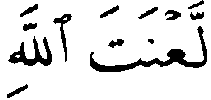 and spelled with ta’ marbuta in Q3:87 and spelled with ta’ marbuta in Q3:87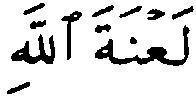 . As Brockett mentions, this occurs also in the Warsh text where we find Q3:61 with ta’ tawila . As Brockett mentions, this occurs also in the Warsh text where we find Q3:61 with ta’ tawila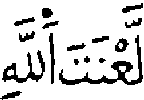 and Q3:87 with ta’ marbuta and Q3:87 with ta’ marbuta . The Taj, and all our other texts include this consistently transmitted spelling mistake. . The Taj, and all our other texts include this consistently transmitted spelling mistake.
The Flugel concordance of which Von Denffer notes "In 1858, the German orientalist Fluegel produced ... a very useful concordance..." (Ulum, p. 65) lists both Q3:54, 81 and Q24:7 (p. 173, as seen at right 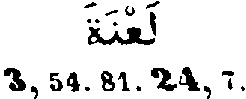 - his number system is somewhat different) in the corrected form with ta’ marbuta . - his number system is somewhat different) in the corrected form with ta’ marbuta .
We note, however, that in the existing printed texts Q24:7 also contains the wrong spelling  . .
In fact, the only place where the word occurs with a ta’ tawila is in Q7:38 where it is required because of the context. There we find and the translation "It curses", being a verb form. On the other hand, what we have just been examining, the spelling and the translation "It curses", being a verb form. On the other hand, what we have just been examining, the spelling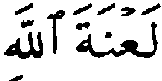 translates as "the curse of Allah", being a noun form (as signified by the sukun above the second letter, instead of a fatha which would signify the verb form). translates as "the curse of Allah", being a noun form (as signified by the sukun above the second letter, instead of a fatha which would signify the verb form).
To have translated Q24:7 as "invoke the curse of" is a deception. Not only is the noun form  present, but the verb "invoke" is not in the Arabic text but the verb "to be" needs to be supplied. Then, the only possible translation could be "God curses them if they tell a lie"!! present, but the verb "invoke" is not in the Arabic text but the verb "to be" needs to be supplied. Then, the only possible translation could be "God curses them if they tell a lie"!!
It is thus truly ironic, or, as those outside Islam would see it, a case of Divine
Back To Top
126 |