Allah
All�h - (الله) |
 |
|
|
|
|
|
|
|
|
|
|
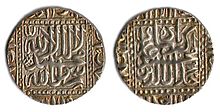
Silver coin of the
Mughal Emperor Akbar with inscriptions of the Islamic declaration of faith, the declaration reads: "There is none worthy of worship but God, and
Muhammad is the messenger of God."
The shahada (Arabic: الشهادة‎ aš-šah�dah  audio (help·info)) (from the verb شهد šahida, "to witness" or "to testify") is the name of the Islamic creed. It is the declaration of belief in the oneness of God (tawhid) and acceptance of Muhammad as God's prophet. The declaration in its shortest form reads:
- لَا Ø¥Ù�لٰهَ Ø¥Ù�لَّا الله Ù…Ù�Øَمَّدٌ رَسÙ�ولÙ� الله (lÄ� ʾilÄ�ha ʾillÄ� l-LÄ�h, Muḥammadur rasÅ«lu l-LÄ�h) (in Arabic)
- There is no god but God, Muhammad is the messenger of God. (in English)
In Shia Islam, the creed is expanded with the addition of a phrase concerning Ali at the end, although it is not obligatory:
- وعليٌ ولي�ّ الله (wa ʿAliyyun waliyyu l-L�h) ["and Ali is the wali (friend; viceregent) of God"].[1]
[edit] Overview
The word shah�dah (شَهادة) is a noun stemming from the verb shahada (شَهَدَ) , meaning "he observed, witnessed, or testified"; when used in legal terms, shah�dah is a testimony to the occurrence of events, such as debt, adultery, or divorce.[2] The shah�dah can also be expressed in the dual form shah�dat�n (شَهادَتانْ, lit. "two testimonials"), which refers to the dual act of observing or seeing and then the declaration of the observation.The person giving the testimony is called a sh�hid (شاه�د), with the stress on the first syllable. The two acts in Islam are observing or perceiving that there is no god but God and testifying or witnessing that Muhammad is the messenger of God. In a third meaning, shih�dah or more commonly istishh�d (إسْت�شْهادْ), means "martyrdom", the shahīd (شَهيد) pronounced with stress on the last syllable ("martyr") demonstrating the ultimate expression of faith.[3] Shahīd can also be used in a non-Islamicreligious context. Long before the advent of Islam, Christian Arabs of the Middle East used the word shahīd referencing to someone that was wrongly killed or someone that died for his family, his Christian faith or his country. The two words sh�hid (شاه�د, "witness") and shahīd (شَهيد, "martyr") are pre-Islamic. Both are paradigms of the root verb (شَهَدَ, shahada, "he observed").
A single honest recitation of the shah�dah in Arabic is all that is required for a person to become a Muslim. This declaration, or statement of faith, is called the kalimah (كَل�مة, lit. "word"). Recitation of the shih�dah, the "oath" or "testimony", is the most important article of faith for Muslims. Non-Muslims wishing to convert to Islam do so by a public recitation of this creed.[4] Most Muslims count it as the first of the Five Pillars of Islam, while the Twelver and Ismaili Shi'a connect it to their respective lists of pillars of the faith.[5] The complete shah�dah cannot be found in the Quran, but comes from hadiths.[6]
[edit] Recitation
Three honest recitations of the shahadah in Arabic is all that is required for a person to convert to Islam according to most traditional schools (madh'hab). In usage, the two occurrences of ašhadu ʾanna or similar (Arabic: اشهد أن‎, "I testify that" or "I bear witness that...") are very often omitted. The recitation of the shahadah needs to done with an Imaam and others to witness [7].
[edit] History
Another of the earliest surviving translations of the shahadah into a foreign language is in Greek, from the reign of al-Walid I (86–96 AH, 705–715 CE): Ο�κ Έστι[ν θεός εἰ μὴ � θεὸς μόνος·] Μααμὲ[τ ἀπόστολος θεοῦ] (Ouk esti[n theos ei mē ho theos monos;] Maame[t apostolos theou]).[8] "There is no god except for the God alone; Muhammad is the Apostle of God."; i.e., "Allah", the Arabic word for "the God", is translated as "� Θεός" and Muhammad is transliterated as "Μωάμεθ".

Photo of the Kalima at Bab al-Futuh/Bab al-Nasr Fatimid Cairo with phrase
ʿAliyyun waliyyu l-L�h.
The Kalimah in its complete Shi'i form also exists at the gate Bab al-Futuh built by the Fatimid minister Al-Afdal Shahanshah (952-975 A.D.), northern wall of Fatimid Cairo.
[edit] Conditions
Muslims believe that the shahadah is without value unless it is earnest. Islamic scholars have therefore developed, based on the data of the Quran and hadith, essential criteria for an expression of the shahadah to be earnest. These criteria are generally divided into seven to nine individual criteria; the varying numbers and orderings are not due to disagreements about what the criteria actually are, but rather different ways of dividing them.[9]
One such list of seven critical conditions of the shahadah, without which it is considered to be meaningless, are as follows:[citation needed].
- Al-ʿIlm (العلم): Knowledge of the meaning of the Shahadah, its negation and affirmation.
- Al-Yaqīn (اليقين): Certainty – perfect knowledge of it that counteracts suspicion and doubt.
- Al-Ikhl�ṣ (الإخلاص): Sincerity which negates shirk.
- Aṣ-Ṣidq (الصدق): Truthfulness that permits neither falsehood nor hypocrisy.
- Al-Maḥabbah (المØبة): Love of the Shahadah and its meaning, and being happy with it.
- Al-Inqiy�d (الانقياد): Submission to its rightful requirements, which are the duties that must be performed with sincerity to God (alone) seeking His pleasure.
- Al-Qubūl (القبول): Acceptance that contradicts rejection.
The second part of the Shahada carries several conditions as well:
- To believe in Muhammad and in whatever he said and conveyed in his message as the seal of the prophets.
- To obey him in whatever he commanded.
- To stay away from or avoid whatever he commanded Muslims not to do.
- To follow or emulate him in our ʿib�dah (عبادة; worship), ʾaḫl�q (أخلاق; manners), and way of life.
- To understand, practice, and promote his sunnah ("habits") in the best way possible, without creating any chaos, enmity or harm.
[edit] National flag
The flags of Saudi Arabia and Afghanistan are the only flags of internationally recognized sovereign states which display the shahada.
The design from the Saudi flag has been used in the flag of the unrecognized state of Somaliland (1996).
The 2004 draft constitution of Afghanistan proposed a flag with the shahada in white script centered on a red background.
An analysis of the calligraphy used in the flags of Saudi Arabia and Hamas is presented below:
It can be seen in the second flag that the name of God (الله) is written in a higher position. The name for God is written twice in each flag, but the first ʾalif (ا) is written after the second l�m (ل) only once in the first instance of Allah in the flag of Hamas (pink), and only once in the second appearance in the flag of Saudi Arabia (green). This overwriting is also visible for the lam of rasul(u) (light blue), but only in the Saudi Arabian flag. The ligature l�m + ʾalif (لا) is always written the same way in the Saudi Arabian flag, but calligraphy is changed in the case of the second لا (red) of the Hamas flag at the left.
[edit] Islamic flag
Flags reported as in use in Islam have been frequently displaying the shahada, usually on a black background, the time of Muhammad. The Taliban used a white flag with the shahada inscribed in black from 1997, until 2001 as the flag of their Islamic Emirate of Afghanistan.
Flags showing the shahadaa, often written on a green background, have also been displayed by supporters of Hamas in rallies during the 2000s.
[edit] Turkish national anthem
The shahadah is referenced in the eighth stanza of the Turkish national anthem, which can be translated as:
Oh glorious God, the sole wish of my pain-stricken heart is that,
No heathen’s hand should ever touch the bosom of my sacred Temples.
These ʾa��ns, whose shahadahs are the foundations of my religion,
May their noble sound last loud and wide over my eternal homeland.
[edit] See also
[edit] References
[edit] External links
|
|
|
| Beliefs |
|
|
| Five Pillars |
|
|
| History & leaders |
|
|
| Religious texts |
|
|
| Denominations |
|
|
| Life and Culture |
|
|
Law &
Jurisprudence |
Baligh · Cleanliness · Criminal · Dhabiĥa · Dhimmi · Divorce · Diet · Economics: Banking, Economic history, Sukuk, Takaful, Murabaha, Riba · Ethics · Etiquette · Gambling · Gender segregation · Ghusl · Honorifics · Hudud · Hygiene: Miswak, Toilet, Wudu, Najis, Tayammum · Inheritance · Jizya · Leadership · Marital: Marriage contract, Nikah, Nikah Mut‘ah · Mahr · Mahram · Ma malakat aymanukum · Military: Prisoners of war · Slavery · Political · Sexuality: Masturbation · Theological: Kalam · Zina · Sources
|
|
| Islamic studies |
Agriculture · Arts: Arabesque, Architecture, Calligraphy, Music, Pottery · Creationism · Feminism · Golden Age · Literature: Poetry · Philosophy: Early philosophy, Contemporary philosophy, Eschatology, Theology · Sciences: Alchemy & Chemistry, Astrology, Astronomy, Economics, Islam and science, Mathematics, Medicine, Physics, Psychology · Shu'ubiyya · Sports · Conversion of mosques · Historiography · Inventions
|
|
| Other religions |
|
|
| Related topics |
|
|