- "Absence of evidence" redirects here, also see Evidence of absence and Argument from silence
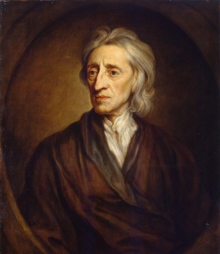
John Locke (1632- 1704) who introduced the term
Argumentum ad Ignorantiam.
[1]
An argument from ignorance, also known as argumentum ad ignorantiam or "appeal to ignorance" (where "ignorance" stands for: "lack of evidence to the contrary"), is an inference that a proposition P is false from the fact that P is not proved to be true or known to be true.[2][1] Arguments from ignorance are based on the absence of evidence and may fail because the lack of evidence for P does not prove P to be false.[3][4]
As an example scenario is of a man sitting in a warehouse with a tin roof and when he hears no sound of raindrops, he assumes that it is not raining, without looking outside for any evidence of rain.[5] Here ignorance about a particular form of evidence for rain (the noise) is used to assume a lack of rain; but the conclusion may fail if it is raining so softly that no noise is heard by the man.[5]
The statement "absence of evidence is not evidence of absence" has been used in fields such as epistemology, medical research, archeology and criminalistics, where it is taken as an axiom that the lack of evidence that a person was present at a scene does not imply that they were not there.[6][7][8][9]
[edit] Definition and usage
John Locke introduced the term "argumentum ad ignorantiam" in 1689 in An Essay Concerning Human Understanding, (Chapter XVII section 20) and stated:[10]
Secondly, Another way that men ordinarily use to drive others and force them to submit to their judgments, and receive their opinion in debate, is to require the adversary to admit what they allege as a proof, or to assign a better. And this I call argumentum ad ignorantiam."
Locke presented this type of argument as a form of eristic debate in which participants wrangle over the issues without substance in evidence, but to "drive each other" to accept a point.[1]
The statement "absence of evidence is not evidence of absence" was made popular by Carl Sagan.[6] Sagan referred to arguments from ignorance as follows:
"Appeal to ignorance": the claim that whatever has not been proved false must be true, and vice versa. (e.g.,
There is no compelling evidence that UFOs are not visiting the Earth; therefore, UFOs exist, and there is intelligent life elsewhere in the Universe....) This impatience with ambiguity can be criticized in the phrase: absence of evidence is not evidence of absence.
[11]
Sagan's widow Ann Druyan stated that Sagan's general position was that "science is saying in the absence of evidence, we must withhold judgment".[12] In this, she also echoed the words of Bertrand Russell, who in 1959 said: "If you can't find out whether [a thing] is true or whether it isn't, you should suspend judgement."[13] Astrophysicist Neil deGrasse Tyson expanded on UFOs, stating: "Remember what the U stands for (...): Unidentified. (...) If you don't know what it is, then that's where your conversation should stop, [rather] than say: "It must be..." anything. That's what argument from ignorance is."[14]
Arguments from ignorance are often found along with false dilemmas.[15] Arguments from ignorance have often been seen as a form of fallacy in informal logic that relies on "negative evidence" and fail given that ignorance of an item should generally not lead to any conclusion about it, e.g. Bunnin and Yu state that: "Truth is one thing, and whether or not truth is known by us is another."[2][15][5]
Douglas Walton states that despite the prevailing view that arguments from ignorance are generally fallacious, in some cases they lead to sound conclusions.[5] Walton states that if we can assume that our "knowledge-base is complete", then an argument from ignorance can be nonfallacious; for anything not in a complete knowledge-base must be false.[16]
Arguments from ignorance, are however distinct from arguments from silence used in fields such as historical analysis where the likelihood of a writer's failure to mention an event is weighed.[6]
[edit] Examples of use
A well known case of an argument from ignorance in legal proceedings was by senator Joseph McCarthy who stated: "I do not have much information on this except the general statement of the agency that there is nothing in the files to disprove his Communist connections." leading to the use of these arguments by his followers to accuse some people of being communists unless they could prove they were not.[17][18][19]
In criminalistics, the statement "absence of evidence is not evidence of absence" is viewed as an axiom of the investigative process; e.g. the lack of traces that indicate a person was present at a specific crime scene does not imply that the person was not there.[9][20][21]
Archeologist Lewis Binford has been generally critical of the use of "ad ignorantiam", and in particular Ignoratio elenchi arguments (which he sees as a form of arguments from ignorance); in particular accusing Richard Gould of the ineffective use of these styles of argumentation.[22] Clive Gamble has used the case of Bronze Age pots found in the Shorncote quarry in Gloucestershire, England as an instance that absence of evidence is not always evidence of absence in archeology in that although no potter's workshop or other evidence of local production facilities at the site can be found, the microscopic analysis of each potsherd's fabric indicates that the pots were locally produced.[8]
In evidence-based medicine, when a study is performed with a small sample size, the failure to detect a statistically significant relationship between two elements does not necessarily imply that none exists, and an absence of evidence can not be taken as an evidence of absence of an effect.[23] In 1995 Altman and Bland pointed out that in medical research, errors in assuming that the absence of evidence may imply evidence of the absence of an effect continue to persists.[24] In a 2004 editorial in the British Medical Journal Phil Alderson suggested the advice provided by Altman and Bland a decade before should be followed more stringently, and an absence of evidence in small studies should not be used to arrive at conclusions.[7]
The US National Research Council report on environmental chemicals cautions that the failure to observe effects from the presence of chemicals in human tissue should not be used to draw the conclusion that they are not harmful, and that the distinction between absence of evidence effects and evidence of absence should be made clear.[25]
In some cases, an absence of evidence may be due to the lack of cooperation from a party subject to legal proceedings, e.g. in World Trade Organization (WTO) cases when a country accused of breaching trading rules specifically refuses to provide any evidence, WTO policies allow for inferences based on the refusal to cooperate.[26]
[edit] Types of arguments
Woods and Walton classify arguments from ignorance into three types: epistemic, inductive and dialectic.[27] The epistemic type is presumptive in nature and attempts to manipulate the negation used in a proposition to shift the burden of knowledge via appeal to modal logic.[27] The inductive type is often used in scientific reasoning and although it can at times produce false results, it may produce some valid results if used with caution (e.g. when sampling is performed and the sample size is not too small) yet it is by its nature usually inconclusive.[27] The dialectic case is largely based on shifting the burden of proof on the other party and runs the risk of continuing as the parties repeatedly shift the burden between them.[27]
[edit] See also
- ^ a b c Aristotelian Logic by William T. Parry and Edward A. Hacker (Sep 3, 1991) ISBN 0791406903 State Univ of NY Press page 477
- ^ a b The Blackwell Dictionary of Western Philosophy by Nicholas Bunnin and Jiyuan Yu (Jan 27, 2009) ISBN 1405191120 page 48" Argument to ignorance: "The inference that a conclusion A is false from the fact that A is not proved to be true or known to be true, or that A is true from the fact A is not proved to be false."
- ^ A Theory of Argument by Mark Vorobej ISBN 052167025X Cambridge Univ Press page 314
- ^ Philosophy Made Slightly Less Difficult by G. J. DeWeese, J. P. Moreland 2005 ISBN 0830827668 IVP Academic page 30
- ^ a b c d Arguments from Ignorance by Douglas Walton (Sep 18, 2009) ISBN 027101475X Penn State Press pages 1-4
- ^ a b c The Routledge Companion to Epistemology by Sven Bernecker and Duncan Pritchard (Dec 2, 2010) ISBN 0415962196 pages 64-65
- ^ a b Phil Alderson, "Absence of evidence is not evidence of absence" British Medical Journal 2004 February 28; 328(7438): 476鈥�477. doi: 10.1136/bmj.328.7438.476 "What can we do to help ensure that in another decade we will be closer to heeding the advice of Altman and Bland?" [1]
- ^ a b Archaeology: The Basics by Clive Gamble (Sep 7, 2007) ISBN 0415359740 Routledge pages 116-117
- ^ a b Crime Reconstruction by W. Jerry Chisum and Brent E. Turvey (Jul 13, 2011) ISBN 0123864607 Academic Press page 239 "These findings do reinforce the evidentiary axiom that "absence of evidence is not evidence of absence"
- ^ An Essay Concerning Humane Understanding (Volume II, Books 3 & 4): 2 by John Locke (19 Dec 2006) ISBN 1406814628 page 207
- ^ Carl Sagan in the The Demon-Haunted World 1995 Ballantine Books ISBN 0-345-40946-9 page 213
- ^ Carl Sagan: A Biography by Ray Spangenburg and Kit Moser (Nov 30, 2004) ISBN 0313322651 page xiii
- ^ Bertrand Russell on God (CBC 1959).
- ^ St. Petersburg College (March 26th, 2009). "Cosmic Quandaries with Dr. Neil deGrasse Tyson". Retrieved March 25th, 2013. (00:54:37鈥�00:56:14)
- ^ a b A Systematic Theory of Argumentation by Frans H. van Eemeren and Rob Grootendorst (Nov 17, 2003) ISBN 052153772X Cambridge Univ Press page 182
- ^ Douglas Walton, Nonfallacious arguments from ignorance American Philosophical Quarterly Vol. 29, No. 4, Oct., 1992 pp. 381-387 [2]
- ^ Arguments from Ignorance by Douglas Walton (Sep 18, 2009) ISBN 027101475X Penn State Press pages 57-58; referring to the statement by McCarthy regarding Case 40, on a list of names.
- ^ Introduction to Logic by Wayne A. Davis (Aug 1986) ISBN 0134862597 Prentice Hall page 59 "a non-sequitor known as argument from ignorance... such arguments were very common during the McCarthy era when people were accused of being communists merely because they could not prove they weren't."
- ^ The Oxford Companion to Philosophy by Ted Honderich (7 Sep 1995) ISBN 0198661320 page 49 "In the McCarthy hearings of the 1950s, absence of any disproof of communist connections was taken as evidence to show that some people were guilty of being communist sympathizers""
- ^ Introduction to Criminalistics: The Foundation of Forensic Science by Barry A.J. Fisher, William J. Tilstone and Catherine Woytowicz (Feb 6, 2009) ISBN 0120885913 Academic Press page 12
- ^ Handbook of Criminal Investigation by Tim Newburn, Tom Williamson and Alan Wright (May 1, 2007) ISBN 184392188X page 321
- ^ Debating Archaeology by Lewis R. Binford (Aug 31, 2009) ISBN 1598744550 pages 75, 111 and 117
- ^ Essential Evidence-Based Medicine by Dan Mayer (Jul 26, 2004) ISBN 0521832616 Cambridge Univ Press page 28 "absence of evidence of an effect is not the same thing as evidence of absence of an effect."
- ^ Douglas G Altman and J Martin Bland, "Statistics notes: Absence of evidence is not evidence of absence" British Medical Journal 1995; 311 doi: http://dx.doi.org/10.1136/bmj.311.7003.485 (Published 19 August 1995) "The non-equivalence of statistical significance and clinical importance has long been recognised, but this error of interpretation remains common"[3]
- ^ Human Biomonitoring for Environmental Chemicals by Committee on Human Biomonitoring for Environmental Toxicants and National Research Council (Oct 31, 2006) ISBN 0309102723 National Academies Press page 218 "absence of evidence effects is not identical with evidence of absence effects - a distinction that must be clear to constituents. Otherwise there is a large practical communication and ethical risk attached to simply saying that the presence of chemicals in human tissue does not imply health effects."
- ^ Evidence, Proof, and Fact-Finding in WTO Dispute Settlement by Michelle T. Grando (Mar 5, 2010) ISBN 019957264X Oxford Univ Press page 272
- ^ a b c d Arguments from Ignorance by Douglas Walton (Sep 18, 2009) ISBN 027101475X Penn State Press pages 143-145
[edit] References
[edit] External links