返回总目录
Is the Qur'an Miraculous? - The Verse on Stoning
The Verse on Stoning
According to Umar, Ali, ibn Abbas and others (follow the links below)
the verse on stoning the adulterers was revealed to Muhammad but
eventually for some reasons not included in the Qur'an.
Many arguments, pro and contra of this omission, have been raised
and are summarized below. One argument is completely missing. If
the language (eloquence) of the Qur'an is miraculous and unlike
any human language, why has none of the commentators said that
this verse is righfully excluded from the Qur'an because its
language is clearly inferior to the text of the Qur'an? How
come this was never even thought of? Actually in the process of
the comittee which collected the Qur'an into one book, headed by
Zaid ibn Tabit, the "eloquence" was never a criterion for inclusion
or exclusion of a verse. It was always the question if there were
enough witnesses who have heard Muhammad say this particular
revelation. Wouldn't it have been so much easier to judge by looking
at the verse and say, "This is God's language" and "That clearly
is not God's language" based on the eloquence of the verse under
scrutiny? Somehow, this didn't seem a valid criterion to the
companions of Muhammad. Then I wonder how this can be a criterion
today for the miraculous nature of the Qur'an.
The verse of stoning in Arabic:
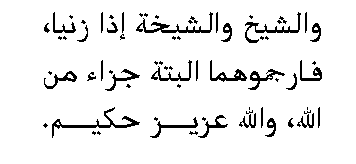
My questions to the Muslim would be:
Does this verse match the eloquence of the Qur'an?
If not, then please explain exactly why this is NOT matching
the eloquence of the Qur'an and for the sake of being specific,
compare it to the verse on lashing the adulterer ... (Sura 24:2)
which is speaking on the same topic and should be a fair verse
to draw on for comparison:
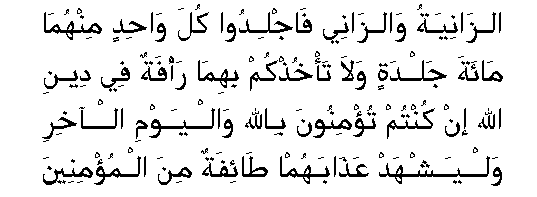
Also then, please explain why none of the great commentators
of Muslim history or any of the companions ever thought that
verse should be excluded on grounds of lacking eloquence.
Neither have I ever seen any currently living Muslim reject
the verse because it is of inferior eloquence! But,
after I now raised the question this might become an issue.
Yet if this only starts to be argued after I raise the question,
then that is not very impressive.
If you cannot give a satisfactory answer to these two above
questions, then you might to ponder the alternative questions
and their implications.
Assuming now that the verse on stoning does meet the criterion
of "Qur'anic eloquence" we are basically faced with two
alternatives.
1. The verse was indeed a revelation from Allah (as several
of the companions said) ... then the Qur'an is not
preserved contradicting another one of its own claims
and a very important part of Muslim defense of the
authenticity of the Qur'an. If one verse is missing, how
many more might be missing?
2. This verse was not from Allah, i.e. it is from human origin
and then the challenge is defeated by this very verse which
is/was so good and eloquent that Umar thought it should be
in the Qur'an. If you do not agree: Do you think your judgement
of the quality of the Arabic in this verse is better than that
of Umar? Why did he think it belonged into the Qur'an?
These are the questions you might want to ponder as you read the
quotations and documentation from the Muslim sources.
More on the verse of stoning
Is the Qur'an miraculous?
Answering Islam Home Page