返回总目录
JUDAISM AND ISLAM [Section 2, Part 1]
page 26
SECOND DIVISION.
Did Muhammad borrow from Judaism? And if so, what did he borrow?
Before we pass to the consideration of individual passages as instances
of borrowing from Judaism, we must show some general historical grounds
for the opinion that a borrowing from that source has taken place; and
thus this division falls again into two sections, a general and a particular.
FIRST SECTION.
Did Muhammad borrow from Judaism?
For the answer to this question we are thrown back entirely on the
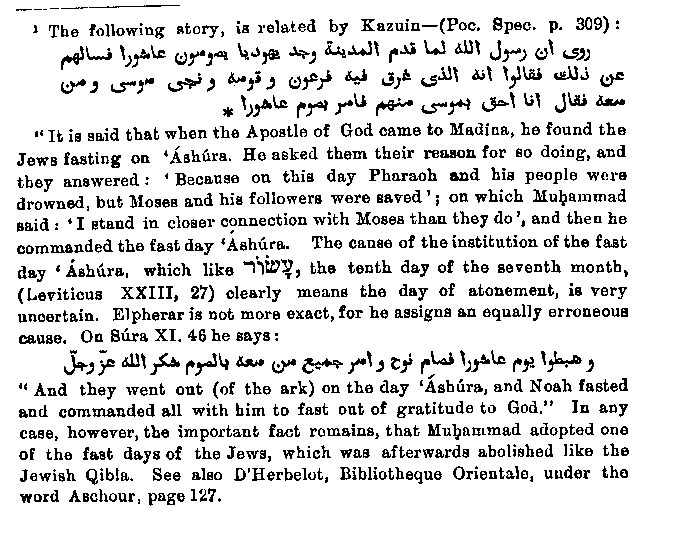
Quran,1 as we have no other
literature
page 27
of the same date which treats of the matter in question. Still there
are plenty of passages there preserved to us, which in a general way
sufficiently prove our point; and indeed they all contain either the
blame expressed by Muhammad's contemporaries at his borrowing from
Judaism, or else an appeal from him to the Jews, as witnesses of the
truth of his assertions. He complains bitterly in many passages that
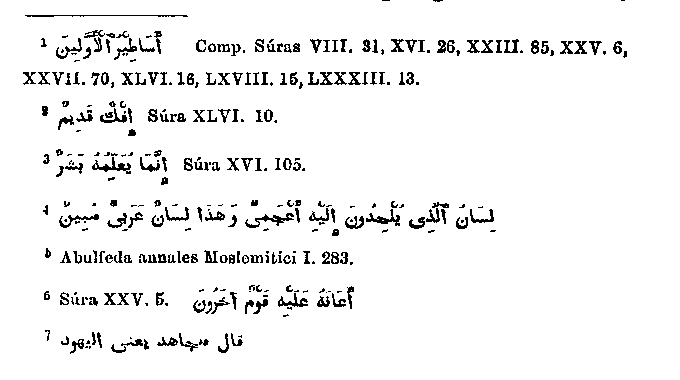
the Arabs said his words were not original,1
and even called them antiquated lies.2
Sometimes they said still more definitely that a certain man taught
him,3 and the addition of
the words:4 "The tongue
of the person unto whom they incline is a foreign tongue, but this
is the perspicuous Arabic tongue," shows plainly that this man was
a Jew. Commentators take this view, and indeed think that it was
'Abdu'llah Ibn Salam, a learned Rabbi, with whom Muhammad was in
constant and close intercourse, and who is frequently mentioned in
the commentaries.5
Another rather more general statement is as
follows:6
"Other people have assisted him therein" on which Elpherar
remarks7: "Mujahid says,
by this he means the Jews". Could any one desire a clearer historical
witness than this accusation, which was so often brought against
Muhammad,
page 28
and which appeared to him so important that he constantly referred
to it in the hope of refuting the charge? He himself confesses,
however, that much related by him is to be found in the earlier
Scriptures. To the embarrassing question, as to why he never worked
a miracle, he constantly answered that he who was called to be
a preacher only, not a wonder-worker, had yet told them plainly
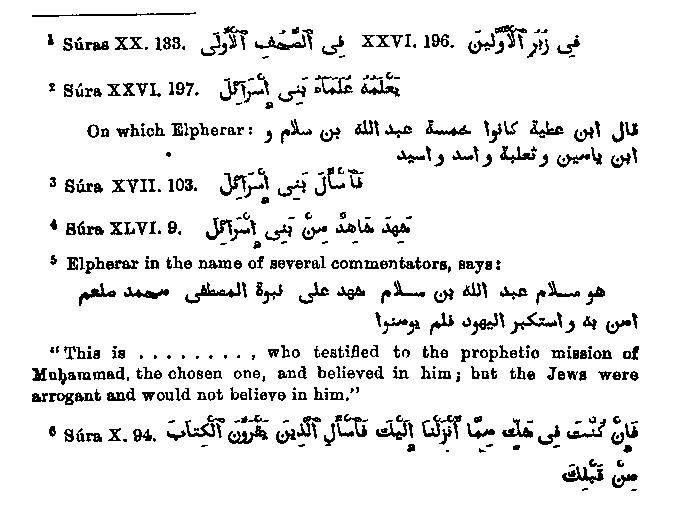
of the miracles which are mentioned in the earlier
writings,1 and which the
learned Jews knew well.2
They could testify to the truth of these narratives,3
and among them one man4,
especially the aforesaid 'Abdu'llah Ibn Salam,5
to whom the laudatory passage in Sura III. 68 is said to refer.
Not only were they to corroborate his words to others, but also
to remove any doubt from Muhammad's own mind as to the truth of
his Mission. Thus we have in one place the injunction given to
him:6 "If thou art in doubt
concerning that which we have sent down unto thee,
page 29
ask them who have read the book before thee."7
If he then, however cunningly, acknowledges the Jews as to a certain
extent witnesses to his revelations, we are justified in expressing
our opinion that Judaism was one source of the utterances in the
Quran, and in this certainty we may proceed at once to discuss the
actually borrowed passages.
JUDAISM AND ISLAM [Table of Contents]
Answering Islam Home Page