返回总目录
Variant Readings In The Qur'an And The Bible
C. VARIANT READINGS IN THE QUR'AN AND THE BIBLE
VARIANTS IN THE QUR'AN
In spite of this great effort to prevent the occurrence of
variant readings in the text of the Qur'an, quite a number may
still be found. Al Baidawi mentions some in his commentary on
Suras 3:100; 6:91; 19:35; 28:48, 33:6, etc. This last one from
the Sura of the Confederates (Al-Ahzab) 33:6 from 5-7 AH is also
mentioned by Yusuf Ali. The Othmanic text reads,
"The prophet is closer to the believers than their own selves,
and his wives are their mothers."
but there are reports stating
that Ubai b. Ka`b's text read,
"The prophet is closer to the believers than their own selves,
and he is a father to them, and his wives are their mothers."
Muhammad Hamidullah has quite a detailed discussion of these
variations in the preface to his French translation of the
Qur'an. He divides them into four classes.
1. Variations caused by a scribe who makes an error while
copying. Naturally these are easy to find by comparing with
other copies.
2. Variations caused by someone writing notes of
explanation in the margin. Hamidullah writes:
"The style of
the Qur'an was such that sometimes even the companions of the
Prophet had to ask him for explanations. Sometimes they noted
these explanations in the margin of their personal copies in
order to not forget them. It is completely understandable that
sometimes the scribe mixed the text and the commentary while
trying to faithfully make a new copy from an old one. We know of
the famous order of Omar, who formally forbid the adding of
commentary to copies of the Qur'an.
"There are hundreds of variant readings of this type. But the
fact that `the Qur'an of such and such a teacher' has a certain
addition which the others don't have, leaves no doubt as to the
origin of that addition. Also the information concerning this
type of variant given by the classical authors is sometimes
contradictory---some saying that the Qur'an of so and so had a
certain addition---others denying it."
3. Variations caused by the permission originally given by
Muhammad to recite the Qur'an in other dialects than that used
by the people of Mecca.
"Muhammad tried to make religion easy for even the most humble.
Therefore, he tolerated some dialectical variations even for the
text of the Qur'an because the essential thing was not the word
but the sense; not the recitation, but the application and the
assimilation. He said willingly, `Gabriel permitted me to have
up to seven different readings.' While guarding for himself and
his fellow citizens a certain reading, he permitted the members
of different tribes to replace certain words by their
equivalents---better known in their tribe. (Later Othman stopped
this also.) But from copies made in outer areas and kept by
their descendants, the teachers from previous centuries were
able to gather a certain number of such words, which are exact
equivalents of those used in the official version."
4. Variations coming from the fact that for the first 150
to 200 years after the Hejira, the hand written copies of the
Qur'an were written without vowel marks, and without dots to
distinguish between different letters written in the same way.
What does it mean to write without vowel marks? It is hard to
give an example that would be clear to English readers. but
perhaps the following will help. The sentence "he painted the
barn" would be "h pntd th brn" if written without vowels as
in Arabic. After one tries this for a while, one gets used to
it, and the above sentence couldn't be anything else. However,
if we consider the sentence, "h gv hm a bd", it might mean
"he gave him a bed" if he was in a furniture store, or "he
gave him a bud" in a florist's shop, or "he gave him a bid"
if he were a contractor. In most cases the context would make
this type of situation clear, but not always.
Secondly, to compound the problem, there are certain letters in
Arabic which are written in exactly the same way except that
they have dots over them or under them to show the difference.
One of these letters is made somewhat like an English "i", but
in Arabic one dot above [arabic letter] =n, 2 dots above
[arabic letter]=t, three dots above [arabic letter] =th, one dot
below [arabic letter] =b, and two dots below [arabic letter] = y
as in the words "you" or "yours".
There are seven other pairs of letters in which the two members
of the pair are told apart by the number of dots, and one group
of three. Or to put the problem simply. There are only l5 letter
forms to represent 28 different letters.
I have spoken to many Muslims who do not know that the first
copies of the Qur'an were written without vowel marks and
without dots; and perhaps some among my readers are among them.
Photograph 2 shows verses 34-36 of Sura 24, the Sura of the
Light (Al-Nur), as found in an old Qur'an preserved at the
British Museum in London. According to the experts it is from
the end of the eighth century A.D., or about 150 A.H.
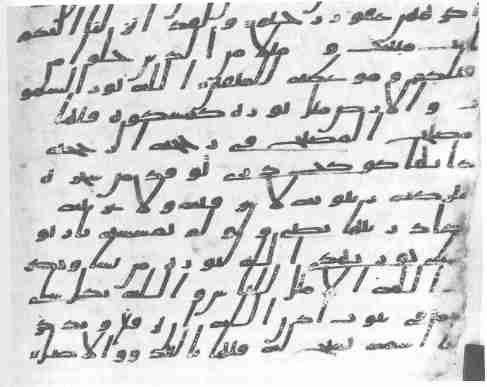
|
Photograph 2--
A Qur'an from 150 A.H. without Vowels and without Dots
to Differentiate the Letters, showing Sura 24:34-36.
By Permission of the British Library.
|
In order that non-Arabic speaking readers can appreciate the
problem clearly I have reproduced the seventh line from the top
of the picture:
Hamidullah discusses this lack of vowels and dots in another
passage from the same page. He writes,
"Finally, a (last) source of variants comes from the Arab
writing of the earliest times, before the use of diacritical
marks. It is sometimes possible to read a word as an active verb
or passive, as masculine or feminine, and the context sometimes
admits several possibilities."
An example of this type of variant is found in the above
photograph. Starting toward the end of line three and continuing
to the end of line seven the text reads,
"God is the Light of the heavens and the earth. The parable of
His light is as if there were a niche and within it a lamp: the
lamp enclosed in glass: the glass as it were a brilliant star:
lit from a blessed olive tree, neither of the east or of the
west..."
In the Arabic texts used for their English and French
translations Yusuf Ali and Hamidullah both have [arabic letter]
(yuqadu) for the passive verb "lit". This masculine form would
usually refer to the preceding masculine noun "star" (kaukab).
But in line six of the photograph we find one letter which has
been singled out and written with vowel points. It is [arabic word]. These two
points above the letter change it to the feminine passive (tuqadu)
which then refers back to the feminine noun "glass" (zujaja ) as
the subject.
This Qur'an was copied when it was still possible for a scholar
to say, "I prefer the reading of so and so", and the man who
ordered the copy, or made it, believed that the feminine passive
form was correct.
Since a translator like Yusuf Ali might mention only two or
three variants in his whole translation, the impression is given
that there are very few. Hamidullah is one of the few Muslim
authors who has been willing to admit, as we saw above, that
"there are hundreds of variant readings". In fact there are
thousands. In Arthur Jeffery's work where he has listed all the
variants which he has found reported in any document, there are
more than 1700 attributed to Ibn Mas`ud alone.
Most of them, 99.9%, are like the above example and have very
little importance, but a few represent real problems such as the
following example from the Sura of the Table (Al-Ma'ida) 5:63
from 10 AH. The verse reads,
"Shall I tell you of an evil worse than that, for retribution
with God? He who God cursed him, and was angry with him, and
made some of them into monkeys and pigs, and worshiped (the
idol) al-taghut."
The translation is mine, and it represents what the Arabic says,
because according to the vowel marks "God" is the subject of
the verb "worshiped"! But it is impossible to have a sentence
in the Qur'an which says that God worshiped (the idol) al-taghut"!
No translator has translated it this way, and I, myself, know
this is impossible, so something has to be wrong.
It could be my faulty knowledge of Arabic, and that would be the
first thing to suspect if I were the only one with a problem.
However, when we look at Arthur Jeffery's Materials For the
History of the Text of the Qur'an we find that this is not the
case. Jeffery has found record of 19 alternate readings; seven
attributed to Ibn Mas`ud, four to Ubai b. Ka`b, six to Ibn
Abbas, and one each to `Ubaid b. `Umair and Anas b. Malik.
Obviously each man could have had only one alternate reading.
But the multiplication of possibilities shows that the scholars
recognized the problem.
Here are the readings attributed to Ibn Mas`ud.
** wa man `abadu al-taghuta

   wa `abadata al-taghuti

   wa `ubada al-taghutu

   wa `abuda al-taghutu

   wa `ubuda al-taghuti

   wa `ubidati al-taghutu

   `ubbada al-taghuta
For those who don't know Arabic, these alternate readings can be
divided into three classes: the verb is made plural so that the
monkeys and swine are "those who worship (the idol) al-taghut",
or the verb is put in the passive tense so that "al-ght is
worshiped" by the monkeys and swine, or the word `abada is
changed to a noun form making the monkeys and swine "slaves"
or "worshipers of al-taghut".
Moreover, in 14 out of the 19 changes all that was done was to
change the vowel combinations. In the other 5 cases one or two
consonants were also added.
I have chosen to reproduce the
readings attributed to Ibn Mas`ud because his first reading
above (marked **) is the one which has been chosen by all the
translators. The verse then reads,
"...(God) made some of them into monkeys and pigs, and who
served (the idol) al-taghut..."
The fact that this difficult reading has been maintained in
spite of the ease with which it could have been eliminated by
altering two or three vowel marks, certainly proves the care
with which copies were made after the vowels were added.
However, to paraphrase Dr. Bucaille's comment concerning the
Christian apocryphal writings,
One can only regret the disappearance of a number of primary
collections of the Qur'an declared unnecessary by Othman,
although they might have allowed present day Muslims to know the
correct text in difficult passages like the one concerning
"al-taghut".
THE CONCLUSION
Now that we have gone over this material, it is time to again
ask our questions. How do you know that there have been no
changes in the Qur'an in the 163 years between the giving of the
first verse of the Qur'an and the oldest known copy? What about
these variants? How do you know that it is just the way it came
from Muhammad?
And again you are going to answer me that these variants are
just little changes. You are going to tell me that the members
of Zaid Ibn Thabit's committee were serious men and they never
would have made any changes on purpose. And you will tell me
that even if the Qur'an was first written without the vowels and
without the dots to distinguish the letters, this was controlled
by the custom of memorizing the whole Qur'an.
And finally you might point out that in 150 A.H. there were men
still alive who had heard about Muhammad's life and teachings
and learned the Qur'an directly from their fathers and from
other men who had known Muhammad or some of the companions
personally. Therefore it is not possible that there could be
important errors which would change the doctrines of the
Qur'an.
And this is exactly the conclusion made by Hamidullah when he
writes:
"Furthermore, in gathering all the variations and studying them
carefully, we are sure that not one of them changes the sense of
the common text so carefully codified and so carefully
transmitted."
The modern Christian translator, D. Masson, comes to the same
conclusion. In the introduction to her French translation of the
Qur'an she says,
"Finally, in spite of these points of debate,
we can say that the text presently in our possession contains
the criteria of a substantial fidelity."
Having arrived at this
conclusion we must now look at what is known about variant
readings in the Gospel.
VARIANT READINGS IN THE GOSPEL-NEW TESTAMENT
With the New Testament as with the Qur'an there are variant
readings in different copies. In his book, The Text of the New
Testament, Dr. Bruce M. Metzger, who is Professor of New
Testament Language and Literature at Princeton Theological
Seminary, devotes a whole chapter to a detailed discussion of
the way in which these variant readings came about. In the
following paragraphs we shall look at some examples.
1. Variations Caused by Scribal Errors
A. Through faulty eyesight.
In the Greek language, in which the Gospel-New Testament was
originally written, the letters sigma, epsilon, theta, and
omicron were sometimes confused with each other. If a scribe
copied the wrong letter this lead to a variant reading. The same
thing can be seen in Arabic where the letter "r" or ra' can
easily be confused with "d" or dal.
In certain manuscripts a whole line has been omitted, because
two lines ended with the same word or words. The eye of the
scribe jumped down to the second use of the word and the
intermediate line was left out. I am sure that each reader has
had the same experience at some time during his schooling when
he had to copy a quotation or some poetry.
B. Arising from faulty hearing.
When scribes made copies from dictation, confusion would
sometimes arise over words having the same pronunciation, but
differing in spelling (as the English words `there' and `their'
or `grate' and `great'. An example of this is found in
Revelation 1:5. The translators in 1611 followed a text which
read, "Unto him that loved us, and washed us from our sins by
his blood", whereas older Greek texts used by modern
translators read correctly "Unto him that loved us and freed us
from our sins by his blood". This difference, which arose
because of confusion between the pronunciation of ou and u,
obviously makes no difference in the spiritual meaning.
C. Variants caused by holding a phrase in the mind while copying.
Sometimes this caused a change in the sequence of the words.
Other times the scribe would write the phrase as found in a
parallel passage. As Hamidullah stated in relation to the
Qur'an, almost all of these scribal errors are easily detected
by comparison with other manuscripts.
2. Variants caused by including marginal notes or comparing
manuscripts.
Words and notes standing in the margin of the older copy were
occasionally incorporated into the text of the new manuscript.
Synonyms of hard words or notes of explanation could pose a
problem which a Scribe sometimes solved by putting both the
original word and the synonym or explanation into the text.
A similar type of variation happened in later years when a
scribe might have more than one copy of the Gospels in front of
him. What would a conscientious scribe do when he found that the
same passage was given differently in two or more manuscripts?
Rather than make a choice between them and copy only one of the
two variant readings, the scribe might incorporate both readings
in the new copy. For example, in some early manuscripts the
Gospel of Luke closes with the statement that the disciples
"were continually in the temple blessing God", while others
read "were continually in the temple praising God". Rather
than choose between the two, later scribes put the two together
and wrote that the disciples "were continually in the temple
praising and blessing God".
3. Variants caused by addition.
A scribe supposed that something was lacking in Jesus' statement
in Matthew 9:13, "For I came not to call the righteous, but
sinners", and added the words "unto repentance" to make it
agree with Luke 5:32.
At Romans 13:9 Paul's reference to four of the Ten Commandments
was expanded in one family of manuscripts when a scribe
inadvertently added a fifth one---"you shall not bear false
witness"---from memory.
4. Variations caused by attempts to solve difficulties.
The most obvious example of this is Mark 16 where the end of the
Gospel is missing. After telling how the women who came to
embalm Jesus' body were told by a man (angel) dressed in white,
"He (Jesus) has risen! He is not here", the oldest texts of
Codex Sinaiticus and Codex Vaticanus end with the words,
"Trembling and bewildered, the women went out and fled from the
tomb. They said nothing to anyone. They were afraid for - - - "
The Greek word translated "for" is the conjunction "gar" and
Metzger says that in all of Greek literature "no instance has
been found where "gar" stands at the end of a book" as it
does in this case.
Metzger suggests that Mark was interrupted while writing and
prevented (perhaps by death) from finishing, or that the last
leaf was lost before other copies were made. All that is known
is that toward the end of the second century some Christian
added a summary of Jesus' resurrection appearances which he made
from the other Gospel accounts. Eventually this got included in
the text as discussed above concerning other marginal notes in
the Qur'an and the Gospel.
ACCURACY OF THE SCRIBES
However, just as we saw with the Qur'an, the very fact that
difficult passages were left intact until today shows that the
scribes were usually very careful in their work. If they had not
been careful and afraid to change God's word, they would have
removed everything that they considered a problem.
Even in incidental details one observes their faithfulness. For
example, in the Codex Vaticanus from 350 AD, there are section
numbers which run in a series throughout the body of Paul's
letters. They were placed there when the book of Hebrews was
between Galatians and Ephesians. The scribe carefully copied
these section numbers just as they had been, even though they
were no longer correct because the order of the books had been
changed.
Interestingly enough this is the very copy of the
Gospel-New Testament which is singled out by Dr. Bucaille to be
challenged. He writes,
"The authenticity of a text, and of even the most venerable
manuscript, is always open to debate. The Codex Vaticanus is a
good example of this. (See Photograph No. 3) The facsimile
reproductions edited by the Vatican City, 1965, contains an
accompanying note from its editors informing us that `several
centuries after it was copied a scribe inked over all the
letters except those he thought were a mistake'. There are
passages in the text where the original letters in light brown
still show through, contrasting visibly with the rest of the
text which is in dark brown. There is no indication that it was
a faithful restoration." (boldfacing mine)
Metzger, a specialist in New Testament Greek, who has spent his
whole academic life studying the source documents, and has
written the textbook called The Text of the New Testament, from
which much of this chapter is adapted, also includes the
information about the later scribe re-inking the text. He
doesn't hide it. But his conclusion is,
"The text which it (Codex Vaticanus) contains has been regarded
by many scholars as an excellent representative of the
Alexandrian type text of the New Testament."
And his own evaluation is summarized in the following statement,
"One of the most valuable of all the manuscripts of the Greek
Bible is Codex Vaticanus."
Dr. Bucaille passes the whole thing off by saying "The
authenticity of a text is always open to debate" and "There is
no indication that it was a faithful restoration".
Yet, Dr. Bucaille has not mentioned one single example of a word
which was wrongly restored, or given us a percentage of words
wrongly restored if there were any. He has ASSUMED that it WAS
NOT a faithful restoration, and that others must prove to him
that it was. Included, of course, is the further implication
that possibly? probably? the validity of the Doctrinal Gospel is
therefore in question.
When we examine Photograph No. 3 we can see, even in the
photo-graphic reproduction, the traces of the original letters
as well as the newly restored ones. Thus we have both the
original and the restoration, and if the reader wishes to spend
the time learning Greek he will be able to verify for himself
that the restoration is faithful.

|
Photograph 3--
Codex Vaticanus from 350 A.D., showing John 8:46 to 9:14,
including the healing of a man born blind.
By Permission of the Vatican Library.
|
The problem is that this type of doubting, attacking statement,
so easily written on a piece of paper by Dr. Bucaille can be
made about any document, including the Qur'an pictured in
Photograph No. 2. "The authenticity of a text, and of even the
most venerable manuscript, is always open to debate." Prove to
us, therefore, that this first complete copy of the Qur'an is a
valid copy!
I am a Christian and each reader will have to evaluate my
success at controlling my own biases in this book, but until Dr.
Bucaille comes up with some hard facts to support his slander
against the codex Vaticanus, I am going to continue to align
myself with the specialist Dr. Metzger and the scribe who
slavishly copied numbers which were no longer of any value when
he copied them. For Christians the codex Vaticanus pictured in
Photograph No. 3 is a valid and excellent fourth century witness
to the text of the original Gospel---just as valid as the codex
of the Qur'an pictured in Photograph No. 2.
FURTHER PROOF FOR THE ACCURACY OF THE SCRIBES FROM THE
TRANSMISSION OF UNFAMILIAR NAMES AND WORDS
In the Old Testament, proper names of kings, both Hebrew and
foreign, were transmitted with great fidelity---even though they
had been dead and gone for hundreds---some for more than a
thousand years. Dr. Bucaille, himself, mentions this when he
discusses the name of the Egyptian Pharaoh Rameses. He says,
"the name of Rameses was almost lost except in the Bible and a
few Greek and Latin books where it was more or less
deformed...The Bible, though, preserved the name very exactly.
It is mentioned four times in the Torah."
Another example is found in the Torah-Old Testament book of I
Samuel where Chapter 13:21 was translated,
"Yet they had a file for the mattocks..."
The Hebrew word, translated as "file", is "pim". It's
meaning was unknown and the translation was strictly a guess
from the context. Then, in one of the archaeological
excavations, they found a previously unknown type of coin. When
they cleaned it off and were able to decipher the name written
on it, they found that it was a "Pim". So the verse is now
understood to give the price for sharpening the mattocks and is
translated,
"and the price was two-thirds of a shekel (pim) for sharpening
plowshares and mattocks..."
The word "pim" is unimportant. It has no bearing on any
doctrine, but it was copied correctly by the scribes for 2000
years from 1000 BC to 1000 AD even though, for most of that
time, nobody knew what it meant.
The reader has probably realized by this time, that the types of
variant readings which we have discussed in relation to the
Torah and the Gospel, like those we examined from the Qur'an,
have no effect at all on the validity of the message. Whether
the verse mentioned in Luke 24 says "praising God" or
"blessing God", or "praising and blessing God" changes
nothing. Whether it says Jesus washed us from our sins, or freed
us from our sins, the DOCTRINAL GOSPEL is the same.
There are now more than 5,300 old copies or portions of the
Gospel in Greek alone. It is not surprising therefore to know
that there are thousands of minor differences in these hand made
copies. LOOK magazine once printed a headline reading 50,000
Errors in the Bible. But for all practical purposes that
headline was a lie, just as a statement saying that there are
5000 errors in the Qur'an would be a lie. The author used the
word "error" for "variant reading", and the reader is not
told that most of them are easily checked out against the other
manuscripts; or that thousands are in later manuscripts which
are controlled by the earlier ones.
Dr. Bucaille has made the same type of misleading statement on
page 3 where he writes,
"It is not difficult to understand why from version to version,
and translation to translation, with all the corrections
inevitably resulting, it was possible for the original text to
have been transformed during the course of more than two
thousand years."
But we are not dealing with two thousand years. Our present
Bibles are translated from copies of the Gospel made in the
second, third, and fourth centuries. A scribal error made in 900
AD can have no effect on our present copies of the Gospel-New
Testament, which are translated from the Codex Vaticanus and the
Codex Sinaiticus of 350 AD, and papyri from 200 AD.
In their edition of the Greek New Testament, Westcott and Hort,
who spent 28 years from 1853 to 1881 comparing in great detail
all the Greek manuscripts available to them, marked "about
sixty passages (only seven of which are from the four Gospels)
which they (or one of them) suspected involved a `primitive
error'". By "primitive error" they meant an error older than
the existing manuscript witnesses. What a fantastic difference
to change from speaking about 50,000 errors to talking about
having a question on 60 places in the new Testament.
Since those lines were written in 1881, many earlier Greek
manuscripts and papyrus copies have been found. In every case
these new finds continue to demonstrate that the confidence of
Westcott and Hort in the present texts of the Gospel was well
founded.
The editors of the Revised Standard Version of the English Bible
published in 1946 say,
"It will be obvious to the careful reader that still in 1946,
as in 1881 and 1901, no doctrine of the Christian faith has been
affected by the revision, for the simple reason that, out of the
thousands of variant readings in the manuscripts, none has
turned up thus far that requires a revision of Christian
doctrine."
Professor Metzger, writing in 1968, summarizes the present
situation with the following remarks.
"It is widely agreed that the Alexandrian text (passed on by
Christians from Alexandria in Egypt) was prepared by skillful
editors trained in the scholarly traditions of
Alexandria...Until recently the two chief witnesses to this form
of text were codex Vaticanus and codex Sinaiticus, dating from
about the middle of the fourth century.
"With the discovery, however, of papyrus p66 (Photograph 9 in
Chapter IV of Section Six) and papyrus p75, (Photograph 5 in III
E of this Section) both dating from about the end of the second
or the beginning of the third century, proof is now available
that (this text) goes back to an older copy from early in the
second century."
The end of the second century or the beginning of the third
century speaks of 200 AD. That is 170 years after Jesus'
ascension and only 110-120 years after John wrote his Gospel. At
that date men were still alive who had heard the Doctrinal
Gospel from their fathers and from other men who had known the
apostles personally.
On good evidence then, we BELIEVE that the text which we have is
essentially the text which the Apostles of Jesus originally gave
us.
CONCLUSION
Abundant evidence from the Hadith and from Muslim commentaries
prove that there were variant readings in the copies of the
Qur'an made by the companions of the prophet. This contradicts
the frequent Muslim claim that the present text is a
"photographic copy" of the original. Nevertheless, these
variant readings are not important enough to undermine Muslim
confidence that they have the essential message of the Qur'an as
it was proclaimed by Muhammad.
Likewise for the Gospel-New
Testament. It is impossible to support a "Christian"
contention that the present text of the Gospel-New Testament is
a perfect reproduction of the original autographs. Nevertheless,
the variant readings are not important enough to alter Christian
confidence that we have the essential message of the Gospel as
it was proclaimed by Jesus.
Continue with Part D
Table of contents
Answering Islam Home Page