返回总目录
The final collection of the Qur'an and the Gospel
B. THE FINAL COLLECTION OF THE QUR'AN AND THE GOSPEL
THE QUR'AN BY ZAID IBN THABIT AND HIS COMMITTEE
In the preceding section we followed the development of
the Qur'an through to the completion of the first
official copy when Abu Bakr was still Khalifa. There
were, however, other men who made their own collections
of Suras, either as they heard them from Muhammad, or by
copying them from those who had.
One of the most well known is that of Abdullah Ibn Mas`ud
who was the personal servant of Muhammad and was present
at both Badr and Uhud. He claimed to have learned some
seventy Suras directly from the mouth of Muhammad, and
tradition says that he was one of the first to teach Qur'an
reading. It is also well-known that his collection differed
in its order of the Suras, and that it did not
include Suras 1, 113, and 114.
Another of Muhammad's companions who made his own
collection of Suras was Ubai b. Ka`b. One of the Ansar, he
served as Muhammad's secretary after Muhammad came to Medina.
Ubai's codex was known to contain two Suras not found in the
Othmanic text---Surat al-Khal` and Surat al-afd, as well as
a verse on men's greed following Sura 10:24. Before the
appearance of Othman's text, Ubai's text was much used in
Syria; and Ubai may have even helped Zaid prepare the official
text for Othman.
In addition to these two men, Islamic history and Hadiths
mention primary collections made by Ali Ibn Abi Talib, the
Prophet's son-in-law, whose codex was arranged in
chronological order starting with Sura 96; by Ibn Abbas,
whose codex is mentioned by al-Suyuti (Itqan, 154) as
including the two extra Suras of Ubai; and by Abu Musa,
whose codex was used by the people of Basra. It also
contained the two extra Suras of Ubai (Itqan 154) as well
as the verse on the greed of men (Muslim, Sahih, 1, 285,
286).
As we shall see in the following Hadith, differences between
collections were so great that Muslim soldiers from Iraq who
followed Ibn Mas`ud's collection and the soldiers of Syria
who followed Ubai's collection, accused each other of lying.
The problem became so severe that while Othman was engaged
in the conquest of Armenia and Azerbaijan (in the year 25 or
30 AH), he was warned of what might happen by Hudhaifah ibn
al Yaman as is explained in the following Hadith,
Hudhaifah therefore said to Othman: "Oh Commander of the
Faithful, be careful of the people."
He answered, "What is the problem?"
Hudhaifah said, "I took part in the expedition against Armenia
where there were Iraqis as well as Syrians. But the Syrians
follow the reading of the Qur'an according to Ubai ibn Ka`b,
and they say some things which the Iraqis have not heard, so
the latter accuse them of unbelief. In the same way the
Iraqis, who follow the reading of Ibn Mas`ud, read some things
which the Syrians have not heard. and the Syrians accuse them
of unbelief. Restrain this people before they differ in the
book, as do the Jews and the Christians."
Accordingly Othman sent to Hafsa, saying, "Send us the sheets
that we may copy them into the volumes. Then we shall return
them to you." Hafsa therefore sent them to Othman. Then he
commanded Zaid ibn Thabit and Abdullah ibn al Zubair and Said
ibn al As and Abdullah ibn Harith ibn Hisham, and they
copied them into the volumes. And Othman said to the company
of the three Quraishites, "When you differ, you and Zaid ibn
Thabit, in any portion of the Qur'an write it in the dialect
of the Quraish, for verily it came down in their dialect."
And they did so until, when they had copied the sheets into
the volumes, Othman restored the sheets to Hafsa. And he
sent to every region a volume from what they had copied, and
commanded regarding everything of the Qur'an besides it,
in every sheet and volume, that it should be burned.
Further evidence demonstrating the great effort made by Zaid
and his committee in compiling their collection is found in
the following Hadith,
Ibn Shahab said that Kharijah ibn Zaid ibn Thabit told me
that he heard Zaid ibn Thabit say, "when we copied the volume,
there was missing from Sura al Ahzab a verse (33:23) which I
used to hear the Apostle of God recite. Therefore we sought
for it. And we found it with Khuzaimah ibn Thabit the Ansari from
among the believers...Therefore we inserted it in its Sura in the
volume."
Now that we have seen how Zaid Ibn Thabit went about his
task of collecting and assembling the Suras of the Qur'an,
let us consider what is known about the composition of the
Gospel accounts with special emphasis on Luke because we have
the most information about his methods.
THE RECORDING OF THE GOSPEL ACCOUNTS
During the first 25 years after the ascension of Jesus all
preaching of the Gospel was based on (a) the prophecies
about Jesus found in the Torah of Moses, the Zabr or
Psalms of David, and the other Old Testament prophets;
plus (b) the eye-witness accounts of the Apostles that
the prophecies had been fulfilled.
As time went on the Holy Spirit led the four evangelists
to write down the life of Christ and his teachings. However,
like the Suras in the Qur'an, there is no date of composition
in the text, so we don't know exactly when they were written.
Papias, already mentioned above as a collector of Christian
traditions, says that Matthew wrote the "oracles" (or sayings)
of Jesus first; that Mark wrote what the Apostle Peter told
him; that Luke was the companion of the Apostle Paul; and that
John wrote the forth Gospel in his old age at Ephesus.
Nevertheless, extra-Biblical history helps in approximating
a date. Thus Tacitus, a Roman historian, mentions the
Christians in his account of the burning of Rome in 64 AD
while Nero was Emperor. He writes,
"But not all the relief that could come from man, not all
the bounties that the prince could bestow, nor all the
atonements which could be presented to the gods, availed to
relieve Nero from the infamy of being believed to have ordered
the conflagration, the fire of Rome. Hence to suppress the
rumor, he falsely charged with guilt, and punished with the
most exquisite tortures, the persons commonly called Christians,
who were hated for their enormities. Christus, the founder
of the name, was put to death by Pontius Pilate, procurator
of Judea in the reign of Tiberius: but the pernicious
superstition, repressed for a time broke out again, not
only through Judea, where the mischief originated, but
through the city of Rome also." (boldfacing mine)
It is clear from the words in boldfaced type that Tacitus
and the Romans believed that Jesus had been crucified under
Pontius Pilate just as the Gospel accounts say. In addition,
Tacitus confirms Nero's severe persecution of the Christians.
According to tradition, both Peter and Paul died in this
persecution. Since Luke does not mentioned either the
persecution or their death at the end of the book of Acts,
evangelical Christian scholars think that Acts must have been
written before this persecution, during the two years that
Luke was with Paul in Rome. If this is true, then Acts would
have been written in 62-63 AD, and Luke would have written
his Gospel around 60 AD while waiting for Paul to be tried
in Palestine.
LUKE'S QUALIFICATIONS AS A COLLECTOR
In Colossians 4:14 the Apostle Paul says of him that,
"Luke, the physician...sends greetings". This, plus the
quality of his Greek writing, shows him to have been an
educated person.
He accompanied Paul personally on at least two occasions,
once for a short time from Troas in Turkey to Philippi in
Greece (Acts 16:10 to 16:40), and again for several years
when he traveled with Paul from Philippi to Jerusalem, waited
with Paul through more than two years of imprisonment in
Palestine, and then waited with him another two years during
Paul's imprisonment in Rome (Acts 20:6 to Acts 28:31).
While in Jerusalem and Palestine, Luke had the opportunity
to talk with many people who knew Jesus, including James
the half-brother of Jesus. Luke describes his meeting
with James in these words,
"The next day Paul and the rest of US went
to see James, and all the elders."
Acts 21:18 (capitals mine)
James, as a full son of Mary and Joseph would have known
about Jesus' miraculous birth and how he worked with Joseph
in the carpenter shop. Luke is the only writer to tell of Jesus'
conversation with the teachers in the Temple at the age of
12 (Luke 2:41-50), a fact which he could have easily learned
from James.
It is recorded in I Corinthians 15:7 that after Jesus rose
from the dead he appeared to James. Obviously when Luke saw
James, he would have asked James about this appearance and
what Jesus said to him.
In addition to asking James, if Mary was still alive
Luke would have been able to ask her personally about the
miraculous birth of the Messiah. For Luke is the only writer
who tells how the Angel Gabriel spoke to Mary and said,
"The Holy Spirit will come upon you, and the power of the
Most High will overshadow you, and the child to be born will
be called, `holy, the son of God.'"
Luke 1:26-38
During the more than two years that Paul was in prison in
Palestine, Luke would have been able to contact literally
hundreds of people who had seen Jesus' miracles and
heard his words; and he would have been able to interview
many of the "more than five hundred" who saw Jesus
at one time after he rose from the dead. (I Corinthians 15:6).
Lastly we know that Luke knew Mark because they were
with Paul at the same time. At the end of his letter to the
Colossians, Paul writes,
"My fellow prisoner Aristarchus sends you his greetings, as
does Mark, the cousin of Barnabas...Our dear friend Luke, the
doctor, and Demas send greetings."
Colossians 4:10,14.
According to a Hadith of Papias, Mark wrote his record of
Jesus' life and sayings from the mouth of Peter. Comparison
of the two Gospel accounts suggest that Luke almost certainly
knew about Mark's work and used it as one of his sources. He
may have even gotten his copy of Mark's Gospel directly from
the author right there in Paul's prison. All this information
indicates clearly that Luke had excellent opportunities to
verify the facts of the Gospel, just as Zaid Ibn Thabit and
his committee verified the collection of the Qur'an.
LUKE'S COLLECTION METHOD
As with the Qur'an, so with the Gospel, various men made
collections of Jesus' words and acts. Luke mentions this in
the preface of his Gospel where he describes his own
collecting activities in these words,
"Many have undertaken to draw up an account of the things
that have been fulfilled among us, just as they were handed
down to us by those who from the first were eyewitnesses and
servants of the word. Therefore, since I myself have carefully
investigated everything from the beginning, it seemed good
also to me to write an orderly account for you, most excellent
Theophilus, so that you may know the certainty of the things
you have been taught."
Luke 1:1-4
Luke first tells us that many people made collections of
Jesus' sayings, including descriptions of his miracles, which
they heard from those who were "eyewitnesses and servants of
the word". "Word" here means Jesus, who is called the
"Word of God" (Kalimatu Allah) first in the Gospel and
then in the Qur'an. Then Luke says, "I, myself, have
carefully investigated everything" (e.g. he searched for at
least two witnesses), and finally he wrote it up in an orderly
account for a man named Theophilus.
Neither Luke, nor any traditions, say "two witnesses".
I assume this from Deuteronomy 19:15 which says,
"One witness is not enough to convict a man accused of any
crime or offense he may have committed. A matter must be
established by the testimony of two or three witnesses."
If two witnesses are necessary to verify human crimes and
offenses, how much greater the necessity for two witnesses
in matters of God's Holy word.
Now let us look quickly at what is known about the other
Gospels.
MARK
Mark was originally from Jerusalem and could have known
Peter and the other apostles in his youth. We know that
later in his life he was with Peter in Rome because in his
second general letter to the Christians Peter writes,
"She (the church) who is in Babylon (Rome), chosen together
with you, sends you her greetings, and so does my son,
Mark."
I Peter 5:13.
Therefore, the statement of Papias that Mark wrote down what
Peter told him is quite possible. Whether Peter told the Gospel
in Aramaic and Mark was translator as well as scribe, we do not
know, but those who are familiar with both Aramaic and Greek
say,
"There is no lack of evidence in (Mark's)
Gospel that much of the material originally existed in
Aramaic; his Greek in places preserves the Aramaic idiom
quite unmistakably."
According to tradition, Peter was executed during the
persecution of the Christians by Nero which began in 64 AD.
Mark could have written things down from memory after Peter's
death as Dr. Bucaille suggests when he gives a date of 70 AD,
but since Luke, who probably wrote his Gospel account in 60 AD,
knew of Mark's gospel and used it as one of his sources, most
conservative scholars, along with early church fathers like
Origen, Jerome and Clement of Alexandria, place it in the 50's.
As we shall see later, Dr. Bucaille's choice of the year
70 AD has nothing to do with either internal or external
evidence. It follows from the "basic assumption"
underlying "form criticism", the assumption that miracles
of prophecy are impossible.
MATTHEW
Concerning Matthew's account, again the date is not known.
As we shall see later, Matthew is quoted in the earliest
Christian letters and writings which we have, and Papias
says that Matthew was the first to write down the "sayings"
of Jesus.
From the Gospel accounts we know that Matthew was a
tax-collector before he responded to Jesus' call to follow
him. As a tax-collector he would have needed to know Latin
and Aramaic to keep records of the debts people owed the
Romans, and he would probably have known Greek, the trade
language of the epoch. Thus there is good reason to believe
that he possessed the skills necessary to record Jesus'
words, and Papias says in another Hadith that Matthew wrote
the "logia" or sayings of Jesus in the Hebrew dialect
(Aramaic).
As Matthew followed Jesus around from village to village
and listened to his preaching, he wrote down the lessons
which Jesus taught. These notes were probably not dated,
just as the Suras of the Qur'an are not dated, and it obviously
makes no difference on what day or in which village Jesus
said, "Be perfect as your Father in heaven is perfect".
(Matthew 5:48)
Later another person, who like Luke made his own collection
of Jesus' acts and sayings, took the material Mark had gotten
from Peter, translated Matthew's collection of Jesus' sayings
into Greek, and added them to Mark in the form of five teaching
lessons---the most famous of which is the "Sermon on the Mount"
(Matthew 5-7).
In this sermon Jesus speaks of prayer, fasting, divorce,
adultery in the heart and other attitudes of the inner
spiritual life, including one of the most difficult commands
ever given by God. Jesus said,
"But I tell you: Love your enemies and pray
for those who persecute you, that you may be sons of your
Father in heaven."
Matthew 5:44-45a
Jesus kept this commandment and fulfilled it when he prayed
for those who were crucifying him saying, "Father (God)
forgive them for they do not know what they are doing."
(Luke 23:34)
Also it is very clear from this commandment that "sons
of your Father in heaven" speaks of a spiritual
relationship. There is absolutely NOTHING physical about it.
Other materials found only in the Gospel of Matthew include
the account of the wise men who came from the east to bow
down to Jesus as the newborn king of the Jewish nation.
Whether this account came from Matthew's collection or not we
just don't know, for no copy of Matthew's collection of
"sayings" has come down to us, just as there is no longer
any copy of Ibn Mas`ud's collection of the Qur'an.
Finally, in the same way that the Suras of the Qur'an
received names from some word found in them, so this
collection was named "according to Matthew" because of the
material which came from him.
JOHN
The date of John's Gospel has usually been given as 90-95 AD
in the Apostle's old age, but there are no statements in the
Gospel which will allow us to date it. In recent years, scholars
have begun to propose an earlier date.
William Foxwell Albright, who was one of the world's foremost
Biblical archaeologists, said: "We can already say emphatically
that there is no longer any solid basis for dating any book
of the new Testament after about 80 AD."
DR. BUCAILLE'S DATES AND WHY
Dr. Bucaille quotes several New Testament scholars in the
field, and settles on the following dates for the composition
of the four Gospel accounts: Matthew in 80 AD, Mark 70 AD,
Luke 70-90 AD, and John in the 90's. Notice that all of these
dates are after 70 AD!! Why? Because Jerusalem was destroyed
in 70 AD, and Matthew, Mark, and Luke all record Jesus'
prophecy that Jerusalem and the temple would be destroyed.
Mark records the prophecy with these words,
As he (Jesus) was leaving the temple, one of his disciples
said to him, "Look, Teacher! What massive stones! What
magnificent buildings!"
"Do you see all these great buildings?" replied Jesus.
"Not one stone here will be left on another; every one will
be thrown down."
Mark 13:1,2
The men whom Dr. Bucaille has chosen to quote are those who
accept the "documentary hypothesis" and "form
criticism" which we discussed in Chapters II and III of
this section. You will remember that the men who first proposed
these theories had as one of their BASIC ASSUMPTIONS
that miracles, including prophecy, are impossible.
Therefore, because of this "basic assumption", they
HAVE to place the date of writing of these words after the
destruction of Jerusalem---i.e. after the event which was
prophesied took place.
As was stated above, there is not one fact in any of the four
Gospel accounts which indicates the date when they were written.
They could have been written in the first decade immediately
after Jesus' death. A recent author, John A. T. Robinson, in
his book entitled Redating the New Testament published
in 1976 concludes that the whole New Testament was written
before the Fall of Jerusalem in 70 AD.
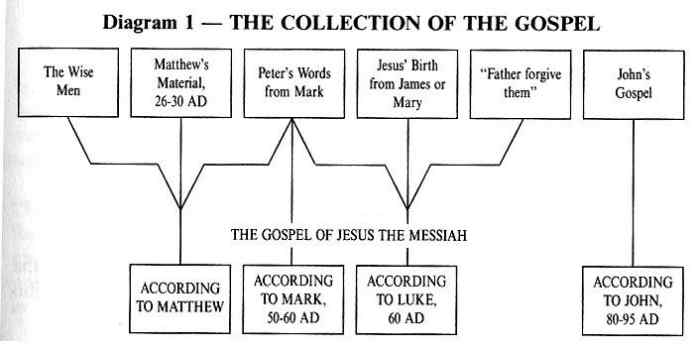
Dr. Bucaille included a diagram of the collection of the
Gospel accounts in his book on page 76 and presented it as
proof that the Bible has been manhandled, altered, and changed.
Diagram 1 demonstrates the collection of the Gospel material
as it has been described in these pages.
|
Diagram 1--
THE COLLECTION OF THE GOSPEL
|
It is obvious from this diagram that I do not agree at all
with Dr. Bucaille's dating. But even if we accept his dates
instead of mine, all scholars are agreed that many of the
New Testament books were written between 52 and 70 AD; that
all of them were written by 95 AD; and that all of the New
Testament authors believed firmly in the Doctrinal Gospel.
I stress these dates of 52 to 70 AD because they represent a
time period of 26 to 44 years after Jesus first started
preaching. When we remember that Othman's official copies
of the Qur'an were sent out, at the earliest, around
26 AH or 40 years after Muhammad started preaching, we see
that the time frames for the distribution of the written
Gospel and the distribution of the written Qur'an are very
similar.
And again you may ask the question, "BUT HOW DO YOU KNOW?"
We will answer:
WE BELIEVE the disciples were upright men who wanted
to know and obey God's truth, and the Qur'an agrees with this
statement when it says that they were "inspired" and wanted
to be God's helpers.
WE BELIEVE that there were many other eye-witnesses
to Jesus' life and miracles who could control the truth.
WE BELIEVE that the accounts were written early and
of even more importance.
WE BELIEVE that the Holy Spirit guided in the
writing. But we don't have absolute proof in the sense of
having the original copy of the book of Acts, or of Luke's
Gospel.
OTHMAN'S "VERY SPECIAL AND UNIQUE PRECAUTIONS"
WITH THE TEXT OF THE QUR'AN
At the beginning of this section several Hadiths were quoted
telling about the final collection of the Qur'an by the
committee of Zaid ibn Thabit. I am repeating here the last
few lines of one of these Hadiths because we must now talk
about the last sentence. It reads as follows,
...When they (the committee) had copied the sheets into the
volumes, Othman restored the sheets to Hafsa. And he
sent to every region a volume from what they had copied, and
commanded, regarding everything of the Qur'an besides it,
in every sheet and volume, that it should be burned.
We must note carefully that last sentence.
...AND HE (OTHMAN)...COMMANDED, REGARDING EVERYTHING OF
THE QURAN BESIDES IT, IN EVERY SHEET AND VOLUME, THAT IT SHOULD
BE BURNED.
Othman decided to make sure that there were no variations in
the Qur'an. To do this he burned all the copies, except the
one made by ibn Thabit's committee.
He burned the copy of Ali, the prophet's son-in-law.
He burned the copy of Ubai b. Ka`b. Ibn Abi Dawud records
that when some Iraqis asked the son of Ubai to see his
father's collection of Suras, the son answered that Othman
"had seized it" (qabadahu).
He ordered Ibn Mas`ud far away in Iraq to destroy his
private copy. Ibn Mas`ud refused while alive, but it also
was eventually destroyed.
If Othman had not ordered all the other copies of the Qur'an
to be burned, there would be four (or more) separate
testimonies to its validity. He burned Qur'ans which were
the primary collections, made by eye-witnesses and ear-witnesses
of what Muhammad said.
We saw above that the
Torah says that there must be at least two witnesses, but
Othman destroyed the plurality of witnesses and turned them
into one. At least one Hadith says, "He found the Qur'ans
many and left one; he tore up the Book".
In all seriousness I now ask my Muslim readers. On what
basis can you prove to yourselves, let alone to non-Muslims,
that there was no "changing of the text"
(al-tahrif al-lafzi).
And what does Dr. Bucaille say about this action of
Othman?!? He has a tiny paragraph with one carefully
constructed sentence!! He writes,
We know that after the death of Muhammad, Islam spread with
great rapidity, and far from its region of origin, among
people, of whom a large number did not know Arabic.
They took SOME SPECIAL AND UNIQUE PRECAUTIONS (des
precautions toutes particulires) so that the Quranic text
did not suffer from this expansion. <sic>,
(capitals and translation mine)
Let us repeat that last sentence.
They took SOME SPECIAL AND UNIQUE PRECAUTIONS so that the
Quranic text did not suffer from this expansion.
<sic> <sic> <sic> !!!
Imagine what Dr. Maurice Bucaille would have said if
Christians wrote one tiny line like this? We would have been
accused of dialectical acrobatics, hiding the truth, deceiving
the faithful, etc. We will now have a new sign in our book.
Our new sign is made like this (-@-@-@). It represents three
somersaults of dialectical acrobatics.
Dr. Bucaille condemns the Christians in strong language,
saying that "Perhaps a hundred gospels were suppressed"
(though he gives no reference for this information), and that
certain texts were "brutally thrust aside". This may have
been true in some local area, but since church leaders had no
political power until a number of years after Constantine I
became Emperor in 324 AD, it was impossible for them to have
taken such an action.
That books were burned in those early years, is true, but
it was done on the orders of a non-Christian. In 303 AD,
the pagan Emperor Diocletian ordered the destruction of all
of the sacred books of the Christians---both Canonical and
apocryphal. This, no doubt, resulted in the destruction
of many books, but it was not done by the church.
Not until 393 AD at the Synod of Hippo in North Africa
did any church council make a list of the books officially
accepted as having been written under the direction of the
Apostles. But when we realize that the Codex Vaticanus and
the Codex Sinaiticus were both written 40-50 years before
this Synod met, and both contain all 27 books of the present
Gospel-New Testament, it is clear that those 27 books were
accepted by the believers during three centuries of open
discussion, during a time when the church had no political
power to enforce its rules.
That Dr. Bucaille should bring this up at all when he has
said nothing about Othman's actions is incredible. Moreover,
he dares to go on with these words,
"One may join Father Boismard in regretting the disappearance
of a vast quantity of literature declared apocryphal by the
Church although it was of historical interest." <sic>
Dr. Maurice Bucaille "regrets" with Father Boismard
"the disappearance of a vast quantity of literature declared
apocryphal, etc", yet he has so little regret over Othman's
action of burning the original copies of the Qur'an that he
doesn't even consider it worth mentioning. He slides right
over it with the polite little phrase "SPECIAL AND UNIQUE
PRECAUTIONS" (-@-@-@).
Jesus said,
"Why do you look at the speck of sawdust in your brother's
eye and pay no attention to the plank in your own eye"
(Matthew 7:3)
Thrusting some texts aside, even if done "brutally"
to use Dr. Bucaille's word, is surely a "speck of sawdust"
compared to the "plank" of burning original collections of
the Qur'an---collections made by some of the most trusted
companions of Muhammad.
Furthermore, it should be noted that the rejected gospels
and letters which Dr. Bucaille does mention by name, some of
which we shall consider in Part D of this chapter, all
contain the Doctrinal Gospel with one exception.
THE FATE OF THE UNIQUE FIRST COPY OF THE QUR'AN
Finally we must mention the destruction of the unique first
copy of the Qur'an collected at the order of Abu Bakr, which
because of his oath, Othman had returned to Hafsa. After
Othman's death, Marwan the Governor of Medina sent to Hafsa
and demanded it. She refused to give it up so it stayed with
her until she died. But Marwan was so concerned to have it
that as soon as he returned from her funeral, he immediately
sent to get it. The story is recorded by Ibn Abi Dawud
(died 316 AH) in his Kitab Al-Masahif. He gives the
Isnad down to Salem ben Abdullah who said,
"When Hafsa died and we returned from her funeral, Marwan
sent with firm intention to Abdullah ben Omar (Hafsa's brother)
that he must send him those pages, and Abdullah ben Omar sent
them to him, and Marwan ordered it and they were torn up. And
he said, I did this because whatever was in it was surely
written and preserved in the (official) volume and I was
afraid that after a time people will be suspicious of this
copy or they will say there is something in it that wasn't
written." (translation mine)
With that destruction and the eventual destruction of Ibn
Mas`ud's copy in Kufa, the primary sources were all destroyed
with no copies having been made of them. However, for the
first two or three centuries of the Hejira, called the period
of original thinking (ijtihd), Quranic teachers would speak
of preferring the reading of one or another of the companions
of the prophet. But finally this became so intolerable for
orthodoxy, that even such an eminent Quranic authority as
the great Baghdad scholar Ibn Shanabudh (245-328 AH) was forced
to make public recantation of his use of readings from the
old Codices.
Dr. Bucaille has repeated many times in his book that
Christians altered, changed and manhandled the Gospel. If that
is true what is to be said about Othman and his committee,
and Marwan? Did they not manhandle, alter and do as they
pleased with the Qur'an?
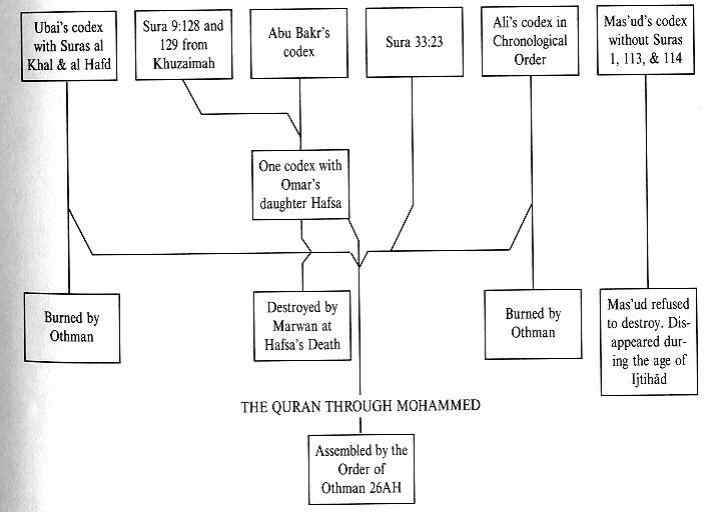
A few pages back, the origin of the four Gospels was presented
in the form of a diagram. The same thing can be done for the
Qur'an. Diagram 2 portrays the origin and transmission of the
Qur'an as it was recounted for us in the above Hadiths.
|
Diagram 2--
THE COLLECTION OF THE QURAN
|
The diagram could be made much more complicated by adding
other codices such as that of Abu Musa Al-Ash`ari which was
used at Basra, but the essential information is clear and
shows the many parallels in the recording of the Gospel and
the Qur'an.
We shall now ask the question again. HOW DO YOU KNOW
that the Qur'an which you have WITH YOU is exactly the same
as that given by Muhammad?
CONCLUSION
If, in spite of this "manhandling" and suppression of
evidence by Othman, Muslims BELIEVE that there has
been no change of any importance in the essential doctrines
of the Qur'an, on what basis shall anyone say that the Gospel
does not contain the essential doctrines of Jesus?
If the Qur'an which came 600 years later does not agree with
the Gospel-New Testament, Muslims will have to find some
other explanation than `'Tahrif". To charge lightly and
easily that "the Christians changed the Gospel" is a basic
assumption for which no proof has been provided.
Christians agree wholeheartedly with the idea expressed in
the late Meccan Sura of Jonah (Yunus) 10:64 when it declares,
"There is no change in the Words of God".
Continue with Part C
Table of contents
Answering Islam Home Page