返回总目录
The Origins of the Qur'an, An Enquiry into the Sources of Islam [Introduction]
ORIGINS OF THE QUR'AN
PREFACE
THIS little book has no claim to originality. It is principally based upon the larger works of Geiger, Tisdall, Zwemer, Muir, Sell and Imadu'd-Din, and aims at presenting in a brief, and therefore inexpensive, form for Indian readers some of the results of the exhaustive studies of those scholars. If it helps any enquiring Muslims to understand more clearly the origin of the faith taught by Muhammad, it will have accomplished, the purpose, for which it was written. The transliteration adopted is that recommended the Royal Asiatic Society, namely,

page vii
INTRODUCTION
THE word "Qur'an" is derived from the Arabic verb to read. It means
"the reading," or rather "that which is to be read." It is taken from
Suratu'l-'Alaq (xcv. 1)1
which is said to have been the first Sura revealed to Muhammad. This
word, first used to designate a portion only of the Qur'an, was
subsequently, and is now, used to describe the whole collection of
the "revelations" made to Muhammad. The Traditions relate many
wonderful stories regarding the descent of inspiration upon Muhammad,
of which 'Ayesha, the favourite wife of the Prophet, has preserved the
following: "The first revelations which the Prophet received were in
true dreams, and he never dreamt but it came like the dawn of day.
After this the Prophet became fond of retirement, and used to seclude
himself in a cave in Mount Hira and worship there day and night ....
till one day the angel came to him and said, 'Read,' but the Prophet
said, 'I am not a reader.' 'Then,' said Muhammad, 'he took hold of
me and squeezed me as much as I could bear, and he then let me go and
again he said, 'Read,'
page viii
and I said, 'I am not a reader.' Then he took hold of me a second
time and squeezed me as much as I could bear, and then let me go and
said, 'Read,' and I said, 'I am not a reader.' Then he took hold of
me a third time and squeezed me as much as I could bear and said
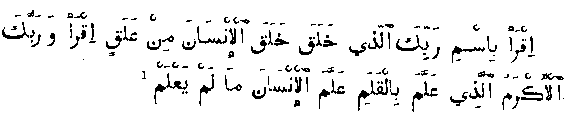 1
1
'Recite! in the name of thy Lord who created;
- Created man from the clots of blood;
- Recite thou! for thy Lord is most Beneficent,
who hath taught the use of the pen;
- Hath taught man that which he knoweth not.'
Then the Prophet repeated the words himself, and with his heart
trembling returned to Khadija and said, 'Wrap me up! Wrap me up!'
and they wrapped him up in a garment until his fear was
dispelled."2
Such Traditions as the one related above, together with the oft-repeated
statements of the Qur'an itself, form the basis of the Muhammadan belief
that the Qur'an is the uncreated word of God which was communicated to
Muhammad in a miraculous manner, chiefly by the mediation of the angel
Gabriel. The Qur'an, it is said, was extant in the highest heaven from
all eternity, written on the Lauhu'l-Mahfuz, or the "preserved table,"
near the throne of God, and then sent down to the lowest heaven in the
month of Ramadan, whence it was revealed to Muhammad
page ix
piecemeal during a period of some twenty-three years. The Qur'an abounds
in passages asserting its divine origin, and many are the anathemas hurled
at those who refuse to acknowledge its claims. Bukhari and others have
preserved numerous Traditions, for which we have no space here, relating
the manner and occasion of these "revelations;" whilst later writers,
such as Jalalu'd-Din as-Syuti, have classified and arranged the different
modes of this divine inspiration such as, by the mediation of an angel,
by suggestion in the heart of the Prophet, by dreams, by direct communication
from God to the Prophet and so forth. We are not concerned here, however,
with these details,1 and for
the purposes of this enquiry it must suffice to state the bare fact that
the Qur'an is held in the highest esteem by 200,000,000 of people, taking
the average estimate, who look upon it as the very word of God, existent
in heaven from all eternity, and finally given to the world through the
agency of his chosen messenger Muhammad.
The purpose of this small book is to examine this stupendous claim, and
to enquire whether the contents of the Qur'an may not be accounted for
apart from this theory of divine inspiration. To the Muhammadan reader,
whose mind revolts from the suggestion to subject the holy Qur'an to such
a critical study, we commend the following words of Sir Syed Ahmad in his
commentary on the Holy Bible.2
This Muhammadan
page x
scholar says, "I can by no means rest content with the superstitious notion
that Scripture, and all Scriptures in general, even the Holy Qur'an, must
not be subjected to critical examination. Would any one imagine for a moment
that the most exalted of blessings bestowed upon man, namely, the faculty of
reason, is given to us to remain idle? Can we conscientiously and faithfully
profess to be Christians or Muhammadans without being able to give a reason
for our belief, or without exercising our intellect to the utmost of our
ability in the thoughtful and reverent consideration and examination of
the precious volume which is given us as a guide of our faith? ...
On the contrary I would earnestly desire that those sacred writings be
examined with fairness, and discussed with respectful but not impertinent
freedom."
May the Muslim reader of this book, remembering the solemn and eternal nature
of the issues involved, seek, in the spirit of Sir Syed Ahmad's statement, to
investigate with candid freedom the book upon which his faith is based. For
ourselves we believe, and will try to prove that the Qur'an is nothing more
than a heterogeneous collection of doctrines and stories already current
in Arabia in the time of Muhammad, which were adopted and altered by him,
and afterwards given out from time to time as a direct revelation from God.
To these stories were added a number of practical precepts, both positive
and negative, which were called forth by the exigences of the time. In
accordance with this plan we purpose to discuss in order (1) those portions
of the Qur'an which Muhammad adopted from the heathen religions of his day;
(2) those portions which
page xi
have a Jewish origin, both Biblical and Talmudic; (3) those portions which
Muhammad learned from his Christian contemporaries; and finally (4) those
portions of the Qur'an which were called forth by the special circumstances
of the moment, and which were suited to support and sanction the varied
actions of the Prophet.
The Origins of the Qur'an [Table of Contents]
Answering Islam Home Page