返回总目录
'Abdullah Ibn Sad Ibn Abi Sarh: Where Is the Truth?


Abdullah Ibn Sad Ibn Abi Sarh:
Where Is the Truth?
Muhammad
Ghoniem & M S M Saifullah
© Islamic
Awareness, All Rights Reserved.

Peace be upon those who follow the guidance:
This article is meant to answer the claims put forward
by the Christian missionaries.
The author of that article claims that cAbdullâh
Ibn Sâd Ibn Abî Sarh, one of the scribes of the Prophet Muhammad(P),
has contributed to the Qur'ânic text. Let us examine the references used by
the author to support his claims and sort out his arguments in the light of famous
Islamic resources.
The author of the criticism says:
Sarh left Islam and lived in Mecca. Some
time later, Muhammad and his army moved on Mecca and took it without a fight.
Then in the passage quoted from the
translation of Sîrat Rasulillah, he went on saying about Ibn Abî Sarh:
then he apostatized and returned to Quraysh
[Mecca]
He also reported from al-Baidawî
commenting on the the verse 6:93 that the reason that triggered apostasy of cAbdullâh Ibn Sâd Ibn Abî Sarh
was the revelation of the verse 23:12. The following is the translation of Baidawî's
report proposed by the critic:
'To me it has been revealed', when naught
has been revealed to him" refers to 'Abdullah Ibn Sâd Ibn Abi Sarh, who
used to write for God's messenger. The verse (23:12) that says, "We created
man of an extraction of clay" was revealed, and when Muhammad reached the part
that says, "... thereafter We produced him as another creature (23:14), 'Abdullah
said, "So blessed be God the fairest of creators!" in amazement at the
details of man's creation. The Prophet said, "Write it down; for thus it has
been revealed." 'Abdullah doubted and said, "If Muhammad is truthful then
I receive the revelation as much as he does, and if he is a liar, what I said is
a good as what he said."
The above claim can be summed up
as follows: cAbdullâh
was one of the scribes of the Prophet(P). Upon the revelation of the verse 23:12 and
his anticipation on the end of the verse 23:14, he thought that he received the revelation
as much as the Prophet(P) and he doubted in the prophethood of Prophet
Muhammad(P).
Therefore, he apostatized and returned to Quraysh [Mecca] where he sought refuge.
Apostacy of Ibn Sarh
In the beginning of our study, we
have to determine whether he apostatized before the Hijrah, i.e., in Mecca
or after the hijrah, i.e., in Medina. The author of the criticism says that cAbdullâh returned to Quraysh [Mecca] and the word
he put between [ ] implies that he returned to Mecca.
As a matter of fact, there is an entire science dedicated
to the study of the life of the companions of the Prophet and the later generations
of Muslims who were involved in the transmission of hadîth. This
science is called cIlm al-Rijâl (i.e., the Science of the Folk).
One of the biggest references in that field is Usûd
Ulghâbah fi Ma'rifat Is-Sahâbah by
Ibn al-Athîr. In the entry concerning cAbdullâh
Ibn Sâd Ibn Abî Sarh we find the following:

The above excerpt reads:
He converted to Islam before the conquest
of Mecca and immigrated to the Prophet(P) [i.e. in Medina]. He used to record the revelation
for the Prophet(P) before he apostatized and went back to Mecca.
Then he told Quraysh: 'I used to orient Muhammad wherever I willed, he dictated
to me "All-Powerful All-Wise" and I suggest "All Knowing All-Wise"
so he would say: "Yes, it is all the same."[1]
From the above quotations of Usûd Ulghâbah, no doubt remains concerning the conversion of cAbdullâh Ibn Sâd Ibn Abî Sarh:
he embraced Islam after the Hijrah and joined the Muslims in Medina.
Thus, his apostasy occurred later which means it occurred in Medina.
cUlûm al-Qur'ân & Revelation
The "Science of Qur'ân"
(in Arabic cUlûm al-Qur'ân) has fortunately conveyed lots of valuable details about
the revelation of the Holy Qur'ân including the reason of the revelation (in
Arabic Asbâb un-Nuzûl which is usually a certain event that motivated
the revelation of some verses of the Qur'ân) and even the places where such
and such verse or chapter of the Qur'ân were revealed to the Prophet(P). Note that the verses revealed in Mecca are called Meccan
verses and the ones revealed in Medina are called Medinite verses. The main reference
used in this article as to cUlûm
al-Qur'ân is Al-Itqân
fî cUlûm il-Qur'ân by Jalaluddîn al-Suyûtî.
Concerning Chapter 6 (from which
the verse 6:93 is quoted), many reports support the fact that it was entirely
revealed in Mecca. They also go on saying that this Chapter was escorted by 70,000
angels when Gabriel carried it down to the Prophet(P). Refer to Al-Itqân, Section 13: What was revealed scattered
and what was revealed in one unit,[2]. One may also refer to Al-Itqân,
Section 14: What was revealed with an escort and what was revealed alone[3]. Consequently, the opinion
the verse 6:93 addressed cAbdullâh Ibn Sâd Ibn Abî Sarh
falls flat on its face. Many commentators convey reports that the revelation of the
verse 6:93 addressed Musaylamah al-Kadhdhâb of al-Yamâmah and al-'Ansy
of Yemen, both of them having claimed prophethood at that time.
For the sake of completeness, we will quote some
more information given in Al-Itqân. According
to Ibn as-Salâh in his Fâtawi:
The report that conveys the revelation
of Chapter 6 entirely in one unit was given from the way of Ubayy Ibn Ka'b, it is
weak in its isnâd (i.e. the chain of narration), and I have never seen a trustful
(Sahih) isnâd for this tradition. Many traditions even said the
contrary i.e. several verses of Chapter 6 were revealed later in Medina. They differed
on the number of these verses whether they are 3 or 6 or some other number, and God
knows best.[4]
So, some reports concerning Chapter
6 classify several verses as Medinite verses. These reports differed on the number
of verses: a report on the authority of Ibn cAbbas
excludes 3 verses (6:151 to 6:153), others say 6 verses (the previous ones + 6:91
+ 6:93 & 6:94- they also say that the last two verses concern Musaylamah). Other
reports exclude two verses only, for example 6:20 & 6:114. They also differ on
Asbâb un-Nuzûl of the verses excluded as they either concern
Musaylamah or a Jewish Rabbi of Medina or other reasons. So, not withstanding what
is said in the previous paragraph, we will not close the case yet because of the
slight doubt about Asbâb
un-Nuzûl of verse 6:93.
According to the critic, the revelation
of verse 23:12 and the amazed anticipation of cAbdullâh Ibn Sâd Ibn Abî Sarh
on the end of verse 23:14 triggered his apostasy. Many books about the cUlûm al-Qur'ân have made an accurate classification of the
Chapters and verses that were revealed in Mecca (those are called Meccan verses or
Chapters), and the ones revealed in Medina (those are called Medinite). According
to Al-Itqân, we learn that the full Chapter 23 (i.e.,
Sûrat al-Mu'minûn) is Meccan. Refer to pages 17-21 where many reports
confirm the revelation of Chapter 23 in Mecca with no exception of any single verse.[5] Obviously, this report quoted from al-Baidawi is a gross
fabrication since cAbdullâh
Ibn Sâd Ibn Abî Sarh embraced Islam after the revelation of Chapter 23.
When we add to the above the fact that the full quotation from al-Baidawî was
not put forward by the critic even when we asked for it, and given the fact that
the reports are stated without the chains of transmission, the authentication of
such a report is impossible. Moreover, a comparison to other commentaries of the
Qur'ân (such as the commentaries of al-Qurtubî[6]
and at-Tabarî[7]) mentioning the same report provide disrupted
chains of transmission. That is why the claim of the critic based on the report of
al-Baidawî looses conclusively all its value.
What Does Sirah Of al-cIraqî Actually Say?
Now let us look into the argument quoted from Is the Qur'ân Infallible? by
cAbdullâh
cAbd al-Fad.
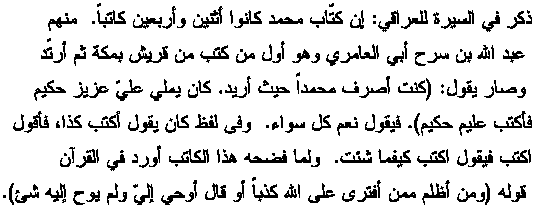
The translation provided by the critic is:
The scribes of Muhammad were 42 in number.
'Abdullah Ibn Sarh al-`Amiri was one of them, and he was the first Quraishite among
those who wrote in Mecca before he turned away from Islam. He started saying, "I
used to direct Muhammad wherever I willed. He would dictate to me 'All-Powerful,
All-Wise' [the critic has wrongly translated 'Aziz by Most-High which is
in Arabic 'Aliyy, it seems that he confused it with the previous word 'Alayya which
means "to me"], and I would
write down 'All-Wise' only. Then he would say, 'Yes it is all the same'. On a certain
occasion he said, 'Write such and such', but I wrote 'Write' only, and he said, 'Write
whatever you like.'" So when this scribe exposed Muhammad, he wrote in the Qur'an,
"And who does greater evil than he who forges against God a lie, or says, 'To
me it has been revealed', when naught has been revealed to him."
The rest of the English translation
go further than what is stated in Arabic, so we will not quote it here. However,
it is available at the original site.
The above argument is presented by
the critic as a "quotation from as-Sîrah by al-'Iraqî". First of all, there
are many people by the name of al-'Iraqî but the author does not say which
al-cIraqî is mentioned here. Fortunately,
God guided us to the source of this claim: Alfiyyat
us-Sîrat in-Nabawiyyah
by al-Hâfidh al-cIraqî. In fact, al-Hâfidh al-cIraqî has wrote the Sîrah in a piece of poetry
of 1000 verse called Alfiyyat
us-Sîrat in-Nabawiyyah.
Here is the relevant quotation:[8]
 In the first verse of the above quotation (i.e. verse
780 in the poem), al-Hâfidh
al-'Iraqî starts by saying that the scribes
of the Prophet(P) were 42. Obviously, this detail links Alfiyyat us-Sîrat in-Nabawiyyah
to the argument stated by the critic. The above quotation consists of twelve verses
mentioning various scribes of the Holy Qur'ân among the most known. cAbdullâh
Ibn Sâd Ibn Abî Sarh is not mentioned yet. In the verse 786, al-Hâfidh al-cIraqî
says:
In the first verse of the above quotation (i.e. verse
780 in the poem), al-Hâfidh
al-'Iraqî starts by saying that the scribes
of the Prophet(P) were 42. Obviously, this detail links Alfiyyat us-Sîrat in-Nabawiyyah
to the argument stated by the critic. The above quotation consists of twelve verses
mentioning various scribes of the Holy Qur'ân among the most known. cAbdullâh
Ibn Sâd Ibn Abî Sarh is not mentioned yet. In the verse 786, al-Hâfidh al-cIraqî
says:
And I added from various accounts on
Sîrah a lot of people, it is for you to verify and check.
This means clearly that not all that
is mentioned is to be taken blindly. Al-Hâfidh al-cIraqî
is making a simple compilation of what he found leaving the verification for the
reader. Then al-Hâfidh
al-cIraqî
goes on with his list:
 In verses 796 to 798, al-Hâfidh
al-cIraqî
says:
In verses 796 to 798, al-Hâfidh
al-cIraqî
says:
They mentioned three who wrote [for the
Prophet] and apostatized: Ibn Abî Sarh and Ibn Khatal and another one
whose name is unknown. No one of them returned to the religion [Islam] except Ibn
Abî Sarh while the others strayed from the right path.
A minimum of objectivity is enough
to understand that al-Hâfidh al-cIraqî does not back up such claims.
He is merely reporting accounts and asks the people interested in them to take upon
themselves the burden of verification.
When we give a second look to the
argument of the critic, we see clearly that he is putting words in the mouth of al-cIraqî. He is using the passage al-cIraqî
himself doubts in the tone of established facts. This is called twisting facts to
serve one's goal. It has nothing to do with objectivity, let alone the claimed honesty
or the quest of the Truth. Al-Hâfidh al-cIraqî
in his Alfiyyat us-Sîrat
in-Nabawiyyah does not assert for sure that cAbdullâh
Ibn Sâd Ibn Abî Sarh was a scribe of the Prophet(P). He also states clearly that the scribes who apostatized
had gone astray. Therefore, he cannot contradict himself by saying what the critic
is putting in his mouth. Consequently, in the absence of the source of such claims,
we dismiss this argument unless the critic provides us with its source stated fully
and correctly.
Discussion
1) What do we know about cAbdullâh
Ibn Sâd Ibn Abî Sarh?
He embraced Islam after the Hijrah while Muslims
were living in Medina. We don't know the year exactly. He probably had the
opportunity to write for the Prophet(P). He apostatized but the reason stated in many accounts (i.e.
verse 23:12) is not consistent because it goes against many established reports in
the cUlûm
al-Qur'ân. He returned to Islam and was a good Muslim. Indeed, here is what
is said about him quoted in the commentary of al-Qurtubî[9]:

For the convenience of our non-Arabic speaking audience,
the full translation
to English of the above report is also
available.
In the above quotation, we read a similar report
to Baidawî's. However, the report gives more details about cAbdullâh
Ibn Sâd Ibn Abî Sarh. Indeed, the report says:
According to Abû Omar, "cAbdullâh Ibn Sâd Ibn Abî Sarh converted
back to Islam during the conquest of Mecca and his Islam was fine, and later, his
behavior was beyond reproach. He was among the wise and the noble from Quraysh, and
was the knight of Banî 'Aamir Ibn Lu'ayy was respected among them. Later, 'Uthmân
named him to govern Egypt in the year 25 H. He conquered Africa in the year 27 H
and conquered Nuba in the year 31 H and he was the one who signed with the Nubites
the armistice that is still valid today. He defeated the Romans in the battle of
as-Sawaary in the year 34 H. When he returned from his advent, he was prevented from
entering al-Fustât [the
capital of Egypt], so he went to
'Asqalân where he lived until the murder of cUthmân(R).
It was also said: he lived in Ramlah until he died away from the turmoil. And he
prayed Allah saying: "O Allah make the prayer of subh the last of my deeds.
So he performed wudu and prayed; he read Surat al-Fâtihah and al-'Aadiyât
in the first rak'ah and read al-Fâtihah and another sûrah in the
second rak'ah and made salâm on his right and died before he made salâm
on the left side. All this report was conveyed by Yazîd Ibn Abî Habîb
and others. He didn't pledge allegiance to cAlî
nor to Mu'âwiyah (RR). His death was before the people agreed on Mu'âwiyah.
It was also said that he died in Africa, but the correct is that he died in 'Asqalân
in the year 36 H or 37 H and it was rather said 36 H.
In a nutshell, Ibn Abî Sarh
embraced Islam after the Muslims had immigrated to Medina. He took the trouble to
migrate to Medina where he became one of the scribes of the Prophet. For an unknown
reason, he apostatized and went back to Mecca. He is supposed to have told the Meccans
that he changed the Qur'ân according to his own will. This seems to be very
predictable for someone in his situation seeking the favours of the Meccans whom
he betrayed not a long time before. Then the above report states what is reported
in Sîrat Rasulillah and in at-Tabaqât
al-Kabîr as well: cAbdullâh was among the bunch that had to be executed
but he could benefit of cUthmân's
intercession and he kept his life safe. Though the beginning of his Islam was unstable
(he migrated then apostatized then converted back to Islam in a very short time),
he became a good Muslim and was even made the commander of Muslim troops. A report
conveyed by 'Ikrimah in the commentary of at-Tabarî about verse 6:93
says that
'Abdullah Ibn Sâd Ibn Abî
Sarh converted back to Islam before the conquest of Mecca by the Prophet(P).[10]
This means that he converted back to Islam willingly without the shadow of any pressure.
Of course, like all the reports involved in this case, the transmission of this report
is disrupted.
2) Did cAbdullâh
Ibn Sâd Ibn Abî Sarh contribute to the Qur'ân?
There is no factual proof for such a horrendous claim.
The claim about Chapter 23 proved to be a fabrication because it was revealed before
cAbdullâh Ibn Sâd Ibn Abî Sarh
became a Muslim. If we take into account the most admitted opinion among the Qur'ânic
scholars, the entirety of Chapter 6 is Meccan. Consequently, the verse 6:93 is not
revealed in regard of Ibn Abî Sarh but rather in regard of Musaylamah and al-'Ansy and more
generally in regard of anyone who claims prophethood falsely.
Moreover, if the scribes were allowed to contribute
to the Qur'ân, how can the critic explain that among the 42 scribes there is
only one (cAbdullâh Ibn Sâd Ibn Abî Sarh)
who was bothered about it? Didn't the others feel uneasy about such a thing if it
ever happened?
Of course, it is out of the question that the Prophet
of God(P)
allow such contribution because it is claimed many times in the Qur'ân that
the Holy Book is dictated upon revelation and any contribution to it must be of divine
inspiration.
3) The author of the criticism asks:
If this story about Sarh were a fabrication,
why did so many early Muslim writers document it? Certainly devout Muslims would
not document a lie that serves to undermine their faith.
This is the best question raised
in the whole argument. Its answer is implied in the quotation of al-Hâfidh
al-cIraqî in his Alfiyyat us-Sîrat in-Nabawiyyah. Many of the early writers were concerned by the compilation
only. Fearing that the material available could be lost, they collected whatever
reports they could find without authenticating them. They left the authentication
process to the following generations as it is clearly stated in the following excerpt
of Alfiyyat us-Sirat in-Nabawiyyah by al-Hâfidh al-cIraqî:

In the verses 5 & 6, he says:
Let the seeker of knowledge know that
Sîrah collects every account whether true or false. But the intention is to
mention all that is conveyed in the books of Sîrah regardless of the isnaad.
(i.e., the authenticity of the chains
of narration)
A devout Muslim does not need to
twist the facts to protect his faith especially when an authentication process existed
even in the early stages of Islam. A whole Science is concerned with the reliability
of the narrators based on their life and their moral values. That is why many people
could compile many reports leaving the authentication procedure to the ones who followed
them. In reality, if all the early scholars cared about authenticating every report
they heard of, a lot of the material available today would be lost.
Unlike Muslims, some people, unaware
of the Science
of Hadîth and
the "Knowledge of the Folk" when venturing into the Islamic references
alone without a teacher, encounter great hardship digesting all the material available.
Others, more wicked, use the same characteristic of the early references to lead
innocent people astray. But, with God's help and protection, their dark plans are
always unveiled. As for the author of the critic, we would rather refrain from classifying
him in either category. The readership may judge him and only God can tell what his
real intentions are.
4) If cAbdullâh
Ibn Sâd Ibn Abî Sarh really deserved to be executed according to a Law, why did
the Prophet(P) accept the intercession of cUthmân?
This is a trick question. However, it also shows
that the author of the criticism is either ignorant in the field of Islamic Law or
his goal is to deceive as many people as he can. In terms of Islamic Law, there are
two categories of crimes. The ones named by God (such as murder, theft, fornication
etc.) to which He defined the proper punishment "Hudood"(the singular is
'Hadd'). And the ones not named by God, their evaluation and their punishment (called
ta'dhîr) are left for the judgment of the sovereign. Provided that the reports
of Sîrat Rasulillah and at-Tabaqât
al-Kabîr are correct, the case of cAbdullâh
Ibn Sâd Ibn Abî Sarh is simply about the sovereign (Prophet Muhammad(P))
making a decree against a criminal (cAbdullâh Ibn Sâd Ibn Abî Sarh)
then upon the intercession of a third party (cUthmân
Ibn 'Affân), the sovereign agrees to give amnesty to the criminal. Given that
the punishment is originally left to the sovereign, a subsequent change in the judgment
especially forgiveness cannot be criticized.
Conclusions
After the above study, the claims that the Holy Qur'ân
has been tainted by Ibn Abî Sarh do not hold water. One thing is sure. We do not know a lot
about the beginning of the faith of Ibn Abî Sarh. It was apparently unstable. However, later, he converted
back to Islam and his faith was beyond reproach. The question raised about the change
in the judgment concerning Ibn Abî Sarh denotes of real ignorance of the Islamic Law or a crooked
intention of deception. If the goal behind that criticism was the quest of the Truth,
then by God's will the above elaboration is likely to be enough for the author of
the criticism to retract it.
And Allah knows best.
Acknowledgements
We would like to express our deep gratitude to Brother
Khalid from the Emirates for his effective contribution to this article and for providing
us with a lot of material and fruitful ideas. May Allah reward him for his good deeds.
References
[1] Ibn al-Athîr, Usûd Ulghâbah fî Ma'rifat Is-Sahâbah, 1995, Dâr al-Fikr, Beruit (Lebanon), Volume 3, p. 154.
[2] Jalaluddîn as-Suyûtî,
Al-Itqân fî cUlûm il-Qur'ân
(In Two Volumes), 1987, First Edition, Dâr al-Kutub al-cIlmiyyah,
Beirut (Lebanon), p. 82.
[3] as-Suyûtî, Op.Cit, p. 83-85.
[4] as-Suyûtî, Op.Cit,,
p. 82.
[5] as-Suyûtî, Op.Cit,,
p. 17-21.
[6] al-Qurtubî, Al-Jâmic li Ahkâm Il-Qur'ân,
Volume 7, page 40-41, Available online.
[7] Abû
Jacfar Muhammad bin Jarîr al-Tabarî, Jâmic ul-Bayân fî Tafsîr Il-Qur'ân, 1986, Volume 5, published by Wizârat ul-Ma'rifah
(The Ministry of Education), Beirut, Lebanon, Available online.
[8] Hafiz Zainuddîn cAbdurrahîm
al-cIraqî, Alfiyyat
us-Sîrat in-Nabawiyyah (attached to the
book of as-Sîrah an-Nabawiyyah of Ibn Hisham), 1998 (Second Print), Dâr al-Fikr, Beirut
(Lebanon), Volume 4, p. 299.
[9] al-Qurtubî, Op.Cit,
[10] al-Tabarî, Op.Cit,
Back
To Index
