But whatever allegorical interpretation is applied to the book,
whatever the historical context in which the Song of Songs was
first used, it is important to understand that primarily the
book is a dramatic poem. All commentators, be they Christian
or Jewish, understand this to be the case, and recognise that the
Song of Songs is as a drama with two or three characters; either
the bride and her bridegroom (King Solomon) or more commonly, the
girl, her shepherd lover, and King Solomon.
| 1:1 |
The Song of Songs, which is Solomon’s |
The expression "Song of Songs" is a
Hebrew idiom for "the best song". Whilst
Solomon is named in this first verse, it is debatable
whether this means that the song was written by him, for
him, or, as is more likely, about him. |
| |
|
|
| 1:2 |
May he kiss me with the kisses
of his mouth!
For your love is better than wine. |
As the poem opens, we
find the maiden in the royal courts of King Solomon. How
she ended up here is not revealed, although there is an
implication later on that she was taken against her will
to the royal harem. In the
anxiety of her separation from her home in the northern
hill country, the maiden recalls her shepherd lover, and
longs for the security and comfort she enjoyed when she
was with him.
|
| |
|
| 1:3 |
Your oils have a pleasing fragrance,
Your name is like purified oil;
Therefore the maidens love you. |
| |
|
| 1:4 |
Draw me after you and let us run together!
The king has brought me into his chambers. |
| |
We will rejoice in you and be
glad;
We will extol your love more than wine.
Rightly do they love you |
Throughout the poem, there are a number of times
when the women of the harem speak as a chorus; remember
that many commentators believe the Song of Songs was
written to be performed to an audience; hence these
dramatic interjections. |
| |
|
|
| 1:5 |
I am black but lovely,
O daughters of Jerusalem,
Like the tents of Kedar,
Like the curtains of Solomon. |
The chorus of the harem
women (daughters of Jerusalem), has reminded the
maiden of how different she is to them, especially in
appearance. Unlike the soft white-skinned harem women,
the maiden is tanned from working for many days under the
hot sun. The anger of her brothers referred to here is
probably a Hebrew word play; the maiden has been burned
by the sun and burned by her brothers anger. The imagery of a vineyard here reoccurs
time and time again throughout the poem, and is used to
refer to the maiden’s own person. She has worked so
hard for her family that she has neglected herself.
|
| |
|
| 1:6 |
Do not stare at me because I am swarthy,
For the sun has burned me,
My mother’s sons were angry with me,
They made me caretaker of the vineyards,
But I have not taken care of my own vineyard. |
| |
| |
|
|
| 1:7 |
Tell me, O you whom my soul
loves,
Where do you pasture your flock,
Where do you make it lie down at noon?
For why should I be like one who veils herself
Beside the flocks of your companions? |
The maiden’s cries here parallel those in verse 4 above, as she longs to find her lover. The depth of
the maiden’s love is revealed, as she calls her
shepherd lover, "you whom my soul loves." |
| |
|
|
| 1:8 |
If you yourself do not know,
Most beautiful among women,
Go forth on the trail of the flock
And pasture your young goats
By the tents of the shepherds. |
Once again, the chorus of the harem women speak
up, testifying to the wonderful beauty of the maiden. Her
beauty is a constant theme throughout the poem; here they
encourage her to follow her heart, and try to find her
shepherd lover whom she has lost. |
| |
|
|
| 1:9 |
To me, my darling, you are like
My mare among the chariots of Pharaoh. |
Now King Solomon enters
the poem for the first time, showering the maiden with
compliments in an attempt to get her to divert her
attention from thoughts of her shepherd lover to himself.
Note that jewellery was an important part of female dress
in Old testament times, hence Solomon’s reference to
her ornamentation. |
| |
|
| 1:10 |
Your
cheeks are lovely with ornaments,
Your neck with strings of beads. |
| |
|
|
| 1:11 |
We will make for you ornaments
of gold
With beads of silver. |
The harem women chorus again; it is interesting
to note that the reference to both silver and gold in
this verse testifies once again to the beauty of the
maiden, as only jewellery of such worth would befit her. |
| |
|
|
| 1:12 |
While the king was at his table,
My perfume gave forth its fragrance. |
While Solomon entertains
at an banquet, the wafts of the maiden’s perfume
calls to her mind once again memories of her shepherd
lover. The references to both the
King (verse 12) and her beloved (verse 14) show that they
are not one and the same person; this is one of the
strongest clues in the poem that it does indeed contain
three characters plus the chorus, as I have assumed in
this commentary.
|
| |
|
| 1:13 |
My
beloved is to me a pouch of myrrh
Which lies all night between my breasts. |
| |
|
| 1:14 |
My
beloved is to me a cluster of henna blossoms
In the vineyards of Engedi. |
| |
|
|
| 1:15 |
How beautiful you are, my
darling,
How beautiful you are!
Your eyes are like doves. |
Once again, Solomon sings the praises of the
maiden, twice calling her beautiful. Comparisons
of aspects of women to animals is common in Near East
love poetry, and the description "eyes like doves"
is especially interesting. The eyes are thought to reveal
the inner character, and elsewhere in the Old Testament
the dove is a symbol of peace, love and purity. As both
the shepherd lover and the maiden are described as having
eyes like doves in the Song of Songs, this may be meant
to convey their innocence, purity, loyalty, and fidelity
to one another. |
| |
|
|
| 1:16 |
How handsome you are, my beloved,
And so pleasant!
Indeed, our couch is luxuriant! |
Maybe the maiden’s
initial response would have encouraged King Solomon, but
it quickly becomes clear that her words are not intended
for him; she compares herself to the more common
wildflowers of the countryside, a reminder once again
that she is an alien and a stranger amongst the riches of
Solomon’s royal palace. |
| |
|
| 2:1 |
I am
the rose of Sharon,
The lily of the valleys. |
| |
|
|
| 2:2 |
Like a lily among the thorns,
So is my darling among the maidens. |
Notice Solomon’s clever play on the maiden’s
use of the word "lily" as he continues to
shower her with praise. |
| |
|
|
| 2:3 |
Like an apple tree among the
trees of the forest,
So is my beloved among the young men.
In his shade I took
great delight and sat down,
And his fruit was sweet to my taste. |
The maiden’s reply
to Solomon’s attempts to flatter her, is to sing the
praises of her shepherd lover; to "sit in his shade"
suggests she feels safety and protection when she is with
him. In stark contrast to Solomon’s
banquet (see 1:12
above), the maiden imagines
what her wedding banquet with her shepherd lover would be
like. Her banner or emblem of betrothal she pictures to
be the pure and faithful love of the shepherd.
|
| |
|
| 2:4 |
He
has brought me to his banquet hall,
And his banner over me is love. |
| |
|
| 2:5 |
Sustain
me with raisin cakes,
Refresh me with apples,
Because I am lovesick. |
| |
|
| 2:6 |
Let
his left hand be under my head,
And his right hand embrace me. |
| |
|
|
| 2:7 |
I adjure you, O daughters of
Jerusalem,
By the gazelles or by the hinds of the field,
That you do not arouse or awaken my love
Until she pleases. |
A constant refrain in the poem is the maiden’s
instructions to the chorus of harem women. Here the
phrase "By the gazelles or by the hinds of the field"
is an ancient oath formula, and demonstrates the urgency
and seriousness of her charge to the harem women. Love is
not to be stirred until the two partners have learnt to
trust and delight in one another. |
| |
|
|
| 2:8 |
Listen! My beloved!
Behold, he is coming,
Climbing on the mountains,
Leaping on the hills! |
Dwelling on her memories of her shepherd lover,
the maiden begins to fantasise that he has come to rescue
her from her imprisonment in the harem of King Solomon. |
| |
|
|
| 2:9 |
My beloved is like a gazelle or
a young stag
Behold, he is standing behind our wall,
He is looking through the windows,
He is peering through the lattice. |
The comparison of her lover to a wild gazelle or
stag is probably an allusion to the freedom such an
animal enjoys, unlike the confinement of her (the doe),
locked in behind the windows and the lattice. |
| |
|
|
| 2:10 |
My beloved responded and said to
me,
‘Arise, my
darling, my beautiful one,
And come along. |
After searching from
window to window — peering through the lattice
— the shepherd lover catches sight of the maiden,
and calls out to her. More poetic
imagery is employed as the shepherd implores his beloved
to return to him; for as the winter has passed and now
spring has come, so the time has also come for their love
to rekindle and spring to life again, just like the
blooming flowers and vines.
|
| |
|
| 2:11 |
‘For behold the winter is past,
The rain is over and gone. |
| |
|
| 2:12 |
‘The flowers have already appeared in the
land;
The time has come for pruning the vines,
And the voice of the turtledove
has been heard in our land. |
| |
|
| 2:13 |
‘The
fig tree has ripened its figs,
And the vines in blossom have
given forth their fragrance.
Arise, my darling, my beautiful one,
And come along!’ |
| |
|
|
| 2:14 |
O my dove, in the clefts of the
rock,
In the secret place of the steep pathway,
Let me see your form,
Let me hear your voice,
For your voice is sweet,
And your form is lovely. |
The "dove" is
a common pet name for the maiden; and as we saw in verse 1:15 the dove is a common symbol for both love and
purity in the Old Testament. The
meaning of verse 2:15 is difficult, but it has often been
suggested that as the image of a vineyard is used
throughout Song of Songs to represent the maiden’s
own person, here "vineyards" refers to both the
maiden and the shepherd, and the love that has blossomed
between the two. Thus the foxes that are ruining the
vineyards are the rivals, like King Solomon, who threaten
to destroy the blossoming love.
|
| |
|
| 2:15 |
Catch the little foxes for us,
The little foxes that are ruining the vineyards,
While our vineyards are in blossom. |
| |
|
|
| 2:16 |
My beloved is mine, and I am his;
He pastures his flock among the lilies. |
The voice of her beloved shepherd has called to
the mind of maiden just how deeply she loves him, and in
this verse — which is repeated a second time later
in the poem — she emphasises that their love is
exclusive and can leave room for no other; she is his,
and he is hers; the way that God intended marriage to be. |
| |
|
|
| 2:17 |
Until the cool of the day
when the shadows flee away,
Turn, my beloved, and be like a gazelle
Or a young stag on the mountains of Bether. |
As the coolness of the evening sets in, the
shepherd runs away from Solomon’s courts like a stag.
"My beloved" is the maiden’s favourite
name for her lover. |
| |
|
|
| 3:1 |
On my bed night after night I
sought him
Whom my soul loves;
I sought him but did not find him. |
The first phrase in this
new section of the poem sets the scene; the maiden is
lying on her bed, and what follows is to be understood as
a poetic dream sequence, as her longing for her shepherd
lover causes her to rise and search the deserted city
streets of Jerusalem for him Soon
she runs she into the city watch as they patrol the
streets, and she implores them to help her in her search;
once again she emphasises the depth of her love for her
lost shepherd — he who my soul loves.
Finding the watch of no help, finally
she finds her beloved shepherd, and is so overjoyed with
the reunion that she cannot bear to let him go lest she
lose him again, and thus she clings onto him tightly.
Her leading the shepherd to the home of
her mother demonstrates the seriousness of her love, and
may signify the formalising of their relationship, first
with parental approval, and then with marriage.
Finally, this part of the poem closes
as the maiden repeats her solemn instruction to the
chorus of harem women: love is a precious, special gift,
and it cannot be forced, but must be allowed to awaken in
its own time.
|
| |
|
| 3:2 |
I
must arise now and got about the city;
In the streets and in the squares
I must seek him who my soul loves.
I sought him but did not find him. |
| |
|
| 3:3 |
The watchmen who make the
rounds in the city found me;
And I said, ‘Have you seen him
who my soul loves?’ |
| |
|
| 3:4 |
Scarcely had I left them
When I found him who my soul loves;
I held on to him and would not let him go
Until I had brought him to my mother’s house,
And into the room of her who conceived me. |
| |
|
| 3:5 |
I
adjure you, O daughters of Jerusalem,
By the gazelles or by the hinds of the field,
That you will not arouse or awaken my love
Until she pleases. |
| |
|
|
| 3:6 |
What is this coming up from the
wilderness
Like columns of smoke,
Perfumed with myrrh and frankincense,
With all scented powders of the merchant? |
As we enter this major
new section of the poem, we begin to learn a little of
how the maiden found herself at the courts of King
Solomon; in a poetical flashback, the chorus of harem
women tell the story of how the maiden travelled to
Jerusalem in the impressive entourage of Solomon. If you read the passage carefully, you will see
that two different ‘vehicles’ are referred to
in the text: firstly there is the travelling couch,
which is how this translation of the Bible renders the
Hebrew word used here. The word is unique in the Old
Testament, and so an exact translation is difficult.
However, given the size of his harem, it would be no
surprise that Solomon would have had one or more
luxuriously perfumed vehicles for the use of his women.
Solomon maintained a huge harem; at the time this poem
was written, it numbered at least 140 (see 6:8), and elsewhere it is recorded that he
eventually had 700 wives and 300 concubines (1 Kings 11:3)
— indeed, the Bible records that it was this that
led to his downfall, as he had broken God’s command
not to have more than one wife:
The king shall
not multiply wives for himself, or else his heart
will turn away.
Deuteronomy 17:17
The second vehicle we read of is
Solomon’s own sedan chair — a richly decorated
throne on long poles that allowed it to be carried. This,
along with the entourage of armed soldiers suggests
Solomon was returning from a tour of his kingdom, rather
than a long military campaign; bringing with him yet
another beautiful girl (the maiden) whom he planned to
marry and add to his growing harem.
|
| |
|
| 3:7 |
Behold, it is the travelling couch of Solomon;
Sixty mighty men around it,
Of the mighty men of Israel. |
| |
|
| 3:8 |
All of them are wielders of the sword,
Expert in war;
Each man has his sword at his side,
Guarding against the terrors of the night. |
| |
|
| 3:9 |
King Solomon has made for
himself a sedan chair
From the timbers of Lebanon. |
| |
|
| 3:10 |
He made its posts of silver,
Its back of gold
And its seat of purple fabric,
With its interior lovingly fitted out
By the daughters of Jerusalem. |
| |
|
| 3:11 |
Go
forth, O daughters of Zion,
And gaze on King Solomon with the crown
With which his mother has crowned him
On the day of his wedding,
And on the day of his gladness of heart. |
| |
|
|
| 4:1 |
How beautiful you are, my
darling,
How beautiful you are!
Your eyes are like doves behind your veil;
Your hair is like a flock of goats
That have descended from Mount Gilead. |
King Solomon’s
extended praise of the beauty of the maiden and of his
desire for her forms the largest single section of the
Song of Songs. In this highly
descriptive praise of the maiden, Solomon draws upon a
wealth of natural images to convey how beautiful she is.
And there are a mix of images from a range of sources;
pastoral, domestic, and urban images, all of which were
common in ancient love poetry from the time when the Song
of Songs was written.
Solomon’s description of her
beauty runs from her head to toe, and takes in all of the
maiden’s body in between; the intense and even, at
times, erotic imagery employed by King Solomon
demonstrates his desire to fully possess all of the
maiden’s many charms through sexual relations once
her has married her and made her fully his.
The phrase in verse 8 "Come with
me …" marks a change in the thrust of Solomon’s
address here, as he shifts from a song in praise of the
maiden’s beauty to a more general poem of admiration,
as the King seeks to woo the maiden, to win her affection,
and thus to be able to claim her for his bride.
Verse 8 also contains some interesting
geographical information concerning the scene where this
poem is set. The maiden is a Shulammite (see 6:13), a race of people about whom the Bible tells
us little else. However, the poem does tell us where she
in particular was from; the northern hill country of
Lebanon, on the outer fringes of Solomon’s empire.
From her home in this mountainous region, she has been
brought to Jerusalem, where Solomon now urges that she
breaks from the her roots — geographically, socially
and emotionally — by committing to him in marriage.
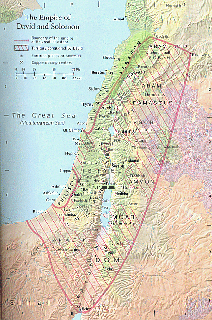
Click here for a larger version
of this map, showing the
locations of Lebanon and Jerusalem respectively
It is interesting to note the names
that Solomon chooses to call the maiden in verse 9;
"sister" is a common term of endearment between
lovers in Near Eastern love poetry, as well as being used
in this way elsewhere in the Bible. And the title "bride"
is better understood as "betrothed one",
showing that Solomon has yet to consummate his
relationship with the maiden, who remains a virgin —
hence Solomon’s description of her a few verses
later as "a garden locked up, a rock garden locked,
a spring sealed up".
The garden imagery employed at the end
of this section of the poem is, once again, a common
metaphor found in Near Eastern love poetry, where the
female character is often portrayed as an orchard, or a
garden full of beautiful and exotic fruits and plants.
|
| |
|
| 4:2 |
Your teeth are like a flock of
newly shorn ewes
Which have come up from their washing,
All of which bear twins,
And not one among them has lost her young. |
| |
|
| 4:3 |
Your lips are like a scarlet thread,
And your mouth is lovely.
Your temples are like a slice of a pomegranate
Behind your veil. |
| |
|
| 4:4 |
Your neck is like the tower of David,
Built with rows of stones
On which are hung a thousand shields,
All the round shields of the mighty men. |
| |
|
| 4:5 |
Your breasts are like two fawns,
Twins of a gazelle
Which feed among the lilies. |
| |
|
| 4:6 |
Until the cool of the day
When the shadows flee away,
I will go my way to the mountain of myrrh
And to the hill of frankincense. |
| |
|
| 4:7 |
You are altogether beautiful, my darling,
And there is no blemish in you. |
| |
|
| 4:8 |
Come with me from Lebanon, my bride,
May you come with me from Lebanon.
Journey down from the summit of Amana,
From the summit of Senir and Hermon,
From the dens of lions,
From the mountains of leopards. |
| |
|
| 4:9 |
You have made my heart beat faster,
My sister, my bride;
You have made my heart beat faster
With a single glance of your eyes,
With a single strand of your necklace. |
| |
|
| 4:10 |
How beautiful is your love,
My sister, my bride!
How much better is your love than wine,
And the fragrance of your oils
Than all kinds of spices! |
| |
|
| 4:11 |
Your lips, my bride, drip honey;
Honey and milk are under your tongue,
And the fragrance of your garments is
like the fragrance of Lebanon. |
| |
|
| 4:12 |
A garden locked is my sister, my bride,
A rock garden locked,
A spring sealed up. |
| |
|
| 4:13 |
Your shoots are an orchard of pomegranates
With choice fruits, henna with nard plants, |
| |
|
| 4:14 |
Nard and saffron, calamus and cinnamon,
With all the trees of frankincense,
Myrrh and aloes, along with all the finest spices. |
| |
|
| 4:15 |
You are a garden spring,
A well of fresh water,
And streams flowing from Lebanon. |
| |
|
|
| 4:16 |
Awake, O north wind,
And come, wind of the south;
Make my garden breathe out fragrance,
Let its spices be wafted abroad.
May my beloved come into his garden
And eat its choice fruits! |
However, the great
praises of Solomon and his attempt to woo the maiden fall
on deaf ears; there is only room in her heart for one,
and the maiden imagines and wishes that the winds would
carry the fragrance of her love to her beloved shepherd,
enticing him to find her and rescue her from the royal
harem where she is currently imprisoned. Some believe verse 5:1 to be the words of the
shepherd, responding to her invitation, but most
commentators rather believe them to the words of the
chorus of harem women, applauding the faithfulness of the
two lovers; the call to the "friends" to drink
deeply may be a foreshadowing of the wedding feast of the
maiden and the shepherd, which will follow after the two
lovers are reunited at the end of the Song of Songs (8:5-14).
|
| |
|
| 5:1 |
I have come into my garden, my sister, my bride;
I have gathered my myrrh along with my balsam,
I have eaten my honeycomb and my honey;
I have drunk my wine and my milk.
Eat, friends;
Drink and imbibe deeply, O lovers. |
| |
|
|
| 5:2 |
I was asleep but my heart was
awake.
A voice! My beloved was knocking:
Open to me, my
sister, my darling,
My dove, my perfect one!
For my head is drenched with dew,
My locks with the damp of the night. |
Similar to the sequence
we have already studied in 3:1-4, we now
encounter another section of the poem that recounts a
dream of the maiden. Just as a few verses earlier she was
calling out for her lover, willing the winds to bring him
to her, now in her dream that has become a reality. He is
outside, knocking at the door! He identifies himself by
his dew-drenched hair, common enough to one whose
profession requires sleeping outside on the hillsides by
night with his flock. Yet the
maiden cannot quite bring herself to believe it is him;
perhaps she is afraid of being let down again — like
the time when he visited the harem before, but could not
get in and had to flee away as night came (2:8-17). Or maybe it is a combination of disbelief
combined with a resignation to her fate, trapped forever
within the walls of the harem.
Finally, the shepherd puts his hand
through the opening of the door, and she is convinced it
is him. Quickly she rises and struggles to open the door,
but when she does, it is too late; her delays have
resulted in the shepherd leaving and so, just like in the
previous dream sequence (3:2) she makes her way
out into the deserted night streets of Jerusalem, to
search for him, calling out frantically, but in vain.
And again, as in the previous dream,
she runs into the night watchmen as they patrol the city
(see 3:3). But this time she incurs their wrath rather
than their pity and help, and she is apprehended and
beaten — perhaps for disturbing the peace with her
shouting, or even for violating the harem curfew which
would have existed for all of Solomon’s many women.
Finally in verse 5:8 comes another of
the maiden’s oft-repeated charges to the women of
the harem; can they tell her beloved shepherd, if they
find him, that she is desperately, desperately love sick
and her hopes of rescue are fading by the day.
|
| |
|
| 5:3 |
I have taken off my dress,
How can I put it on again?
I have washed my feet,
How can I dirty them again? |
| |
|
| 5:4 |
My beloved extended his hand through the opening;
And my feelings were aroused for him. |
| |
|
| 5:5 |
I arose to open to my beloved;
And my hands dripped with myrrh,
And my fingers with liquid myrrh,
On the handles of the bolt. |
| |
|
| 5:6 |
I opened to my beloved,
But my beloved had turned away and had gone!
My heart went out to him as he spoke.
I searched for him but I did not find him;
I called him but he did not answer me. |
| |
|
| 5:7 |
The watchmen who make the rounds in the city
found me.
They struck me and wounded me;
The guardsmen of the walls took away my shawl from me. |
| |
|
| 5:8 |
I
adjure you, O daughters of Jerusalem,
If you find my beloved,
As to what you will tell him:
For I am lovesick. |
| |
|
|
| 5:9 |
What kind of beloved is your
beloved,
O most beautiful of women?
What kind of beloved is your beloved?
That thus you adjure us? |
The women of the harem are puzzled, however;
what is so special about the maiden’s lover that she
so longs for him, that she will not rest until she sees
him again? The chorus of women ask her to explain her
love. |
| |
|
|
| 5:10 |
My beloved is dazzling and ruddy,
Outstanding among ten thousand, |
The request of the harem
women for the maiden to describe just what is so special
about her shepherd lover is an excuse for the maiden to
launch into a song of praise describing, in great detail
and with wonderful poetic language, the tremendous merits
of the shepherd who has her heart. We saw earlier, in
verses 4:1-5 how Solomon used great poetic license to
describe the beauties of the maiden, and it is
interesting to see the maiden apply the same technique to
her lover. One of the remarkable things about this
passage is that descriptive songs about male characters
are very rare in ancient Near Eastern love poetry. The maiden praises various aspects of the
shepherd’s appearance; his strength and splendour,
how handsome he is, how in the maiden’s eyes there
is none finer than this lover of hers.
Her closing words in this stanza are
deeply moving. Whilst her lover may be rugged, strong,
and handsome, this is not the primary reason she seeks to
be reunited with him, nor why she cannot accept King
Solomon’s proposal of marriage and become yet
another wife in his expanding harem. No, the primary
reason she explains why she must find him, why she must
escape is because he is her beloved and her friend.
This is not some idle teenage crush, but she is deeply
and truly in love. This is why he is worthy of such
single-minded, loyal devotion.
|
| |
|
| 5:11 |
His head is like gold, pure gold;
His locks are like clusters of dates
And black as a raven. |
| |
|
| 5:12 |
His eyes are like doves
Besides streams of water,
Bathed in milk,
And reposed in their setting. |
| |
|
| 5:13 |
His cheeks are like a bed of balsam,
Banks of sweet-scented herbs;
His lips are lilies
Dripping with liquid myrrh. |
| |
|
| 5:14 |
His hands are rods of gold
Set with beryl;
His abdomen is carved ivory
Inlaid with sapphires. |
| |
|
| 5:15 |
His legs are pillars of alabaster
Set on pedestals of pure gold;
His appearance is like Lebanon
Choice as the cedars. |
| |
|
| 5:16 |
His
mouth is full of sweetness.
And he is wholly desirable.
This is my beloved and my friend,
O daughters of Jerusalem. |
| |
|
|
| 6:1 |
Where has your beloved gone?
O most beautiful among women?
Where has your beloved turned,
That we may seek him with you? |
The maiden’s words have won over the women
of the harem. At first they wanted to know what was so
special about this shepherd: now they see how deeply the
maiden loves him and the kind of man he is, they agree to
her begging request (5:8) to help find her beloved and so they agree to
join in the search. |
| |
|
|
| 6:2 |
My beloved has gone down to his
garden,
To the beds of balsam,
To pasture his flock in the gardens
And gather lilies. |
The maiden’s
response to the question posed by the harem women is
intriguing; she seems to know where her beloved
shepherd is. Why then not go there and find him herself?
Perhaps the answer is that she is confined to the harem
and cannot leave; we saw this idea at the end of the
dream sequence in 5:7 where the watchmen of the city arrested and
beat the maiden, quite probably for breaking the harem
curfew. However, despite her
inability to flee to her lover, the maiden is still able
to affirm in such strong words the bond between the two
of them. Note the sense of mutual ownership in 6:3
— the maiden is not some mere possession of the man,
but rather their mutual love and devotion to one another
means that she belongs to him, and likewise he belongs to
her.
|
| |
|
| 6:3 |
I am my beloved’s and my beloved is mine,
He who pastures his flock
among the lilies. |
| |
|
|
| 6:4 |
You are beautiful as Tirzah, my
darling,
As lovely as Jerusalem,
As awesome as an army with banners. |
Once again, King Solomon
enters the picture. Not put off by his earlier failures
to woo the maiden and to persuade her to give up her love
for the shepherd and to marry him, Solomon once again
tries to flatter the maiden with highly descriptive
poetry. It is interesting to note
the two cities referred to in 6:4. Jerusalem was,
obviously, the royal capital and home to Solomon’s
expansive palaces. Describing the maiden as being "as
lovely as Jerusalem" would have been high praise
indeed, for it was the religious, royal, political, and
emotional centre of Israel. Tirzah, on the other hand,
was a northern stronghold and would have been known to
the maiden who, as an alien and stranger to the southern
lands, might not have had such a love for Jerusalem.
Tirzah was originally a Canaanite town and was later
captured by the Israelite king Jeroboam I (931-910BC).
Verse 6:8 gives us some information as
to the size of Solomon’s harem at this point; 140
wives and concubines in total, an utter flouting of God’s
instructions to the Israelite kings (see Deuteronomy 17:17).
The "maidens without number" are probably young
women who are available for marriage; it seems Solomon is
trying to win the maiden by arguing "look, I have
all these women, I could marry any young virgin in my
kingdom, yet I desire you".
This section of Solomon’s speech
closes with a chorus from the harem women, who are not so
much asking a question as making a rhetorical statement
about the beauty of the maiden. The phrase "who
is this" as spoken by the chorus is repeated
three times throughout the poem, and gives it much of its
underlying structure. The chorus ask:
- 3:6 Who is this?
As the maiden is brought to Jerusalem by
Solomon amidst much pomp and ceremony, dragged
away from her home and her shepherd lover.
- 6:10 Who is this?
The maiden who is more beautiful than any of the
harem women, whose total devotion to the shepherd
lover for whom she pines has won the admiration
of Solomon’s 140 wives and concubines.
- 8:5 Who is this?
Finally the maiden free and reunited with her
shepherd lover, returning to her home village in
the northern hill country, to marry her shepherd
and finally consummate her love.
|
| |
|
| 6:5 |
Turn your eyes away from me,
For they have confused me;
Your hair is like a flock of goats
That have descended from Gilead. |
| |
|
| 6:6 |
Your teeth are like a flock of ewes,
Which have come up from their washing,
All of which bear twins,
And not one among them has lost her young. |
| |
|
| 6:7 |
Your temples are like a slice of a pomegranate
Behind your veil. |
| |
|
| 6:8 |
There are sixty queens and eighty concubines,
And maidens without number; |
| |
|
| 6:9 |
But my dove, my perfect one, is unique:
She is her mother’s only daughter;
She is the pure child of the one who bore her.
The maidens saw her and called her blessed,
The queens and concubines also, and they praised her,
saying, |
| |
|
| 6:10 |
‘Who is this that grows like the dawn,
As beautiful as the full moon,
As pure as the sun,
As awesome as an army with banners?’ |
| |
|
|
| 6:11 |
I went down to the orchard of
nut trees
To see the blossoms of the valley,
To see whether the vine had budded
Or the pomegranates had bloomed. |
Replying to the great
compliment given to her by the harem women, the maiden
sheds a little more light on how she was captured and
brought to Jerusalem after wandering into an orchard of
nut trees near her home one spring. Before she fully
understood what was happening, she had been spirited away
to Jerusalem and was now facing a marriage to Solomon,
binding her forever into the royal household; "over
the chariots of my noble people" an allusion to the
fact the as one of the many wives of Solomon she would
enjoy position and protection but, ironically, all
freedom would be lost. |
| |
|
| 6:12 |
Before I was aware, my soul set me
Over the chariots of my noble people. |
| |
|
|
| 6:13 |
Come back, come back,
O Shulammite;
Come back, come back, that we gaze at you!
Why should you gaze at the Shulammite,
As at the dance of the two companies? |
This next section of the
poem marks the final appearance of the chorus of harem
women and Solomon’s final attempts to win over the
affections of the maiden and persuade her to marry him. The harem women’s chorus in 6:13 seems to
imply a great urgency; four times they cry "come
back!" Where is the maiden going? The whole thrust
of the verse seems to suggest the maiden is about to
leave — probably the shepherd has finally come to
claim to claim his beloved and take her home. That, or
the maiden is refusing to take part in the dance referred
to with the other harem women, perhaps a dance that is
supposed to mark the start of her own wedding to King
Solomon.
The question asked by the harem women
seems to be possibly directed to King Solomon himself :
"why should you gaze so intensely at the Shulammite
maiden?" King Solomon responds to the question by
launching into one last song of praise for the maiden,
but it is ironic that the language he uses has more
sexual overtones here. His answer seems to be to the
harem — "I will gaze at the maiden because I am
captivated by her sheer physical beauty, and I must have
her for my own!"
The praise of the maiden’s beauty
this time moves up from her feet, whereas before Solomon
had praised her from the head downwards (5:1-5). He describes her feet, her hips, her navel,
her belly, and her breasts; you can almost imagine the
desire burning in his eyes as he longs to add her to his
harem.
It is fascinating to contrast the lust
of the King with the beautiful and all-committed love
that the maiden and the shepherd have for one another.
The King wants to own her for himself — the maiden
and the shepherd have given themselves to one another.
The relationship between the maiden and the shepherd is
built on a deep love — the words of Solomon here
display instead, not love but lust. Thus this part of the
poem provides a moving contrast between real, genuine one-to-one
love and the self-centred, self-seeking love that is the
one-to-many love found in the royal harem.
|
| |
|
| 7:1 |
How beautiful are your feet in your sandals,
O prince’s daughter!
The curves of your hips are like jewels,
The work of the hands of an artist. |
| |
|
| 7:2 |
Your navel is like a round goblet
Which never lacks mixed wine;
Your belly is like a heap of wheat
Fenced upon with lilies. |
| |
|
| 7:3 |
Your two breasts are like two fawns,
Twins of a gazelle. |
| |
|
| 7:4 |
Your neck is like a tower of ivory,
Your eyes like the pools in Heshbon
By the gate of Bath-rabbim;
Your nose is like the tower of Lebanon
Which faces towards Damascus. |
| |
|
| 7:5 |
Your head crowns you like Carmel,
And the flowing locks of your head are like purple
threads;
The king is captivated by your tresses. |
| |
|
| 7:6 |
How beautiful and how delightful you are,
My love, with all your charms! |
| |
|
| 7:7 |
Your stature is like a palm tree,
And your breasts like its clusters. |
| |
|
| 7:8 |
I said, ‘I will climb the palm tree,
I will take hold of its fruit stalks.’
Oh, may your breasts be like clusters of the vine,
And the fragrance of your breath like apples, |
| |
|
| 7:9 |
And your mouth like the best wine!
It goes down smoothly for my beloved,
Flowing gently through the lips of those who fall asleep. |
| |
|
|
| 7:10 |
I am my beloved’s
And his desire is for me. |
For the final time, the
maiden categorically rejects the advances of King Solomon
by declaring wholeheartedly her love for the shepherd. It
is this joyful expression of devotion, loyalty, and
commitment that finally gains the maiden’s release
from the harem. Whether King Solomon freed her in
recognition of her loyalty to her lover, or whether
through simple resignation that nothing he could do would
bend her from her unswerving devotion, we will never know.
But at last she is free! As she
is reunited with her shepherd lover, she is able to
affirm what we already knew from earlier (4:12)
— that despite all the attempts of Solomon she has
remained a virgin, she has saved herself for the shepherd
who is to be her husband, as he has saved himself for her;
hence the poetic reference to "over our doors are
all choice fruits … which I have saved up for you,
my beloved", an allusion to the honour and virginity
of the two lovers as the poem nears its end.
The maiden is so overjoyed to see her
shepherd lover again that she has thrown herself into his
arms, such a public display of affection probably
warranting disapproving looks from the elders of the
village. For a moment the maiden wishes (8:1) that he
were a brother, because then nobody would show any
disapproval of such affection in public.
Finally the maiden and her lover are
united, the reference to "house of my mother"
in verse 8:2 being, as we saw earlier, a strong
suggestion that the relationship of the two has now been
blessed by the family, and has been consummated in
marriage (8:3).
Once more, the maiden sings her oft-repeated
advice to the harem women who would have formed the
chorus in public readings of this poem; that for love to
grow and take root it must not be awakened early nor
rushed, but allowed to nurture in its own time. Then, and
only then, can it blossom into the kind of devoted,
faithful, deep, and sincere love that we have seen
reflected throughout the poem in the two characters of
the maiden and the shepherd.
|
| |
|
| 7:11 |
Come, my beloved, let us go out into the country,
Let us spend the night in the villages. |
| |
|
| 7:12 |
Let us rise early and go to the vineyards;
Let us see whether the vine has budded
And its blossoms have opened,
And whether the pomegranates have bloomed.
There I will give you my love. |
| |
|
| 7:13 |
The mandrakes have given forth fragrance;
And over our doors are all choice fruits,
Both new and old,
Which I have saved up for you, my beloved. |
| |
|
| 8:1 |
Oh that you were like a brother to me
Who nursed at my mother’s breasts.
If I found you indoors, I would kiss you;
No one would despise me, either. |
| |
|
| 8:2 |
I would lead you and bring you
Into the house of my mother, who used to instruct me;
I would give you spiced wine to drink from the juice of
my pomegranates. |
| |
|
| 8:3 |
Let his left hand be under my head
And his right hand embrace me. |
| |
|
| 8:4 |
I want you to swear,
O daughters of Jerusalem,
Do not arouse or awaken my love
Until she pleases. |
| |
|
|
8:5
|
Who is this coming up from the wilderness
Leaning on her beloved?
Beneath the apple
tree I awakened you;
There your mother was in labour with you,
There she was in labour and gave you birth. |
As the scene has shifted
from the royal harem at Jerusalem, this final section of
the poem poses an interesting question — who is the
speaker posing the question to in 8:5? The answer comes a
few verses down (8:8-9) where we realise the voice is
that of the maiden’s brothers. We saw in the
previous section that the maiden had finally been able to
return to her home in the northern hill country; and now
the brothers have seen her in the distance, and are
questioning one another about who it can possibly be they
are seeing. To what exactly the
maiden is referring when she speaks in 8:5 is not
entirely clear, but it is probable that she is speaking
about the cycle of life that God has decreed for humanity:
love, marriage, love making, conception, birth, and love
aroused again.
The imagery in verse 8:6-7 is beautiful;
seals were important emblems of ownership in the ancient
world, and by asking her shepherd lover (now her husband)
to put her like a seal over his heart is to both imply
that she owns him, and he alone owns her. Only in such
complete giving of one to another like this can love be
"as strong as death". True love does indeed
burn brightly, and righteous jealousy can flash like
flames of fire, because true love does not want to give
up the object of its love to another. This love is a
special gift from God, hence the description of love as
"the very flame of the LORD". The poem also
describes how the kind of deep and lasting love that the
maiden and the shepherd have shown for one another cannot
be quenched and it cannot be bought at any price.
In verses 8:8-9 the maiden’s
brothers speak up again, talking of how they worked hard
to protect the virtue of their sister as she grew from a
small girl into a beautiful young woman. However, as the
maiden then explains in 8:10, both their groundwork and
her love for the shepherd — which burned like fire
— enabled her to stand like a wall against the
advances of Solomon, until finally he relented and set
her free.
The imagery in verses 8:11-13 goes back
to the royal courts at Jerusalem; the "vineyard"
is Solomon’s harem, and he was free to do what he
wanted with those who were trapped within it. The maiden’s
honour and virtue — her "vineyard" —
were, on the other hand, her’s alone to give, and
she had chosen to save it for the shepherd who had won
her heart.
|
| |
|
| 8:6 |
Put me like a seal over your heart,
Like a seal on your arm.
For love is as strong as death,
Jealously is as severe as Sheol;
Its flashes are flashes of fire,
The very flame of the LORD. |
| |
|
| 8:7 |
Many waters cannot quench love,
Nor will rivers overflow it;
If a man were to give all the riches of his house for
love,
It would be utterly despised. |
| |
|
| 8:8 |
We have
a little sister,
And she has no breasts;
What shall we do for our sister
On the day when she is spoken for? |
| |
|
| 8:9 |
If she
is a wall,
We will build on her a battlement of silver;
But if she is a door,
We will barricade her with planks of cedar. |
| |
|
| 8:10 |
I was a wall, and my breasts were like towers;
Then I became in his eyes as one who finds peace. |
| |
|
| 8:11 |
Solomon had a vineyard at Baal-hamon;
He entrusted the vineyard to caretakers.
Each one was to bring a thousand shekels of silver for
its fruit. |
| |
|
| 8:12 |
My very own vineyard is at my disposal;
The thousand shekels are for you, Solomon,
And two hundred are for those who take of its fruit. |
| |
|
|
| 8:13 |
O you who sit in the gardens,
My companions are listening for your voice —
Let me hear it! |
Finally the shepherd
calls out to the maiden, imploring her to sing a song
confirming anew her love for him and a commitment to the
kind of love that nothing can destroy. And the maiden
answers his call, her imagery of a stag or gazelle
mirroring the fantasy she had whilst imprisoned in the
harem (2:8-13). The maiden invites her shepherd lover to
playfully, happily unite with her, in all the wonder and
joy of love, marriage, and amazing gift of sexual love. |
| |
|
| 8:14 |
Hurry,
my beloved,
And be like a gazelle or a young stag
On the mountains of spices. |