返回总目录
The Original Sources of the Qur'an [Chapter III]
THE ORIGINAL SOURCES
OF THE QUR'AN
CHAPTER III.
INFLUENCE OF SABIAN AND JEWISH IDEAS AND PRACTICES.
WHEN Muhammad appeared as a prophet, although the Arabs had many religious ideas and
practices in which they were agreed, they possessed no volume which could pretend to contain
a Divine revelation, and to which Muhammad could appeal when he claimed to be commissioned
to lead them back to the purer faith of their fathers. Yet in Arabia there dwelt certain communities
which possessed what they regarded as inspired books, and it was natural that Muhammad and
his followers should therefore feel no little interest in and respect for the ideas and rites of these
different religious sects. The title "People of the Book," given more especially perhaps to the Jews,
but also to the Christians, in the Qur'an is an evidence of this. The four communities who then
possessed book-religions in Arabia were the Jews, the Christians, the Magians or Zoroastrians,
and the Sabians. These are all mentioned together in Surah XXII., Al Hajj, 17. We shall see that
each of these exercised a considerable influence over nascent Islam, but that of the Sabians
was by no
means the slightest. Hence we begin by stating what is known of these sectaries, who are
mentioned again in Surah II., Al Baqarah, 59.
Our knowledge of the Sabians is slight, but sufficient for our purpose. An early Arabic writer,
Abu ‘Isa'l Maghribi, is quoted by Abu'l Fida as giving the following account of them.
"The Syrians are the most ancient of nations, and Adam and his sons spoke their language.
Their religious community is that of the Sabians, and they relate that they received their
religion from Seth and Idris (Enoch). They have a book which they ascribe to Seth, and they
style it ‘The Book of Seth.’ In it good ethical precepts are recorded, such as
enjoin truth-speaking and courage and giving protection to the stranger and such like: and
evil practices are mentioned and command given to abstain from them. The Sabians had
certain religious rites, among which are seven fixed times of prayer, five of which correspond
with that of the Muslims. The sixth is the prayer at dawn, and the seventh a prayer, the time
for which is at the end of the sixth hour of the night. Their prayer, like that of Muslims, is one
which requires real earnestness and that the worshiper should not let his attention wander
to anything else when offering it. They prayed over the dead without either bowing down
or prostration, and fasted thirty days; and if the month of the new moon were a short one,
then they kept the fast for twenty-nine
days. In connexion with their fast they observed the festivals of Fitr" (breaking the
fast at the end of the month) "and Hilal" (new moon), "in such a way that the festival
of Fitr occurred when the sun entered Aries. And they used to fast from the fourth
quarter of the night until the setting of the disk of the sun. And they had festivals at the time
of the descending of the five planets to the mansions of their dignity. The five planets are
Saturn, Jupiter, Mars, Venus, and Mercury. And they used to honour the House of Mecca"
(the Ka'bah)1.
From this account we see clearly that the Muslims have borrowed from this obscure sect not
a few of their religious practices all of which they believe were taught them by Muhammad
at the command of God through the Angel Gabriel. For example, the Ramadan fast of the Muslims
lasts2
a month, from sunrise to sunset, though the rule as to the exact moment when each day begins
and ends is, as we shall see3,
derived from the Jews. In Persia and some other countries a gun is fired at dawn and sunset
to announce the beginning and end of each day's fast during the holy month. The Fitr
feast at the end of the month is still celebrated by the Muhammadans. They have, as is well
known, five stated times of prayer each day, but they have also two other times each day
at which
prayer is optional, thus having exactly the same number as the Sabians had. Bowing down
(raku) and prostration (sujud) are enjoined in Muhammadan worship, but not
during the prayers offered at burials. Finally we have seen that the Muslims still most highly
honour the Ka'bah. Of course it is possible that all these practices were common to
the Quraish tribe as well as to the Sabians. Some of them certainly were; but, if all had been,
it would be difficult to account for the observations made by the Arabic writer whom we have
quoted. The supposition that many of these religious customs were borrowed by Muhammad from
the Sabians, and that their religion in general (owing perhaps in a measure to its supposed antiquity)
had great influence on Islam at its foundation is confirmed by the fact that, when the Banu Jadhimah
of Taif and Mecca announced to Khalid their conversion to Muhammadanism, they did so
by crying out, "We have become Sabians."
The Sabians are supposed to have been a semi-Christian sect. Others have identified them
with the Mandaeans, whose religion represents a strange medley of Gnosticism and ancient
Babylonian heathenism, but has nevertheless borrowed certain elements from Magism,
Judaism, and Christianity, though largely anti-Christian as a system. The Mandaeans derive
their name from Manda, the most important of the Emanations or Aeons in whom they believe.
He is said in their sacred
book, the Sidra Rabba, to have manifested himself in a series of incarnations, the first
three of which were Abel, Seth, and Enoch, and the last John the Baptist. The latter conferred
baptism on Jesus Messiah, who finally returned to the Kingdom of Light after a seeming
crucifixion. This latter idea is repeated in the Qur'an (Surah IV., An Nisa, 159) and will require
notice later4.
Our very limited knowledge of the Sabians and the doubt whether the Mandaeans can be
identified with them renders it impossible to say whether their influence on Islam has or has
not been still more important and extensive5.
We now turn to the Jews from whom Muhammad borrowed so very much that his religion
might almost be described as a heretical form of
later Judaism. In Muhammad's time the Jews were not only very numerous but also very
powerful in various parts of Arabia. No doubt many of them had settled in that country
at different times, when fleeing from the various conquerors — Nebuchadnezzar,
the successors of Alexander the Great, Pompey. Titus, Hadrian, and others — who
had overrun and desolated Palestine. They were especially numerous in the neighbourhood
of Medina, which city they at one time held by the sword. In Muhammad's time the three
large Jewish tribes called Banu Quraidhah, Banu Nadhir, and Banu Qainuqa', settled in
the neighbourhood of Medina, were so powerful that Muhammad, not long after his arrival
there in A.D. 622, made an offensive and defensive alliance with them. Other Jewish
settlements were to be found in the neighbourhood of Khaibar and the Wadi u'l Qura'
and on the shores of the Gulf of 'Aqabah. The fact that the Jews possessed inspired books
and were undoubtedly descended from Abraham, whom the Quraish and other tribes claimed
as their ancestor also, gave the Israelites great weight and influence. Native legends would
naturally therefore undergo a process of assimilation with the history and traditions of
the Jews. By6
a summary adjustment, the story of Palestine became the story of the Hijaz. The precincts
of the Ka'bah were hallowed as the scene of Hagar's distress, and the sacred
well Zamzam as the source of her relief. The pilgrims hastened to and fro between Safa and
Marwa in memory of her hurried steps in search of water. It was Abraham and Ishmael
who built the temple, imbedded in it the Black Stone, and established for all Arabia the
pilgrimage to 'Arafat. In imitation of him it was that stones were flung by the pilgrims as
if at Satan, and sacrifices offered at Mina in remembrance of the vicarious sacrifice by
Abraham. And so, although the indigenous rites may have been little, if at all, altered
by the adoption of Israelitish legends, they came to be received in a totally different light,
and to be connected in Arab imagination with something of the sanctity of Abraham
the Friend of God7 ...
It was upon this common ground Muhammad took his stand, and proclaimed to his people
a new and a spiritual system, in accents to which the whole Peninsula could respond.
The rites of the Ka'bah were retained, but, stripped of all idolatrous tendency, they still
hang, a strange unmeaning shroud, around the living theism of Islam.
"Familiarity with the Abrahamic races also introduced the doctrine of the immortality of
the soul, and the resurrection from the dead; but these were held with many fantastic ideas
of Arabian growth. Revenge pictured the murdered soul as a bird chirping for retribution
against the murderer; and a camel was sometimes left to
starve at the grave of his master, that he might be ready at the resurrection again to carry him.
A vast variety of Biblical language was also in common use, or at least sufficiently in use to be
commonly understood. Faith, Repentance, Heaven and Hell, the Devil and his Angels, the
heavenly Angels, Gabriel the Messenger of God, are specimens acquired from some Jewish
source, either current or ready for adoption. Similarly familiar were the stories of the Fall of
Man, the Flood, the destruction of the Cities of the Plain, &c. — so that there was an
extensive substratum of crude ideas bordering upon the spiritual, ready to the hand of
Muhammad."
Early Arabian writers inform us that when Muhammad appeared the Jews were expecting
the advent of the Messiah, and used frequently to threaten their enemies with the vengeance
which the coming Prophet would take upon them. This no doubt had its influence in leading
some among the Arabs, especially the Banu Khazraj of Medina (as Ibn Ishaq says), to accept
Muhammad as the Prophet whose advent was predicted.
Muhammad declared that he was Divinely commissioned not to found a new religion but to recall
men to the "Faith of Abraham." It was natural for him, therefore, to endeavour to gain the Jews
over to his side. This he attempted to do at Medina, and for some time it seemed as if he had
a fair prospect of success. One step which he took
at this time shows very clearly this purpose. He adopted Jerusalem as the Qiblah
of his Faith — that is to say, he directed his followers to imitate the Jewish practice by
turning their faces towards Jerusalem when praying. At a later period, when he had broken
with the Jews and found it more useful to conciliate the Arabs, he adopted
Mecca8
as the Qiblah, and this it has ever since continued to be amongst Muslims. But soon
after his arrival in Medina, observing the Jews engaged in the observances of the Day of
Atonement, he enjoined upon his own followers the same observance, adopting even
the same name (in Arabic 'Ashura) by which it was known among the
Jews9.
The sacrifices offered on this occasion were doubtless intended to supersede those which
the heathen Arabs used to offer in the Valley of Mina during the pilgrimage to Mecca. It was
not until April, A.D. 624, after his quarrel with the Jews, that Muhammad instituted the
'Idu'd Duha which festival is supposed to commemorate Abraham's sacrifice of
Ishmael (as the Muslims assert). Even thus we perceive the influence of Judaism
on Islam. This festival is still observed by the Muslims. Muhammad initiated the Jewish
practice in offering two10
sacrifices on
the day of the 'Id, inasmuch as he slew two kids, one for his people and the other
for himself, though he reversed the Jewish order in accordance with which the High Priest
on the Day of Atonement offers first for11
himself and then for the nation at large. In these matters we see Jewish influence at work
both in Muhammad's adoption of their rites when he wished to gain the Jews, and in his
altering them when no longer hoping to do so. In the latter case he generally reverted more
or less to the customs of the heathen Arabs. On the Muhammadan theory of the Divine
authority of the Qur'an, this phenomenon is absolutely inexplicable. It is to the period
shortly before, and especially to that which immediately followed, the Hijrah, according to
Tradition (in this respect no doubt reliable), that most of those verses of the Qur'an belong,
in which it is asserted that the Qur'an is in accord12
with the teaching of the Prophets of Israel, and that this constitutes a decisive proof that
it is from God. At that time Muhammad introduced into the Surahs which he delivered
a particularly large measure of Jewish legends, as the perusal of the later Meccan and
earlier Medinan Surahs will show. He soon, however, found that the Jews were not
prepared to believe in him, though it might suit their purpose to pretend for
a time to be favourably impressed and likely to admit his claim. A rupture was bound
to come sooner or later, since no true Israelite could really believe that either the Messiah
(which Muhammad did not claim to be, for he accepted that as the title of Jesus) or any
other great Prophet was predicted as about to arise from among the descendants of Ishmael.
We know how the quarrel did come, and how, finding persuasion useless, Muhammad finally
turned upon the Jews with the irresistible logic of the sword, and either slaughtered them or
expelled them from the country. But before that time he had borrowed very extensively from
them. Even if we do not grant, with some writers, that the doctrine of the Unity of God was
derived by Islam from Jewish teaching, there can he no doubt that Muhammad's maintenance
of that doctrine received great support from what he learnt from the Israelites. We proceed
to show that very much of the Qur'an is directly derived from Jewish books, not so much from
the Old Testament Scriptures as from the Talmud and other post-Biblical writings. Although
the Arabian Jews doubtless possessed copies of their Holy Books, they were not distinguished
for learning, and then as now for the most part, they practically gave greater heed to their
Rabbinical traditions than to the Word of God. It is not surprising therefore to find little
real knowledge of the Old Testament in the Qur'an, though, as we shall see, it contains
a great deal of Jewish legend. It is impossible to quote all the passages that prove this,
but we shall now adduce a few out of many13.
The Story Of Cain and Abel
The Qur'an does not mention the names of these "two sons of Adam," though commentators call
them Qabil and Habil. But we find in Surah V., Al Maidah, 30-35, the following account of them.
"Recite unto them truly the narrative of Adam's two sons, when they both offered sacrifice:
then it was accepted from one of them, and from the other it was not accepted. [The latter]
said, ‘Verily I shall assuredly slay thee.’ [The other] said, ‘Truly God
accepteth from the pious. Verily if thou stretch forth thine hand upon me to slay me, I shall
not stretch forth mine hand upon thee to slay thee: indeed I fear God, the Lord of the worlds.
I indeed choose rather that thou shouldst bear my sin and thine own sin, then shalt thou
be of the companions of the Fire, and that is the recompense of the unjust.’ Then
his soul permitted to him [Cain] the murder of his brother: accordingly he slew him: thus
he became one of the lost. Then God sent a raven, which scratcheth in the ground, that it
might show him how to hide his brother's corpse. He said, ‘Ah! woe unto me!
cannot I be as this raven and hide my brother's corpse?’ Then did he become one
of the penitent. On that account have We written for the Children of Israel that whoso
slayeth a soul, except for a life or for evildoing in the land, then truly shall it be as though
he had slain all men; and whoso saveth it alive, then truly it shall be as though he had
saved all men alive."
A conversation, or rather argument, between Cain and Abel is mentioned in Jewish legend both
in the Targum of Jonathan14
and in the Targum of Jerusalem. Cain, we are told, said, "There is no punishment for sin, nor is
there any reward for good conduct." In reply to this, Abel asserted that good was rewarded
by God and evil punished. Angered at this, Cain took up a stone and with it smote his brother
and slew him. The resemblance between this narrative and that given in the beginning of the
foregoing quotation from the Qur'an is not striking. But the source of the rest of the
Qur'anic account of the murder is the legend related in the Pirqey Rabbi Eli'ezer, chapter xxi,
which may be thus rendered:—
"Adam and his helpmeet were sitting weeping and lamenting over him (Abel), and they did not
know what to do with Abel, for they were not acquainted with burial. A raven, one of whose
companions had died, came. He took him and dug in the earth and buried him before their eyes.
Adam said, ‘I shall do as this raven.’ Immediately (lit. out of hand) "he took
Abel's corpse and dug in the earth and buried it." When we compare the Jewish legend with
the one given in the Qur'an, we see that the only difference is that in the former the raven taught
Adam how to bury the body, whereas in the Qur'an it is Cain who is said to have
been thus taught. It is clear also that the passage in the Qur'an is not a literal translation from
one or more Jewish books, but is rather, as we might expect, a free reproduction of the story as
told to Muhammad by some of his Jewish friends, of whom early Arabian accounts mention the
names15
of several. This explains the mistake that the Qur'an makes in attributing the burial to Cain instead
of to Adam. We shall notice similar phenomena throughout the whole series of these excerpts.
It is hardly probable that these slight divergences were purposely made by Muhammad, though
it is quite possible that the Jews who related the legends to him had learnt them orally themselves,
and that they and not the Arabian prophet made the mistake. That is a matter of small moment.
What is certain is that we can here, and in very many other instances, trace the account which
Muhammad gives to earlier Jewish written sources.
What is recorded in the thirty-fifth verse of the Surah quoted above seems to have no immediate
relation to the preceding part of the passage. A link is evidently missing. If, however, we turn to
Mishnah Sanhedrin (chapter iv. § 5), we find the whole matter fully stated, so that the connexion
which exists between the verse above mentioned and the narrative of the murder of Abel becomes
clear. For the Jewish commentator, in commenting on the words which the Pentateuch tells us
God spoke to Cain, "What16
hast thou done? The voice of thy brother's blood crieth unto me front the ground;" — in
which passage the word blood is in the plural in Hebrew because it denotes blood shed
by violence, — writes thus: "Concerning Cain who slew his brother, we have found that it
is said concerning him, ‘The voice of thy brother's bloods crieth.’ He saith
not, ‘Thy brother's blood’ but ‘Thy brother's bloods,’ —
his blood and the blood of his descendants. On this account was Adam created alone, to teach
thee that everyone who destroyeth one soul out of Israel, the Scripture reckoneth it unto him
as if he had destroyed the whole world; and everyone who preserveth alive one soul out of Israel,
the Scripture reckoneth it unto him as if he had preserved alive the whole world." We are not
concerned with the correctness or otherwise of this fanciful exposition of the sacred text, but it
is of importance to notice that the thirty-fifth verse of Surah Al Maidah is an almost literal translation
of part of this extract.
The former part of the passage as it stands in the Mishnah is omitted in the Qur'an, possibly because
it was not fully understood by Muhammad or his informant. But when it is supplied, the connexion
between verse thirty-five and the preceding verses becomes clear17.
2. Story of Abraham's deliverance from the fire
which Nimrod made to destroy him.
This narrative is not found detailed in one consecutive passage of the Qur'an, but it is related
in a fragmentary manner in a number of different Surahs18.
Hence Muhammadans have found it useful to collect these passages and to form them into
a consecutive whole by supplying connecting passages in the way that we find it done in such
books as the ‘Araisu'l Majalis or the Qisasu'l Anbiya. Such connecting links
are supplied from the Traditions of Muhammad. When we compare the narrative thus current
among and accepted by all Muslims with the account of the same legendary
occurrence which is contained in the Midrash Rabba of the Jews, it becomes clear that the
latter is the source of the Muhammadan account. That the reader may perceive this, we translate
first the story as related by Muhammadan writers, and then turn to the shorter and simpler narrative
of Jewish traditionists. Passages from the Qur'an which are incorporated into the Arabic account
are here put in italics. We begin with an extract from Abu'l Fida:—
"Azar, Abraham's father," he says19,
"used to make idols, and he used to give them to Abraham that he might sell them. Abraham, however,
used to say, ‘Who will buy what will injure him and will not benefit him?’ Afterwards,
when God Most High commanded Abraham to summon his people to Monotheism, he invited his
father; however, he refused. And he invited his people. Accordingly, when the matter got abroad
concerning him and reached Nimrod, son of Gush, who was king of that country, ... Nimrod accordingly
took Abraham, the Friend [of God], and threw him into a great fire. Then the fire became cool and
safe unto him, and Abraham came forth from the fire after some days. Then certain men of his people
believed on him."
This is the shortest Arabic account we have. We proceed to translate the most important part
of the narrative given in the 'Araisu'l Majalis. There we read that Abraham was brought up
in a cave without any knowledge of the true God. One night he came forth and beheld the glory of
the stars, and was so impressed that he resolved to acknowledge them as his gods. The account then
proceeds as follows, incorporating as many as possible of the passages of the Qur'an which deal
with the subject:—
"When therefore the night overshadowed him he saw a star. He said, ‘This is my Lord.’
Then when it set, he said, ‘I love not those that set.’ Then when he saw the moon rising,
he said, ‘This is my Lord.’ And when it set, he said, ‘Verily if my Lord guide me
not I shall assuredly be of the people who go astray.’ Then when he saw the sun rising,
he said, ‘This is my Lord, this is greater,’ for he saw that its light was grander.
When therefore it set, he said, ‘O my people! verily I am guiltless of the polytheism which
you hold, verily I turn my face to him who hath formed the heavens and the earth, as a
Hanif20,
and I am not one of the polytheists21.’
They say his father used to make idols. When therefore, he associated Abraham with himself, he
began to make the idols and to give them over to Abraham to sell. Abraham (Peace be upon him!)
therefore goes off with them and cries aloud, ‘Who will buy what injures and does not benefit?’
Hence no one purchases from him. When therefore they proved unsaleable to him, he took them
to a river. Then he smote them on the head and said to them, ‘Drink, my bad bargain!’
in mockery of his people and of their false religion and ignorance, to such an extent that his reviling
and mocking them became notorious among his people and the inhabitants of his town. Therefore
his people disputed with him in regard to his religion. Then he said to them, ‘Do ye dispute
with me about God? and He hath guided me,’ &c. ... And that was Our reasoning which We
brought to Abraham against his people: We raise (many) steps whomsoever We will; verily thy Lord
is all-wise and all-knowing22.
So that he vanquished and overcame them. Then verily Abraham invited his father Azar to embrace
his religion. Accordingly he said, ‘O my father, why dost thou worship that which heareth
not nor seeth nor doth profit thee at all?23’ &c.
Then his father refused assent to that to which Abraham invited him. Thereupon verily Abraham
proclaimed aloud to his people his abjuration of their worship, and declared his own religion.
He said therefore, ‘Have ye then seen that which ye worship, ye and your fathers
the ancients? for verily they are hostile to me, except the Lord of the worlds.24’
They said, ‘Whom then dost thou worship?’ He said, ’The Lord of
the worlds.’ They said, ‘Thou meanest Nimrod.’ Then said he, ‘No! Him
who has created me, and who therefore guideth me,’ &c. That matter accordingly was spread
abroad until it reached the tyrant Nimrod. Then he called him and said to him, ‘O Abraham,
hast thou seen thy God, who hath sent thee, and to whose worship thou dost invite men, and
whose power thou recordest and on account thereof dost magnify Him above all other? What
is He?’ Abraham said, ‘My Lord is He who preserveth alive and causeth to die.’
Nimrod said, ‘I preserve alive and cause to die.’ Abraham said, ‘How
dost thou preserve alive and cause to die?’ He said, ‘I take two men to whom death
is due in my jurisdiction, then I slay one of them, thus I have caused him to die; next I pardon
the other and let him go, thus I have preserved him alive.’ Accordingly Abraham said
unto him thereupon, ‘Verily God bringeth the sun from the East, do thou therefore bring
it from the West25’
Thereupon Nimrod was confounded and gave him no answer."
The story goes on to inform us that the custom of the tribe to which Abraham belonged was
to hold a great festival once every year, during which everyone for a time went out of the city.
(This may contain a confused reference to the Jewish Feast of Tabernacles, for the forte
of the Qur'an is undoubtedly the number of its anachronisms, and Muhammadan tales regarding
the patriarchs
and prophets are in general distinguished by the same characteristic.) Before leaving the city,
we are told, the citizens "had made some food ready. Accordingly they placed it before the
gods, and said, ‘When it shall be time for us to return, we shall return, and the gods will have
blessed our food and we shall eat.’ When therefore Abraham26
beheld the idols and the food which was before them, he said unto them in mockery, ‘Will
ye not eat?’ And when they did not answer him, he said, ‘What is the matter
with you? will ye not speak?’ Then he turned upon them, striking a blow with his right
hand27,
and he began to dash them in pieces with an axe which he held in his hand, until there remained
none but the biggest idol, on the neck of which he hung the axe. Then he went out. Such then
is the statement of the Honoured and Glorified One: ‘So he broke them into pieces,
except the largest of them, that perchance they might come back to it’ (and find
what it had done28).
When therefore the people came from their festival to the house of their gods, and saw them
in that condition, they said, ‘Who hath done this to our gods? verily he is one of
the unjust.’ They said, ‘We heard a youth who is called Abraham make mention
of them. It is he, we think, that hath done this.’ Then that
matter reached Nimrod the tyrant and the nobles of his people. They said therefore,
‘Bring him then to the eyes of men, that perchance they may bear witness
against him that it is he that hath done this.’ And they disliked to arrest him without
poof. ... When therefore they had brought him forward, they said unto him, ‘Hast
thou done this unto our gods, O Abraham?‘ Abraham said, ‘On the
contrary, the biggest of them did it: he was angry at your worshipping these little idols
along with him, since he is bigger than them, therefore he dashed them in pieces. Do ye
then inquire of them, if they can speak.’ The prophet — may God bless
and preserve him! — hath said, ‘Abraham told only three lies, all of them on
behalf of God Most High: when he said, "I am sick," and when he said, "On the
contrary, this the biggest of them did it," and when to the king who purposed to take
Sarah, he said, "She it my sister."’
"When therefore Abraham said this unto them, they returned to themselves; then
they said, ‘Verily ye are the unjust persons. Here is this man of whom you are
inquiring, and these your gods are present to whom he has done what he has done; therefore
inquire of them.’ And that was what Abraham had said, ‘Do ye then inquire
of them, if they can speak.’ Therefore his people said, ‘We do not find it
otherwise than as he hath said,’ and it was said, ‘Verily ye are the unjust
persons29,
since ye worship
the small images along with this big one.’ Then they were turned upside down
in their astonishment at this matter of his, and they knew that (the idols) do not speak and
do not take by violence. Therefore they said, ‘Truly thou knowest that these do
not speak.’ When therefore the argument which Abraham had brought against
them had confuted them, he said to them, ‘Do ye then worship instead of God
that which doth not profit you at all and doth not harm you? Shame on you and on that
which ye worship instead of God! Do ye not then understand?’ When therefore
this argument overcame them and they could not answer it, they said, ‘Burn
ye30
him and aid your gods, if ye are active men.’ 'Abdu'llah ibn 'Umar has said
that the person who urged them to burn Abraham in the fire was a Kurd. Shu'aibu'l Jabai
says that his name was Dainun, and accordingly God Most High caused the earth
to split open for him, and he was swallowed31
up therein until Resurrection Day. Accordingly when Nimrod and his people assembled
to burn Abraham, they shut him up in a house and erected for him an edifice like a sheepfold.
This is the statement of God: They said, ‘Build an edifice for him, then hurl him
into the flames32.’ Then they collected for him some of
the hardest wood and different kinds of fuel."
The writer whom we are quoting goes on to relate how Abraham was cast into the fire
but came forth safe and well. He concludes his narrative thus: "And it is recorded in
Tradition that Abraham was preserved through saying, ‘God is sufficient for
me33,’
and ‘He is an excellent Guardian34.’
God said, ‘O fire, become cool and safe unto Abraham35.’"
We now proceed to compare with this narrative that which, is contained in the Midrash Rabba of
the Jews There the tale runs thus36:—
"Terah was a maker of idols. Once he went out somewhere, and seated Abraham as salesman
in place of himself. A person would come, wishing to purchase, and Abraham would say to him,
‘How old art thou?’ and he (the other) would say to him, ‘Fifty’ or
‘Sixty years.’ And he (Abraham) would say unto him, ‘Woe to that man
who is sixty years of age, and wisheth to worship a thing a few days old!’ And he
(the other) would become ashamed and would go his way. Once a woman came, carrying in
her hand a plate of wheaten flour. She said to him, ‘Here! set this before them.’
He arose, took a staff in his hand, and broke them all in pieces; then he gave the staff into
the hand of the one that was biggest among them. When his father came, he said to him,
‘Who has done this unto them?’ He (Abraham) said to him, ‘What is
hidden from thee? A woman came, bringing with her a plate of wheaten flour, and said to me,
"Here! set this before them." I set it before them. This one said, "I shall eat first," and that one
said, "I shall eat first." This one, which is the biggest among them, arose, took a staff, and
broke them.’ He (the father) said to him, ‘Why dost thou tell me a fable? Do these
understand?’ He (Abraham) said to him, ‘And do not thine ears hear what thy
lip speaketh?’ He (Terah) seized him and delivered him over to Nimrod. He (Nimrod)
said to him, ‘Let us worship the fire.’ Abraham said unto him, ‘And let
us worship the waters which extinguish the fire.’ Nimrod said to him, ‘Let us
worship the waters.’ He (Abraham) said to him, ‘If so, let us worship the cloud
which brings the waters.’ He (Nimrod) said to him, ‘Let us worship the cloud.’
He (Abraham) said to him, ‘If so, let us worship the wind that drives away the cloud.’
He (Nimrod) said unto him, ‘Let us worship the wind.’ He (Abraham) said to him,
‘And let us worship man who resisteth the wind.’ ‘If thou bandiest words
with me, lo! I worship naught but the fire; lo! I cast thee into the midst of it, and let the God
whom thou worshippest come and deliver thee from it!’ Abraham went down into
the furnace of fire and was delivered."
It is perfectly clear that the Muhammadan fable is directly borrowed from the Jewish though
expanded by the addition of particulars due to Muhammad's
vivid and poetical imagination. But here again we see that Muhammad does not reproduce
an account which he had read, but a story which he had heard related orally by
the Jews. The hold which the narrative took upon his mind is clear not only from his having
expanded the tale, but also from the large number of times that he recurs to it in different
parts of the Qur'an. That the tale was well known in its main outline in his time is evident from
the fact that Muhammad has nowhere thought it necessary to narrate the story at full length.
His words in the Qur'an show that he believed it to be perfectly well known to and accepted
by all his followers. It was probably current in Arabia long before his time, as so many other
tales about Abraham were. Our object in quoting the story as it is contained in the Midrash
Rabba is not to prove that Muhammad plagiarized from that work in this matter, but to show
that the story in its main details was current among the Jews at an earlier time still, and that
either this or some similar form of the fable must have been the source from which the Arabs
derived their knowledge of it. It is hardly likely that Muhammad omitted to verify the tale
by consulting his Jewish friends, who would tell him that it was contained in certain of their
books, and thus confirm his faith in its truth.
We notice, however, that in the Qur'an the name of Abraham's father is stated to have been
Azar and
not Terah, as in Genesis. But Eastern Jews sometimes call him Zarah, from which
the Arabic form may have been corrupted. Or, again, Muhammad may have learnt the name
in Syria, whence Eusebius probably derived the form of the name,  ,
which he uses. Modern Persian Muhammadans often write the name
,
which he uses. Modern Persian Muhammadans often write the name  ,
pronouncing it, however, just as it is pronounced in Arabic, though the original Persian
pronunciation was Adhar, nearly the same as the form used by Eusebius. This word
in Persian meant "fire," and was the title of the angel who was supposed to preside over that
element, one of the good creatures of Ormazd. There may in fact have been some attempt made
to win reverence for Abraham among the Magians by identifying his father with this good
Genius (Izad) of Fire. However this may be, we are able to trace the origin of the legend
of Abraham's being cast into the fire to a simple blunder made by certain Jewish commentators,
as will be pointed out in due course.
,
pronouncing it, however, just as it is pronounced in Arabic, though the original Persian
pronunciation was Adhar, nearly the same as the form used by Eusebius. This word
in Persian meant "fire," and was the title of the angel who was supposed to preside over that
element, one of the good creatures of Ormazd. There may in fact have been some attempt made
to win reverence for Abraham among the Magians by identifying his father with this good
Genius (Izad) of Fire. However this may be, we are able to trace the origin of the legend
of Abraham's being cast into the fire to a simple blunder made by certain Jewish commentators,
as will be pointed out in due course.
Before doing so, however, it may be well to indicate the line of argument commonly used by
Muslims in refutation of the statement that the detection of the source of this and other similar
legends in the Qur'an effectually disposes of its claim to be a Divine revelation. They urge in
reply that such facts as those we have adduced form a clear proof of the truth of their religion.
"For," they say, "although Muhammad did not
borrow this narrative from the Jews, but on the contrary received it by inspiration through the
angel Gabriel, yet, since the Jews, who are Abraham's descendants, have accepted this narrative
on the authority of their own traditions, it must be confessed that their testimony forms a strong
confirmation of the teaching of the Qur'an on the subject37."
In reply it is sufficient to state that only ignorant Jews now place any reliance upon such fables,
since they do not rest upon anything worthy of the name of tradition. The only reliable traditions
of the Jews which relate to the time of Abraham are to be found in the Pentateuch, and it is hardly
necessary to say that this childish tale is not found there. On the contrary, it is evident from
Genesis that Nimrod lived many generations before Abraham's time. It is true that Nimrod is not
mentioned by name in the Qur'an, but his name occurs, as we have seen, in this tale about Abraham's
being cast into the fire both in Muhammadan tradition and in their commentaries on the Qur'an,
as well as in the Jewish narrative in the Midrash Rabba. The anachronism here is as great as if
some ignorant person were to state that Alexander the Great had cast the Turkish Sultan 'Uthman
into the fire, not knowing what a long period had elapsed between Alexander and 'Uthman and
being
unaware that Uthman had never experienced such an adventure!
Moreover the whole story of Abraham's being delivered from the fire is founded upon an
ignorant blunder made by an ancient Jewish commentator. To explain this we must refer to
the Targum of Jonathan ben Uzziel. This writer found Ur of the Chaldees mentioned as
the place38
where Abraham dwelt when God first called him to leave home and country and to remove into
the land of Canaan. Now this city is the place that is at the present time known by the name of
Muqayyar. The word ur or uru in ancient Babylonian meant a city. It
occurs again in the name Jerusalem (still in Arabic called Urushalim), "the city of the
God of Peace." But Jonathan had no knowledge of Babylonian, and he imagined that Ur
must have a meaning similar to that of the Hebrew word Or, "light," which in Aramaic
means "Fire." Hence he rendered Gen. xv. 7 thus, "I am the LORD, who brought thee out of
the furnace of fire of the Chaldees!" So also in his comment on Gen. xi. 28, he writes
thus: "When Nimrod cast Abraham into the furnace of fire because he would not worship his
idols, it came to pass that the fire was not given permission to injure him." We see that the
whole story rose from a wrong explanation of a single word, and has no foundation in fact.
Whether Jonathan was the first person to make the mistake is very doubtful;
he may, very probably, have accepted the idea from others. In any case the result is the same.
The story puts us in mind of Cinderella's glass slipper. Doubtless it was originally
"un soulier de vair," not "un soulier de verre," the latter substance not being
so very suitable for making slippers!
It is not to be wondered at that Jonathan ben Uzziel should make such a mistake as we have
pointed out. But it is indeed strange that one claiming Divine inspiration should have accepted
the fable based upon such a blunder as literally true, should in many different places introduce
portions of the tale into a book which he professed to have received from God Himself through
Gabriel, and should have taught his followers to believe it, and to consider that the agreement
between the Qur'an and the Jewish Scriptures (in which he erroneously supposed that the tale
was to be found) in this and similar matters was a proof that he was Divinely commissioned
as a prophet
3. Story of the Queen of Sheba's visit to Solomon.
Regarding the origin of this tale as narrated in the Qur'an there cannot be the slightest doubt. It
is taken with only very slight alterations from the Second Targum on Esther, which is printed in
the Miqraoth Gedoloth. Muhammad no doubt believed it to form part of the Jewish Scriptures,
and its absurdities were so much to his taste and that of
the Arabs that he introduced it into the Qur'an (Surah XXVII., An Naml, v. 17 and vv. 20-45),
where it is related in the following manner:—
"And his hosts (composed) of jinns and men and birds were gathered together unto Solomon.
And he reviewed the birds: then He said, ‘What (hath happened) to me that I do not
see the hoopoe (hudhud)? Or is it among the absentees? Truly I shall punish it with
severe punishment. Either I shall slaughter it assuredly, or it shall surely bring me clear
proof39.’
Accordingly it delayed not long. Then it said: ‘I am aware of what thou art not aware of,
and I have come to thee from Sheba40
with sure information. Verily I found a woman who reigneth over them and who is brought
some of everything, and she hath a great throne. And I found her and her people worshipping
the Sun instead of God, and Satan hath made their deeds attractive unto them, and hath turned
them aside from the way, therefore they are not guided aright so that they should worship God,
who bringeth forth what is concealed in the heavens and the earth, and knoweth what ye hide
and what ye reveal. God! there is no god but He, the Lord of the Great Throne.’ He said,
‘We shall see whether thou hast spoken truly or art among the liars. Go thou with this
my epistle, and cast it down to
them; then turn thou away from them: then see what (answer) they will return.’
"(The queen) said, ‘O nobles, verily to me hath a gracious epistle been cast down:
verily it is from Solomon: verily it is "In the name of God the Merciful, the Compassionate!
Rise not up against me, but come unto me submissively41."’
She said, ‘O nobles, instruct ye me in my matter: I do not decide a matter until ye
bear witness.’ They said, ‘We are men of strength and of mighty courage
and command (belongeth) unto thee: therefore see thou what thou wilt command.’
She said, ‘Verily when kings enter a city, they destroy it and make humble the most
honoured of its people, even so do they. And verily I do send unto them a gift and see
with what (answer) the messengers return.’
"Accordingly when (the messenger) came to Solomon, (the king) said, ‘Do ye
increase my goods? since what God hath brought me is better than what He hath brought
you. Nay, ye boast of your gift. Return thou to them: for indeed we shall come to them
with hosts which they cannot resist, and we shall expel them from it (the country) humbled,
and they shall be small.’ He said, ‘O nobles, which of you will bring me her
throne, before they come to me submissively41?’
An 'Ifrit of the jinns said, ‘I shall bring it to thee before thou risest up from thy place,
and verily I am indeed able to do it (and am) faithful.’ He who had
knowledge from the Book said, ‘I shall bring it to thee before thy glance shall
return42
to thee.’ When, therefore, (Solomon) saw it placed beside him, he said,
‘This is from my Lord's favour, that he may prove me, whether I be grateful or
ungrateful. And he who is grateful is grateful indeed for himself, and he who is
ungrateful, verily my Lord is rich and gracious.’
"He said, ‘Alter her throne for her! we shall see whether she is rightly guided or is
among those who are not guided aright.’ Accordingly, when she came, it was said,
‘Is this thy throne?’ She said, ‘It is as if it were.’ ‘And
we were brought knowledge before she was, and became Muslims: And that which
she used to worship instead of God hath led her astray: verily she is of an unbelieving
people.’ It was said to her, ‘Enter the palace.’ When therefore she
saw it, she accounted it an abyss, and she uncovered her legs. He said, ‘Verily
it is a palace paved with glass.’ She said, ‘O my Lord, verily I have wronged
my soul, and I resign43
myself along with Solomon to God, the Lord of the worlds.’"
This narrative omits some details that are mentioned in the Targum and differs from the
latter in a few points. The Targum states that the throne44
a belonged to Solomon, and that
twenty-four eagles, stationed above the throne, cast their shadow upon the king's head
as he sat thereon. Whenever Solomon desired to go anywhere, these eagles would transport
him and his throne thither. Hence we see that the Targum represents the eagles as the bearers
of the throne, whereas the Qur'an states that an 'Ifrit did Solomon such a service once only,
and then when the throne was empty. But with regard to the Queen of Sheba and the letter
which the king sent her by means of the bird, there exists a marvellous resemblance between
the two books, except that the Targum calls the hoopoe a "cock of the desert" which is much
the same thing. We here give a translation of this passage of the Targum for the sake of
comparison with the Arabic account.
"Again, when King Solomon's heart was merry with his wine, he commanded to bring the
beasts of the field and the fowls of the air and the creeping things of the earth and the jinns
and the spirits and the night-goblins to dance before him, in order to show his greatness to
all the kings who were prostrating themselves before him. And the king's scribes summoned
them by their names, and they all assembled and came unto him, except the prisoners and
except the captives and except the man who took charge of them. At that hour the cock of
the desert was enjoying himself among the birds and was not found. And the king commanded
concerning him that they should
bring him by force, and wished to destroy him. The cock of the desert returned to King Solomon's
presence and said to him, ‘Hearken, my lord the king of the earth, incline thine ear and
hear my words. Is it not three months ago that I took counsel in my heart and formed a firm
resolution with myself that I would not eat, and would not drink water, before I had seen the
whole world and flown about in it? And I said, Which province or kingdom is there that is
not obedient to my lord the king? I beheld and saw a fortified city, the name of which is Qitor,
in an eastern land. The dust is heavy with gold, and silver is like dung in the streets, and trees
have been planted there from the beginning; and from the Garden of Eden do they drink water.
There are there great multitudes with garlands on their heads. From there are plants from
the Garden of Eden, because it is near unto it. They know how to shoot with the bow, but
cannot be slain with the bow. One woman rules over them all, and her name is the Queen of
Sheba. Now if it please thee, my lord the king, this person45
will gird up my loins, and I shall rise up and go to the fortress of Qitor, to the city of Sheba;
I shall "bind their kings with chains and their nobles with links of iron," and shall bring them
unto my lord the King.’ And the saying was pleasing before the king, and the king's
scribes were called, and they wrote a letter
and fastened the letter to the wing of the cock of the desert. And he arose and went up high
into the sky and bound on his tiara and grew strong, and flew among the birds. And they flew
after him. And they went to the fortress of Qitor, to the city of Sheba. And it came to pass
at morning time that the Queen of Sheba went forth by the sea to worship. And the birds
darkened the sun; and she laid her hand upon her garments and rent them, and she became
surprised and troubled. And when she was troubled, the cock of the desert came down to her,
and she saw, and lo! a letter was fastened to his wing. She opened and read it. And this was
what was written in it:— ‘From me, King Solomon. Peace be to thee, peace be
to thy nobles! Forasmuch as thou knowest that the Holy One, blessed be He! has made me
King over the beasts of the field, and over the fowls of the air, and over jinns and over spirits
and over night-goblins, and all the kings of the East and the West and the South and the North
come and inquire about my health (peace): now, if thou art willing and dost come and inquire
after my health, well: I shall make thee greater than all the kings that bow down before me.
And if thou art not willing and dost not come nor inquire after my health, I shall send against
thee kings and legions and horsemen. And if thou sayest, ‘What kings and legions
and horsemen has King Solomon?’ — the beasts of the field are kings and
legions and horsemen. And if thou sayest, ‘What horsemen?’ — the fowls
of the air are horsemen, my armies are spirits and jinns, and the night-goblins are legions
that shall strangle you in your beds within your houses: the beasts of the field shall slay you
in the field; the birds of the air shall eat your flesh from off you.’ And when the Queen
of Sheba heard the words of the letter, again a second time she laid her hand upon her garments
and rent them. She sent and called the elders and nobles, and said to them, ‘Do ye not
know what King Solomon has sent to me?’ They answered and said, ‘We do not
know King Solomon nor do we make any account of his kingdom.’ But she was not
contented, nor did she hearken unto their words, but she sent and called all the ships of the sea
and loaded them with offerings and jewels and precious stones. And she sent unto him six
thousand boys and girls, and all of them were born in the same (one) year, and all of them were
born in one month, and all of them were born in one day, and all of them were born in one hour,
and all of them were of the same stature, and all of them were of the same figure, and all of them
were clad in purple garments And she wrote a letter and sent it to King Solomon by their hands.
‘From the fortress of Qitor to the land of Israel is seven years journey. Now through thy
prayers and through thy petitions which I entreat of thee, I shall come to thee at
the end of three years.’ And it came to pass at the end of three years that the Queen
of Sheba came to King Solomon. And when King Solomon heard that the Queen of Sheba had
come, he sent unto her Benaiah the son of Jehoiada, who was like the dawn that rises at morning-time,
and resembled the Star of Splendour (Venus) which shines and stands firm among the stars, and
was similar to the lily which stands by the water-courses. And when the Queen of Sheba saw
Benaiah, son of Jehoiada, she alighted from the chariot. Benaiah, son of Jehoiada, answered and
said to her, ‘Why hast thou alighted from thy chariot?’ She answered and said to him,
‘Art not thou King Solomon?’ He answered and said to her, ‘I am not King
Solomon, but one of his servants who stand before him.’ And forthwith she turned her face
behind her and uttered a parable to the nobles, ‘If the lion has not appeared to you, ye have
seen his offspring, and if ye have not seen King Solomon ye have seen the beauty of a man who
stands before him.’ And Benaiah, son of Jehoiada, brought her before the king. And when
the king heard that she had come to him, he arose and went and sat in a crystal house. And when
the Queen of Sheba saw that the king sat in a crystal house, she considered in her heart and said
that the king sat in water, and she gathered up her garment that she might cross over, and he saw
that she had hair on her legs. The king answered
and said unto her, ‘Thy beauty is the beauty of women, and thy hair is the hair of a man;
and hair is beautiful for a man, but for a woman it is disgraceful.’ The Queen of Sheba
answered and said to him, ‘My lord the king, I shall utter to thee three parables, which if
thou explain to me, I shall know that thou art a wise man, and if not, thou art as the rest of men.’
(Solomon solved all three problems.) And she said, ‘Blessed be the Lord thy God who delighted
in thee to seat thee upon the throne of the kingdom to do judgment and justice.’ And she
gave unto the king good gold and silver. ... And the king gave her all that she desired."
In this Jewish narrative we see that there is mention made of certain puzzles which the Queen
of Sheba desired Solomon to solve for her. Although this matter is not mentioned in the
Qur'an, yet it is all recorded in the Traditions. And since what the Qur'an says with regard to
the Queen's mistaking the crystal pavement for a deep pool of water is not quite so full an
account of the incident as that given in the Targum, certain Muhammadan writers have filled up
the details exactly. For instance, in the 'Araisu'l Majalis (p. 438) we read: "She uncovered her legs
that she might wade through it, unto Solomon. Then Solomon beheld her, and lo she was the
fairest of women as to leg and foot, except that she was hairy-legged. When therefore Solomon
saw that,
He cried out to prevent her, and he called aloud to her, ‘Verily it is a palace paved with
g1ass.’"
The mention of the crystal pavement may be due to a confused recollection of the "molten sea"
in the Temple at Jerusalem (1 Kings vii. 23). All the other marvels seem to be purely Jewish
fancies. The Jewish account is so evidently fabulous that it is surprising that Muhammad so
evidently believed it to be strictly true. But some of the incidents mentioned can be somewhat
more fully explained than others. For instance, the idea (widely prevalent in the East to the present
day) that Solomon ruled over various kinds of evil spirits was derived from the Jews from
a misunderstanding46
of the Hebrew words  in Eccles. ii. 8. These words
probably mean "a lady and ladies." But the commentators seem to have misunderstood the terms,
which occur nowhere else in the Bible, and to have explained them as denoting certain demons
(fem. of
in Eccles. ii. 8. These words
probably mean "a lady and ladies." But the commentators seem to have misunderstood the terms,
which occur nowhere else in the Bible, and to have explained them as denoting certain demons
(fem. of  ). Hence he is spoken of in both the Jewish
legend and in the Qur'an as having armies composed of various kinds of spirits. The story of
the Merchant and the Jinni in the Arabian Nights is another instance of the same belief. It is
strange to find the Prophet Muhammad emulating the writer of that wonderful book as a story-teller
even though the source of
the Qur'anic tale is known. In credulity, however, Muhammad undoubtedly eclipsed his rival, for
the latter cannot be supposed to have believed his own wondrous tales, nor does he profess to
have received them from above.
). Hence he is spoken of in both the Jewish
legend and in the Qur'an as having armies composed of various kinds of spirits. The story of
the Merchant and the Jinni in the Arabian Nights is another instance of the same belief. It is
strange to find the Prophet Muhammad emulating the writer of that wonderful book as a story-teller
even though the source of
the Qur'anic tale is known. In credulity, however, Muhammad undoubtedly eclipsed his rival, for
the latter cannot be supposed to have believed his own wondrous tales, nor does he profess to
have received them from above.
The historical basis for the whole tale is afforded by the record given in 1 Kings x. 1-10 (and
repeated in 2 Chron. ix. 1-9), which tells us nothing whatever marvellous about Solomon, nothing
about Jinns and 'Ifrits and crystal palaces, but is a simple narrative of a visit paid to Solomon by
the Queen of Sheba, a well-known part of Arabia.
"And when the Queen of Sheba heard of the fame of Solomon concerning the name of the Lord,
she came to prove him with hard questions. And she came to Jerusalem with a very great train,
with camels that bare spices and very much gold and precious stones: and when she was come
to Solomon, she communed with him of all that was in her heart. And Solomon told her all her
questions: there was not anything hid from the king which he told her not. And when the queen
of Sheba had seen all the wisdom of Solomon, and the house that he had built, and the meat of
his table, and the sitting of his servants, and the attendance of his ministers, and their apparel,
and his cupbearers, and his ascent by which he went up unto the house of the Lord; there was
no more spirit in her. And she said to the king, ‘It was a true report that I heard in my own
land of thy
acts, and of thy wisdom. Howbeit, I believed not the words, until I came, and mine eyes had seen it:
and, behold, the half was not told me: thy wisdom and prosperity exceedeth the fame which I heard.
Happy are thy men, happy are these thy servants, which stand continually before thee, and
that hear thy wisdom. Blessed be the Lord thy God, which delighted in thee, to set thee on the throne
of Israel: because the Lord loved Israel for ever, therefore made He thee king to do judgment and
justice.’ And she gave the king an hundred and twenty talents of gold, and of spices very
great store, and precious stones: there came no more such abundance of spices as those which
the queen of Sheba gave to King Solomon."
Although many others of the narratives that are contained in the Qur'an have been borrowed
from Jewish fables, yet here it is not necessary to quote them all at length. In every case Muhammad
seems to have been ignorant of the true history of the Prophets as related in the Canonical Books
of the Old Testament. This was doubtless due to the fact that the Jews of Arabia were not learned
men, and that they were better acquainted with the fables of the Talmud than with the Bible. Before
we proceed to more important matters, however, we must deal with the story of Harut and Marut,
the two angels that sinned in Babylon. This legend is of much interest, as we can trace it
in the first instance to the Jews, and can then show that it is of composite origin. We first quote it
as it is narrated in the Qur'an and the Traditions, and shall then refer to the Jewish and other
legends from which it was derived.
4. Story of Harut and Marut
In the Qur'an (Surah II., Al Baqarah, 96) it is thus written:—
"Solomon did not disbelieve, but the Devils disbelieved. And they teach men sorcery and
what had been sent down unto the two angels in Babel, Harut and Marut. And they teach not
anyone until they both say, ‘Verily we are Rebellion, therefore do not thou disbelieve.’"
In the 'Araisu'l Majalis we find the following story, told on the authority of Tradition,
in explanation of this verse. "The Commentators say that, when the angels saw the vile deeds
of the sons of men that ascended up to heaven in the time of the Prophet Idris, they rebuked them
for that and repudiated them and said, ‘These are those whom Thou hast made Vicegerents
upon earth and whom Thou hast chosen, yet they offend against Thee.’ Therefore God Most
High said, ‘If I had sent you down to the Earth and had instilled into you what I have instilled
into them, ye would have done as they have done.’ They said, ‘God forbid! O our Lord,
it were unfitting for us to offend against Thee.’ God Most High
said, ‘Choose ye out two angels of the best of you: I shall send them both down to the Earth.’
Accordingly they chose Harut and Marut, who were among the best and most devout of the
angels. Al Kalbi says, ‘God Most High said, "Choose ye out three of you;" so they chose
'Azz, who is Harut, and 'Azabi who is Marut, and 'Azrail. And indeed he changed the names of
those two when they became involved in guilt, as God changed the name of Iblis, for his name
was 'Azazil. Then God Most High instilled into them the desire which He had instilled into the sons
of men, and sent them down to the Earth; and He commanded them to judge justly between men,
and He prohibited them from polytheism and from unjustly slaying and from unchastity and
from drinking wine. As for 'Azrail, when desire fell into his heart, verily he asked pardon of his
Lord and begged that He would take him up to heaven. Therefore He pardoned him and took
him up. And he worshipped for forty years; then he raised his head; and after that he did not
cease to hang down his head through feeling shame before God Most High. But as for the other
two, verily they remained as they were. They used to judge among men during the day, and when
it was evening they repeated the Great Name of God Most High and ascended up to heaven.
Qatadah says that a month had not passed ere they fell into temptation, and that because one
day Zuhrah, who
was one of the most beautiful of women, brought a law-suit to them. 'Ali says she was of the
people of Fars and was queen in her own country. When therefore they saw her, she captivated
the hearts of both of them. Hence they asked her for herself. She refused and went away. Then
on the next day she returned, and they did as before. She said, ‘No, unless ye both worship
what I worship and pray to this idol and commit murder and drink wine.’ They both said,
‘We cannot possibly do these things, for God has prohibited us from doing them.’
Accordingly she went away. Then on the third day she returned, and with her a cup of wine,
and she showed herself favourable unto them. Accordingly they asked her for herself. Then she
refused and proposed to them what she had said the previous day. Then they said, ‘To
worship any but God is a fearful thing, and to murder is a fearful thing, and the easiest of the
three is to drink wine.’ Accordingly they drank the wine: then they became intoxicated
and fell upon the woman. ... A man saw them, and they slew him. Kalbi bin Anas says that they
worshipped the idol. Then God transformed Zuhrah into a star. 'Ali and Sadi and Kalbi say
that she said, ‘Ye will not obtain me until ye teach me that by means of which ye ascend
to heaven.’ Therefore they said, ‘We ascend by means of the greatest name
of God.’ Then she said, Ye will not therefore obtain me until ye teach it to me.’
One of them said to his companion, ‘Teach it to her.’ He said, ‘Verily I fear
God.’ Then said the other, ‘Where then is the mercy of God Most High?’
Then they taught it to her. Accordingly she uttered it and ascended to heaven, and God Most
High transformed her into a star."
Zuhrah is the Arabic name of the planet Venus. The number of authorities quoted for the various
forms of this story is a sufficient proof how generally it is accepted among Muslims as having
been handed down by Tradition from the lips of their Prophet. There are several points in the tale
which would of themselves indicate its Jewish origin, even had we no further proof. One of
these is the idea that any one who knows the special name of God — the "Incommunicable
Name" as the Jews call it — can thereby do great things. It is well known, for example,
that certain Jewish writers of olden times explained our Lord's miracles by asserting that He
performed them by pronouncing this Name, the Tetragrammaton. Again, the angel
'Azrail bears not an Arabic but a Hebrew name.
But we have more direct proof than this of the Jewish origin of the tale. It is contained in the
Midrash Yalkut, chapter xliv, in these words:—
"His disciples asked Rab Joseph, ‘What is 'Azael?’ He said to them, ‘When
the generation (that lived at the time) of the Flood arose and offered up vain worship (i.e. worship
to idols), the
Holy One, Blessed be He! was wroth. At once there arose two angels, Shemhazai and 'Azael, and
said in His presence, "O Lord of the World! did we not say in Thy presence, when thou didst
create Thy world, ‘What is man that Thou art mindful of him?’" (Ps. viii. 4). He said
to them, "And as for the world, what will become of it?" They said to Him, "O Lord of the World,
we shall rule over it." He said to them "It is manifest and known unto Me that, if ye were dominant
in the Earth, evil desire would reign in you, and ye would be more stubborn than the sons of men."
They said to Him, "Give us permission, and we shall dwell with the creatures, and Thou shalt see
how we shall sanctify Thy name." He said to them, "Go down and dwell with them." At once
Shemhazai saw a damsel, whose name was Esther. He fixed his eyes upon her: he said,
"Be complaisant to me." She said to him, "I shall not hearken unto thee until thou teach me
the peculiar Name [of God], by means of which thou ascendest to the sky at the hour that thou
repeatest it." He taught it to her. Then she repeated it: then too she ascended to the sky and
was not humbled. The Holy One, Blessed be He! said, "Since she hath separated herself from
transgression, go ye and place her among the seven stars, that ye may be pure with regard to
her for ever." And she was placed in the Pleiades. They instantly degraded themselves with
the daughters of men, who
were beautiful, and they could not satisfy their desire. They arose and took wives and begat
sons, Hiwwa and Hia. And 'Azael was master of varieties of ornaments and kinds of adornments
of women, which render men prone to the thought of transgression.’"
To what is said in this last sentence we shall recur again later47.
It should be noticed that the 'Azael of the Midrash is the 'Azrail of the Muhammadan
legend.
It is impossible for any one to compare the Muhammadan with the Jewish legend without
perceiving that the former is derived from the latter, not exactly word for word, but as it was
related orally. There are, however, some interesting points in the Muhammadan form of the fable
which require attention before we investigate the question, "Where did the Jews themselves
learn the story?"
One of these points is the origin of the names Harut and Marut. These angels are said to have
had other names originally, being called 'Azz and 'Azabi respectively and the latter names are
formed from roots common to the Hebrew and the Arabic languages. In the Midrash Yalkut,
however, the angels that sinned are called Shemhazai and 'Azael, whereas the Arabic legend
says that 'Azrail, though he did come down, accompanied Harut and Marut as a third member
of the party,
and afterwards returned to heaven without committing actual sin. He is now regarded by
Muslims as the Angel of Death, a part played by Sammael among the Jews. The Arabic legend
says that the names Harut and Marut were not given to these two angels until after they had
sinned. The meaning underlying this becomes clear when we discover that the names are those
of two ancient Armenian deities, worshipped by the Armenians before their conversion to
Christianity in the third and fourth centuries of the Christian era. In Armenian they were termed
Horot and Morot, and a modern Armenian writer mentions the part which they were supposed
to play in the ancient mythology of his country in these words:—
"Among the assistants of the goddess Spandaramit were undoubtedly Horot and Morot,
demigods of Mount Masis (Ararat), and Amenabegh, and perhaps other deities also which
are still unknown to us. They were the special promotors of the productiveness and
profitableness of the earth48.’
The Armenian Spandaramit is the Avestic Spenta Armaiti, the female archangel who presides
over the earth and is the guardian of virtuous women. Horot and Morot appear in the Avesta
as Haurvat (or Haurvatat) and Ameretat "abundance" and "immortality." They are the fifth
and sixth of the Amshaspands (Amesha-spentas, "bountiful
immortals"), who are the chief assistants and ministers of Ahuro Mazdao (Ormazd), the creator
of all good things. In the Avesta, Haurvatat and Ameretat are inseparable companions, as
are Horot and Morot in Armenian mythology. The latter presides over the whole vegetable
kingdom. In later Persian the names were gradually corrupted into Khurdad and Murdad, and
these two good genii gave their names to the third and fifth months of the year. The words
are of purely Aryan origin and occur under their proper form in Sanskrit (sarvata and
amrita — the former occurring in the form sarvatati in the Rig Veda), though
they have not become mythological beings. The Aryan legend represented these demigods as
givers of fertility to the earth, personified as Spenta Armaiti, and as presiding over all kinds of
fruitfulness. They were holy beings, and their descent to the earth was in accordance
with the command of Ormazd, as in the Muhammadan legend. But originally the execution of
their mission was not associated with any thought of sin. Borrowing their names from the ancient
mythology of Armenia and Persia, Muhammad confounded them (or his informants did) with the
two sinful angels of Jewish mythology. As we shall see in due time49,
he derived not a little information from Persian as well as from Jewish sources, and there was
sufficient resemblance between the two originally
quite independent myths to lead him to consider them one and the same. Hence the strange
phenomenon of the appearance of two Aryan genii as the chief actors in a scene borrowed from
the Talmud in its main features.
The girl called in the Jewish story Esther is the goddess Ishtar of ancient Babylonia, worshipped
in Palestine and Syria under the name of Ashtoreth. She was the goddess of love and of sinful
passion, and was identified by the Greeks and Romans with Aphrodite and Venus respectively.
As she was also identified with the planet Venus, called Zuhrah by the Arabs, it is easy to perceive
that the difference of names in the Jewish and the Arabian tales is not a matter of moment, the
mythological person referred to being in reality one and the same.
It is well known what an important part Ishtar played in the mythology of the Babylonians and
Assyrians. One of the tales of her many amours must be translated here, as it explains, in part,
the origin of the story of the angels' sin, and also shows why Zuhrah or Esther is said to have
been enabled to ascend, and did ascend, to heaven.
In the Babylonian myth we are told that Ishtar fell in love with a hero called Gilgamesh, who
repelled her advances:
"Gilgamesh put on his crown. And for (the purpose of attracting) the favour of Gilgamesh
towards herself, the majesty of the goddess Ishtar
(said to him), ‘Kiss me, Gilgamesh: and would that thou wert my bridegroom. Give me
thy fruit as a gift. And would that thou were my husband, and would that I were thy wife! Then
(shouldest thou) drive forth in a chariot of lapis lazuli and gold, the wheels of which are
of gold, and both its shafts are of diamond. Then wouldst thou every day yoke the great mules.
Enter into our house with perfume of cedarwood50.’"
But when Gilgamesh refused to receive her as his wife and taunted her by mentioning some of
the many husbands she had had, who had come to a bad end, then, as the tale goes on to tell us:—
"The goddess Ishtar became angry, and went up to the heavens, and the goddess Ishtar (came)
before the face of the god Anu." Anu was the Heaven and the god of Heaven of the oldest
Babylonian mythology, and Ishtar was his daughter. Here we see her ascent to heaven mentioned,
just as in the Muhammadan legend. In the latter she tempts the angels to sin, just as in the Babylonian
tale she tempted Gilgamesh.
In Sanskrit literature also we find a very remarkable parallel to the story that is related in the
Qur'an and the Traditions. This is the episode of Sunda and Upasunda51
in the Mahabharata. There
we are told that once upon a time two brothers Sunda and Upasunda practised such austerities
that they acquired much merit for themselves — so much in fact that they ultimately obtained
sovereignty over both earth and heaven. Then the god Brahma began to fear lest he should in
this way lose all his dominions. In order to prevent this he decided to destroy his two rivals.
The method which he adopted was to tempt them by sending them one of the maidens of Paradise,
called Huris by the Muhammadans and Apsarasas by the ancient Hindus. He therefore created
a most lovely Apsaras named Tilottama, whom he sent as a gift to the brothers. On beholding her,
Sunda seized her right hand and Upasunda her left, each desiring to have her as his wife. Jealousy
caused hatred and enmity to spring up in the hearts of the brothers, and the result was that they
slew each other. Tilottama then returned to Brahma, who, delighted at her having thus enabled him
to rid himself of both his rivals blessed her and said, "In all the world that the sun shines upon
thou shalt circle around, and no one shall be able to gaze directly at thee, because of the brilliancy
of thy adornment and the excellence of thy beauty."
In this fable we find mention of the nymph's ascent to the sky, though the Hindu story agrees
with the Babylonian and differs from the Muhammadan one in representing her as having from the
first had some connexion with the upper regions, for the Apsarasas dwell in the sky, though often
visiting the earth, and Ishtar was a goddess. The two brothers in the Hindu tale were at first on
the earth, though they ultimately gained authority over heaven. In this at first sight they differ from
the angels who came down from heaven, according to the Jewish and the Muhammadan fables.
But the difference is slight even in this matter, since the Hindu myth represents the brothers as
descended from a goddess, Diti by name, who was also mother of the Maruts or storm-gods.
The resemblance between these various legends is therefore very striking.
We can hardly, however, suppose that the different forms of the story current among all these
different nations were all derived from one and the same origin. The Jews, doubtless, borrowed
the tale, in part at least, especially the name of Ishtar or Esther and certain other details, from the
Babylonians, who had learnt it from the still more ancient Accadians. Forgetting its heathen source,
the Talmud admitted the tale, and on the authority of the Jews it was received into the Qur'an and
the Traditions of the Muslims.
If we further inquire how it was that the Jews accepted the legend, the answer is that they did so
through mistaking the meaning of one Hebrew word in the Book of Genesis. The word Nephilim,
which occurs in the passage
Gen. vi. 1-4, was supposed to be derived from the verb naphal "to fall." Hence Jonathan
ben Uzziel in his Targum took it to mean "fallen angels," and doubtless in doing so he was adopting
the then current etymology of the word. In order to account for the etymology the story was in
part invented, in part (as we have seen) borrowed from Babylonian mythology by the ignorant
Jews, much in the same way that, as we have previously pointed out, a false etymology of Ur
gave rise to the story of Abraham's deliverance from "the furnace of fire of the Chaldees".
Hence Jonathan in his comment on Gen. vi. 4 explains Nephilim by saying, "Shemhazai and
'Uzziel: they fell from Heaven and were on the earth in those days." The myth in the
Midrash Yalkut already quoted arose from this blunder.
Yet, even accepting the supposed derivation of Nephilim from the verb meaning "to fall," it was
not necessary to explain the origin of the name in such a way. The Targum of Onkelos acts much
more wisely by understanding the Nephilim to have been so called because they were men who
used to fall violently on the helpless and oppress them. Hence this Targum translates the
word by one which means "violent men" or oppressors52.
Others have in more recent times denied the derivation of the word from naphal, "to fall,"
preferring to connect it with the Arabic word nabil 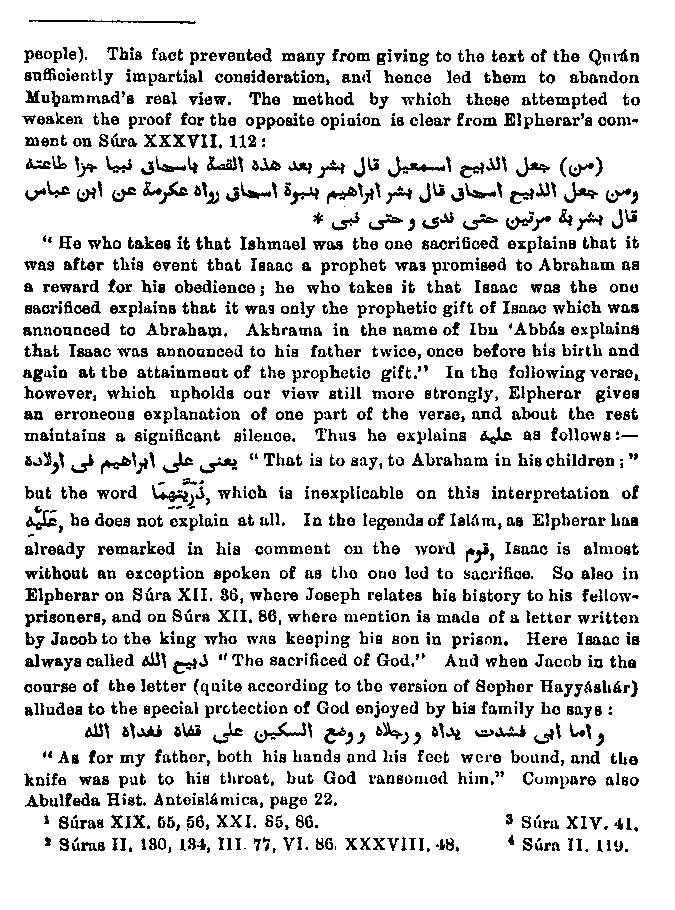 which means "noble" and also "skilled in archery." After all, like many proper names in the early
chapters of Genesis, the word may prove to be of Sumerian origin, unconnected with any root
in the Semitic languages.
which means "noble" and also "skilled in archery." After all, like many proper names in the early
chapters of Genesis, the word may prove to be of Sumerian origin, unconnected with any root
in the Semitic languages.
As the more ignorant of the Jews were lovers of the marvellous, the story of the sin of the
fallen angels grew ever more and more strange and wonderful. At first only two angels are
spoken of as having fallen, and this was an exaggeration of the Babylonian tale of Ishtar's
tempting Gilgamesh alone. But in later times their number in the tales current among the Jews
grew greater, until at last in the apocryphal Book of Enoch it is said that the angels who fell from
heaven amounted to 200, and that they all descended in order to sin with women. The following
extract from that book is important as narrating the legend in a fuller form than those which we
have previously quoted. It also gives a statement which agrees with one made at the conclusion
of the Jewish legend in the Midrash Yalkut and also in the Qur'an, in a passage which we
shall soon have to consider.
"And it came to pass, wherever the children of men were multiplied, in those days daughters fair
and beautiful were born. And the angels, sons of heaven, beheld them and longed for them and
they said to one another, ‘Come, let us choose out for ourselves wives from men, and we
shall beget children for ourselves.’ And Semiazas, who was their chief, said to them,
‘I fear that ye will refuse to do this deed, and I alone shall be guilty of a great sin.’
Therefore they all answered him, ‘Let us all swear an oath, and let us all bind one another
under a curse not to give up this intention until we accomplish it and do this deed.’ Then
they all swore together, and therewith bound one another under a curse." After giving the names
of the chiefs of the rebel angels, the story proceeds thus, "And they took to themselves wives:
they chose out wives for themselves each of them, ... and they taught them poisons and incantations
and root-gathering, and they showed unto them the herbs. ... Azael taught men to make swords
and weapons and shields and breast-plates, the teachings of angels, and he showed them metals
and the method of working them, and bracelets and ornaments and paints and collyrium and all
sorts of precious stones and dyes53."
This account of the origin of feminine ornaments is the same that we have found in the Midrash
(see above, p. 98). It enables us to understand the meaning and to recognize the source of the
following passage from the Qur'an, in which, speaking of Harut and Marut, Muhammad says that men
"learnt54 from
them that by which they separate a man from his wife." He adds, "And they used not to injure
any one except by God's permission, and they teach what injureth them and doth not profit them."
It is hardly necessary to produce any further proof that the story of Harut and Marut is
borrowed from a Jewish source, at least in all essential particulars, though in the names of these
angels we perceive traces of Armenian and perhaps Persian influence. We have also seen that
the Jews derived their form of the legend from Babylonia, and that their acceptance of it was in
large measure due to a misunderstanding about the meaning of a Hebrew word in Genesis.
It may he urged that some Christians understand Gen. vi. 1-4, in much the same sense as the Jews
did or still do, and that possibly this view is correct. But even granting all this, it is evident from
what a corrupt source Muhammad borrowed the narrative, which, in the form in which the Qur'an
and the Traditions relate it, cannot possibly be correct.
5. Other Instances.
We cannot mention with the same fulness of detail all the other points in which the Qur'an has
borrowed from Jewish legends. An examination of what is related in the Qur'an in reference to
Joseph, David, and Saul (Talut), for example, will show how far these accounts differ from
what the Bible tells us about these persons. In most, if not in every instance, the reason of the
divergence from the Biblical account is found in the fact that Muhammad followed the Jewish
legends current in his time, instead of the true history of these men as given in the sacred text.
Occasionally he has misunderstood the legends, or has amplified them from imagination or from
other sources. But the legends already given at some length will serve as examples of all other
similar ones.
We now proceed to deal with other instances in which the Qur'an's indebtedness to Jewish
legends is obvious.
In Surah VII., Al A'raf, 170, we read, "And when We raised up the mountain above them as if it
were a covering, and they fancied that it was falling upon them, [We said], ‘Take ye with
fortitude what We have brought you, and remember ye what is in it; perchance ye may be pious.’"
Jalalain and other Muhammadan commentators explain this verse by informing us that God raised
up the mountain (Sinai) from its foundation and held it
over the heads of the children of Israel in the wilderness, threatening to let it fall on them and
crush them if they did not accept the commandments contained in the Law of Moses. These they
had previously refused to obey, because of their severity. But on hearing this threat the Israelites
received the law. God then uttered the rest of the speech contained in the verse quoted above.
The same legend is referred to in Surah II., Al Baqarah, 60, 87.
Its origin is found in the Jewish tractate 'Abodah Zarah (cap. ii. § 2), where we are told
that on that occasion (so God is represented as saying to the Israelites), "I covered you over
with the mountain like a lid." So also in Sabbath (fol. 88, 1) we read, "These words teach
us that the Holy One, blessed be He, inverted the mountain above them like a pot, and said unto
them, ‘If ye receive the law, well: but if not, there shall your grave be.’"
Perhaps it is hardly necessary to say that there is nothing like this fable to be found in the Pentateuch.
It has originated in the mistake of a Jewish commentator, who has misunderstood the words of
the Bible. In Exod. xxxii. 19 we are informed that when Moses descended the mountain with the
two tables of stone in his hands, he saw that the Israelites were worshipping the golden calf which
they had made. Angry at the shameful sight, he threw down the stone tablets from his hands and
broke them beneath the mount." Chapter xix. 17 tells us that while God was giving Moses
the Law the people stood "at the nether part of (or beneath) the mountain." In each case
the phrase means "at the foot of the mountain." But the wonder-loving and credulous Jews of
later times chose to misunderstand the phrase, and the legend of the elevation the mountain was
invented to explain the words "beneath the mount." The tale of the holding up of the
mountain above men's heads is, however marvellously similar to a Hindu legend, related in
the Sanskrit Sastras. It is said that Krishna, wishing to protect the people of Gokula, his native
city from a severe rain-storm, dragged up from its stony base a mountain named Govardhana,
which is styled the biggest of all mountains, and for the space of seven days and nights
suspended it on the tips his fingers over their heads like an umbrella! We cannot suppose
that the Jews borrowed this story from the Hindus, but it is evident that Muhammad derived
the tale referred to in the Qur'an from Jewish sources, while the Jews were led to accept or invent
the story through taking literally55
and in an unnatural sense the Hebrew phrase "beneath the mount."
This is not, however, the only wonderful story which the Qur'an relates concerning what took
place during the sojourn of the Israelites in the wilderness. Not less strange is what we are told about
the calf which they made to worship during Moses' absence. In Surah XX56,
Ta Ha, we are told that when Moses returned and reproached them for this, they said, "We were
made to bear loads of the ornaments of the people, and we threw them [into the fire]: and the Samaritan
likewise cast in. Then he brought out unto them a calf in body, which could low." Jalalain's note says
that the calf was made of flesh and blood, and that it had the power of lowing because life was given it
through a handful of dust from the print left by the hoof of the Angel Gabriel's steed, which "the Samaritan"
had collected and put into its month, according to v. 96 of the same Surah.
This legend also comes from the Jews, as is evident from the following extract which we translate from
Pirqey Rabbi Eli'ezer § 45, "And this calf came out lowing, and the Israelites saw it. Rabbi
Yehudah says that Sammael was hidden in its interior, and was lowing in order that he might deceive
Israel." The idea that the calf was able to low must come from the supposition that, though made of
gold (Exod. xxxii. 4), it was alive, since it "came out" (v. 24) of the fire. Here, again, we see that the use
of a figurative expression, when taken literally, led to the growth of a myth to explain it. The Muhammadan
commentator in
explaining the words "a calf in body" in the Qur'an as signifying that it had "flesh and blood" has
only gone a step further, and he does this to explain how it was that the animal could low. Muhammad
seems to have understood most of the Jewish legend correctly, but the word Sammael puzzled him. Not
understanding that this is the Jewish name of the Angel of Death, and perhaps misled as to the pronunciation,
he mistook the word for the somewhat similar "Samiri," which means "Samaritan." Of course he made
this mistake because he knew that the Jews were enemies of the Samaritans, and he fancied that they
attributed the making of the calf to one of the latter. He was doubtless confirmed in this belief by some
indistinct recollection of having heard that Jeroboam, king of what was afterwards called Samaria, had
"made Israel to sin" by leading them to worship the calves which he made and placed in Dan
and Beth-el (1 Kings xii. 28, 29). But since the city of Samaria was not built, or at least called by that name,
until several hundred years after Moses' death, the anachronism is at least amusing, and would be startling
in any other book than the Qur'an, in which far more stupendous ones frequently occur.
Here, as in very many other instances, Muhammad's ignorance of the Bible and acquaintance with Jewish
legends instead is very striking. It is hardly necessary to point out that in the Bible the maker of the
golden calf is Aaron, and that we
read nothing of either Sammael or of the "Samaritan."
Again, in Surah II., Al Baqarah, 52, 53, we are told that the Israelites said, "O Moses, we shall never
believe thee until we see God clearly!" and that while they were gazing at the manifestation of God's
presence a thunderbolt struck them and they died; but after their death God raised them to life again.
This fable also is borrowed from the Jews, for in Tract Sanhedrin, § 5, we are told that they died
on hearing the Divine voice (in the thunder), but that the Law itself made intercession for them and
they were restored to life. If it is necessary to seek for any foundation for such a fable, it may perhaps
be found in the words of the Hebrews in Exod. xx. 19 (cf. Deut. v. 25) "Let not God speak with us,
lest we die."
All Muslims believe that the Qur'an was written on the "Preserved Tablet" long before the creation
of the world. This belief of theirs is in accordance with what is said in Surah LXXXV., Al Buruj, 21, 22,
"Nay, but it is a Glorious Qur'an in a Preserved Tablet." Strangely enough, they do not believe that
the Psalms are of the same antiquity, although in Surah XXI., Al Anbiya, 105, God is represented as
saying, "And indeed We have already written in the Psalms ... that, as for the earth, My righteous
servants shall inherit it." The reference here is to Ps. xxxvii. 11, 29, "The just shall inherit the earth."
This is the only text in the Old Testament
which is actually quoted in the Qur'an, though there are some 131 passages in the Qur'an in which
the Law, the Psalms, and the Gospel are named, always with respect, and it is frequently asserted of
them that they were "sent down" by God to His prophets and apostles. To most men it would seem
evident that a book cannot be quoted and referred to as an authority until after it has been composed,
and that therefore the books of the Bible must have been in existence before the Qur'an. Of course
we know from history that this is the case. But we do not find that any consideration of this kind
weighs at all with Muslims, who still cling to their assertion that the Qur'an was, long ages before
Muhammad's time, written upon the "Preserved Tablet." We therefore proceed to inquire what their
received Traditions tell us in explanation of this phrase, and we find the answer in such accounts as
that given in the Qisasu'l Anbiya (pp. 3, 4). In giving an account of the way in which God
created all things, that work says, "Beneath the Throne (or Highest Heaven) He created
a Pearl, and from that Pearl He created the Preserved Tablet: its height was 700 years' journey and
its breadth 300 years' journey. Around it was all adorned with rubies through the power of God
Most High. Then came to the Pen the command, ‘Write thou My knowledge in My creation,
and that which is existent unto the day of the Resurrection.’ First it wrote on the Preserved
Tablet, ‘In the
Name of God the Merciful, the Gracious. I am God, there is no God but Me. Whoso hath submitted
to My decree and is patient under the ill I assign him and is thankful for My favours, I have
written him (i.e. his name) and raised him with the truthful ones; and whoso hath not been
pleased with My decree and bath not been patient under the ill I assign him and bath not been
thankful for My favours, then let him seek another Lord than Me, and let him go forth from
beneath57
My heavens.’ Accordingly the Pen wrote down God's knowledge in God Most High's
creation of everything that He had wished unto the Resurrection Day, the extent that the leaf of
a tree moveth or descendeth or ascendeth, and it wrote every such thing by the power of God
Most High."
The idea of the Preserved Tablet is borrowed from the Jews. In the Book of Deuteronomy (x. 1-5)
we are told that when Moses had, at God's command, hewn out two tablets of stone similar to the ones
that he had broken, God wrote upon them the Ten Commandments, and commanded Moses to
preserve them in an ark of shittim- or acacia-wood. The Hebrew word for tablet here used
is identical with the Arabic. From 1 Kings viii. 9, and Heb. ix. 3, 4, we learn that these two tablets
were preserved in the Ark of the Covenant which Moses had made in accordance with
God's command. This is the account from which
the narrative of a Preserved Tablet inscribed with God's commandments and by His power gradually
arose among the Jews and afterwards among the Muhammadans. From the language of Surah LXXXV., 21, 22,
translated above, it is clear that in Muhammad's mind there existed not only one but at least two
"Preserved Tablets," for the Arabic is "a Preserved Tablet," not "the Preserved Tablet,"
as Muhammadans at the present day seem to understand it. There must therefore be a reference to
the two stone tablets which Moses prepared and preserved in the Ark of the Covenant. As
these were kept in the Tabernacle which symbolized God's presence with His people, it was natural
to speak of them as preserved in God's presence. Hence the origin of the fancy that the Preserved
Tablets were kept in heaven, and it was not difficult to deduce their antiquity from that belief.
But why does Muhammad assert that the Qur'an was written "upon a Preserved Tablet"? To
answer this question we must again consult the Jews and learn what they, in Muhammad's time
and previously, thought to have been written upon the two Tablets, which were preserved in the
Ark of the Covenant. In spite of the fact that Deuteronomy clearly states that only the Ten Commandments
were written upon these Tablets, yet after a time the belief arose that all the books of the Old Testament
and also the whole of the Talmud were either inscribed upon them or at least given
along with them. When Muhammad heard this assertion made by the Jews regarding their Sacred Books,
it was natural for him to assert that his Revelation too was written upon one or the other of these Preserved
Tablets. Otherwise he thought he could hardly claim for it a degree of authority equal to that of the Old
Testament. It is probable that the Muslims, not understanding to what the words "a Preserved Tablet"
referred, gradually invented the whole of the marvellous story about it which we have quoted above.
To ascertain what the Jews thought about the contents of the Tablets, we must consult Tract
Berakhoth (fol. 5, col. 1). There we read "Rabbi Simeon ben Laqish saith, ‘What is that
which is written, "And I shall give thee the tablets of stone, and the Law, and the commandment
which I have written, that thou mayest teach them"? (Ex. xxiv. 12). The Tablets —
these are the Ten Commandments; the Law, that which is read; and the Commandment,
this is the Mishnah:— which I have written, these are the Prophets and the Hagiographa:
that thou mayest teach them, this denotes the Gemara. This teaches that all of them were given
to Moses from Sinai.’"
Every learned Jew of the present time acknowledges that we should reject this absurd explanation
of the above-quoted verse, because he knows that the Mishnah was compiled about the year 220
of the Christian era, the Jerusalem Gemara about 430,
and the Babylonian Gemara about A.D. 530. But the Muslims, not knowing this seem to have
tacitly accepted such assertions as true, and applied them to their own Qur'an also.
To complete the proof that the legend about the Preserved Tablet upon which the Qur'an is said to
have been written is derived from a Jewish source, it remains only to state that in the Pirqey Aboth,
cap. v. § 6, it is said that the two Tablets of the Law were created, along with nine other things,
at the time of the creation of the world, and at sunset before the first Sabbath began.
It is well known that the fabulous Mount Qaf plays an important part in Muhammadan legend.
Surah L. is called Qaf and begins with this letter. Hence its name is supposed to refer to the name
of the mountain in question. The commentator 'Abbasi accepts this explanation and quotes
tradition handed down through Ibn 'Abbas in support of it. Ibn 'Abbas says, "Qaf is a green
mountain surrounding the earth, and the greenness of the sky is from it: by it God
swears58."
So in the 'Araisu'l Majalis59
it more fully explained in these words, "God Most High created a great mountain of green
emerald. The greenness of the sky is on account of it. It is called Mount
Qaf, and it girds it all" (the whole earth), "and it is that by which God swears, for He said,
‘Qaf'60.
By the Glorious Qur'an.’" In the Qisasu'l Anbiya it is narrated that one day
'Abdu'llah ibn Salam inquired of Muhammad which was the highest mountain-peak on the earth.
Muhammad said, "Mount Qaf." In answer to the further inquiry of what this mountain is composed,
Muhammad replied, "Of green emerald, and the greenness of the sky is on account of that."
The inquirer, having expressed his belief that the "Prophet of God" in this matter spoke truly,
then said, "What is the height of Mount Qaf?" Muhammad replied, "It is 500 years' journey in
height." 'Abdu'llah asked, "How far is it around it?" "It is 2,000 years' journey." We need not
enter into all the other circumstances told us in connexion with this wonderful range of mountains
of which Muslim legends are so full.
If we inquire as to the origin of the myth of the existence of such a range of mountains, the answer
is supplied by a reference to Hagigah xi. § 1. There, in explanation of the somewhat rare
Hebrew word "Tohu" in Gen. i. 2, it is thus written: "Tohu is the green line which
surrounds the whole, entire world, and from which darkness proceeds." The Hebrew word which
we here render line is Qav. Muhammad and his disciples, hearing this Hebrew word
Qav and not knowing that it meant
"line," thought that without doubt that which was thus said to surround the whole world, and from
which darkness came forth, must be a great chain of mountains named Qav or Qaf
It is hardly necessary to say that geographers have explored the whole world without — as yet
— discovering the range of mountains61
described in Muhammadan tradition!
We must indicate a few of the many other ideas which are also clearly of Jewish origin that have
found an entrance into the Qur'an and the Traditions.
In Surah XVII., Al Asra', 46 62,
mention is made of seven heavens, and in Surah XV., Al Hajr, 44, the seven doors of hell are
spoken of. Both these statements are derived from Jewish tradition. The former is found in
the Hagigah, cap. ix. § 2, the latter in Zohar, cap. ii. p. 150. It is remarkable
that the Hindus hold that beneath the surface of the earth there are seven lower stages, so to speak,
and above it seven higher storys, all of which rest upon one of the heads of an enormous serpent
named Sesha, who possesses a thousand heads. The seven heavens doubtless are, or at least were,
identical with the orbits of the sun, moon, and the planets Mercury, Venus, Mars, Jupiter and
Saturn, which in Muhammad's time were supposed to
revolve round the earth. According to Muhammadan tradition the earth with its
seven63
storys rests between the horns of a Bull named Kajutah, who has 4,000 horns, each of which is 500 years
journey from every other. He has as many eyes, noses, ears, mouths and tongues as he has horns.
His feet stand upon a fish, which swims in water forty years' journey deep. Another authority holds
that the earth in the first place rests upon the head of an angel and that the feet of this angel are placed
upon an immense rock of ruby, which is supported by the Bull. This idea of the connexion between
the Earth and a Bull is probably of Aryan origin64.
The legend which represents the Earth as consisting of seven storys is possibly due to the desire to
represent it as resembling the sky in this respect. It may, however, have originated from a misunderstanding
of the Persian statement, found in the Avesta, that the Earth consists of seven Karshvares,
or great regions now spoken of as the "seven climes." Thus in Yesht, xix. § 31, Yima Khshaeta
or Jamshid is said to have reigned "over the seven-regioned earth." These again correspond with
the dvipas of Hindu geography. It was a mistake, however, to fancy that these were
situated one below another, except in so far as the first of the seven Karshvares was
a high mountain plateau and the others stood at lower levels.
In Surah XI., Hud, 9, in reference to God's throne it is said that, before the creation of the heavens
and the earth65,
"His Throne was above the water," in the air65.
So also, in commenting on Gen. i. 2, the Jewish commentator Rashi, embodying a well-known Jewish
tradition, writes thus: "The Throne of Glory stood in the air and brooded over the waters."
Muhammadan writers tell us that the Angel Malik, who is named in Surah XLIII., Az Zukhruf, 77,
is the chief of the nineteen (Surah LXXIV., 30) angels appointed to preside over hell. So also the Jews
often write of a "Prince of Hell." But the Muslims have borrowed Malik's name from Molech (Molek),
one of the deities mentioned in the Bible as formerly worshipped by the Canaanites, who burnt human
beings alive in his honour. The word in Hebrew as in Arabic is a present participle and means "ruler."
In Surah VII., Al A'raf, 44, we are told that between heaven and hell there is a partition called by the same
name as this Surah, which in fact received its title from the mention of Al A'raf in it. "And between them
both there is a veil, and
upon Al A'raf there are men." This idea is derived from the Midrash on Eccles. vii. 14, where we are informed
that, when asked "What space is there between them?" (heaven and hell), Rabbi Yohanan said, "A wall":
Rabbi Akhah said, "A span." "And the Rabbans say that they are both near one another, so that rays
of light pass from this to that." The idea is probably taken from the Avesta, where this division between
heaven and hell is mentioned under the name Miswanogatus (Fargand XIX). It was the place "assigned
to the souls of those whose deeds of virtue and vice balance each65
other." In Pahlavi it was called Miswat-gas. The Zoroastrians held that the space between heaven
and hell is the same as between light and darkness. The idea of a special place reserved for those whose
good deeds equal their evil ones has passed into other religions also.
In Surah XV., Al Hajr, 18, it is said concerning Satan that he and the other fallen angels endeavour to
"steal a hearing" by listening to God's commands given to the angels in heaven. The same idea is again
repeated in Surah XXXVII., As Saffat, 8, and in Surah LXVII., Al Mulk, 5. This belief comes from the Jews,
for in Hagigah, cap. vi. § 1, it is said that the demons "listen from behind a curtain," in order to obtain
a knowledge of future events. The Qur'an represents the shooting
stars as hurled at them by the angels, in order to drive them away.
In Surah L., Qaf, 29, in speaking of the Day of Judgment, God is represented as saying: "A day when
we shall say to Hell, ‘Art thou filled?’ and it shall say, ‘Is there more?’"
This is the echo of what we read in the Othioth of Rabbi 'Aqiba' viii, § 1, "The Prince of Hell saith
on a day and a day (i.e. day by day), ‘Give me food unto repletion.’" This Jewish
work refers to Isa. v. 14 in proof of the truth of the assertion.
In Surah XI., Hud, 42, and again in Surah XXIII, Al Mu'minun, 27, we are told that in the time of Noah
"the furnace boiled over." This doubtless refers to the Jewish opinion (Rosh Hashshanah xvi., § 2,
and Sanhedrin cviii.) that "The generation of the Flood was punished with boiling water."
The whole of the statement in the Qur'an as to the way in which the unbelievers mocked Noah is
taken from this chapter of Tract Sanhedrin and from other Jewish commentators. Probably in
ignorance of this the commentary of Jalalain on Surah XI., 42, says that it was "a baker's oven" that
"boiled over," and that this was a sign to Noah that the Flood was at hand.
If any further proof were needed of the great extent of the influence which Jewish tradition has
exerted upon Islam it would be supplied by the
very noteworthy fact that, although the Muslims boast of the style of the Qur'an and the purity
of its Arabic as a miracle and as an evidence of the Divine origin of the book, yet there are to be
found in it certain words which are not properly Arabic at all, but are borrowed from the Aramaic
or the Hebrew. Among these may be mentioned:  derived from roots common to all three languages, but they are not formed in accordance with
the rules of Arabic Grammar, whereas they are of frequent occurrence in Hebrew and Aramaic
and properly belong to those languages. The word "Paradise,"
derived from roots common to all three languages, but they are not formed in accordance with
the rules of Arabic Grammar, whereas they are of frequent occurrence in Hebrew and Aramaic
and properly belong to those languages. The word "Paradise,"  is taken from late Hebrew, but has come from old Persian, and belongs to that language and
to Sanskrit. It is as foreign to Arabic as the same word
is taken from late Hebrew, but has come from old Persian, and belongs to that language and
to Sanskrit. It is as foreign to Arabic as the same word  is to Greek. Muhammadan commentators have often found it impossible to give the exact meaning
of such words, through their ignorance of the languages from which Muhammad borrowed them.
When we know their meaning in this way, we find that it suits the context. For example, it is
a common mistake to imagine that
is to Greek. Muhammadan commentators have often found it impossible to give the exact meaning
of such words, through their ignorance of the languages from which Muhammad borrowed them.
When we know their meaning in this way, we find that it suits the context. For example, it is
a common mistake to imagine that  (malakut)
denotes the nature or the abode of the angels, since it is not derived from
(malakut)
denotes the nature or the abode of the angels, since it is not derived from
 (malak) "an angel," but is the Arabic way
of writing the Hebrew
(malak) "an angel," but is the Arabic way
of writing the Hebrew  (malkuth) , "kingdom."
Not less noteworthy is the influence which the Jewish form of worship has had upon that
of the Muhammadans. It would be a mistake doubtless to suppose that the Muhammadans
borrowed from the Jews their practice of worshipping with covered heads, that of separating
the men from the women in the mosque (when the latter are allowed to take part in public
worship at all), and of removing their shoes. All these were probably the customs of the Arabs
as well as of other Semitic nations from the earliest times. It is much more probable that the
ceremonial ablutions of the Muslims were imitated from those of the Jews, though here there is
room for doubt. The practice of worshipping towards Jerusalem was, as we have seen, for a short
time adopted by the Muhammadans in imitation of the Jews, though ultimately Mecca was substituted
as the Qiblah. We have also learnt67
that the observance of a fast-month was derived not from the Jews but from the Sabians.
Yet in connexion with that fast there is a rule enjoined which is undoubtedly of Jewish origin.
In Surah II., Al Baqarah, 183, where a command is given in reference to the permission to feast
at night during that month, the Qur'an says: "Eat ye and drink until the white thread is distinguishable
to you from the black thread by the dawn: then make your fasting perfect till night." The meaning
of the mention
of the colour of the threads is that the Muslims were commanded to fast from dawn till dark.
When the question arose at what precise moment the day began, it was necessary to lay down
a rule on the subject, as is done in this verse. The rule is taken from that of the Jews on the same
subject, for in Mishnah Berakhoth (i., § 2) the day is said to begin at the moment "at which
one can distinguish between a black thread and a white one."
(malkuth) , "kingdom."
Not less noteworthy is the influence which the Jewish form of worship has had upon that
of the Muhammadans. It would be a mistake doubtless to suppose that the Muhammadans
borrowed from the Jews their practice of worshipping with covered heads, that of separating
the men from the women in the mosque (when the latter are allowed to take part in public
worship at all), and of removing their shoes. All these were probably the customs of the Arabs
as well as of other Semitic nations from the earliest times. It is much more probable that the
ceremonial ablutions of the Muslims were imitated from those of the Jews, though here there is
room for doubt. The practice of worshipping towards Jerusalem was, as we have seen, for a short
time adopted by the Muhammadans in imitation of the Jews, though ultimately Mecca was substituted
as the Qiblah. We have also learnt67
that the observance of a fast-month was derived not from the Jews but from the Sabians.
Yet in connexion with that fast there is a rule enjoined which is undoubtedly of Jewish origin.
In Surah II., Al Baqarah, 183, where a command is given in reference to the permission to feast
at night during that month, the Qur'an says: "Eat ye and drink until the white thread is distinguishable
to you from the black thread by the dawn: then make your fasting perfect till night." The meaning
of the mention
of the colour of the threads is that the Muslims were commanded to fast from dawn till dark.
When the question arose at what precise moment the day began, it was necessary to lay down
a rule on the subject, as is done in this verse. The rule is taken from that of the Jews on the same
subject, for in Mishnah Berakhoth (i., § 2) the day is said to begin at the moment "at which
one can distinguish between a black thread and a white one."
In every country where Muslims are to be found, they are directed, whenever any one of the five
fixed times for prayer comes round, to offer the stated prayers in the spot where they happen
to be at the time, whether in the house, the mosque, or the street. Many of them do so, especially
in public places. This practice seems at the present day to be peculiar to them. But if we inquire
what its origin was, we must again turn to the Jews. Those of them who lived in Arabia in
Muhammad's time were the spiritual and, in a measure, the actual descendants of those Pharisees
who are described in the Gospels as making void the word of God through their excessive reverence
for their traditions68.
In our Lord's time these Pharisees are reproved for loving "to stand and pray in the synagogues
and in the corners of the streets69,"
in order to gain from men full credit for their devotion. The resemblance between the practice of
the Pharisees of old and that of the
Muslims of to-day is so striking that some of the opponents of Christianity among the latter
have alleged this as a proof that the Gospels are now interpolated, since they assert that the verses
above referred to are such an exact description of Muhammadan methods of worship that they
must have been written by some Christian who had seen the Muslims at their devotions and
wished to condemn them! Nor was it unnatural for Muhammad and his followers to take the Jews
for their models in this matter. They knew that the latter were descendants of Abraham and were
the "People of the Book." Hence, attaching undue importance as they did to outward forms in
worship, it was not strange that they should think that the Jewish method of adoration must be
the right one. Muhammad, of course, told his followers that he had been taught by Gabriel how
to worship, and to the present day they imitate him in every prostration.
We shall mention only one other point out of many in which Jewish practices have very clearly
influenced Islam. In Surah IV., An Nisa, 3, Muhammad laid down a rule restricting for the future
the number of wives, which each of his followers might have at any one time, to four at most.
Commentators tell us that previously several of them had many more legal wives than this. The rule
did not apply to Muhammad himself, as
we learn from Surah XXXIII., Al Ahzab, 49, since he was granted as a special privilege the right
to marry as many as he pleased. The words of the restricting rule are: "And if ye fear that ye will
not act justly towards orphans, then marry of wives what seemeth good to you, by twos or threes
or fours." This has ever since been explained by commentators as forbidding Muslims to have
more than four legal wives at a time, though they enjoy almost unlimited freedom in the matter
of divorcing any or all of them, and marrying others to make up the permitted number.
When we inquire the source from which Muhammad borrowed this rule, and why he chose four
as the highest permissible number of legal wives for a Muhammadan to have at one time, we again
find the answer in Jewish regulations on the subject, one of which runs thus: "A man may marry
many wives, for Rabba saith it is lawful to do so, if he can provide for them. Nevertheless the wise
men have given good advice, that a man should not marry more than four wives70."
In reply to the argument contained in this chapter and in those which follow, the Muhammadans
have but one answer, besides the mere assertion that the Qur'an is not Muhammad's
composition but that of God Himself. They tell us that Muhammad was ignorant of both reading
and writing, and that hence he could not possibly have studied the Hebrew, Aramaic, and other
books from which we have shown that he really drew, directly or indirectly, much of what now
appears in the Qur'an. "An unlettered man," they say could not possibly have consulted such
a mass of literature, much of it in languages which he did not know, and which are known to but
a few students at the present time."
This argument rests on two assumptions: first that Muhammad could neither read nor write; and
second, that only by reading could he learn the traditions and fables accepted by Jews, Christians,
Zoroastrians and others in his time. Both of these are destitute of proof. An attempt is made to
substantiate the former by referring to Surah VII., Al A'raf, 156, where Muhammad is called
An nabiyyu'l Ummi, which words the Muslims render "The Unlettered Prophet."
Rabbi Abraham Geiger, however, has clearly shown that the word rendered unlettered
in this verse really means "Gentile," as opposed to Jewish. This is confirmed by the fact that in
Surah III., Al 'Imran, 19, the prophet is commanded to speak "to the Ummiin and to the people
of the Book," in which verse we see that the Arabs in general are thus designated " Gentiles."
Moreover, in Surah XXIX., Al 'Ankabut, 27, and in Surah XLV., Al Jathiyyah, 15, it is clearly stated
that the prophetic office was bestowed on the family of Isaac and Jacob, not on that of Ishmael.
Hence Muhammad distinguishes himself as "the Gentile Prophet," differing in that respect from
the rest, who were, generally speaking, from Isaac's descendants. There is absolutely no proof
that Muhammad was ignorant of reading and writing, though we are not compelled, as some have
fancied, to infer that the polished style of the Qur'an is a proof that he wrote out much of it carefully,
and thus elaborated the different Surahs before learning them off by heart and reciting them to his
amanuenses. This latter might have been done without ability to write71.
But even if, for the sake of argument, we admit that reading and writing were arts unknown to
Muhammad, that admission does not in the slightest degree invalidate the proof that he borrowed
extensively from Jewish and other sources. Even if he
could read Arabic, it is hardly likely that he was a student of Aramaic, Hebrew, and other languages.
The parallels which we have drawn between certain passages in the Qur'an and those resembling them
in various Jewish writings are close enough to show the ultimate source of much of the Qur'an. But
in no single case are the verses of the Qur'an translated from any such source. The many errors
that occur in the Qur'an show that Muhammad received his information orally, and probably from men
who had no great amount of book-learning themselves. This obviates the second assumption of
the Muslims. It was doubtless for many obvious reasons impossible for Muhammad to consult a large
number of Aramaic, Zoroastrian, and Greek books; but it was by no means impossible for him to learn from
Jewish72,
Persian, and Christian friends and disciples the tales, fables, and traditions which were then current.
His enemies brought against him in his own time the charge of having been assisted by such persons
in the composition of the Qur'an, as we learn both from the Qur'an itself and from the admissions of
Ibn Hisham and of the commentators. Among others thus mentioned as helping in the composition of
the book is the Jew spoken of in Surah XLVI., Al Ahqaf, 9, as a "witness" to the agreement between
the Qur'an
and the Jewish Scriptures. The commentators 'Abbasi and Jalalain in their notes on this passage
tell us that this was Abdu'llah ibn Salam, who, if we may believe the Raudatu'l Ahbab, was a Jewish priest
or Rabbi before he became a Muslim. In Surah XXV., Al Furqan, 5, 6, we are told that Muhammad's enemies
said, "Others have helped him with it," and stated that he had merely written down certain "Tales of the
Ancients," which were dictated to him by his accomplices morning and evening. 'Abbasi states that
the persons thus referred to were Jabr, a Christian slave, Yasar (also called Abu Fuqaihah), and a certain
Abu Takbihah, a Greek. In Surah XVI., An Nahl, 105, in answer to the accusation, "Surely a human
being teacheth him," Muhammad offers the inadequate reply that the language of the man who is hinted
at was foreign, whereas the Qur'an itself was composed in plain Arabic. This answer does not attempt
to refute the obvious meaning of the charge, which was that (not the style of the language used but)
the stories told in the Qur'an had thus been imparted to Muhammad. 'Abbasi says that a Christian named
Cain was referred to, while Jalalain's Commentary again mentions Jabr and Yasar. Others suggest Salman,
the well-known Persian disciple of Muhammad, others Suhaib, others a monk named Addas. We may
also note the fact that 'Uthman and especially Waraqah, cousins of Khadijah, Muhammad's first wife,
were
acquainted with the Christianity73
and the Judaism of the time, and that these men exercised no slight influence over Muhammad during his
early years as a prophet, and perhaps before. Zaid, his adopted son, was a Syrian, according to Ibn Hisham,
and must therefore have at first professed Christianity. We shall see that other persons were among
Muhammad's friends, from whom he might easily have obtained information regarding the Jewish, Christian,
and Zoroastrian faiths. The passages borrowed from such sources are, however, so disguised in form that
it is quite possible that those from whom Muhammad made his inquiries may not have recognized the imposture,
but may have really fancied that these passages were revealed, as they professed to be, to confirm the truth
of the respective creeds, at least so far. If so, Muhammad adroitly employed the information he obtained from
these men in such a manner as to deceive them, though he could not deceive his enemies. Hence, despairing
of silencing the latter, he finally turned upon them with the sword.
In the next chapter we proceed to inquire what, if any, influence Christianity, orthodox or unorthodox,
exercised upon nascent Islam and the composition of the Qur'an.
Table of contents to The Original Sources of the Qur'an
Answering Islam Home Page