返回总目录
Life of Mahomet [Volume II Chapter 4]
Page 97
THE BIOGRAPHY OF MAHOMET, AND RISE OF ISLAM.
CHAPTER FOURTH.
Extension of Islam and Early Converts, from the assumption by Mahomet of the prophetical office to the date of the first Emigration to Abyssinia
Position of Mahomet in his forty-fourth year
The weary region of uncertainty and speculation
has been left behind. Towards the forty-fourth
year of his age we find Mahomet, now emerged
from doubt and obscurity, clearly and unequivocally
asserting that he had been ordained a Prophet to
call the Arabs to the Lord, reciting, his warnings
and exhortations as messages that emanated direct
from the mouth of God, and implicitly believing (to
all outward appearance) his inspiration and mission
to be divine. We find him already surrounded by
a little band of followers, all animated by ardent
devotion to himself and earnest belief in God as
his guide and inspirer.
Earliest converts
It is strongly corroborative of Mahomet's sincerity
that the earliest converts to Islam were his
bosom friends and the people of his household;
who, intimately acquainted with his private life,
could not fail otherwise to have detected those
Page 98
discrepancies which, more or less, invariably exist
between the professions of the hypocritical deceiver
abroad, and his actions at home.
Khadija,
The faithful KHADIJA has already been made
known to the reader, as the sharer in the enquiries
of her husband, and probably the first convert to
his doctrines. "So Khadija believed" (runs the
simple tradition), "and attested the truth of that
which came to him from God. Thus was the Lord
minded to lighten the burden of his Prophet; for he
heard nothing that grieved him touching his rejection by the people, but he had recourse unto her,
and she comforted, re-assured, and supported him."1
Zeid,
ZEID, the former slave, and Ms wife Omm Ayman
(or Baraka), the nurse of Mahomet, have also been
noticed. Though Zeid was now a free man, yet
being the adopted son of Mahomet and Ms intimate
friend, it is probable that he lived in close connection with his family, if not actually an ostensible
member of it He, too, 'was one of the earliest
believers.2
Ali
ALI. The little Ali had now reached the age of thirteen, or fourteen years, and already gave tokens of the wisdom and judgment which distinguished his
Page 99
after life. Though possessed of indomitable courage,
he was meditative and reserved, and lacked the
stirring energy which would have rendered him a
valuable and effective propagator of Islam. He grew
up from a child in the faith of Mahomet, and his
earliest associations strengthened the convictions of
matured age. It is said that as Mahomet was once
engaged with the lad in prayer, in one of the glens
near Mecca, whither they retired to avoid the jeers
of their neighbours, Abu Talib chanced to pass by,
and said to Mahomet, "My nephew! what is this
new faith I see thee following?" - "Oh, my uncle I
This is the religion of God, and of His angels, and
of His prophets; the religion of Abraham. The
Lord hath sent me an Apostle unto his servants;
and thou, my uncle, art the most worthy of all that
I should address my invitation unto, and the most
worthy to assist the Prophet of the Lord." Abu
Talib replied, "I am not able, my nephew, to separate from the religion and the customs of my fore-fathers, but I swear that so long as I live, no one shall
dare to trouble thee." Then, turning to his son, the
little Ali, who had professed a similar faith and the
resolution to follow Mahomet, he said, "Well, my
son, he will not invite thee, to aught but that which
is good; wherefore thou art free to cleave unto
him.3
Page 100
Waraca
To the family group it is hardly necessary to add
the aged cousin of Khadija, WARACA, whose profession of Christianity aud support of Mahomet have been already mentioned; because it is agreed by
all that he died before Mahomet had entered upon
his public ministry.
Abu Bakr
In the little circle there was on belonging
to another branch of the Coreish, who, after
Khadija, may claim precedence in conversion to
Islam. ABU BAKR, of the Bani Taym, had long
been a familiar friend of Mahomet; with him he
probably had lamented the gross darkness of Mecca,
and sought after a better faith. He lived in the
same quarter of the city as Khadija.4 When Mahomet
removed thither the intimacy became closer,
and the attachment of Abu Bakr was soon rivetted
by implicit faith in his friend as the apostle of God.
Ayesha, his daughter (born about this period, and
destined while yet a girl to be the Prophet's bride),
"could not remember the time when both her parents
Mahometan ideas. The tale has however been admitted.
into the text because in itself not improbable. The facts are at
any rate in accordance with Aba Talib's character, and his constant support of Mahomet.
Page 101
were not true believers,5 and when Mahomet did not
daily visit her father's house morning and evening."6
Of Abu Bakr, the Prophet said, "I never invited
any to the faith who displayed not hesitation and
perplexity-excepting only Abu Bakr; who, when
I had propounded unto him Islam, tarried not,
neither was perplexed."7
His appearance and character
The character and appearance of this Chief of
Islam, and bosom friend of Mahomet, demand a
detailed description. Abu Bala was about, two
years younger than the Prophet; short in
stature, and of a small spare frame; the eyes deeply
seated under a high projecting forehead. His complexion
was fair, and his face thin, so that you could
see the veins upon it.8 Shrewd and intelligent, he
yet wanted the originality of genius; his nature
page 102
was mild and sympathetic, but not incapable of firm purpose where important interests were concerned. Impulse and passion rarely prompted his actions; he was guided by reason and calm conviction. Faithful and unvarying in his attachment to the Prophet, he was known (and is to the present day familiar throughout the realms of Islam), as AL SADICK, "the True9." He was also styled Al Awwah, "the Sighing," from his tender and compassionate heart.
His generosity and popularity
Abu Bakr was a diligent and successful merchant, and being frugal and simple in his habits, possessed at his conversion about 40,000 dirhems.
His generosity was rare, his charity unwearying. The greater part of his fortune was expended in the purchase of such unfortunate slaves as from their inclination to the new faith were persecuted by the
unbelieving Meccans; so that but 5,000 dirhems were left when, ten or twelve years after, he emigrated
page 103
with the Prophet to Medina. Abu Bakr was unusually familiar with the history of the Coreish, who often referred to him for genealogical
information. His judgment was calm and impartial, his conversation agreeable, his demeanour affable and engaging; his society and advice were therefore much sought after by the Coreish, and he was popular throughout the city.10
Abu Bakr's influence gains five early converts;
To gain such a man as a staunch adherent of his
claims was for Mahomet a most important step.
Abu Bakr's influence was freely surrendered to the
cause of Islam, and five of the earliest converts are
attributed to his exertions and example. Three
were but striplings.
Saad, Zobeir, Talha,
Saad, the son of Abu Wackkas, converted in his sixteenth or seventeenth year, was the nephew of Amina11. Zobeir, son of Al Awwam,
page 104
probably still younger, was at once the nephew of
Khadija, and the son of Mahomet's aunt Safia.12
About the same age was Tahla, the renowned
warrior of after days, and related to Abu Bakr
himself.13
Othman son or Affan, and Abd al Rahmin
The fourth was Othman son of Affan (successor
of Abu Bakr and Omar in the Caliphate), who,
place the conversion of the leaders of Islam earlier than it
actually occurred. It is therefore not improbable that Saad's conversion
may have taken place a few years later that the period referred
to in the text; or, occurring at the period specified, he may
have died more advanced in years than is admitted by tradition.
page 105
though of the Ommeyad stock, was a grandson by his mother of Ab al Muttalib. Rockeya, being now, or shortly after, free from her connection with Otba, the son of the hostile Abu Lahab, Mahomet gave
her in marriage to Othman, whose wife she continued until her death some ten or twelve years afterwards. Othman was at this period between
thirty and forty years of age.14 The fifth was Abd
Talha may possibly hare heard some Syrian monk speak of the
evil of idolatry &C. and been thus prepared to follow Mahomet's
doctrine. But the details of the story as given by the Secretary
are too absurd to need refutation.
Nowfal, a brother of Khadija, persecuted Abu Bakr and Talha,
and bound them together with a rope, whence they received the
name of Al Caranein, "the Bound." Katib al Wackidi, p. 220 ˝; Hishami, p. 75. The latter authority calls Nowfal one of the
devils of the Coreish ;-the former calls him their lion. He was
killed at Badr.
Othman was early exposed to persecution. His uncle, Al
Hakam, grandson of Omeyd, seized and bound him, saying, "Dost
thou prefer a new religion to that of thy fathers? I swear I will
not loose thee until thou givest up this new faith thou art
following after." Othman said;-" By the Lord, I will never abandon
it!" So when Al Hakam saw his firmness in the faith, he let
him go. Katib al Wackidi, p.189.
page 106
al Rahman, son of Awf; of the Bani Zohra,15 about ten
years younger than the Prophet, and a man of wealth
and character. Abd al Rahman, Othman, and Talha
were, like Abu Bakr, merchants or traders; and the
pursuit of the same profession may have occasioned
community of interest among them.
Four other converts with Abd al Rahmin
Abd al Rahman is said to have been accompanied on his first visit to the house of Mahomet by four companions, who simultaneously with him embraced Islam; Obeida, son of Mahomet’s uncle, Harith;16 Abu Salma, of the Bani Makhzum;17 Abu Obeida, son of Al Jarrah, subsequently a warrior of
Othman, son of Matzun
note;18 and Otman, son of Matzun. It is
related that the latter had already abandoned wine before
his conversion, and was with difficulty persuaded
by Mahomet to renounce the asperities of an ascetic
life. The family of Othman appear to have been
He was subsequently called Abu Abdallah, after a son by
Rockeya; when about six years of age, this child had his eye
pecked out by a bird, fell sick, and died, A.H. 4.
Having succeeded Abu Bakr in the Caliphate, he was murdered,
A.H. 36, aged seventy-fire (or according to others) eighty-two,
which would make him at the time of the emigration to Medina,
thirty-nine or forty-six years of age; and at the period under
consideration from thirty to thirty-five.
page 107
well inclined to Islam, for we find two brothers, a
son, and other relatives of his in the list of early
believers.19
Converted slaves, Bilal
Of the slaves ransomed by Abu Bakr from persecution,
for their adherence to the new doctrine, the
foremost is BILAL, the son of an Abyssinian slave
girl. He was tall, dark, and gaunt, with negro
features and bushy hair. Mahomet honoured and
distinguished him as "the first fruits of Abyssinia;"
and to this day he is renowned throughout the Moslem world as the first Muadzzin, or crier to prayer.20
Amr ibn Foheira, after being purchased and released
from severe trial, was employed by Abu Bakr in
tending his flocks.21
Abdallah ibn Masod, "small
His brothers were Abdallah and Cudama. His son emigrated to Abyssinia. Mumir, another Jumhite, is also mentioned as converted at this stage. The whole family or Othman ibn Matzun, with their wires and children, emigrated to Medina at the Hegira.
page 108
in body, but weighty in faith," constant attendant
of Mahomet at Medina ;23 and Khobab, son of
Meccan slaves susceptible of religious impression
Aratt, a blacksmith, were also converted at this period.24 The slaves of Mecca were peculiarly accessible to the solicitations of the Prophet. As foreigners they were generally familiar either with
Judaism or Christianity. Isolated from the influences of hostile partizanship, persecution alienated them from the Coreish, and misfortune made their hearts susceptible of spiritual impressions.25
page 109
Thirteen other early believers
In addition to the twenty persons who have now
been noticed as among the first confessors of the
new faith, the Katib al Wackidi enumerates at least
thirteen others as having believed "before the entry
of the Prophet into the house of Arcam;" - by which
expression the biographers mark the few earliest
years of Islam. Among these thirteen we observe
the youthful son Sa'id,20 and several of the relatives
of the aged enquirer Zeid, who was already some
time dead, but whose remarkable life has been above
alluded to as possibly paving the way for Mahomet.
The wife of Said, Fatima, a cousin of the same
family, and her brother Zeid, son of Khattab,21 were
likewise among the early converts. There was also
among the number Obeidallah, son of Jahsh, himself
one of the "Four enquirers." On the persecution
becoming hot, he emigrated with his wife Omm
Habiba (subsequently married to Mahomet), and
page 110
others of his family, to Abyssinia, where he was
converted to Christianity, and died in that faith.28
It is interesting to note among these converts Abu
Hodzeifa,29 son of Otba, the father-in-law of Abu
Sofian, a family inveterately opposed to Mahomet.
We find also the name of Arcam, whose house will
shortly be mentioned as memorable in the annals of
Islam.30
The whole family of the Bani Dudan were very favourable to
Islam; for it is related that at the Hegira they all emigrated to
Medina, men, wonien and children, locking up their houses. Katib
al Wackidi, p. 195 ˝. It is remarkabic that this tribe were confederates of Harb and Abu Sofian, the opponents of Mahomet ;-
the influence of Islam thus frequently over-leaping and baffling
political combinations of Mecca.
page 111
Several female converts
Besides this early group of three-and-thirty
individuals, the wives and daughters of some of the
converts are mentioned as faithful and earnest professors
of Islam31. It is, indeed, in conformity with
the analogy of religious movements in all ages,
that women should take a forward part, if not in
direct and public acts of assistance, yet in the
encouragement and exhortation which are perhaps
of even greater value. On the other hand, in estimating
fifth convert; but there is so great a tendency in each party and
family vain-gloriously to represent its own leaders or ancestors
as the earliest believers, that little dependance can be placed
on such assertions of priority. Hatib ibn Amr (of the Bani Amr
ibn Lowry) was a convert of the same stage. Katib al Wackidi,
p.260.
Two others descended from families allied to the Coreish, Amr
ibn Abasa, and Abu Dzarr Ghifari; are also said to have been
converted at this period, but to have left Mahomet and returned
to their tribes. They rejoined Mahomet after the retreat of the
Meccans from the siege of Medina. The accounts however are
so vague and unlikely as to lead to the suspicion that they were
imagined or fabricated by descendants who wished to assume for
their families a precedence in the faith.
page 112
the number of the early converts, we must not forget that their ranks have been unduly swelled by the traditions of those whose piety or ambition have imagined or invented a priority in the faith for
their own ancestors or patrons. Weighing both considerations, we shall not greatly err if we conclude that,
Converts during the first three or four years estimated at forty
in the first three or four years after the assumption by Mahomet of his prophetic office, the
converts to his faith amounted to nearly forty souls.
Steps by which this success was attained
By what degrees, under the influence of what
motives or arguments, and at what precise periods,
these individuals, one by one, gave in their adhesion
to the claims of Mahomet, we can scarcely
determine, farther than has been done in the general
outline already before the reader. It is usual among
traditionists to assign to the Prophet three years of
secret preaching and private solicitation, after which
an open call was made to the Coreish at large. But
we hardly find grounds for this theory when we
bring it to the surer test of the Coran. It is probable that the preliminary term of doubt and
enquiry, which we sought to trace in the preceding
chapter, has been confounded by tradition with the
actual assumption of the prophetic office. The truth
we may conjecture to be as follows. An interval
of pious musing, and probably of expostulation with
others, preceded the fortieth year of Mahomet's life.
About that year the resolution to "recite" in God's
page 113
name (in other words, the conviction of inspiration),
was fully adopted. For some succeeding period his
efforts would be naturally directed to individual
persuasion and entreaty; but there is nothing to
warrant the belief that the prophetic claim, once
assumed, was ever confined within the limits of a
narrow circle, or held a secret not to be divulged to
the people of Mecca. it was after this that the
Prophet received (as he imagined) the command
to "preach:"32 and forthwith his appeal was made
to the whole community of Mecca. Gradually
And preach to thy more near kinsfolk.
And lower thy wing to the believers that follow thee.
And if they rebel against thee, &C
The tradition that the passage, Sara xxvi., v.213, was the
first call to preach, (Katib al Wackidi pp.18 and 68; Tabari, p.114) appears entirely erroneous. That verse is not only contained in a late Sura, but itself bean evidence of persecution, of development, and of believers already numerous. It was probably revealed while the Prophet with his relatives was shut
up in the "Sheb" or Quarter of Abu Talib, as will be related
in the next chapter, and while his preaching was necessarily
confined to them.
The stories also of the Prophet taking his stand upon Mount
Safa, summoning his iclatives family by family, and addressing
to them the divine message; of the contemptuous reply of Abu
Lahab (see above, p.80, note); of the miraculous dinner at
which Mahomet propounded his claim to his relatives, Ali alone
standing forth as his champion and "Vizier," &C are all apocryphal
page 114
his followers increased, and the faith of each (though little more than the reflection of his own conviction) was accepted by Mahomet as a new
and independent evidence of his mission, emanating from Him who alone can turn the heart. Success made the sphere of Islam to expand before him: and that which was primarily intended for Mecca and Arabia alone, soon embraced, in the
ever-widening circle of its call, the whole human race.
Persecution caused by the attachment of the people to the national Idolatry
An important change now occurred in the relations of Mahomet with the citizens of Mecca. Their hostility was aroused, and believers were
subjected to persecution and indignity. The main ground of this opposition was simply an hereditary attachment to the established system of idolatry. There was no antagonism of a privileged caste, or
of a priesthood supported by the temple ;- no "craftsmen of Diana" deriving their livelihood from the shrine. But there was the universal and deep-seated affection for practices associated from infancy
with the life of the Meccan, and the proud devotion to a system which made his city the foremost in
and owe their origin to the above or other similar passages in the Coran which it was desired to illustrate, or to Alyite prepossessions. See some of these accounts in Tabari, pp. 115-118. At the miraculous dinner, food was prepared hardly sufficient for one person, but served to their content for a company of forty.
page 115
all Arabia. These advantages he would not lightly abandon.
Weakness of Mahomet's position
Whether the idolatry of Mecca would not have Mahomet's succumbed without a struggle before such preaching position. as Mahomet's, sustained by reasonable evidence, may be matter for speculation. That which now imparted to the national faith strength and obstinacy was the equally weak position of its unexpected antagonist. Amidst the declamation and rhetoric of the Arabian Prophet there was absolutely no proof whatever (excepting his own convictions) advanced in support of the divine commission. Idolatry might be wrong, but what guarantee had the idolater that Islam was not equally fallacious? This was the sincere, and for many years the invincible objection of the Meccans; and the conviction, though no doubt mingled with hatred and jealousy, and degenerating often into intolerance and cruel spite, was the real spring of their long-sustained opposition.
Advantages accruing from opposition to the cause of Mahomet
Persecution, though it may sometimes have
deterred the timid from joining his ranks, was
eventually of unquestionable service to Mahomet.
It furnished a plausible excuse for casting aside
the garb of toleration; for opposing force to force
against those who "obstructed the ways of the
Lord;" and at last for the compulsory conversion of
unbelievers. Even before the Hegira it forced the
adherents of the Prophet in self-defence into a closer
union, and made them stand forth with a bolder
page 116
aim and more resolute front. The severity and
injustice of the Meccans, overshooting the mark,
aroused personal and family sympathies; unbelievers
sought to avert or to mitigate the sufferings of the
followers of the Prophet, and in so doing were.
sometimes themselves gained over to his side.33
Period at which it commenced
It was not, however, till three or four years of his ministry had elapsed, that any general opposition was organized against Mahomet. Even after he had begun publicly to preach, and his followers had multiplied, the Coreish did not gainsay his doctrine. They would only point slightingly at him as he passed, and say : There goeth the Man of the children of Abd al Muttalib, to speak unto the people about the Heavens. But, adds tradition, when the Prophet began to abuse their idols, and to assert the perdition of their ancestors who bad all died in unbelief, then they became displeased and began to treat him with contumely.34
Once formed, it grew rapidly
Hostility, once excited, soon showed itself in
acts of violence. Saad, it is related, having retired
for prayer with a group of believers - to one of the
valleys near Mecca, some of his neighbours passed
unexpectedly by. A sharp contention arose between
them, followed by blows. Saad struck one of his
page 117
opponents with a camel goad; and this, they say,
was "the first blood shed in Islam35."
Mahomet occupies, for the purpose of his mission, the house of Arcam, AD. 613.
It was probably about this time,- the fourth year of his mission,-that, in order to prosecute his endeavours peaceably and without interruption,
Mahomet took possession of the house of Arcam, (a convert already noticed,) situated a short distance to the south of his own dwelling, upon the gentle rise of Safa. Fronting the Kaaba to east, it was in
a frequented position; and all pilgrims, in the prescribed walk between Safa and Marwa, must needs pass often before it36. Thither were conducted all who began to show any leaning towards Islam, and there Mahomet expounded to them his way more perfectly37. Thus of one and another of the believers

In after days, Arcam devoted it to the divine service in a deed
which Wackidi himself saw, and of which the following extract
page 118
Conversions there
it is recorded that "he was converted after
the entry into the house of Arcam, and the preaching
there " - or, that "he was brought unto Mahomet
in the house of Arcam, and the Prophet recited
contains a copy;-


"And the house of Arcam was called the house of Islam; and
Arcam devoted it (to God) under the trust of his children; and I
(Wackidi) read the document of consecration, as follows ;-In the
name of the Lord, the Compassionate, the Merciful -this is what
Arcam hath determined regarding the house which bordereth upon
Safa, that it is devoted, as a part of the sacred place. It
shall not be sold, neither shall it be inherited. Witnessed by Hisham
ibn al As and his freedman."
The descendants of Arcam continued to possess the house, either
occupying it themselves, or taking rent for it, until the Caliphate of Abu Jafar. when Mohammad, Hasan's grandson, rebelled in Medina, Abdallah the grandson of Arcam sided with him, and Abu Jafar caused him to be put in prison and in irons. Then the Caliph sent a message to Abdallah, now above eighty years of age, promising him a full pardon if he would sell him the house of Arcam. Abdallah objected that it was devoted property ;- but at last, partly through intimidation, partly tempted by the large price, he sold his share in it for 17,000 dinars; and his relatives did likewise. Thus it became the property of the Caliph. Afterwards Mahdi gave it to Kheizaran (the slave girl, mother of Musa and Harun,) who enlarged it. And it was called after her name.
Ibid.
There is nothing to show clearly on what footing Mahomet
occupied this building ;-whether continuously with his family, or
only as a place of retreat where, sheltered from the observation
and annoyances of the Meccans, he could pursue his teaching un-
molested. From several incidental notices of converts remaining
there concealed during the day, and slipping away in the evening,
the latter appears to be the more probable view.
Omar, who was converted at the close of the 6th year of Mahomet's mission, is said to have been the last who was brought
page 119
the Coran unto him, and explained the doctrines of
Islam, and he was converted and embraced the faith.".
So famous was it as the birth-place of conversion,
that it was afterwards styled the House of Islam38.
Converts among the connexions of Omar; son of Khattab
Four sons of Abul Bokeir, a confederate of the
family of Khattab, were the first to believe, and
"swear allegiance to Mahomet," in this house39.
Hence we may conclude that, although Omar, son
of Khattab, was not yet converted, the leaven of the
new doctrine was doubtless spreading rapidly among
his connections.
Story of Musab;
The story of Musab ibn Omeir, a great grandson
of Hashim, will illustrate some of the obstacles to
the progress of Islam. His wife was a sister of
Obeidalla son of Jahsh,40 and it was probably
to this house. Tradition states that the male converts had then
reached the number of forty; and that they quitted the house of
Arcam because the influence of Omar enabled them to dispense
with secrecy. V. Ibn Hajar, p.49.
The remarkable expression in the text is the same as that for doing homage or swearing fealty to a Leader or Chief. "Ackil and his three brothers were converted in the house of Arcam, and they were the first to swear allegiance to Mahomet therein ;"-  The "swearing allegiance to Mahomet" was probably a general declaration of faith and submission to his teaching. Possibly it may have been only the retrospective application by the traditionists of an after practice and phrase to a period when as yet there was no actual homage done to Mahomet.
page 120
through the influence of her family that he visited
the house of Arcam, listened to the exhortations of
Mahomet, and embraced his doctrine. But he feared
publicly to confess the change; for his tribe, and
his mother who doated upon him, (and through whose
fond attention he was noted as the most handsomely dressed
youth in Mecca), were inveterately opposed to Mahomet.
His conversion being at last noised abroad, his family
seized and kept him in durance; but he escaped, and
proceeded to Abyssinia with the first Moslem emigrants.
When he returned from thence, he had become so altered
and wretched that his mother had not the heart to abuse
him. At a latter period, having been deputed by Mahomet
to teach the converts at Medina, he revisited Mecca in
company with them. His mother was apprised of his arrival,
and sent to him saying:- "Ah, disobedient son! wilt thou
enter a city in which thy mother dwelleth, and not first
visit her?" "Nay, verily; he replied "I shall never visit
the house of any one before the Prophet of God." So,
after he had greeted and conferred with Mahomet, he went
to his mother, who thus accosted him:- "Well! I suppose
thou art still a renegade." He answered,- "I follow
the Prophet of the Lord, and the true faith of Islam."
"Art thou then well satisfied with the miserable way
thou hast fared in the land of Abyssinia, and now again
at Yathreb?" But he perceived that she was meditating
his imprisonment, and exclaimed,- "What! wilt thou
page 121
force a man from his religion? If ye seek to
confine me, I will assuredly slay the first person
that layeth hands upon me." His mother said;-
"Then depart from my presence;" and she began
to weep. Musab was moved and said;- "Oh, my mother!
I give thee affectionate counsel.
Testify that there is no god but the Lord, and that
Mahomet is his servant and messenger." And she
replied; "By the sparkling Stars!41 I shall never
make a fool of myself by entering into thy religion.
I wash my hands of thee and thy concerns, and
cleave steadfastly unto mine own faith."42
and of Tuleib
There were social causes on the other hand to
aid the spread of the new doctrine. These may be
exemplified (though we anticipate a year or two)
by the conversion of Tuleib a maternal cousin of
Mahomet.43
This young man having been gained
over in the house of Arcam, went to his mother
and told her that he now believed in the true God,
and followed his Prophet. She replied that he did
very right in assisting his cousin; "And, by the
Lord!" she added, "if I had strength to do that


page 122
which men do, I would myself defend and protect
him." "But, my mother! what hindereth thee from
believing and following him? And truly thy brother
Hamza hath believed." She replied, "I wait to
see what my sisters do. I shall verily be like unto
them." "But, I beseech thee, mother, by the
Lord! wilt thou not go unto him and salute him,
and testify thy faith?" And she did so; and
thenceforward she assisted the cause of Mahomet
by her speech, and by stirring up her sons to aid
him and to fulfil his commands.44
Further slave converts
Shortly after Mahomet began to occupy the
house of Arcam, several slaves allied themselves to
him. Of these, Yasar and Jabr, are mentioned, by
the commentators of the Coran, as the parties
accused by the Coreish of instructing the Prophet.
The latter was the Christian servant of a family
from Hadhramaut, and the Prophet is said to have
sat much at his cell.45 The former, better known
page 123
Yasar, or Abu Fokeiha;
under the name of Abu Fokeiha,46 was subjected to
great persecution, but probably died some time
before the Hegira. His daughter Fokeiha was
married to Hattab, a convert, whom we find with
others of his family among the subsequent emigrants
to Abyssinia.47
Suheib
A more important convert, styled by Mahomet
"the first fruits of Greece;" was Suheib son of Sinan.
His home was at Mousal, or some neighbouring
Mesopotamian village. His father, or his uncle, had
been the Persian governor of Obolla.' A Grecian
band made an incursion into Mesopotamia, and
carried him off while yet a boy to Syria, perhaps
to Constantinople. Bought afterwards by a party
of the Bani Kalb, he was sold at Mecca to Abdalla
ibn Jodaan, who gave him freedom, and took him
under his protection. A fair and very ruddy complexion marked his northern birth, and broken
page 124
Arabic betrayed a Grecian education. By traffic
he acquired considerable wealth at Mecca; but
having embraced Islam, and being left by the death
of Abdalla without a patron, he suffered much at
the hands of the unbelieving Coreish. It is probable that Mahomet gained some knowledge of
Christianity from him, and he may be the same to
whom the Meccans at a latter period referred as
the source of his Scriptural information ;- and
indeed WE know that they say, VERILY A CERTAIN
MAN TEACHETH HIM. But the tongue of him whom
they intend is foreign, whereas this Revelation is
in pure Arabic.48 At the general emigration to
Medina, the people of Mecca endeavoured to prevent Suheib's departure; but he bargained to relinquish the whole of his property, if they would
let him go free. Mahomet, when he heard of it,
exclaimed ; - Suheib, verily, hath made a profitable
bargain.49
The family of Suheib maintained that he fled from Constantinople to Mecca after reaching the years of maturity; and that he
voluntarily placed himself under the guardianship of Abdallah.
Katib al Wackidi, p. 222. Sprenger concludes that they held
him to be "a native of the Greek empire" (p.162); but this does
not appear from the authority quoted.
The description of Suheib is given in considerable detail. He
was a little below middle stature, and had much hair. Ibid.
p.222 1/2.
page 125
Ammar
Another freed slave, Ammar, used to resort to
the house of Arcam and simultaneously with
Suheib, embraced Islam. His father Yasir, a
stranger from Yemen, his mother Sommeya, and
his brother Abdallah, were also believers.50
hath increased with us, until thou hast reached thy present prosperity; and now thou art departing, not thyself only, but with all
thy property. By the Lord that shall not be! And he said, If I
relinquish my property until ye leave me free to depart? And they
agreed thereto. So he parted with all his goods. And when
that was told unto Mahomet, he said, VERILY SUHEIB HATH TRAFFICKED TO PROFIT." Another version states that when on his
flight he was pursued by the Meccans, he turned round on his
camel and swore that if they persisted he would shoot every
arrow in his quiver at them, and then take to his sword. So
they, knowing him to be one of the best archers in Mecca, left
him and returned.
Suheib had some humour. After his flight he reached Medina
in the season of fresh dates; and being weary and hungry, he
commenced devouring them eagerly. But he suffered from ophthalmia in one of his eyes, and the Prophet asked why he ate
dates as they were injurious to that disease; he replied, Verily I
am eating them on the side only of the eye that is well; and the
Prophet smiled thereat. Suheib then asked Abu Bakr why they
had deserted and left him at Mecca to be imprisoned, adding that
"he had been forced to buy his life with his wealth;" whereupon
Mahomet made use of the weighty saying in the text. Upon the
same occasion was produced Sura ii. 207 - And of men there is
one who buyeth his left, through the desire of those things that
be pleasing unto God, &C Katib al Wackidi, p.223. He died A.H.
33, aged seventy, and was buried at Backi, the cemetery of Medina.
page 126
Story of the blind man, Abdallah ibn Omm Maktum
The following incident will illustrate at once the anxiety of Mahomet to gain over the principal men of
"After Yasir" Sommeya married Azrack, a Greek slave, belonging
to a man of Taif, and to him she bore Salma. It is not easy to
explain this, for at the time referred to in the text (i.e. 614 or
615 A.D.) Yasir was alive, and is mentioned as having with his
wife joined the cause of Mahomet and suffered severe persecution.
The second marriage of Sommeya, and the birth of Salma, were
consequently after this period. But Ammar, her son by Yasir,
was at least one year (perhaps four) older than Mahomet; that
is
he was now at lent forty-six years of age. Consequently, his
mother (who had moreover borne to Yasir a son, Horeith, older
than Ammar, Katib al Wackidi p.227), must have been at this
time sixty years old. Yet we are to believe that she married,
and bore a son, after that age!
The Secretary of Wackidi has a tradition that Sommeya
suffered martyrdom at the hands of Abu Jahl:


(after a day of persecution) when it was evening, Abu Jahl came
and abused Sommeya, and used filthy language towards her, and
stabbed (or reviled?) her, and killed her. And she was the first
martyr in Islam, - excepting Bilal, who counted not his life
dear unto
him in the service of the Lord; so that they tied a rope about
his
neck and made the children run backwards and forwards, pulling
him between the two hills of Mecca (Abu Cobeis and Ahmar,
marg. gloss.); and Bilal kept saying, ONE, ONE! I only God!" Katib al Wackidi p.224.
The story of this martyrdom is certainly apocryphal. I. This
is the only place we find it mentioned in the early biographers;
whereas had it really occurred, it would have been trumpeted
forth by every collector and biographer in innumerable traditions and versions. There is certainly no danger of the perils
and losses of the early Moslems being under-estimated or lost
sight of by tradition. II. The tendency to exaggerate persecution would readily lead the descendants of the family to
attribute
page 127
the Coreish, and when he was rejected, the readiness
with which he turned to the poor and uninfluential.
Sommeya's death (which we may conclude happened before the
Hegira) to Abu Jahl’s ill treatment, with which it had probably
little or nothing to do. See Introduction, p. lx, Canon II.a. The
double signification of the word  (abuse and stabbing) may have formed a starting point for the story. The manner in which it was subsequently expanded and embellished will be seen by a reference to Sale's note on Sura xvi. p.106. III. The
desire to heap contumely on Abu Jahl would lead to the same
result. Introduction, p. lviii., Canon I. G. IV. Bilal, in the above
extract, is also noticed as the first martyr, though he long survived these persecutions, and died a natural death. This
certainly is in favour of a metaphorical and not an exact and literal
interpretation of the passage. V. The chronological difficulty, above
stated, still remains. Repeated traditions speak of Yasir, Sommeya, and Ammar (Father, Mother and Son), being all tormented
together, and in that predicament seen by Mahomet as he passed
by, Katib al Wackidi, p. 227 1/2; and the manner in which this is mentioned clearly implies that Sommeya was at the time the wife
of Yasir. Yet "after Yasir" (apparently after his death) she married Azrack. How then are we to understand that she died under
persecution? It may be suggested (1), that her marriage with
Arrack was a previous interlude in her married life with Yasir, to whom she again returned as wife; but this is unlikely and is not
the natural meaning of the expressions used ; - or (2), that her
marriage to Azrack and her martyrdom may have occurred at a
later period. But this, too, is out of the question; for she bore
Arrack a son, and must have survived the period of hot persecution. On the whole the evidence for the martyrdom is totally insufficient. Arrack belonged to Taif, and wan one of the slaves who at the siege of that city (some fifteen years later), fled over to Mahomet's camp. It is natural to conclude that Sommeya, after Yasir's death, married Arrack, and lived at Taif.
(abuse and stabbing) may have formed a starting point for the story. The manner in which it was subsequently expanded and embellished will be seen by a reference to Sale's note on Sura xvi. p.106. III. The
desire to heap contumely on Abu Jahl would lead to the same
result. Introduction, p. lviii., Canon I. G. IV. Bilal, in the above
extract, is also noticed as the first martyr, though he long survived these persecutions, and died a natural death. This
certainly is in favour of a metaphorical and not an exact and literal
interpretation of the passage. V. The chronological difficulty, above
stated, still remains. Repeated traditions speak of Yasir, Sommeya, and Ammar (Father, Mother and Son), being all tormented
together, and in that predicament seen by Mahomet as he passed
by, Katib al Wackidi, p. 227 1/2; and the manner in which this is mentioned clearly implies that Sommeya was at the time the wife
of Yasir. Yet "after Yasir" (apparently after his death) she married Azrack. How then are we to understand that she died under
persecution? It may be suggested (1), that her marriage with
Arrack was a previous interlude in her married life with Yasir, to whom she again returned as wife; but this is unlikely and is not
the natural meaning of the expressions used ; - or (2), that her
marriage to Azrack and her martyrdom may have occurred at a
later period. But this, too, is out of the question; for she bore
Arrack a son, and must have survived the period of hot persecution. On the whole the evidence for the martyrdom is totally insufficient. Arrack belonged to Taif, and wan one of the slaves who at the siege of that city (some fifteen years later), fled over to Mahomet's camp. It is natural to conclude that Sommeya, after Yasir's death, married Arrack, and lived at Taif.
Some accounts represent Ammar as one of the emigrants to
Abyssinia, but others state this to be doubtful. He was killed in
the battle of Siffin, A.H. 37, aged ninety-one or ninety-four. He
was at one period appointed, by Omar, Governor of Cufa
page 128
"The Prophet was engaged in deep converse with the Chief Walid; for he greatly coveted his conversion. Then a blind man Abdallah ibn Omm
Maktum chanced to pass that way, and asked to hear the Coran. And Mahomet was displeased at the interruption, and spake roughly unto him.
Other men likewise came up and still farther occupied his attention. So he turned from the blind man frowningly, and left him.51 But the heart of Mahomet smote him, because he had thus slighted one whom God perhaps had chosen, and paid court to one whom God had reprobated. As usual the vivid conception of the moment is framed into a divine Revelation, which at once affords relief to his own mind, and ample amends to the neglected enquirer.-
Sura lxxx
SURA LXXX.
The Prophet frowned and turned aside,
Because the Blind man came to him.
And what shall cause thee to know whether haply he may not
be purified?
Or whether he might not be admonished, and the Admonition profit him?
As for the Man that is rich,
Him thou receivest graciously;
And it is not thy concern that he is not purified.
But he that cometh unto thee earnestly enquiring,
And trembling anxiously,
Him dost thou neglect.
Nay! but it (the Coran) is an Admonition;
And he that willeth remembereth the same, &C.
page 129
Persecution of converted slaves
The jealousy and enmity of the Coreish were
aggravated by the continued success of the new
sect, which now numbered more than fifty followers.
The brunt of their wrath fell upon the converted
slaves, as well as upon the strangers and believers
of the lower classes who had no patron or protector.
These were seized and imprisoned; or they were
exposed, in the glare of the mid-day sun, upon the
scorching gravel of the Meccan valley.52 The torment was enhanced by intolerable thirst, until the
wretched sufferers hardly knew what they said. 53
If under this torture they reviled Mahomet and
acknowedged the idols of Mecca, they were refreshed
by draughts of water brought for the purpose to
the spot, and then taken to their homes. Bilal
alone escaped the shame of recantation. In the
depth of his anguish, the persecutors could force
from him but one expression,--AHAD! AHAD!
"ONE, ONE, only God!" On such an occasion,54
page 130
Abu Bakr passed by, and secured the liberty of
conscience to the faithful slave by purchasing his
freedom. Some of the others retained the scars of
sores and wounds thus inflicted to the end of their
lives. Khobab and Ammar used to exhibit with
pride and exultation the marks of their suffering and
constancy to a wondering generation, in which
glory and success had well nigh effaced the memory
of persecution.55
Converts permitted to dissemble
Towards those who under such trying circumstances renounced their faith, Mahomet exhibited much commiseration. He even encouraged them
to dissemble in order that they might escape the torment
me a share in him?" To which Abu Bakr replied that he could
not because he had already released him. Katib al Wackidi,
p. 224. Hishami gives the following particulars. Waraca used
to pass by while Bilal was being tormented, and intended to buy
him. At last Abu Bacr, whose house was in the same quarter,
said to his master, - Dost thou not fear God that thou treatest the
poor creature thus? – "Nay," replied his master, - "it is thou
that hast perverted him; it is for thee to deliver him from this
plight." So Abu Bakr bargained to give for him another black slave, much stronger than Bilal. Hashami, p.89.
Abu Bakr bought and freed, besides Bilal, six male and female
slaves, converts to Islam. His father, seeing that they were all
poor weak creatures, told him that he had much better redeem
able-bodied men who would be fit to help his cause; but Abu
Bakr replied that he had done as God had put it in his heart to do.
page 131
The prophet happening to pass by Ammar, as he sobbed and wiped his eyes, enquired of him what was the matter: "Evil; Oh Prophet! They
would not let me go until I had abused thee, and spoken well of their gods." But how dost thou find thy heart? "Secure and steadfast in the faith." then, replied Mahomet, if they repeat their cruelty,
repeat thou also thy words. A special exception for such unwilling deniers of Islam, was even provided in the Coran.56
Mahomet safe under Abu Talib's guardianship
Mahomet himself was safe under the shadow of
the respected and now venerable Abu Talib, who
though unconvinced by the claims of the Prophet,
scrupulously acknowledged those of the kinsman, and
withstood resolutely every approach of the Coreish
to detach him from his guardianship.
Position of the converts connected with influential families
Abu Bakr, too, and those who could claim affinity with any powerful family of Mecca, though exposed perhaps to contumely and reproach, were generally secure from personal injury. The chivalrous feeling which makes common cause among the members and connections of an Arab family, and
page 132
arouses the fiery impetuosity of all against the
injurers of one, deterred the enemies of Islam from
open and. violent persecution.57 Such immunity,
however, depended in part on the good will of the
convert's family and friends. Where the entire
family or tribe were inimical to the new religion,
there would always be the risk of insult and injury.
Thus, when the Bani Makhzum were minded to
chastise Walid (among others of their number) for
joining Islam, they repaired to his brother Hisham,
a violent opposer of the Prophet, and demanded his
permission; this he readily gave, but added, - "Beware of killing him; for if ye do, ! 8hall verily slay in his stead the chieftest among you.58
First emigration to Abyssinia, A.D. 618
To escape these indignities, and the danger of
perversion, Mahomet now recommended such of his
followers as were without protection, to seek an
asylum in a foreign land. Yonder, pointing to the
west, lieth a country wherein no one is wronged -a
land of righteousness. Depart thither; and there
remain until it pleaseth the Lord to open you way
before you. Abyssinia was well known to the
Meccans as a market for the goods of Arabia; and
page 133
the Court of the Najashy (or king,) was the ordinary destination of one of their annual caravans.59 In the month of Rajab, in the fifth year of Mahomet's ministry 60 eleven men, some mounted,
some on foot, and four of them accompanied by their wives, set out for the port of Shueiba;61 where finding two vessels about to sail, they embarked in haste, and were conveyed to Abyssinia for half a
dinar a-piece. The Meccans are said to have pursued them, but they had already left the port. Among the emigrants were Othman son of Affan
followed by his wife Rockeya the Prophet's daughter, and Abd al Rahman, both as merchants already perhaps acquainted with the country. The youths Zobeir and Musab were also of the number. The party was headed by Othman son of Matzun, as its leader.62 They met with a kind reception from the Najashy and his people. The period of exile
was passed in peace and in comfort.
Bearing and advantages of this emigration
This is termed the first "hegira" or flight to
Abyssinia, as distinguished from the later and more
page 134
extensive emigration thither. On this occasion the
emigrants were few, but the part they acted was of
deep importance in the history of Islam. It convinced the Meccans of the sincerity and resolution
of the converts, and proved their readiness to undergo
any loss and any hardship rather than abjure the
faith of Mahomet. A bright example of self-denial
was exhibited to the believers generally, who were
led to regard peril and exile in "the cause of God,"
as a glorious privilege and distinction. It suggested
that the hostile attitude of their fellow citizens,
together with the purity of their own faith, might
secure for them within the limits of Arabia itself a
sympathy and hospitality as cordial as that afforded
by the Abyssinians; and thus it gave birth to the
idea of a greater "hegira," the emigration to Medina.
Finally, it turned the attention of Mahomet more
closely and more favourably to the Christian religion.
If an Arab asylum had not at last offered itself at
Medina, the Prophet himself might have emigrated
to Abyssinia, and Mohametanism might have
dwindled, like Montanism, into an ephemeral
Christian heresy.
page 135
SUPPLEMENT TO CHAPTER FOURTH.
The Coran, during the period in this Chapter.
Substance and composition of the Coran throw light on Mahomet's history
To complete the view of Islam and its Prophet during the
period to which this chapter relates, it is needful that we
should examine the portions of the Coran given forth in it; for their
purport, and even their style, will throw an important light upon
the inner, as well as the external, struggles of Mahomet
A change observable daring this period
To the two or three years intervening between the commission to preach and the first emigration to Abyssinia, may be assigned about twenty of the Suras as they now stand. During even this short time a marked change may be traced both in the sentiments and the composition of the Coran63.
Gradual decline of life and spirit
At first, like a mountain stream, the current dashes headlong,
pure, wild, impetuous. Such are the fragments described, and
quoted, in the Third chapter. As we advance, the style becomes
calmer and more uniform; yet ever and anon a tumultuous
rhapsody, like the unexpected cataract, interposes thrilling
words of ardent conviction and fervid aspiration64. Advancing
still, though the dancing stream sometimes sparkles and the foam
deceives the eye, we trace a rapid decline in the vivid energy of
page 136
natural inspiration, and even the mingling with it of grosser elements. There is yet, indeed, a wide difference from the turbid,
tame, and sluggish course of later days; but the tendency towards
it cannot be mistaken. The decay or life is now supplied by artificial expedients. Elaborate periods, and the measured cadence of
a rhyming prose, convey too often only unmeaning truisms or
silly fiction. Although we still meet with powerful reasonings
against idolatry, and the burning words of a living faith, yet the
chief substance of the Coran begins to be composed of native
legends expanded by the Prophet's imagination; pictures of
heaven and hell, the resurrection and the judgment day; and
dramatic scenes in which the righteous and the damned, angels,
genii and infernal spirits, converse in language framed adroitly
as arguments in the cause of Mahomet.
The Suras become longer
The Suras gradually extend in length. In the preceding stage a whole Sura seldom exceeds the quarter of a page. In the present period a simple Sura occupies one, and sometimes two pages.65
Theory of inspiration farther developed
The theory of inspiration is more fully developed. The Almighty, from whom Revelation alone proceeds, is the sole authority also for its collection, recitation, and correct explanation.
On these points, Mahomet must wait for heavenly direction. He
Up to within a short time of the emigration to Medina, the Suras
appear to have been produced generally entire at one time, as we now find them. Subsequently it became Mahomet's practice to throw together.
according to their subject matter, verses given forth at various
times, -which is one reason why the later Suras are or such great length. See vii. chap. i. or the Introduction.
page 137
must not be hasty in repeating the Divine words, for "the Coran
is revealed by a gradual revelation ;",66 and it is the
prerogative of the Lord to prescribe what shall be remembered, and what forgotten67. How much soever the Prophet may have sincerely believed, or persuaded himself to believe, that this regulating influence was exercised by the Deity, the doctrine offered an irresistible temptation to suit the substance of the Coran to the varying necessities of the hour. It led eventually to the open assertion (which so damaged his cause in the eyes of unbelievers) that where two passages were irreconcilably opposed in their meaning, the earlier was abrogated by the later.
A heavenly original assigned to the Coran
Notwithstanding this apparent fallibility, we begin to find a
disposition to claim for the Coran a superstitious reverence by
ascribing to it not Divine inspiration only, but a heavenly
original. "Truly, it is the glorious Coran, IN THE PRESERVED TABLET."68
Suras lxxx,and xcvii
"It in an admonition in revered pages;
Exalted, pure;
Written by scribes honorable and just"69
In another passage, Mahomet is thus addressed by the Deity; - "And
move not thy tongue in the repetition of the Coran, that thou
shouldest be hasty therewith. Verily upon US devolveth the collection
thereof; and the recitation thereof; and when WE shall have recited it unto thee, then follow thou the recitation thereof. Farther, upon US devolveth the explanation thereof." Sure lxxv. 17-19. So in another Sura, we find the following verse; - "And be not hasty in reciting the Coran, before that the revelation thereof hath been completed And say, Oh Lord! increase knowledge unto me!" Sure xx 112.
page 138
Verily WE caused it to descend on the Night of Power,
And what shall make thee to know what the NIGHT OF POWER is?
The Night of Power excelleth a thousand months:
On it the Angels and THE SPIRIT descend by their Lord's command
upon every errand.
It is Peace until that breaking of the Morn.70
The" holy spirit," came to signify Gabriel
It was not clear what ideas Mahomet to "the Spirit" here spoken of. 71 They were perhaps indefinite It was a phrase he had heard used, but with different meanings, by the Jews and Christians. That "the Holy Ghost" (however interpreted) was intended by the term, appears probable from the repeated use, though at a later date, of the expression - "God strengthened Him (Jesus) by the Holy Spirit72 . But eventually there can be no doubt that the "Holy Spirit," in the acceptation of Mahomet, came to signify the Angel Gabriel. He had learned, and he believed, that Jesus was "born of the Virgin Mary, by the power of the holy Ghost;" and either knowingly rejecting the divinity of that blessed Person, or imperfectly informed as to his nature, he seems to have confounded Gabriel announcing the conception, with the holy Spirit that overshadowed Mary. The two
expressions became, in the phraseology of the Coran, synonymous.
Visions of Gabriel
Gabriel, the " Spirit," was the Messenger that communicated to Mahomet the words of God, and sometimes appeared to him
 , - the expression is the same in both passages.
So Sura lviii 22: "He hath strengthened them (believers) with
His Spirit"
, - the expression is the same in both passages.
So Sura lviii 22: "He hath strengthened them (believers) with
His Spirit"  - in later periods of the Coran the same Verb is used to imply the communication of supernatural help, as by Angels in battle; Suras ix. 42, vii. 65, 1ii.13, viii 25.
page 139
in a material form. The traditional account of the vision of
Gabriel at the commencement of his inspiration, has been noticed
in the preceding chapter. It is perhaps to this apparition the
Prophet alludes in an early Sura of the present period:--
Sura lxxxi
And I swear by the Sint which is retrograd
By that which goeth forward, and that which disappeareth.
By the Night when it closeth in,
By the Morn when it breaketh!
I swear that this verily is the word or an honoured Messenger;
Powerful; and, in presence of the Lord of the Throne, of great
dignity:
Obeyed there and faithful.
And your Companion is not mad.
Truly he hath seen him in the clear Horizon;
And he entertaineth not suspicion regarding the Unseen;
Neither is this the word of a rejected73 Devil
Whither then are ye going?
Verily this is no other than an Admonition to all creatures,-
To him amongst you that willeth to walk uprightly.
But ye shalt not will, unless the Lord willeth -The Lord of
Creation!74
Growth of the doctrine of predestination
The concluding verses show that Mahomet already contemplated his mission as embracing the whole world. But the vivid
conviction of its heavenly origin contrasted strangely with the
apathy and unbelief around him; and hence is springing, up a
belief in the Divine decree of election and reprobation, which
alone could account for these spiritual phenomena ;- ye shall not
will unless the Lord willeth.75 Again in the very strength of the asseveration that he was not deceived, and that his inspiration
was not that of a "rejected devil," do we not trace the symptoms of a
lurking suspicion that all night possibly not be right?
Teaching and precepts
The teaching of the Coran is, up to this stage, very simple
Belief in the Unity of God, and in Mahomet as His messenger, in
page 140
the resurrection of the dead, and retribution or the good and
evil,76 are perhaps the sole doctrines insisted upon; and the only duties to be observed, prayer77 and charity, honesty in weights and
measures,: truthfulness in testimony, chastity,78 and the
faithful observance of covenants.
Renunciation of Idolatry
It is doubtful whether, at this period, Mahomet inculcated the rites of the Meccan system as divine. The absence of allusion to them inclines to the opinion that they formed at least no part of his positive teaching. There was at any rate a clear and conclusive renunciation of idolatry: -
Sura cix
SURA CIX
SAY, Oh, ye unbelievers!
I worship not that which ye worship,
And ye do not worship that which I worship?
I shall never worship that which ye worship,
Neither will ye worship that which I worship.
To you be your Religion; to me my Religion.
-And they are continent,
Except as regardeth their Wives, and that which their right hands
possess
For in respect of them they shall be blameless.
But he that lusteth after more than that, verily they are the
transgressors.
It is to be especially noted that at this early period Mahomet,
(according apparently to the loose custom of the country,) admitted slave girls to be lawful concubines, besides ordinary wives. Bond women with whom cohabitation is thus approved are him specified by the same phrase as that afterwards used at Medina for female slaves taken captive in war, or obtained by purchase, viz, that which your right hands possess. The principle was not at this time abused by Mahomet himself, for he was now living chastely with a single wife of advanced age. Though therefore the license was in after days largely taken advantage of both for his own indulgence, and as holding out an inducement to his followers to fight in the hope of capturing
females who would then be, lawful concubines as "that which their right hand possessed," yet these were not the original motives for the rule. It was in fact one of the earliest compromises or adaptations by which Mahomet fitted his system to the usages and wants of those about him.
page 141
This Sura is said to have been revealed when the aged Walid
pressed Mahomet to the compromise that his God should be
worshipped in conjunction with their deities, or alternately
every
year80 . Whatever the occasion, it breathes a spirit of uncompromising hostility to idolatry.
The Paradise of Mahomet
The vivid pictures or Heaven and Hell, placed to increase their
effect in close juxtaposition, are now painted in colours of
material
joy and torment; which, however to our conceptions absurd and
childish, were well calculated to effect a deep impression upon
the simple Arab mind. Best and passive enjoyment; verdant
gardens watered by murmuring rivulets, wherein the believers
clothed in garments of green silk and brocades with silver ornaments, repose beneath the wide-spreading shade upon couches
well furnished with cushions and carpets, drink the sweet waters
of the fountain, and quaff aromatic wine (such as the Arab loved)
placed in goblets before them, or handed round in silver cups
resplendent as glass by beautiful youths; while clusters of fruit
hang close and invite the hand to gather them;---such is the
frequently repeated and glowing scene, framed to captivate the
inhabitant of the thirsty and sterile Mecca81 .
The Houries of Paradise
And another element is soon added to complete the Paradise
the pleasure-loving Arab:-
Verily for the Pious Is a blissful abode;
Gardens and Vineyards,
And Damsels with swelling bosoms, of an equal age,
And a full Cup"82.
In the oft described shady garden “ with fruits and meats, and
beakers of wine causing not the head to ache; neither disturbing
the reason," these damsels of Paradise are introduced as "lovely
large-eyed Girls83, resembling pearls hidden in their shells, a
reward
page 142
for that which the faithful have wrought. Verily we have
created them of a rare creation; we have made them Virgins, fascinating, of an equal age."
Further description or Paradise,
The following passage will illustrate the artificial style and
unworthy materialism, into which the fire or early inspiration
was now degenerating. It is taken from a psalm with a fixed
alternating versicle throughout, quaintly addressed in the dual
number both to Men and Genii. To suit the rhyme the objects
are introduced in pairs, excepting the Damsels, whose number
may not thus be limited.
Sura lv
This is the Hell which the wicked deny;
They shall pass to and fro between the same and scalding Water.
Which then of the Signs of your Lord will ye deny?
But to him that dreadeth the appearing of his Lord, there shall
be two Gardens.
Which then of the Signs of your Lord will ye deny?
Planted with shady trees,
Which then of the Signs of your Lord will ye deny?
Through each of them shall two fountains flow,
Which then of the Signs of your Lord will ye deny?
And In each shall there be of every fruit two kinds,
Which then of the Signs of your Lord will ye deny?
They shall repose on brocade lined Carpets, the fruits of the two
gardens hanging those by,
Which then of the Signs of your Lord will ye deny?
In them shall be modest Girls, refraining their looks, whom
before them no Man shall have deflowered, neither any Genius,
Which then of the Signs of your Lord will ye deny?
Like as if they were rubies or pearls84.
system, and which other creeds have singled out as the
distinguishing feature
of Islam. They were not thought of; at least not introduced into
the revelation, till four or five years after Mahomet had assumed the office or Prophet.
And besides these, there shall be two other Gardens,
Which then of the Signs of your Lord will ye deny?
Of a dark green;
Which then of the Signs of your Lord will ye deny?
In each, two Fountains of welling Water.
Which then of the Signs of your Lord will ye deny?
page 143
Passages regarding the Huries revealed when Mahomet lived chastely with Khadija alone
It is very remarkable that the notices in the Coran of this
voluptuous Paradise are alniost entirely confined to a time when,
whatever the tendency of his desires, Mahomet was living chaste
and temperate with a single wife of threescore years of age.1
Gibbon characteristically observes that "Mahomet has not specified the male companions of the female elect, lest he should
either alarm the jealousy of the former husbands, or disturb their
felicity by the suspicion of an everlasting marriage." The remark, made in raillery, is pregnant with reason, and aims a fatal blow (if
any were needed) at the Paradise of Islam. Faithful women will renew
their youth in heaven as well as faithful men; why should not
In each fruits, and the Palm and the Pomegranate.
Which then or the Signs of your Lord will ye deny?
In them shall be Women, amiable, lovely;
Which then of the Signs of your Lord will ye deny?
Large-eyed Houries kept within Pavilions;
Which then of the Signs of your Lord will ye deny?
Whom no Man shall have deflowered before them, nor any Genius;
Which then of the Signs of your Lord will ye deny?
The Believers shall recline upon green rugs, and lovely carpets,
Which then of the Signs of your Lord will ye deny?
So at a somewhat later date; - "And close unto the believers shall
be modest damsels refraining their looks, like ostrich eggs
delicately covered," Sura xxxvii. 49. In a passage of the same period, the faithful are said to be "married" to these" large-eyed Houries." Sura xliv. 53. See also Sura xxxviii 53.
In four other places of a still later date, and probably after
Khadija's death, the Wives of believers (their proper wives of this world apparently) are spoken of as entering into paradise with their husbands. Did Mahomet deem it possible that the earthly wives might still remain united to their husbands in Paradise, in spite of their new black-eyed rivals? Suras xxxvi. 55; xliii 68; xiii. 25; xi 9.
page 144
their good works merit an equal and analogous reward? But
Mahomet shrank from this legitimate conclusion.
The Hell of the Coran,
The Hell of Mahomet is no less material and gross than his heaven. The drink of the damned is boiling water and filthy corruption. When cast into the Pit, they hear it roar wildly like the braying of an ass. "Hell boileth over, it almost bursteth with fury: the smoke, rising in three columns, affordeth neither shade nor protection, but casteth forth great sparks like castles, or as it were yellow camels.86
Sura lvi
And the companions of the Left Hand, how miserable
they!
In scorching Blasts, and scalding Water;
And the shade or Smoke
That is not cold nor is it grateful.
Verily before that, they lived in Pleasure;
And they were bent upon great Wickedness
And they need to say,
What! after we have died and become dust and bones, shall we be
raised?
Or our Fathers that preceded us?
SAY, yes, verily, the Former and the Latter
Shall be gathered at the time of the appointed Day.
Then shall you, oh ye that err and reject the Truth!
Eat assuredly of the Tree of ZACKRUM,
Filling your bellies therewith,
And drinking thereupon boiling water;
As a thirsty Camel drinketh.
This shall be your entertainment on the Day Or Reckoning!
Sura lvi.42-58.
Threats of temporal judgment
The menace of a nearer vengeance in this life begins to loom
darkly forth, yet mingled mysteriously with the threats of the
Judgment-day and Hell, thus:-
Suras lxxvii, lxxviii and lxii
The Day of separation!
And what shall make thee know what the DAY OF SEPARATION meaneth?
Woe on that day unto the deniers of the Truth!
What! have we not destroyed the former Nations?
Wherefore we shall cause the latter to follow them.
Thus shall we deal with the wicked People!
Woe on that day unto the deniers of the Truth.87
page 145
Verily, we warn you of a Punishment close at hand,-
The day whereon a man shall see that which his hands have
wrought!
And the unbeliever. shall say, Oh! would that I were dust!88
What! are ye secure that he who dwelleth in the Heavens
will not cause the Earth to swallow you up, and she shall quake?
Or that he will not send upon you an overwhelming Blast, and then
ye shall know or what nature is my warning?
And verily the Nations that preceded these, denied the Truth; and
how awful was my Vengeance!89
Defiance of the Meccans,
But the men of Mecca scoffed at this threat, and defied the
preacher to bring it into execution.
Sura lxvii
And they say, When shall this promised Vengeance be, if ye
speak the Truth?
SAY; "Nay, verily, the knowledge thereof is with God alone;
for me I am but a plain Warner."
But when they see it, the countenance or those who disbelieved
shall fall
And it shall be said, This is that which ye have been calling
for.
SAY; "What think ye? Whether the Lord destroy me and those that be
with me or have mercy upon us, who shall deliver the Unbelievers from a dreadful punishment?" 90
Objections of opponent and answers thereto, entered in the Coran
We begin also to find detailed in the Coran the arguments used
by the Meccans against the Prophet, and the mode in which he
replied to them. The progress of incredulity can thus be
followed, and the very expressions employed by either party traced.
Resurrection derided.
The Resurrection of the body was derided by his fellow-citizens as an idle imagination. When the Prophet sought to illustrate the raising of the dead by the analogies of Nature, and the power of God in creation, he was scouted as a Sorcerer or Magician, who would pretend that a living body could be produced from dust and dead men's bones.
The Coran impugned
The Coran was denounced at one time as a bare-faced imposture, as Fables of the Ancients91 borrowed from the foreigners at
Mecca, and dressed up to suit the occasion; at other times as
the
page 146
effusion or a phrenzied poet,92 or the incoherent drivelling of an
insane fool.
Derision.
Jeers and jests were the ordinary weapons by which the
believers were mailed:--
Sura lxxxiii
Verily, the Sinners laugh the Faithful to scorn.
When they pass by them, they wink at one another.
And when they turn aside unto their own people, they turn aside
jesting scurrilously.
And when they see them, they say, Verily, THESE are the erring
ones.
But they are not sent to be keepers over them.
Wherefore one day the Faithful shall laugh the Unbelievers to
scorn,
Lying upon couches, they shall behold them in Hell.93
Patience and stedfastness inculcated
Amid the derision and the plots of the Meccans, patience is in the Coran inculcated on the Prophet. His followers are exhorted to stedfastness and resignation, and in one passage are reminded of the constancy of the Christian martyrs in Najran.94
He affected at Medina to be unable to distinguish poctry from
prose; and even when put right he continued to transpose the words of a
couplet which the Mussulmans sang as they laboured at the building of their Mosque. The lines were,---
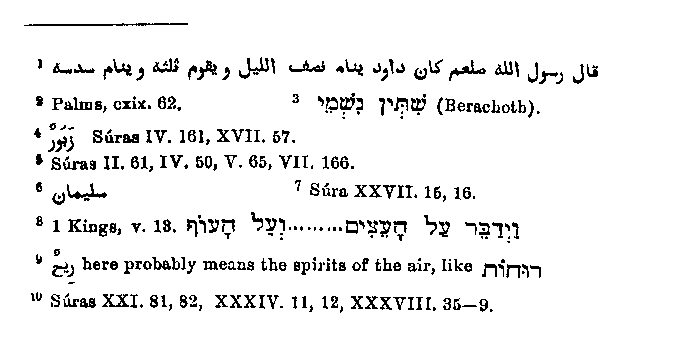
The termination illa aish al akhira, rhymes with al ansar w’al muhajira. But Mahomet would insist on repeating the last line with the words transposed ; - thus al muhajira w’al ansar, al ansar w'al muhajiran destroying the rhyme. Hishami, p.173.
By the Heavens with their Zodiacal Signs;
By the threatened Day!
By the Witness and the Witnessed!
Damned be the Diggers of the pits filled with burning Fuel, when
they sat around the same.
And they were witnesses of that which they did unto the Believers.
page 147
Jewish and Christian Scriptures not yet referred to
There is at this period hardly any allusion to Jewish and
Christian Scripture or legend95. The Coran did not yet rest its
claim upon the evidence of previous Revelation, and the close correspondence therewith of its own contents.
The language of Islam becomes fixed
The peculiar phraseology of the new faith was already becoming
fixed. The dispensation of Mahomet was distinguished as
ISLAM, that is the surrender of the soul to God; his followers as
MUSSALMANS (those who surrender themselves), or as Believers; 96 his opponents as KAFIRS, that is, rejecters of the divine message, or as MUSHRIKEN, namely such as associate companions or sharers with the Deity. Faith, Repentance, Heaven, Hell, Prayer, Almsgiving, and many other terms of the religion, soon acquired their stereotyped meaning. The naturalization in Arabia of Judaism and Christianity (but chiefly of the former), provided a ready and
extensive fund of theological words and phrases which, if not
already in actual current use, were at least widely known in a
sense approaching that which Mahomet attached to them.97
And they tormented them no otherwise than because they believed in
God the Mighty and the Glorious.
Verily they who persecute the Believers, male and female, and
repent them not,
For such the torment of Hell is prepared, and a burning anguish,
&C.
The "diggers of the pit." were the Jewish persecutors of Yemen,
Dzu Nowas and his followers. See Introduction, chap-iii. p. clxii.
This the phrase, "the merciful, the compassionate" affixed by
Mahomet to the name of God, though not actually in use, was known among
the
page 148
These remarks have been almost entirely confined to the portion
of the Coran produced by Mahomet during the period reviewed in
the present chapter. By thus connecting the several periods of
his active life with die Saran belonging to them, the enquirer is
beat able to trace the development of the religious system, and to
observe what bearing the external circumstances of the Arabian
Prophet may have had upon the peculiarities of his creed.
idolatrous Meccans, as we see by the treaty of Hodeibia. In
dictating to the scribed the terms of this truce, Mahomet commenced, "In the name of God, the Merciful, the Compassionate" The Meccans interrupted him, saying:-" Nay, as for God, we acknowledge him, but as for the Compassionate and Merciful, we acknowledge him not" Then said the Prophet:
"Write, in thy name Oh God!"

Geiger has examined ingenuously and carefully the Mahometan
terms borrowed from Judaism in his Was hat Mohammed aus dem
Judenthums aufgenommen. See also for some analogous remarks, Havernick's Introductian to Old Testament, p.116; vol 28, Clark’s For. Theo. Lib.
The Life of Mahomet, Volume II [Table of Contents]