返回总目录
JUDAISM AND ISLAM [Chapter 2, Part 4]
page 151
SECOND CHAPTER.
Fourth Part.
Holy Men after the time of Solomon.
Many important men might be mentioned here, but Muhammad knew but few of
them, and about those whom he does name he gives for the most part
nothing special, but mentions them only with other pious persons.
Some only are treated with a little more detail, and we will mention
them here first, so as then to put the others together briefly.
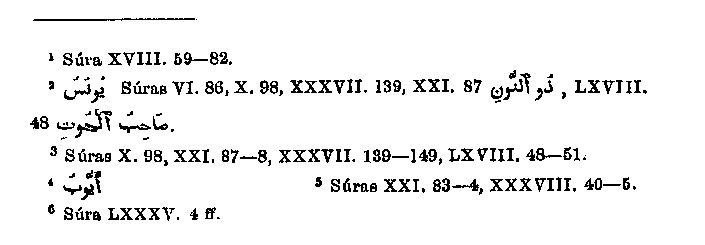
Of Elijah1 his dispute with
the people about the worship of Baal is related briefly. In the legends
of Islam as was in those of later Judaism Elijah plays a very important
part. He is that mystical person2
known under the name of Khizr. He is therefore the same as
Phinehas,3 erroneously
called by some the nephew of Aaron4
instead of his grandson, and, like Elijah the prophet5
in later Jewish traditions, he is the mediator between heaven and earth.
It is he who appears

page 152
to the pious under the most varied forms, who visits the schools,
and imparts to famous teachers that which God communicates about this
or that opinion expressed by them. The Muslims too know him in this
capacity, and they recognize him in the servant of God who proposed
himself as a travelling companion to Moses,1
and in these actions they have the prototype of his ministry as
one who appears in a miraculous manner, has intercourse with men in
human fashion, and performs incomprehensible actions which only
receive true significance through knowledge which in hidden from man.
Jonah is mentioned in several passages of the Quran.2
His mission to Nineveh, his being swallowed by the fish, his rescue
from it, and the story of the gourd which shaded him, are all given
very briefly.3
Job's4 sufferings and
healing are mentioned in two passages,5
and in the latter passage Muhammad adds that Job produced a cooling
and refreshing fountain for himself by stamping on the earth. We know
of no parallel passage to this in the Rabbinical writings.
We come now to a passage6
hitherto wrongly referred which translated runs thus:
"Slain were the men or the pit of the burning fire,
When they sat around the same,
And were witnesses of what was done to the true believers,
and they wished to punish them only because they believed in
the mighty and Glorious God," &C.
page 153
Commentators make this refer to the punishment of a Jewish Himyarite
King who persecuted the Christians, but the appellation "believers"
as applied to Christians has no parallel elsewhere in the Quran, no
detail bearing on this event is mentioned, and just this one form of
persecution (burning) is not given by the martyrologists.
If we compare the passage with the story of the three
children1 all fits in perfectly.
The three believers would not bow themselves before an idol, and were
thrown into the fiery furnace; those who threw them in were slain by
the heat and the believers were saved. Evidently, Muhammad here alludes
to this.2
It is possible that there is an allusion to the story of the revival
of the dry bones3 in a passage
of the Quran,4 which tells us
that many who left their habitations for fear of death were slain by God,
but were afterwards restored to life.5
The Talmud treats the narrative given in Ezekiel more in detail.6

page 154
Another biblical reference may perhaps be found in the words:1
"Dost thou not see how thy Lord stretches (lengthens) out the shadow
when he will, makes it quiescent, then sets the Sun over it as an
indicator." This I think is perhaps an allusion to the Sign given to
Hezekiah.2
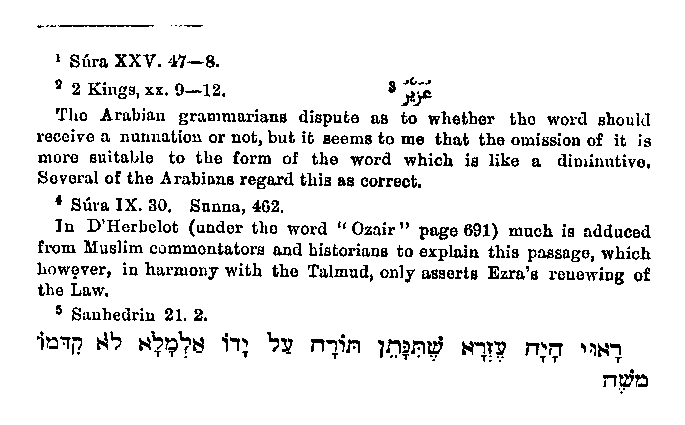
We find more in the Quran about Ezra3,
if not about his history, yet about the way in which the Jews regarded him.
According to the assertion of Muhammad the Jews held Ezra to be the Son of
God.4 This is certainly a mere
misunderstanding which arose from the great esteem in which Ezra was
undoubtedly held. This esteem is expressed in the following
passage5 "Ezra would have been
worthy to have made known the law if Moses had not come before him."
Truly Muhammad sought to cast suspicion on the Jews' faith in the unity
of God, and thought he had here found a good opportunity of so doing.
This utterance as an expression of the Jewish opinion of that time loses
much in value when we consider the personality of that Phineas the son
of Azariah, to whom it is attributed.
In the traditions of Islam there is a great deal about Ezra as the compiler
of the Law. In this character also
page 155
he comes before us in Scripture, and the Jews believed this of him;
so the probability becomes great that Muhammad, on the one hand,
intentionally exaggerated, and, on the other hand, eagerly caught up
the hasty and mocking utterance of some individual to prove this point
against the Jews.
The Arabian commentators according to Maraccius1
refer another passage in the Quran2
to Ezra, namely, the one where it is related of some person that he passed
by a ruined city and doubted if it could ever be restored. God let him
die for one hundred years, then revived him and imparted to him the
assurance that one hundred years had gone by, while he believed that
but one day had passed. The proof was that his food and drink had
perished and his ass was mouldering away. Then behold! God put together
the bones of the animal and clothed them with flesh, so that the man
acknowledged: "God is mighty over all." The fable is derived, as Maraccius
rightly observes, from the ride round the ruined city of Jerusalem made
by Nehemiah3 who is often
confused with Ezra.
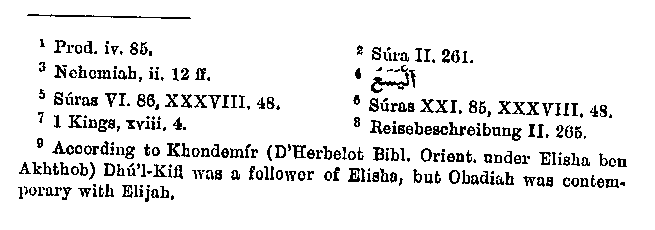
Two other Biblical characters are merely mentioned:
Elisha4 in two
passages,5 and each time
strangely enough immediately after Ishmael; and
Dhu'l-Kifl,6 who according
to his name which means the nourisher, and from the fact related of
him that he nourished a hundred Israelites in a cave, must be
Obadiah.7 Perhaps however
he may be Ezekiel who according to Niebuhr8,
is called Kephil by the Arabs.9
page 156
Now all the historical allusions have been put together, and when we
examine them we see unmistakably in them the verification of the
hypothesis which we laid down at the beginning-namely, that Muhammad
borrowed a great deal from Judaism, that he learned that which he did
borrow from oral traditions and that he sometimes altered it to suit
his purpose. We have tried to shew in the first part that external
circumstances must have raised in Muhammad the desire to borrow much
from Judaism, that he had the means thereto within his reach, and that
other circumstances, particularly his own main aim, offered no obstacle
to, but rather fitted in with each a borrowing. In the second part,
we have attempted to show that Muhammad really did borrow from Judaism,
and that conceptions, matters of creed, views of morality, and of life
in general, and more especially matters of history and of traditions,
have actually passed over from Judaism into the Quran.
And now our task is practically ended. If a thorough demonstration has
been made of all these points, then the questions as to whether Muhammad
did borrow from Judaism, and what and how he so borrowed,
have been sufficiently answered. Now, as a supplementary note we add a summary
of the passages in which Muhammad's attribute towards Judaism seems
to be negative and even hostile. Some of these passages oppose Judaism,
some abrogate laws binding on the Jews, and some allude to Jewish customs
without imposing them upon the Arabs. But since we consider the question,
the answer to which forms the subject of our theme, as now fully answered,
without giving the results of further investigation, we therefore do not
give these results as a part of this work itself but add them as an appendix.
JUDAISM AND ISLAM [Table of Contents]
Answering Islam Home Page