返回总目录
JUDAISM AND ISLAM [Chapter 2, Part 3]
page 143
SECOND SECTION.
Chapter II
Third Part.
The three kings who ruled over undivided Israel. The history following
immediately on the time of Moses, including the time of the Judges, must
either have seemed to Muhammad unedifying, which is improbable, as the
story of that heroic age was quite in accord with his feelings and aims,
or else it must have been wholly unknown to him, and this appears to have
been the case from the fact that he speaks of the choosing of a king as
an event happening after Moses,4
in terms which can only mean immediately or very soon after Moses. Saul
stands very much in the back ground; for on the one hand his history
was known to Muhammad only in a very abbreviated form, and on the other
hand the Prophet had such an undefined notion of Saul's personality that
he attributes to him the actions of others. Saul's history is related in
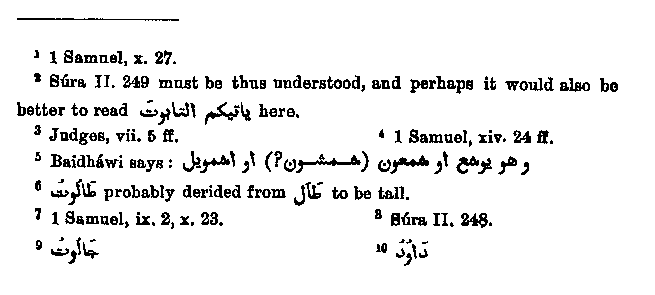
the Quran5 in the following
manner: "After Moses the Israelites desired a king, in order that they
might go out under him to the Holy War;6
to which however only a few of them

page 144
afterwards went. The prophet (Samuel) gave out that Saul was sent of God,
still he seemed despicable in the eyes of the people.1
As a sign that the tale pertained to Saul, the prophet of Israel announced
the return of the Ark of the Covenant. Saul then proved his troops,
and allowed only those to belong to his army who drank water lapping it
with the hand; this was done by very few, and even these were afraid
of Goliath and his armies. David at length overcame the Philistine and
his hosts and gained the dominion." The circumstance that through Saul
the Ark of the Covenant came back2
contrary to Scripture, according to which the Ark came back earlier.
The story of Saul's proving his troops is evidently a confusion with
that of Gideon, concerning whom this is related in the Bible,3
and has doubtless risen from the similar story of Saul's forbidding
food to the army.4
This confusion with Gideon accounts too for the saying that only
a few mighty men followed Saul. The name of the prophet is not given,
and later Arabians also are in ignorance about it.5
Saul is called Talut,6 a name
probably given on account of his height.7
Muhammad notices in the Quran that Saul was of great height,8
and Baidhawi gives this derivation for his name. Goliath is called
Jalut.9 The personality of
David10 is certainly more
clearly grasped in the Quran, but the actual historical events of his
life are scarcely touched upon. David's victory over Goliath is mentioned
page 145
incidentally in the history of Saul. Again, the story of David and
Bathsheba is only distantly alluded to, in that (setting aside the
passage1 in which he is
called "Penitent" probably with reference to her) the parable of the
case in law devised by the Prophet Nathan2
is narrated,3 and to it
is added4 that David perceived
that this was a sign; and after he had repented, he was received back
into favour by God. According to the Quran the case in dispute is not
related by the prophet, but the two disputants themselves come before
David. In another passage5
mention is made of David's and Solomon's excellent judgement on the
occasion of some quarrel unknown to as about shepherds tending flocks
on strange fields at night. A remarkable circumstance is given in several
passages,6 where it is stated
that David compelled the mountains and the birds to praise God with
him, which, as Wahl rightly remarks, owes its origin to David's poetical
address to all creatures, in which address he imagines them endowed with
life and reason, and calls on them to join with him in extolling the
Almighty. According to the Quran7
mankind is indebted to David for the invention of armour. This legend
probably arose from David's warlike fame, although there is much
said in the Bible about Goliath's armour. In another
passage8 we find a general
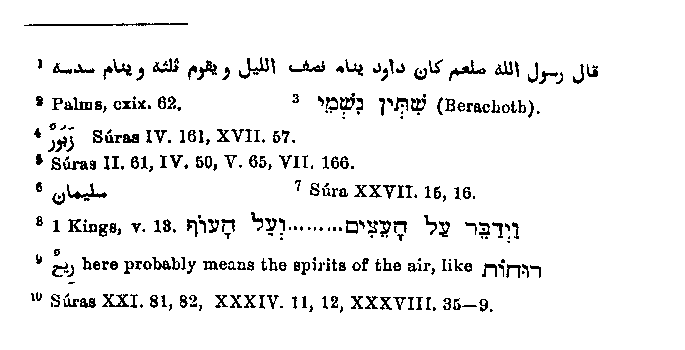
mention of David. In one of the Sunnas9
it is mentioned that David did with very little sleep; and
Elpherar10 in a long chain
of tradition beginning with Ibn 'Abba's and ending

page 146
with 'Amra, says:1
"The Apostle of God said: '(David) slept half the night, rose for
a third, and then slept again for a sixth.'" The Rabbis also speak
of this, on the strength of the2
verse, "At midnight I will rise to give thanks unto Thee,"
and they assert that David used to sleep only during sixty
respirations.3 David is
also known to Muhammad as the author of the Psalms.4
The affair of the Sabbath-breakers, who were punished by being changed
into apes, is also supposed to belong to the time of David, but the
circumstance is mentioned5
only in general terms, and nothing definite is given about time or
details, except in verse 82, where the time is given, but not the
fact. Among the Jews there is no trace of this legend.
The life of Solomon6 is in
itself important, and it is only the wisdom for which he is famed in
the Bible which makes him the hero of the whole East, one might expect
to find much more about him in the Quran than really exists there.
Muhammad speaks of his wisdom,7
and especially brings forward the fact that Solomon understood the
language of the birds. This is also asserted by the Rabbis, and is
founded on the Biblical statement:8
"He spake of trees and birds." The winds9
also performed his will, and the Genii were found in his
following;10 this is also
related, e.g., in the second
page 147
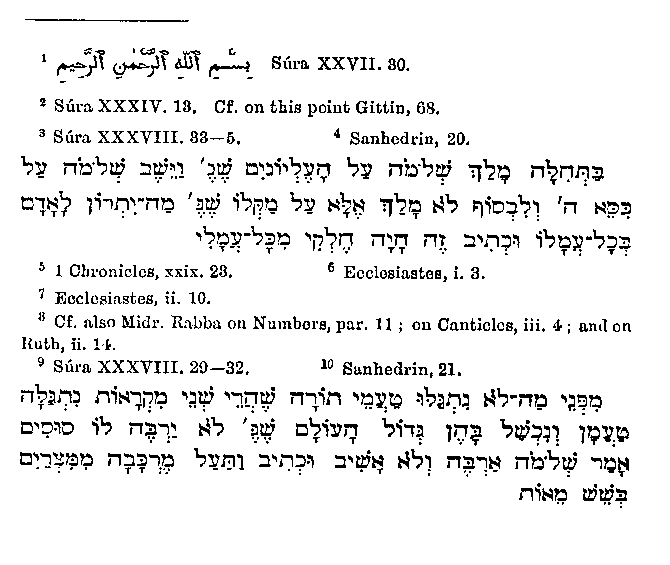
Targum on the Book of Esther,1
thus "To him were obedient demons of the most diverse sorts, and the evil
spirits were given into his hand." This legend is derived primarily from
a mistaken interpretation of a passage in Ecclesiastes.2
Muhammad relates the following tale:3
"On one occasion the lapwing4
was not found in attendance on Solomon, and the King regarding him as a
truant threatened to kill him. Then the lapwing came with the news that
he had discovered a land as yet unknown to Solomon, which was not
subject to him, the land of Sheba, in which the people together with
the Queen worshiped the Sun. Solomon sent the bird back with a letter
summoning these people to adopt the belief in the Unity of God. He
himself went thither at once with his troops, and had the Queen's
throne brought to him by a ministering angel. The Queen had been
already converted, and she came into Solomon's camp; he had her brought
before him into a hall, of which the flooring was glass, and she imagining
it to be water, exposed her legs." This same story is to be found in the
Targum5 already referred to,
together with some other circumstances which I shall omit here. The story
runs as follows: "Thereupon the partridge was sought and not found among
the birds, and the King commanded angrily that it should be fetched,
and he wanted to kill it. Then the partridge answered the king:
'My lord and King, attend and hear my words, for three months
I considered and flew about the whole world to find the town where
thou wast not obeyed. Then I saw a town in tho East called Kitor,
where there are many

page 148
people, but a woman rules over them; she is called the Queen of Sheba.
If it please thee now, my Lord King, I will go to that town and bind
the Queen with chains and its nobles with iron fetters and bring them
all here.' And it pleased the King, and Scribes were called who wrote
letters and bound them to the wings of the partridge. When the bird
came to the Queen she saw the letter tied on to its wing, she opened
it, and these were the contents: 'From me, Solomon the King, greeting
to thee and to thy princes! Thou I knowest well that God hath appointed
me King over the beasts of the field and the birds of the heaven and
over the demons, spirits and spectres of the night, and that the
kings of all the countries under heaven approach me in submission.
If thou also will do this, great honour will be shown thee; if not,
then I will send against thee kings and legions and horsemen. The
kings are the beasts of the field; the horsemen, the birds of the
air; the armies, demons and spirits; while the legions are nightmares,
which will strangle you in your beds.' When the Queen had read this,
she rent her clothes and sent for the elders and lords and said:
'Do you know what King Solomon has sent me?' They said: 'We neither
know him, nor heed him.' But the Queen did not trust them, but
called for ships and sent presents to the king, and after three
years she went herself. When the king heard that she had come,
he seated himself in glass room. She thought the king was sitting
in the water, and bared herself to go through it. When she saw his
magnificence, she said:1
'Blessed be the Lord thy God, which delighted in thee, to sit thee
on the throne ... to do judgment and justice.'"
We must forgive Muhammad the two slight changes he makes in the story,
viz., that he turns the matter from one of government into one of

page 149
religion, and that he begins the letter1
with the words "In the name of the Merciful God." Solomon built
the Temple, so by the help of the spirits, who even went on building
after his death, while he remained sitting on his throne till a worm
gnawed him.2
Once when Solomon became arrogant he was driven from the kingdom, and
a spirit reigned in his stead until he repented.3
The Sanhedrin4 gives the
following brief account: "At first Solomon reigned even over the exalted
ones, as it is written:5
Solomon sat on the throne of the Lord; but afterwards only over his
own stick, as it is written:6
What profit hath man of all his labour? and further,7
this was my portion from all my labour."8
When he repented, he gave up big useless extravagances, and had his
horses disabled,9 to which
the following passage alludes:10
"It is wisely ordained that the reasons for the commandments are not
given; they were given in two
page 150
cases, and one of the greatest of men sinned. For it is
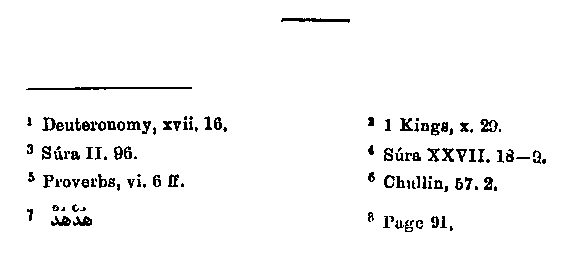
written:1 The king shall
not multiply horses to himself, nor cause the people to return to
Egypt, to the end that he should multiply horses. Then Solomon thought,
I will get me many horses and not send to Egypt; but it is
written:2 And a chariot
came up and went out of Egypt for six hundred shekels of silver."
A story about spirits, which is said to have happened in Solomon's
time,3 has already been
mentioned in connection with Noah. A story about the ants, which
fled before Solomon's army, is related in the Quran4
and remains to be noticed. It is evidently founded on the
verse,5 "Go to the ant thou
sluggard and be wise;" and based on this same foundation we have
a beautiful fable in the Talmud,6
but I could find there no trace of the story given in the Quran.
The story of the lapwing7
has gained a firm foot hold in Arabic legend, and a pretty myth about
the bird is found in Fakihat Elcholafa.8
For Muhammad there were no very important personages between Moses
and Jesus; and such as he does mention he merely alludes to. This is
not to be wondered at when Solomon the wise man of the East, who is
endowed with all manner of legendary adornment comes, comparatively
speaking, so little before us in the Quran.
JUDAISM AND ISLAM [Table of Contents]
Answering Islam Home Page