返回总目录
JUDAISM AND ISLAM [Chapter 2, Part 2]
page 118
SECOND CHAPTER
Second Part
Moses and his Time.
The history of the earlier times was preserved only in brief outlines,
and was not so important either in itself, or in the influence whole,
it exerted on the subsequent
page 119
ages; therefore Muhammad adopted from it only such legends as were
edifying in themselves and to which he could append pious reflections.
In the period of which we are now going to treat, there is certainly
still a long array of legends, but historical facts are preserved
for us with greater distinctness and clearer detail, and these facts
are of greater religions importance. The giving of the Mosaic Law
and the eventual life and noble personality of Moses himself afford
Muhammad plenty of material for his narrative. Here we will first
put together the whole life of Moses as represented in the various
passages of the Quran, and then we will go on to consider the details
to be commented upon. Among the oppressive enactments of Pharaoh
against the children of Israel was an order that their children
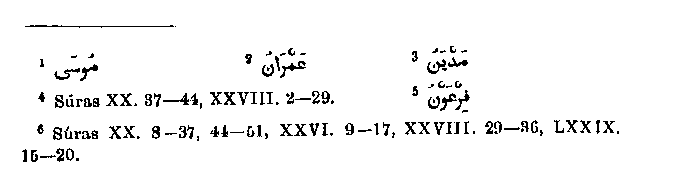
should be thrown into the water. Moses1
the son of Amram2 was
laid by his mother in an ark; Pharaoh's wife, who saw the child
there, saved it from death and had it nursed by its mother. When
Moses was grown up he tried to help his oppressed brethren, and
once killed an Egyptian; the next day however he was reminded by
an Israelite of his yesterday's deed. This made him afraid, and
by the advice of a friend he fled to Midian,3
and married there the daughter of a Midianite.4
When he wished to leave Midian he saw a burning bush, approached it,
and received a command to go to Egypt to warn Pharaoh5
and to perform some miracles to make him believe; he asked for his
brother Aaron as an assistant in this work.6
He obeyed the command and accomplished his mission, but Pharaoh
remained unbelieving and assembled his magicians, who
page 120
indeed imitated the wonders, but were so far surpassed by Moses and
Aaron that they themselves became believers in spite of the threats
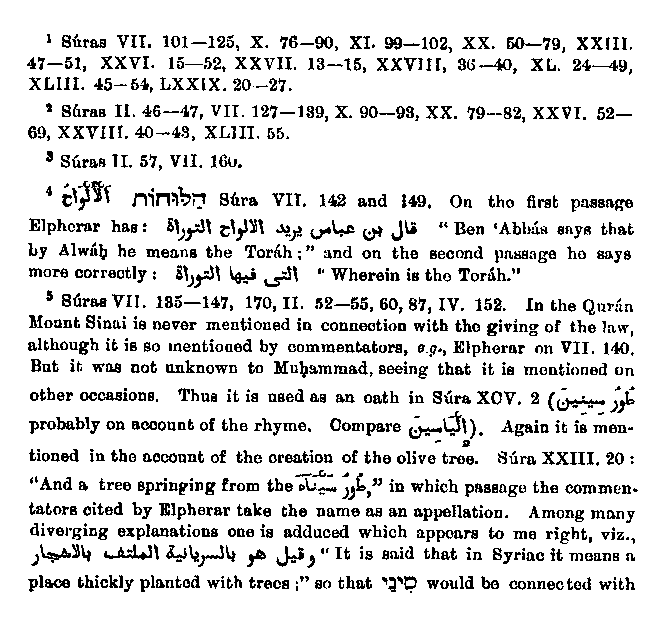
of Pharaoh.1 But a mighty
judgment overtook Pharaoh and his people, who remained stubborn in
their unbelief; and at last the Egyptians were drowned in the sea,
while the Israelites were saved.2
Nothing is related of the journey of the children of Israel before
the giving of the Law, except the striking of the rock with the staff
so that water flowed out, and this comes in only incidentally in two
passages;3 in the former
of which however other facts about the stay in the wilderness are
related. Moses then received the Law,4
and prayed to see God's glory.5
During his absence the6
page 121
Israelites made the golden calf, which Moses on his return dashed
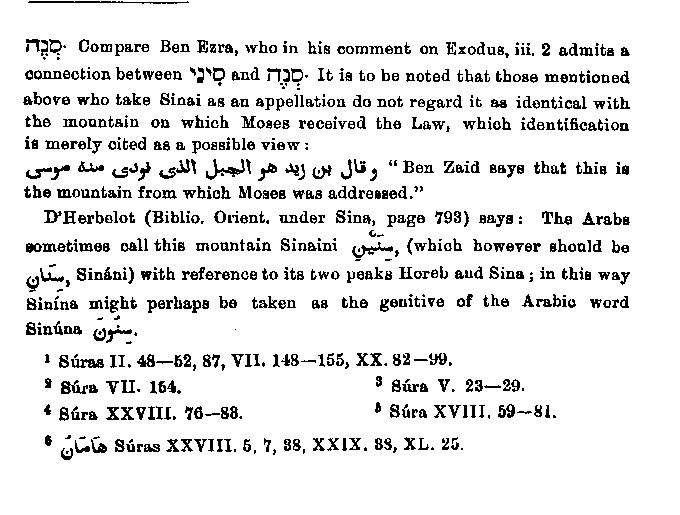
into pieces and gave to the Israelites to drink;1
and after that he appointed seventy men.2
Later on he sent spies to Canaan, but they all except two were godless.
The people let themselves be deceived by them and in consequence
were obliged to wander for forty years in the wilderness.3
Further, Moses had a dispute with Korah, whom the earth swallowed
up,4 and he was wrongly
accused.
This last statement may be either a reference to the matter of Korah,
or to the dispute with Aaron and Miriam. These are the main events of
Moses's life as they are given in the Quran, and we have arranged them
partly according to the order of their mention in that book, but more
with reference to our better source. Besides all this, a wonderful
journey which Moses is said to have taken with his
servant5 is given, about
which we shall speak further on. To pass on now to details.
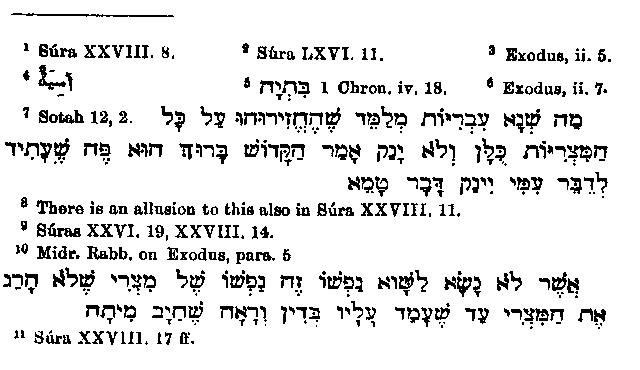
Haman6
page 122
and Korah1 are mentioned
as counselors of Pharaoh and persecutors of the Israelites. The latter
is alluded to in this capacity by the Rabbis,2
who say "Korah was the chief steward over Pharaoh's house." As to
the former, Muhammad must at gone time have heard him mentioned as
the Jew's enemy,3 and
therefore have put him in here, although later Arabians do not thus
designate the Haman4 who
lived in the time of Ahasuerus. The Rabbis also say a good deal about
Pharaoh's advisers, amongst whom they sometimes mention Balaam, Job
and Jethro. Of these the first agreed with Pharaoh and for this reason
he was afterwards killed by the Israelites; the second remained silent,
therefore he had to endure sufferings; the third fled, and so the
happiness of being the father-in-law of Moses fell to his lot. The
two chief magicians,5 who
are also mentioned in a letter of the apostle Paul, are specially
named as abettors. Fear on account of some dream6
is given as the greatest cause of persecution; and this is in accord
with the statement of the Rabbis that it was foretold to Pharaoh by
the magicians7, that a boy
would be born who would lead the Israelites out of Egypt; then he thought,
if all male children were thrown into the river, this one would be thrown
with them.8 The finding

page 123
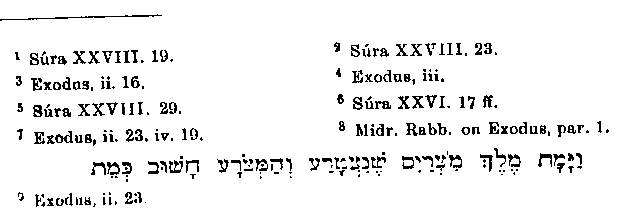
of Moses is attributed to Pharaoh's wife,1
and she is mentioned as a believer,2
evidently having been confounded with Pharaoh's daughter, by whom Moses
was found according to the Scriptures,3
and in the same way the name4
given to Pharaoh's wife by the commentators is a corruption of the
name5 by which his daughter
was known among the Jews. The words of the Bible "Shall I go and call
thee a nurse of the Hebrew women?"6
give rise to the following Rabbinical fable:7
"Why must the nurse be a Hebrew women?" This shows that he refused the
breast of all the Egyptian women. For God said "Shall the month that
is one day to speak with me suck an unclean thing?"8
According to Muhammad Moses regarded his slaying of the Egyptian as
sinful and repented thereof,9
which is contrary to the Jewish view,10
expressed as follows; "The verse in the 24th Psalm (according to the reading
of the Kethibh; 'Who took not away his soul out of vanity') refers to
the soul of the Egyptian, which Moses did not take away, until he had
investigated his case judicially and had found that he deserved death."
That the Hebrew whom he released strove again on the following day
with an Egyptian,11 and
that he betrayed Moses, because he would not uphold him, but on the
contrary reproved him
page 124
for his quarrelsome temper is mere embellishment, as is also the
very happy invention of a man who warned Moses to
flee.1 There is a mistake
to be found in the very brief account of Moses' flight to Midian and
his residence there, for Muhammad speaks of two2
instead of seven3 daughters
of the Midianite. Instead of letting the vision in the bush be the
occasion of Moses' leaving Midian, as it is in the
Bible,4 Muhammad erroneously
makes out that Moses had formed the resolution to leave the country
before this event, and that the vision appeared to him on the
way.5 The appearance of
Moses before Pharaoh is connected in a remarkable way with the
divine commission to the former. So closely are the two circumstances
bound together that in many places Pharaoh's answer follows immediately
upon God's command, without its having first been mentioned that Moses
and Aaron had gone in obedience to God to Egypt, had done wonders before
Pharaoh and had admonished him. But on the other hand in those passages
where only the admonitions given by Moses to Pharaoh are related,
without the preceding events being given, the part elsewhere omitted
is of course supplied but as we might expect with changes. Pharaoh
is said to have reproached Moses with the murder of the
Egyptian.6 This is a very
simple invention, which however is contrary to the literal sense of
the Scriptures,7 unless
we accept the Rabbinical explanation8
of the words, "the king of Egypt died,"9
that is, "he became leprous and a leper is as one dead; "and also of
the words, "for all are died who sought
page 125
thy life"1 which is as follows:
"Were they dead? They were Dathan and Abiram, who were involved in
the dispute of Korah. This only means that they had become powerless."*
Further, Moses is supposed to have shown the sign of his leprous hand
before Pharaoh,2 which is
not mentioned in Scripture,3
but which agrees with the following statement in the Rabbinical
writings4 "He put his hand
into his bosom, and drew it out as white as snow from leprosy they
also put their hands into their bosoms and drew them out as white as
snow from leprosy." The magicians who were summoned asked at first,
in distinction from God's messengers, for their reward5;
but when they had seen their serpents swallowed by that of Moses
they believed, praised God and were not intimidated by Pharaoh's
threats. This is quite contrary to the Bible, in which such
a confession is found only after the plague of lice,6
and there too only in the form of a mere hint. Among Moses' own people
only his own tribe is said to have believed on him,7
and the Rabbis say8 that
"the tribe of

page 126
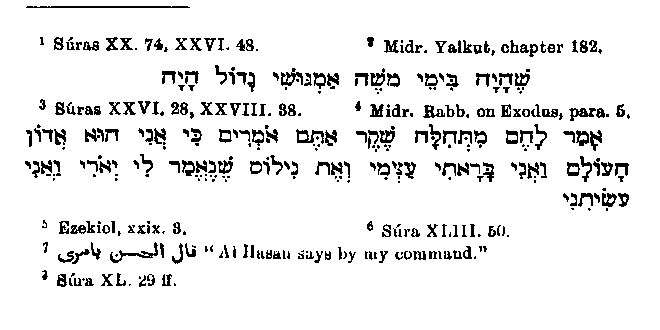
Levi was exempt from hard labour." Pharaoh himself was also a magician,
and this he claims, according to my opinion, in his address to the other
magicians.1 This is in
accord with the Rabbinical statement2
that the Pharaoh who lived in the days of Moses was a great magician.
In other passages of the Quran,3
Pharaoh claims for himself divinity which assumption no doubt is intended
to be accepted by the people. This trait is also developed in Jewish
legend,4 where we read:
"Pharaoh said to them 'From the first have ye spoken an untruth,
for lord of the world am I, I created myself and the Nile; as it
is written:5 my river
is mine own and I have made it for myself.'" In another
passage6 Muhammad puts
the following words into Pharaoh's mouth: "Is not the kingdom of Egypt
mine and these rivers which flow beneath me?" Elpherar, with
others,7 remarks on the
words "beneath me?" that they mean "by my command." A quite new but
charming fiction is that of a pious Egyptian, who warned his countrymen
not to despise the teaching of Moses and not to persecute
him.8 Certain features of
this story sound familiar. For instance, the words in verse 29: "If he
be a liar, on him will the punishment of his falsehood light; but if
he speaketh the truth, but some of those judgments with which he
threateneth you will fall upon you," bear a resemblance to the words of
page 127
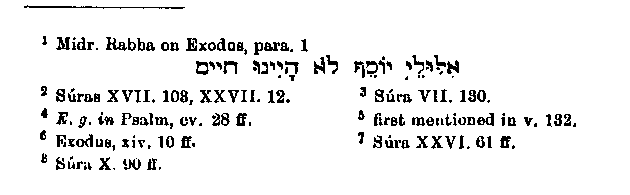
Gamaliel in the New Testament. The allusion to Joseph in verse 86 is
found in a very dissimilar Jewish tradition, as follows:1
"If Joseph had not been, we should rot be alive." Muhammad is not clear
about the plagues. In some passages2
he speaks of nine plagues. In another passage2
he enumerates five, which stand in the following order: Flood, Locusts, Lice,
Frogs and Blood. Although we cannot here find fault with the want of order
in the plagues and with the omission of some of them since Muhammad here
is not, any more than is the Psalmist,4
to be considered as a strict historian, get the mistaken inclusion of a flood,
which is not to be confounded with the overthrow in the
sea,5 may fairly be considered
as a proof of the want of reliable information on the subject. The fear of
the Israelites6 at the approach
of the Egyptians by the sea is also mentioned by Muhammad.7
Now we come to a circumstance, which is also taken from Jewish legend,
but which has been almost entirely misunderstood, from ignorance of its
origin. The passages may be translated as follows: "And we caused the
children of Israel to pass through the sea, and Pharaoh and his army
followed them in a violent and hostile manner, until when he was drowning,
he said: 'I believe that there is no God but He on Whom the Children of
Israel believe, and I am now one of the resigned;' on which God said,
(or perhaps this is to be read in the first person, so that this verse
too expresses Pharaoh's penitence, and the next verse begins the expression
of God's answer) 'Thou hast been hitherto one of the rebellious and wicked
doers. This
page 128
day, however will we save thee with thy body, that thou mayest be a sign
to those who shall be after thee.'"1
This is the quite simple meaning of the words, which has been turned and
twisted about by others, because they were ignorant of the following Jewish
legend:2 "Recognize the power of
repentance Pharaoh King of Egypt rebelled excessively against the Most High
saying: 'Who is God that I should hearken to His voice?'3
but with the same tongue he repented saying: 'Who is like Thee, O Lord,
among the Gods?'4 God delivered
him from the dead, for it is written: 'For now I had put forth my hand and

page 129
smitten thee,1 but God let him
live to proclaim His power and might, even as it is written in Exodus, ix. 16."
On the occasion of the striking of the Rock Muhammad makes twelve streams
gush out, so that each individual tribe2
had its own particular stream. Apparently this is a confusion of the events
at Raphidim, where the rock was struck,3
with those at Elim where the Israelites found twelve wells.4
On these wells the commentator Rashi, probably following earlier expositors
says:5 "They found them ready for
them, in number as the twelve Tribes." when it came at last to the giving of
the Law, the Israelites are said to have rebelled; but God threatened them
that He would overturn the mountain6
upon them if they would not accept the Law. The Jews also say that God
threatened to cover them with the mountain as with a basin turned upside
down.7 But now the Israelites
demanded that they themselves should see God; they died at the sight of Him,
but were afterwards raised again.8
The corresponding Rabbinical statement may be translated as
follows:9 "The Israelites desired
two things of
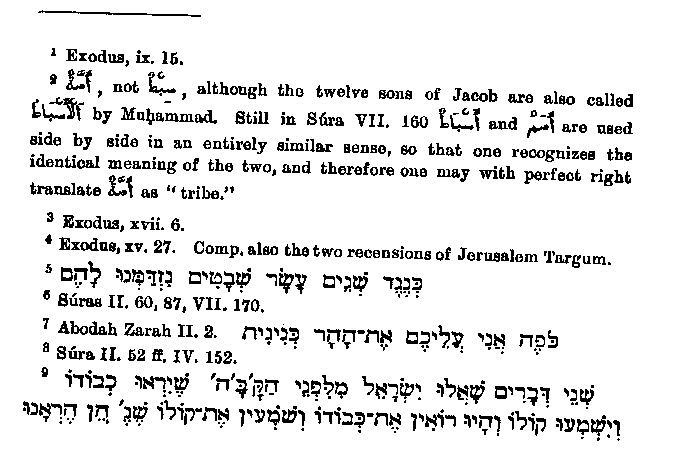
page 130
God, that they might see His glory and hear His voice; and both wore
granted them, as it is written:1
'Behold the Lord our God hath showed us His glory and His greatness,
and we have heard His voice out of the midst of the fire.' Then they
had no power to bear it; for when they came to Sinai and He appeared
to them, their soul departed at His speech, as it is
written:2 'My soul went forth
when he spake.' The Law (the Torah) however interceded with God for them
saying: 'Would a king marry his daughter and slay all his household?'
The whole world rejoices (on account of thy appearance), and shall thy
children (the Israelites) die? At once their souls returned to them,
therefore it is written:3
'The Law of the Lord is perfect, restoring the soul.'"
The story of the calf is also one of those which Muhammad, following
the Rabbis, has found it easy to embellish. He says that the people
would have killed Aaron, if he had not made them a calf;4
and the Rabbis say:5
"Aaron saw Hur (who had wished to oppose them) killed; then he thought:
if I do not listen to them they will do with me as with Hur? According
to another statement of the Quran6
one, of
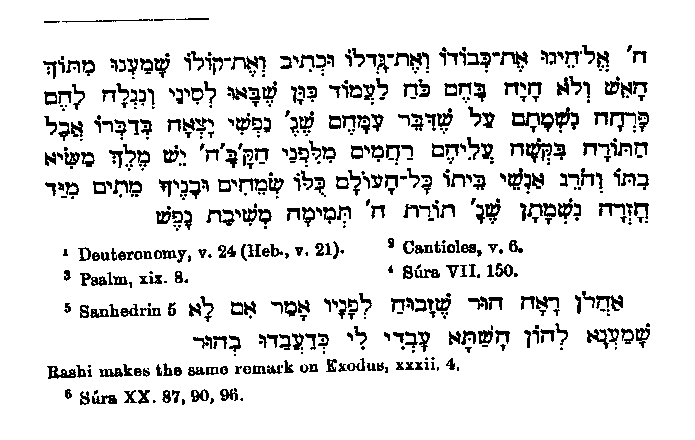
page 131
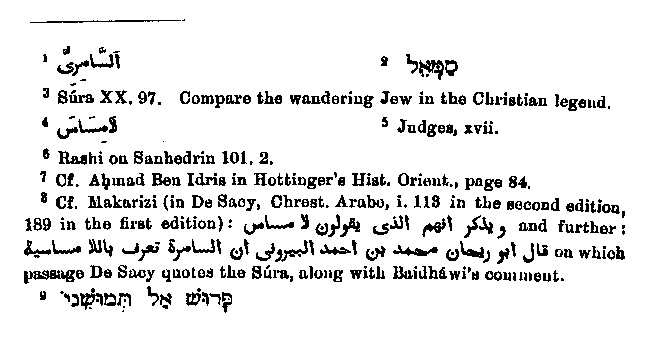
the Israelites, named Samiri,1
led them astray and also made the calf. This arose perhaps from
Samael,2 the name of one who
is supposed by the Jews to have been helpful at the making of the calf;
but at any rate the tale has been differently developed by Muhammad.
According to him this was one of the Israelites who was present, and
whom Moses condemned to everlasting wandering,3
so that he was compelled to say perpetually, "Touch not."4
One recognises that this legend is composed of different elements.
It is not foreign to Jewish tradition that another Israelite, not Aaron,
made the calf, and according to one legend, Micah,5
who is mentioned in Judges, helped in the making;6
whence it comes that many Arabians assort that Samiri and Micah are one
and the same person.7 Perhaps
Muhammad formed the word Samiri from a confusion with the name Samael.
Samiri was the name for Samaritan, and according to the Arabians the
Samaritans said, "Touch us not."8
With how much reason the Arabians hold this is indeed unknown, perhaps only
from confusion with a sect of the Pharisees described as bad in the Talmud,
where it is named "The set-apart, touch me not;"9
but I have only a dim recollection of the passage. In short the Samaritans
were certainly known to later Arabians by this name, and
page 132
Muhammad doubtless knew them by it too; and since he gave the name
of Samaritan1 to the maker
of the calf, this man must have seemed to him to be the founder of
the sect, and the "Touch me not" must have originated with him, which
as a punishment was known to Muhammad from the similar story of the
wandering Jew. Muhammad says that the calf lowed as it come
forth.2 With this is to
be compared the Rabbinical statement: "There came forth this
calf3 lowing, and the
Israelites saw it. Rabbi Johuda says that Samael entered into it
and lowed in order to mislead Israel."4
In the Quran it is said5
that among the people of Moses there was a tribe which kept to the
truth. This seems to refer to the tribe of Levi and especially to
their behaviour about the calf, although possibly it may refer also
to their belief in Moses's mission to Pharaoh of which we have
spoken before. In the biblical account a statement is
made,6 which is explained
by the Rabbis as follows:7
"From Exodus, xxxii. 26, it is clear that the tribe of Levi was not
implicated in the matter of the golden calf." The Arabian commentators
produce the most unedifying fables about this passage.
In the events which follow abbreviations are to be found, but neither
changes nor embellishments, except in the story of the dispute with
Korah, which gives rise to some. Korah is said to have had such riches
that a number of

page 133
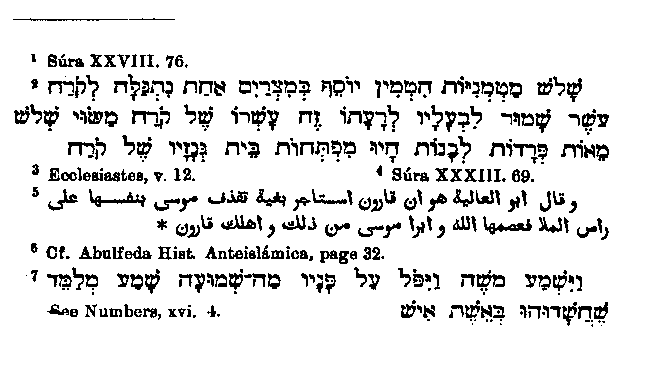
strong men were required to carry the keys of his treasure-chamber,1
and the Rabbis tell us,2
"Joseph buried three treasures in Egypt, one of which became known to
Korah. Riches kept by the owner to his hurt3
may be applied to the riches of Korah. The keys of Korah's treasure
chamber were a burden for three hundred white mules." It is implied
in the same Talmudic passage that he became overbearing and quarrelsome
from the possession of such riches, and Muhammad embellishes this idea
in a fine manner. One passage in the Quran may refer to this dispute,
for it says there that some persons had accused Moses, but that God
cleared him from the charge which they had brought against
him.4 Some of the commentators
also refer the passage to this event, while they bring forward the
following story, which we give in Elpherar's words:5
"Abu'l-'Aliah says that it refers to the fact that Korah had hired
a bad woman, who accused Moses before all the people of bad conduct
with herself. God made her dumb, cleared Moses of the accusation,
and destroyed Korah." This is actually supposed to have happened
after Moses had made known the law about adultery, and after the
enquiry as to whether it applied to him also had been answered by him
in the affirmative.6
The Rabbis also allude to this in the following words7
"And when Moses
page 134
heard it, he fell on his face. What did he hear? That he was blamed
for being intimate with the wife of another;" and in another passage
we read:1 "Each man suspected
his wife on account of Moses." Other commentators understand that
the accusation was that Moses had killed Aaron, because the two were
alone together when Aaron died on Mount Hor; but Moses was cleared
from this by the angels, who produced Aaron's corpse.2
This is also a Rabbinical idea, for we read in the Midrash
Tanchuma3:
"All the congregation saw that Aaron was dead.4
When Moses and Eleazar came down from the mountain, the whole congregation
came together against them asking them 'Where is Aaron?' They said:
'He is dead.' They replied: 'How can the death angel come to a man
who has once resisted him and held him back? for it is
written:5 He (Aaron) stood
between the dead and the living and the plague was stayed. If you
produce him, well; if not, we will stone you.' Moses then prayed:
'Lord of the world, clear me from this suspicion.' Then God immediately
opened

page 135
the grave and shewed Aaron to them, and to this refers the passage
'The whole congregation saw, etc.'" Here I omit entirely a third very
insipid fable which the commentators mention, and which seems to them
to be the most probable occasion of the verse, but I cannot trace it
to any Jewish source. The most correct view is, as Wahl has already
remarked, that the verse refers to the reproaches of Aaron and
Miriam.1 In short the
fifth verse of Sura LXI is about the answer of Moses to the disputants.
Here the commentators give only the fable not quoted by us, just because
here, as in the second passage, they repeat only the most universally
accepted view. But this cannot prevent us from holding to our opinion.
Of the journey described by Mubammad2
I could not find a trace in Jewish writings, although the colouring is
Jewish.* Moses is said to have gone with his servant to see the place
where two seas met, and to have forgotten a fish, which they were taking
with them for food and which sprang into the sea. When they went back to
seek it, a servant of God met them and made the journey with them,
telling them before hand that his notions would rouse their impatience.
He sank a ship, killed a youth and propped up a wall; and only when they
parted did he give sufficient reasons for these actions. The story
following this about Dhu'l-

page 136
Qarnain1might well refer to Moses,
the shining one,2 if anything
of the sort were known about him.
Of the individual laws which are mentioned historically in the
Quran,3 only one, viz that
relating to the red hefer,4
affords material for a narrative, and that is given5
in very unnecessary fullness and with manifold errors. In the first
place Muhammad confounds the red heifer6
with the calf which is slain for one murdered by an unknown
hand,7 and he also makes the
dead man live again8 on being
struck with a piece of the animal. In view of such great distortions
we must not deal hardly with him for the following small one; he says
that the cow must be of one year,9
in contradiction to the rabbinical statement that she had to be
a two-year old.10
As to those persons who come into the history of Moses, we have already
disposed of Pharaoh, Aaron and Korah,11
while we have only mentioned others and therefore must add more about
them. Miriam12 is praised in
the scripture and called a prophetess,13
but the Rabbis value her still more highly and say of
her:14 "The angel of death
had no power over Miriam, but she died from the divine afflation,
and therefore worms could not touch her." According to
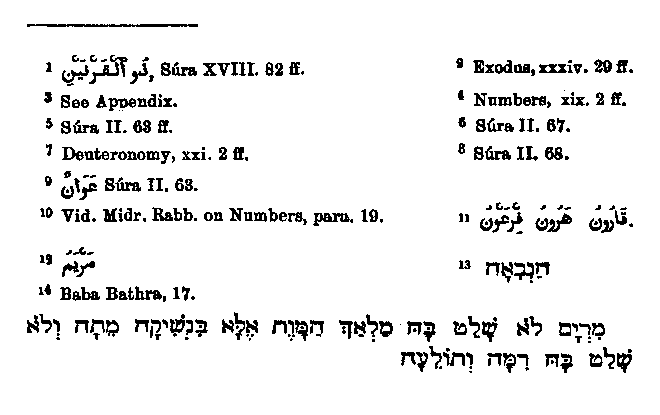
page 137
Muhammad1 Miriam is the mother
of Jesus.2 Although Miriam's
name is not mentioned in the passage where she is alluded to in the
history of Moses3 yet there
is not the slightest doubt that Muhammad took both Marys for one and
the same person; for The Talmudic utterance already cited, viz., that
Miriam did not die through the angel of death, could easily be turned
into a statement of a long, if not endless, life for her, especially
by Muhammad, who treats chronology pretty much according to his own
pleasure. The other person who appears in the history of Moses is his
father-in-law Jethro. Now it is true that his name, like that of Miriam,
is not mentioned in the story of Moses,4
hence the Muhammadan tradition connects this Midianite (as the Quran
simply designates the father-in-law of Moses) with Shu'aib, the Arabic
name for Jethro, and so they came to be considered as one and the
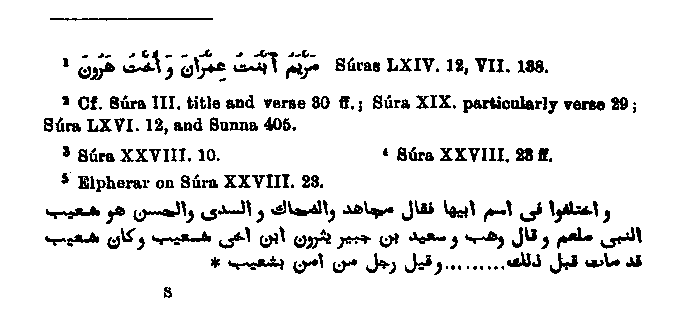
same, not however without more or less opposition. Thus Elpherar
says:5 "Opinions are divided
as to the name of Moses' wife’s father. Many say he was the prophet
Shu'aib; others that he was Jethro the nephew of Shu'aib who died
before him; others again that he was a man who believed on Shu'aib."
But the most widespread tradition is that it was Shu'aib himself.
Thus Elpherar always calls him by this name, when mentioning him in
connection with these events and
page 138
Abulfeda1 relates just
this one thing about Shu'aib, viz., that he was the father-in-law
of Moses, without giving any other opinion. Though his name is not
mentioned in this connection in the Quran, other events independent
of Moses' life are related of him, particularly his admonition of
the Midianites, which is said by the Rabbis to have been the cause
of the hatred of that people towards him.2
Muhammad took up the admonition without mentioning the consequence
which it entailed on Jethro, viz., the driving away of his daughters
which was just the circumstance which led to Jethro's connection
with the life of Moses. According to Muhammad an immediate punishment
fell on the Midianites.3
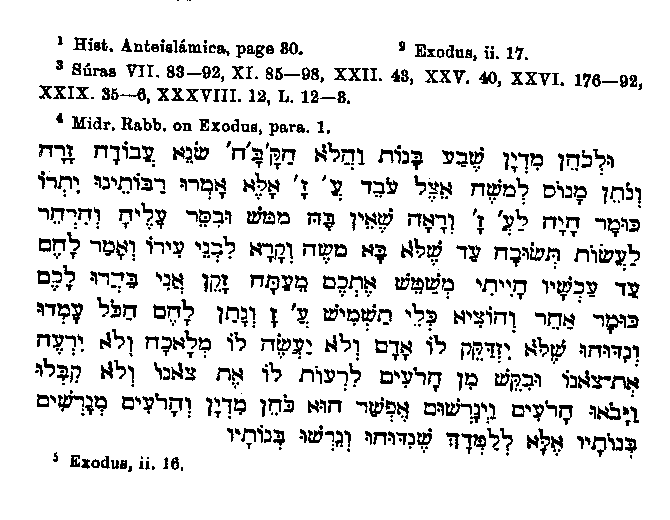
The Rabbis have the following on the subject:4
"The priest of Midian had seven daughters.5
God hates idolatry and did He give Moses a refuge with an idolater?
Concerning this our teachers tell us: Jethro was priest of the idols,
but knew their worthlessness, despised
page 139
idolatry and had thought of being converted even before Moses came.
Then he called his fellow-townsmen and said to them: 'Till now
I have served you, but now I am old, choose you another priest:
and he gave them back the vessels of service.' Then they put him
under a ban, so that no one conversed with him, no one worked for
him, no one tended his flocks; and when he asked this service from
the shepherds, they would not give it. The shepherds came and drove
them away.1 Was it possible?
Jethro was the priest of Midian and the shepherds drove away his
daughters? But this shows that they had put him under a ban, and
for this reason they drove his daughters away." In the mouth of
the people, or more probably from Muhammad himself, the legend
received the embellishment that Jethro wanted to convert his
fellow-countrymen to the faith, and that they were punished on
account of their unbelief. A reproach which is specially brought
against them, or rather the point of the exhortation, viz., to give
just weight and measure,2
must be founded on some legend or other, although I have not yet
come across it in Jewish writings.3
Jethro shows himself as a preacher quite according to Muhammad's
ideas. He preaches about the Last Day4
and asserts that he desires no reward;5
on the other hand his townspeople reproach him with working no
miracles.6 I have
presented the facts and quotations here as though there were no
doubt that all these passages refer to Jethro, but exception might
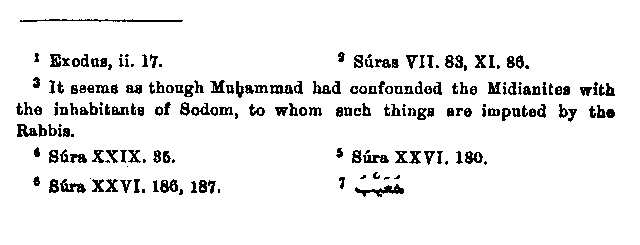
be taken to this. An altogether different name7
is found in the Quran, and it is not easy to
page 140
explain how Jethro came by it. However, we must first try to show
that Shu'aib and Jethro are identical, and then put forward our
conjectures as to how the many-named Jethro added this name to his
others. The identity is first shewn by the fact that those to whom
he was sent are called "Midianites;"1
in the second place, the two first passages2
give the events concerning him between the story of Lot and that of Moses.
Now if we can find among the Rabbis any intimation favourable to
this supposition, then nothing important will remain to oppose its
adoption3 as a probable
hypothesis. Very little, however, can be adduced to show how Shu'aib
and Jethro came to be one and the same person. Muhammad may have
confused the name Hobab4 -
often used for Jethro and probably pronounced Chobab - with Shu'aib.
Perhaps an etymological explanation may be thought of here, for the
Rabbis assert that the staff used later by Moses and called the
divine staff5 grew in
Jethro's garden.6
Now Sha'ba7 means staff
and Shu'aib8 may be taken
as the possessor of the staff. If Shu'aib is the same as Jethro,

page 141
there are passages1 in which
the former is mentioned, while those to whom he is sent are not called
Midianites; and so we find a new name for these people,2
viz., "men of the wood," a which name is evidently derived from the
thorn bushes which were in the vicinity.
It remains for us to justify the bringing forward of two more
passages,4 and it is all
the more difficult for us to do so, because in order to prove our
point we must accuse Muhammad himself of a misunderstanding. In these
passages Shu'aib is not mentioned, but the people who are held up
as a warning are called "men of the well,"5
without any other particulars being given about them. But further these
"men of the well"6 are mentioned
in one passage along with the "men of the wood," and so it seems certain
that Muhammad regarded them as two different peoples; but nevertheless
we allow ourselves to believe them to be really identical.
The real reason for bringing Jethro into the Quran is, as we have
already remarked, the quarrel of the shepherds with his daughters,
although the fact itself is not mentioned in that book; and it is thus
easy to understand that the Jews may have sometimes called the Midianites
by this name, "men of the well". No other circumstances related about
these persons mentioned in the Quran would authorize this appellation.
The story of Jacob at the well (setting aside the fact that not the
slightest allusion

page 142
to it is to be found in the Quran,) has in it no trace of hostility; and so
the conjecture is not too daring that, as a matter of fact, all these
three,1 viz., the Midianites,
the people of the wood, and the people of the well, are the same, but
that Muhammad regarded the first two only as identical and looked on
the last as different. Still this tradition seems to have been received
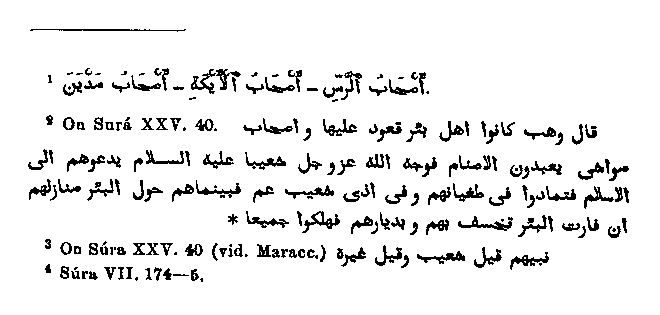
even among the Arabs, for we find in Elpherar2
among other explanations the following: Wahb says that the people of
the well sat beside it (the well), and the shepherds served idols. Then
God sent Shu'aib, who was to exhort them to Islam, but they remained in
their error, and continued their efforts to harm Shu'aib. While they sat
round the well in their dwellings the spring babbled up and gushed over
them and their houses, so that they were all ruined." In like mariner
Jalalu'd-din says:3
"Their prophet is called by some Shu'aib, by others differently."
This admission of the Arabic commentators strengthens our opinion
considerably. Another person of some importance in the Mosaic age is
said by some Arabic commentators to be alluded to in the
Quran,4 but many others
dispute the allusion. Elpherar quotes four different opinions on this
passage. The first opinion is that it refers to Balaam, for which he
quotes many authorities, and relates the history of Balaam in almost
complete accord with the
page 143
Bible narrative.1
Jalalu'd-din and Zamakhshari2
refer this to Balaam, and call him Balaam the son of
Ba'ura3. Beyond these
no other persons who come into the life of Moses, or who were
important in his time, are mentioned, and thus our second part
comes to an end.

JUDAISM AND ISLAM [Table of Contents]
Answering Islam Home Page