返回总目录
JUDAISM AND ISLAM [Section 2, Chapter 2]
page 73
SECOND SECTION
Chapter II
Stories borrowed from Judaism
This division will prove to be the largest, partly, because these narratives,
draped in the most marvellous garb of fiction, lived mostly in the mouth
of the people; partly, because this fairy-tale form appealed to the poetic
fancy of Muhammad, and suited the childish level of his contemporaries. In
the case of the Old Testament narratives, which are seldom related soberly,
but are for the most part embellished, it needs scarcely a question, or
the most cursory enquiry, as to whether or not they have passed from the
Jews to Muhammad; for the Christians, the only other possible source to
which they could be attributed, bestowed very little attention in those
days on the Old Testament, but in their narratives kept to what is strictly
page 74
Christian, viz., the events of the Life of Jesus, of His disciples and
His followers, and of the multitude of subsequent Saints and wonder-workers,
which afforded them abundant material for manifold embellishments. The
Christians, for all that they accepted the Old Testament as a sacred
writing, and although in those days no doubt had arisen as to whether
or not they were to put the Old Testament on a level with the New in
respect of holiness and divine inspiration, a doubt which has been
brought forward for example by Scheiermacher in later times, - the
Christians of that period, I say, had nevertheless a more lively interest
in the New Testament, since it was the expression of their separation
and independence. The Old Testament was common to them and the Jews,
and indeed they could not deny to the latter a greater right of possession
in it, for the Jews possessed it entirely, and were versed in it even
to the minutest detail, an intimate knowledge with which we cannot
credit the Christians. Further, just those points in the Old Testament
which were specially suited to the Christian teaching are found to be
scarcely touched upon in the Quran; thus, for instance, the narrative
of the transgression of the first human pair is not at all represented
as a fall into sin, involving the entire corruption of human nature
which must afterwards be redeemed, but rather Muhammad contents himself
with the plain, simple narration of the fact. This may be taken as an
instance to prove that the narratives about persons mentioned in the
Old Testament are almost all of Jewish origin, and this will he more
clearly shewn when we come to details.
As we proceed to the enumeration of the individual borrowed stories,
the necessity is forced upon us of arranging them in some order. We
have no reason for arranging them according to their sources,
(Bible, Mishna, Gemara, Midrash, etc.) as Muhammad did not gain his
knowledge of these narratives from any of these sources, but was taught
page 75
them all verbally by those round him, and so they were all of the
same value for him, and were all called biblical; furthermore we must
pay no attention to their contents, for the narratives are not given
as supporting any doctrines of Islam but are merely quoted as records
of historical facts; and even in those cases where they are intended
to set forth a doctrine, it is almost always either that of the
unity of God, or that of the Resurrection of the dead. It appears
therefore advisable to arrange them chronologically, by which means
it will be most easy to recognise the numerous anachronisms among
them. Either Muhammad did not know the history of the Jewish nation,
which is very probable, or the narration of it did not suit his
object, for only once is the whole history summed up in
brief,1 and only the events
in the lives of a few persons are mentioned. In this chronological
arrangement we shall have to pay more attention to the personal
importance of individuals than to any changes in the condition
and circumstances of the nation, and thus in this arrangement
we shall have the following Divisions: 1. Patriarchs; 2. Moses;
3. The three Kings who reigned over the individed Kingdom, viz.,
Saul, David & Solomon; and 4. Holy men who lived after them.
SECOND CHAPTER
First Part.
Patriarchs: A. - From Adam to Noah.
The great event of the creation of the first man gave occasion
for much poetical embellishment. Before the appearance of Adam,
the jealousy of the angels, who had counselled against his creation,
was roused, and God shamed them by endowing Adam more richly with
knowledge than any of them. In the Quran we have the following
description:2 "When thy
Lord said unto the angels, 'I am

page 76
going to place a substitute on earth'; they said, 'Wilt thou place
there one who will do evil therein and shed blood? but we celebrate
thy praise and sanctify thee.' God answered 'Verily I know that
which ye know not'; and He taught Adam the names of all things,
and then proposed them to the angels, and said: 'Declare unto me
the names of these things, if ye say truth.' They answered: 'Praise
be unto thee, we have no knowledge but what thou teachest us, for
thou art knowing and wise.' God said: 'O Adam, tell them their names;'
and when he had told them their names, God said: 'Did I not tell you
that I know the secrets of heaven and earth' and know that which ye
discover, and that which ye conceal!'" The corresponding Hebrew
passage may be thus translated:1
"When the Holy One, blessed be He! would create man, he took counsel
with the angels, and said to them: 'We will make man in our
image;'2 then they said:
'What is man that thou art mindful of him?3
What will be his peculiarity?' He said: 'His wisdom is greater than yours.'
Then He brought beasts, cattle, and birds before them, and asked for
their names, but they knew them not. But when He had

page 77
created man He caused the animals to pass before him and asked him
for their names, and he replied: 'This is an ox, that an ass, this
a horse and that a camel.' 'And what art thou called?' 'It is fitting
that I should be called earthy, for I am formed of the earth.' And
'Thou art called LORD, for thou rulest all Thy creatures."3
From this arose the other legend1
that God, after the creation of man, commanded the angels to fall down
before him, which they all did except Iblis,2
the devil. The legend bears unmistakeable marks of Christian development,
in that Adam is represented in the beginning as the God-man, worthy of
adoration, - which the Jews are far from asserting.3
It is true that in Jewish writings great honour is spoken of as shewn
by the angels to Adam, but this never went so far as adoration; indeed
when this was once about to take place in error, God frustrated the
action. We find in Sanhedrin 29,4
"Adam sat in the Garden of Eden, and the angels roasted flesh for him,
and prepared cooling wine"; and in another passage it is
said,5 "After God had created
man, the angels went astray in regard to him, and wanted to say before him,

page 78
O Holy one! then God permitted sleep to fall on him, and all knew
that he was of earth." In favour of the Christian origin of this
narrative we must count the fact that the name used by Christians
for the devil is the one used in all the passages referred to instead
of the general Hebrew name.1
From this event according to Muhammad arises the hatred of the Devil
against the human race, because on their account he became accursed
of God; and so his first work was to counsel man in the Garden of
Eden2 to eat of the tree of
knowledge.3 In this narrative
the Devil is again given his Hebrew name,4
and yet the first explanation of the temptation through the snake as
coming from the Devil seems to be entirely Christian, as no such reference
is to be found in the older Jewish writings; the passage quoted below
can only be regarded as a slight allusion:5
"From the beginning of the book tip to this point6
no Samech is to be found; as soon however as woman is created, Satan
(with the initial letter Sin like Samech) is created also."
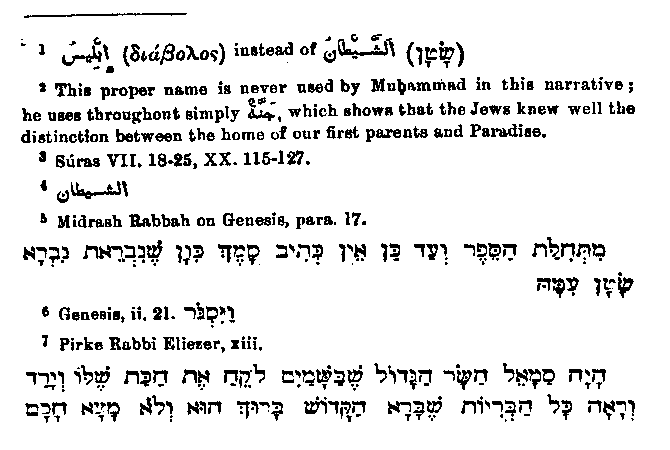
Still we find in a book which, though forged, is undoubtedly
old,7 the following statement:
page 79
"Samael", the great prince in heaven, took his companions and went down
and inspected all God's creatures; be found none more maliciously wise
than the serpent, so he mounted it, and all that it said or did was at
the instigation of Samael."1
This is legend, even if not entirely Jewish, appears to have been derived
by Muhammad from the Jews. In the details of this narrative some confusion
is found between the tree of knowledge and the tree of life. The former
only is mentioned in Scripture as prohibited by God,2
and to the eating of that alone the serpent incites Eve. After the
transgression has taken place, we find the fear mentioned lest men should
eat of the tree of life and live forever.3
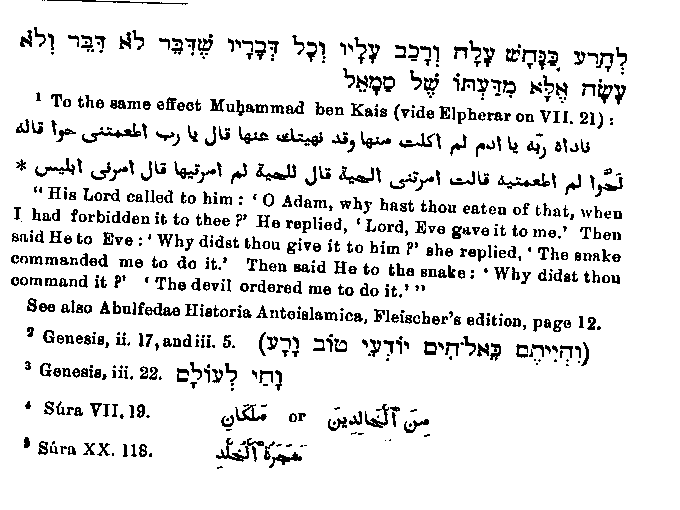
Muhammad confuses the two. In one passage he puts into the devil's mouth
the statement that men through eating of this tree would become "Angels,"
or "immortal"4 but in another
passage he mentions only the tree of eternity.5
All the rest of the history of the first human pair is omitted, and
page 80
only one event in the life of Cain and Abel is depicted. This is depicted
for us quite in its Jewish colours. In this passage, and indeed throughout
the Quran, they are called sons of Adam, but in later Arabic
writings1 their names are
given as Qabil and Habil, which are clearly chosen out of love for the
rhyming sounds. The one event mentioned is their sacrifice and the
murder which it led to.2
Muhammad makes them hold a conversation before the murder, and one
is likewise given in the Jerusalem Targum3
on the strength of the words in Genesis, "Cain said unto Abel his brother."
Still, the matter of the conversation is given so differently in each
case that we do not consider it worth while to compare the two passages
more closely. After the murder, according to the Quran, God sent a
raven which scratched the earth to shew Cain how to bury Abel. What
is here attributed to Cain is ascribed by the Jews to his parents,
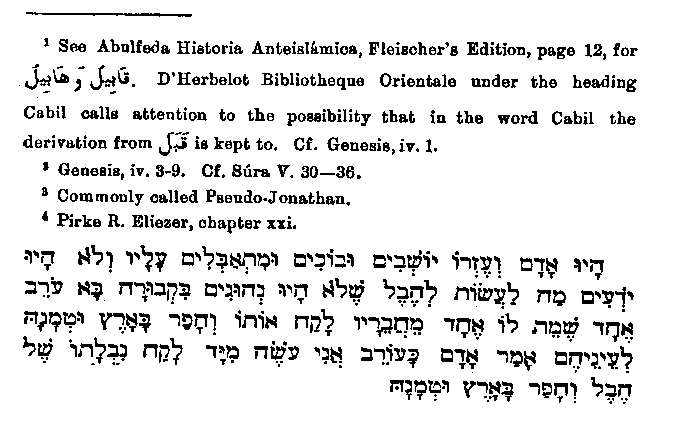
and in a Rabbinical writing we find the following passage:4
"Adam and his companion sat weeping and mourning for him (Abel) and
did not know what to do with him, as burial was unknown to them. Then
came a raven, whose companion was dead, took its
page 81
body, scratched in the earth and hid it before their eyes; then
said Adam, I shall do as this raven has done, and at once he took
Abel's corpse, dug in the earth and hid it.1"
In the Quran a verse follows I which, without knowledge of the source
from which it has come, seems to stand in no connection with what has
gone before, but which will be made clear by the following explanation.
The verse according to my translation runs thus: "Wherefore we commanded
the children of Israel, that he who slayeth a soul, without having
slain a soul, or committed wicked-floss in the earth, shall be as if
he had slain all mankind but he who saveth a soul live, shall be as
if he had saved the lives of all mankind." One perceives here no
connection at all, if one does not consider the following Hebrew
passage:2 "We find it said
in the case of Cain who murdered his brother: The voice of thy brother's
bloods crieth.3 It is not
said here blood in the singular, but bloods in the plural, i.e.,
his own blood and the blood of his seed. Man was created single in order
to show that to him who kills a single individual, it shall be reckoned
that he has slain the whole race; but to him who preserved the life of
a single individual it is counted that he hath preserved the whole race."
By this comparison it is made clear what led Muhammad to this general d
igression; he had evidently received this rule from his informants when
they related to him this particular event. Another

page 82
allusion to Cain is found in the Quran in a passage where he is called
the man "who has seduced among men."1
No one else is mentioned in this period excepting Idris2
who, according to the commentators, is Enoch. This seems probable from
the words,3 "And we uplifted
him to a place on high," and also from a Jewish writing in which he is
counted among the nine who went to Paradise alive. Jalalu'ddin brings
this point even more prominently forward4
"He lived in Paradise where he had been brought after he had tasted
death; he was quickened however, and departed not thence again." He
appears to have gained his name5
on account of the knowledge of tbe Divine Law attributed to him. Elpherar
remarks: "He was called Idris (searcher) on account of his earnest search
in the revealed Scriptures." It is remarkable that in both these passages
of the Quran6 he is mentioned
after Ishmael.

page 83
B. From Noah to Abraham
The corruption which spread in the time of Noah is not described with
any details in the Quran, and one event which is stated by the Rabbis
to have taken place at this period is transferred by Muhammad to
Solomon's time, to which he considered it better suited, as it
treats of angels and genii. The Rabbinical passage runs
thus1 "Rabbi Joseph was asked
by his scholars: 'What is Azael?' and he answered: when men at the time
of the Flood practised idolatry, God was grieved at it, and two angels,
Shamhazai and Azael, said to him 'Lord of the world, did

page 84
we not say unto Thee at the creation 'What is man that Thou art mindful
of him ?'1 But He said:
'What shall become of the world ? ' They answered: 'We would have made
use of it.' 'But it is well-known to Me that, if you lived on the earth,
lust would overcome you, and you would become even worse than man.'
'Then give us permission to live with men, and Thou wilt see how we
shall sanctify Thy name.' 'Go and live with them.' Then Shamhazai saw
a maiden by name Istahar. He cast his eyes on her and said: 'Listen to me;'
to which she replied: 'I will not listen to thee until thou - teachest
me the explicit name of God, through the mention of which thou risest
to heaven.' He taught her this name which she then uttered and rose
unspotted to heaven. Then God said: 'Because she turned herself from
sin, well I fasten her between the seven stars, that ye may enjoy her
for ever'; and so she was fastened into the Pleiades. But they lived
in immorality with the daughters of men, for these wore beautiful, and
they could not tame their lusts. Then they took wives and begat sons,
Hiwwa and Hiyya. Azael was master of the meritricious arts and trinket
of women which beguile men to immoral thoughts." It is evident that this
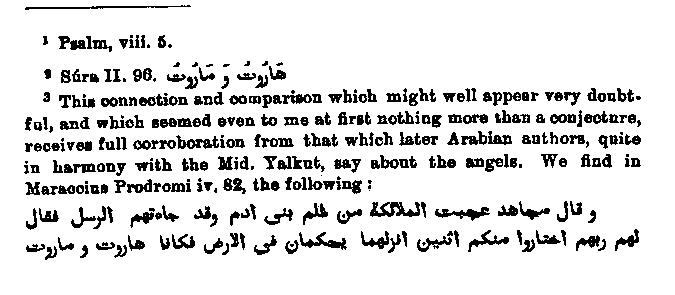
story is alluded to in the passage in the Quran,2
where the two angels Harut and Marut are said to have taught men
a charm by which they might cause division between a man and his
wife.3 During this state of
page 85
corruption of morals Noah appears, teaching men and seeking by exhortation
to turn them from their evil ways. He builds himself the Ark and is saved,
while the rest of the people perish.1
His whole appearance as an admonisher and seer is not Biblical but Rabbinical,
and serves Muhammad's ends perfectly, as Noah in this way is a type of
himself. According to rabbinical writings,2
Job, xii. 5 refers to Noah, "who rebuked thou, and spake to them words
as severe as flames, but they scorned him and said "Old man, for what
purpose is this ark ?' He, however, said: 'God is going to bring a flood
upon you.'" Other particulars

page 86
also accord with Rabbinical tradition, e.g., "The people laughed at
the ark,"1 accords with
"They mocked and laughed at him in their words." "The waters of the
Flood were hot,"2 with
"The generation of the deluge was punished with hot water." Still
many inaccuracies and perversions are to be found; for instance,
Muhammad makes Noah to have lived 950 years before the
Flood,3 whereas this
is really the whole term of his life; and he represents one of Noah's
sons as disobedient to him, and states that this same son did not
follow him into the Ark, but believed himself safe on a mountain
peak.4 This idea probably
arose from a misunderstanding of Ham's evil conduct after the
Deluge.5 Muhammad also
makes out Noah's wife to have been unbelieving,6
although he is silent as to wherein her unbelief consisted,
and I can find no reason for this statement, which is not mentioned
either in the Bible or in the Rabbinical writings.

page 87
Perhaps Muhammad was misled by the analogy of the wife of Lot,
who is mentioned in the same context. While these variations are
fine to errors and to the confusion of different times and events,
others are to be ascribed to deliberate1
alteration and elaboration. And of this kind are those details not
mentioned in Jewish History, which represent Noah as one occupying
the same position as Muhammad and speaking in his spirit. This
applies particularly to that which is put into his month as admonisher.
This is the case not only with Noah, but with all who appear in the
character of the righteous in any evil age. Thus he puts into the
mouth of Luqman, as a wise man known to the Arabs,2
words suitable to his own circumstances and opinions, and the same
thing happens in the case of Noah and the other preachers of Jewish
history to whom he alludes. Noah, though he worked no miracle, was
saved in a miraculous way, and so Muhammad cannot put into his mouth
the same words which he uses of himself, as well as ascribes to other
forerunners of himself after Noah's time, viz., that he is a mere
preacher; yet be makes him say everything which is not clearly
contrary to the historical facts related about him. He was only an
unimportant man,3 and did
not pretend to be anyone wonderful or supernatural.4
But he was divinely commissioned to warn the people, and for this he
asked no reward.5
O sancta simplicitas! one would exclaim in considering this last point,
if Muhammad had written it down with fall consideration of Noah's
position as one threatening the world with punishment, and if it
had not been rather that he saw everything from his own distorted
point of

page 88
view, and was determined to make every thing accord with his ideas.
In another place he goes so far as to interpolate a verse into Noah's
discourse, which is entirely characteristic of his own, and in which
the little word (translated "speak")1
actually occurs, which is always regarded as a word of address to
Muhammad from God (or Gabriel). The same thing will be noted
further on in the case of Abraham.
After Noah the next mentioned is Hud2
who is evidently the Biblical Eber.3
This seems a striking example of the ignorance of Muhammad, or, as
it appears to me more probable here, of the Jews round about him.
According to the Rabbinical opinion4
the name Hebrew is derived from Eber, but in later times this name was
almost entirely forgotten and the name Jew5
was commonly used. The Jews, to whom it was known that their name was
derived from an ancestor, believed that the name in question was that
in use at the time, and that the ancestor therefore was this patriarch
Hud.6 His time is that in
which a second punitive judgment from God on account of bold, insolent
behaviour is mentioned in the Scripture,

page 89
and this is treated of in several chapters of the Quran.1
In order to have the right to refer what is said about Hud to the
time of the confusion of tongues, or, as the Rabbis call it, the
Dispersion,2 we must adduce
some particulars which point to this reference, for the statements are
very general in their tenor and might be referred to ether occurrences.
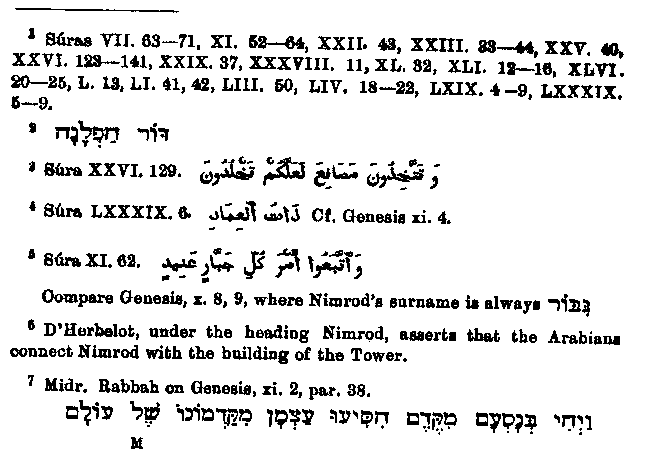
The following verse a possibly refers to the building of the Tower:
"And ye erect magnificent works, hoping that ye may continue for ever."
The Arabic commentators take it that the buildings would afford them
a perpetual dwelling place, but the verse might also mean, "make by
building it an everlasting name for yourselves." The neighbourhood is
called in the Quran the "Possessor Of Pillars.4
In one passage5 there appears
to be a reference to Nimrod, who lived at this time and in this region,
since the children of Ad are here reproached for obeying the command
of every contumacious hero.6
The idea that they were idolators, which is brought up against them in
all the passages in the Quran, agrees perfectly with the Rabbinical view
expressed as follows7
"And it came to
page 90
pass when they journeyed from the beginning (East), that is to say,
when they withdrew themselves from Him Who is the beginning of the
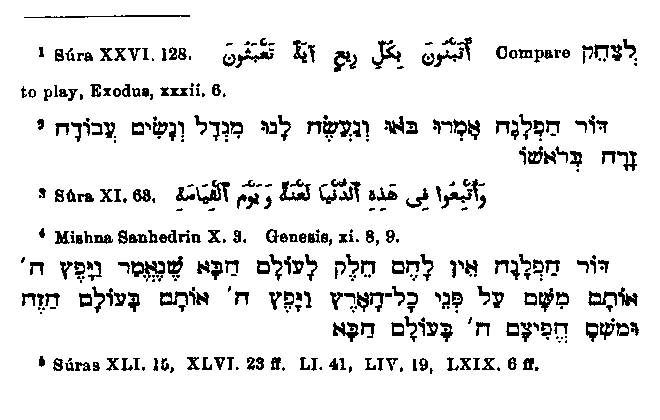
world." Muhammad says of these people1
that they built an (idolatrous) symbol on every high place in order to
play there (i.e. to practice idolatry). And the Rabbis tell
us2 that the race of the
dispersion contemplated building a tower and putting an idol on its
summit. Resemblances are also to be found with reference to the
punishment which overtook them. Muhammad tells us3
they were followed in this world by a curse, and that they shall be
followed by the same on the day of resurrection, and the Rabbis
say4 that the race of the
dispersion had no part in the next world, for the twice-mentioned
dispersion applies to this world and the other. In Muhammad's treatment
the essential point of the punishment is lost sight of, for instead of
describing it as a simple dispersion and confusion of tongues,
he speaks of an absolute annihilation of the sinners by a poisonous
wind.5 One sees at once the
mistaken source from which this change is derived. We recognize partly
from our knowledge of Muhammad's motives in making the alteration, and
partly from the minuteness with which
page 91
the new punishment is described, which would not have been accorded to
a fiction. It appears therefore that the history reached this development
in the mouth of the people, who delight in minute descriptions of punishment.
The remaining deviations and additions, particularly the latter, are caused,
as we have already remarked in the case of Noah, by confusion with Muhammad's
own time and person. This is the case when he transfers unbelief in the
resurrection to the time of Hud and counts it among the sins of that time
which were worthy of punishment.1
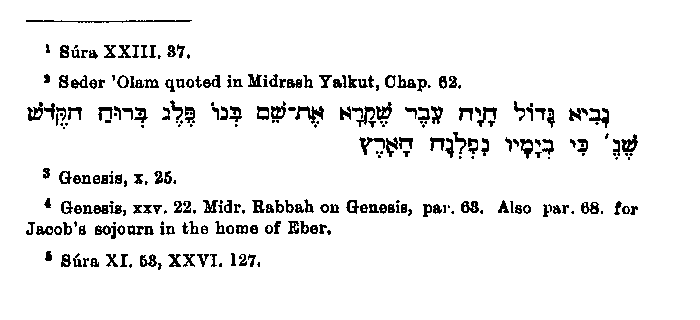
This is seen too especially in the great importance assigned to Eber and to
his desire to turn the people from their evil ways. Decided traces of this
are certainly to be found in Jewish writings,2
where we are told that Eber was a great prophet, who by the Holy Spirit
called his son Pelag, because in his days the earth was
divided3 (which Eber had known
beforehand). Much also is said of the school of Eber, and Rebekah is said
to have gone there; for it is written: "She went to enquire of the
Lord,"4 and Jacob is supposed
to have stayed there for fourteen years. But of the fact that Eber preached
to the people, he being their brother (on which Muhammad places great
stress, because he himself was sent as an Arab to the Arabs), not a trace
is to be found, still less of the fact that he took no reward from
them.5 One point still
remains to be cleared up, why the race under discussion is called in the
page 92
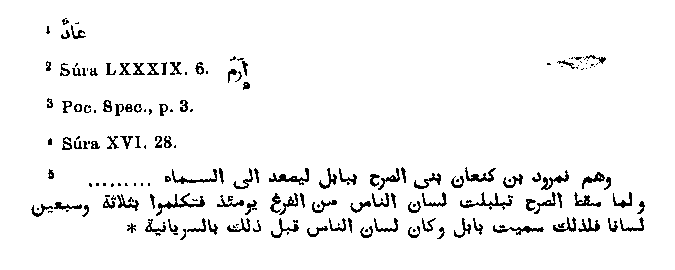
Quran the people of Ad1.
The commentators state that Ad was the son of Uz, the son of Aram,
the son of Shem, the son of Noah; and Muhammad seems also to have been
of this opinion, whence it comes that he transfers the events to the
land of Aram or Iram.2
Nevertheless it seems to have come about chiefly from the fact that
all those occurrences are described with an Arabian colouring, and so
they were attributed to Arab tribes, amongst which an ancient extinct
one had the name of Ad3
perhaps in it there is also an etymological reference to a "return"
to the early evil conduct of the generation of the Deluge. In another
passage there is an allusion to this occurrence,4
where the fact itself is brought forward much more in accordance
with the Biblical account, but quite without specification of time
or persons: "Their predecessors devised plots heretofore, but God
came into their building to overthrow it from the foundation, and
the roof fell on them from above and a punishment came upon them
which they did not expect." On this Elpherar remarks:5
"These are Nimrod, the son of Canaan, who built a tower in Babel
in order that he might mount to heaven"; and further:
"And when the tower fell the language of men became confused, and
so they could not finish it; then they spoke seventy-three languages,
on this account the city was called Babel (confusion), before this
the language of men was Syriac." The Rabbis, too, assert that
before this
93 page
men spoke in Hebrew, but afterwards in seventy languages. Jalalu'd-din
says the same thing,1 and
adds that Nimrod built the Tower "in order that be might mount out
of it into heaven to wage war with the inhabitants
thereof."2 But the identity
of this narrative with that of Hud and Ad is no more accepted by
Abulfeda3 than it is by
Elpherar and Jalalu'd-din, even on the view that Hud is the same as
Eber. Although the colouring of this narrative as given in the Quran
differs much from that of the Biblical account, yet the identity of
the two can be shown by putting this and that together, and by explaining
the way in which the individual differences arose. But in the case
of another narrative which follows this one in almost all the passages
of the Quran,4 it is very
difficult to find out the subject of which it treats and the Bible
characters to which it refers. This narrative is about
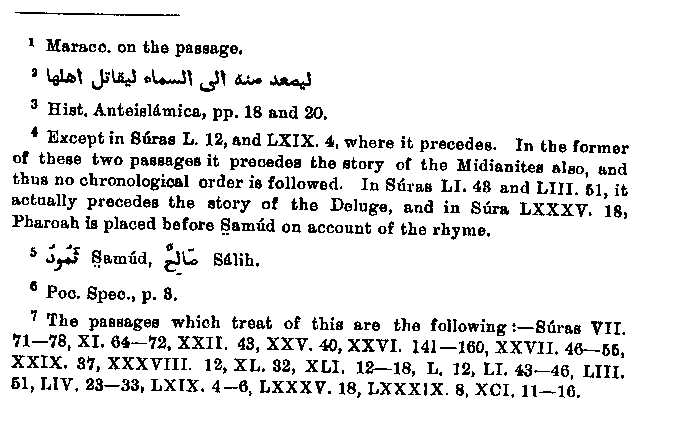
Samud5 which like Ad is
an ancient extinct Arab tribe,6
to whom their brother Salih was sent when they fell into sin.
Salih is said to have exhorted the Samudites to righteousness and
to have commended to them a certain she-camel as especially under
divine protection;
page 94
he even bade them share water with her.1
But the unbelievers of his time (according to one
passage2 only nine in number)
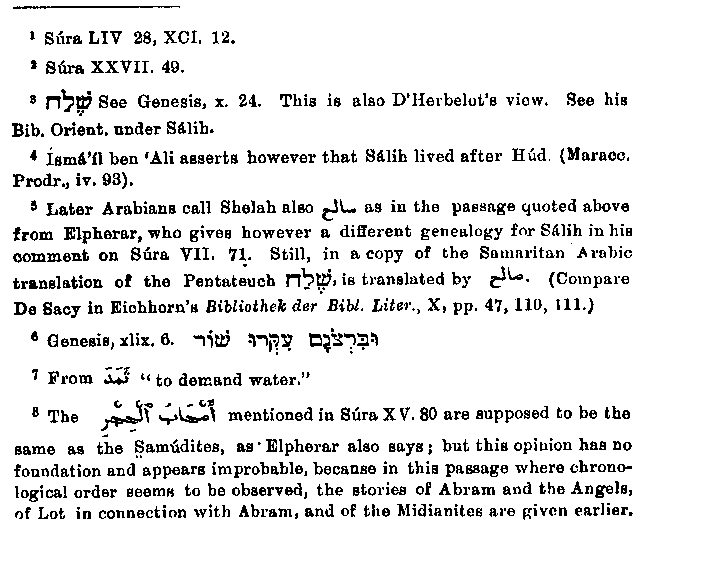
hamstrung her and so divine punishment overtook them. I find no similar
occurrence in Jewish writings, but the likeness of the name points to
Shelah3 who however,
as the father of Eber, would have deserved mention before
him.4 On the whole, the
word is so general in its meaning of "a pious man" that we cannot
treat it here with certainty as having been originally a proper
name.5 Perhaps the story
of the houghing is founded on the words in Jacob's blessing of his
sons6, and the sharing of
the water on the etymology of the name Samud.7
Moreover Sumud was, according to the commentators the son of Getter
the son of Aram, the son of Shem, the son of Noah, which fits in
fairly well with the date already assigned to
Shelah.8 It is however
impossible
page 95
for me to give any more exact explanation from Jewish writings
C.-Abraham to Moses.
Though the saints mentioned earlier bore some likeness to Muhammad,
and though their condition, so similar to his own, encouraged him as
well as verified his statements, yet Abraham was his great prototype,
the man of whom like thought most history, and the one with whom he
liked best to compare himself and to make out as one with himself
in opinion. Abraham's faith2
is that which is preached in the Quran.3
He was a believer in the unity of God.4
He was neither Jew nor Christian for it is written:5
"Abraham was not a Jew, nor a Christian, but be was a believer
in the unity of God, given up to God (a Muslim)."6

page 96
He is represented as the friend of God,1
and this is; his name throughout the East.2
Abraham's importance and the rich legendary material concerning him, which
Judaism offered lead us to expect much about him in the Quran, and our
expectation is not disappointed. It is to him that the founding of the
Ka'bah is traced back.3
He is supposed to have lived in the Temple,4
and to have composed books.5
This opinion is also held by the Rabbis, many of whom attribute to Abraham
the well-known cabalistic and undoubtedly very ancient Sepher Jazirah.
Passing to the events of his life, we first come across the beautiful
legend of his attaining to the true knowledge of God. "Ye are told
also how he tried to persuade his father and his people thereto.
A special instance of this when he destroyed the idols, and, putting
the staff into hand of the largest, attributed the action to him. He
sought thus to convince the people, who quite perceived the impossibility
of the idols having done it, since they could not move, but they were
not thereby persuaded.6
Abraham is represented as praying in vain that his father might be
released from the punishment of hell.7
We are told too that the people, embittered by Abraham's conduct
towards the idols, wanted to have him burnt alive, but that be was
rescued from that fate by divine intervention.8
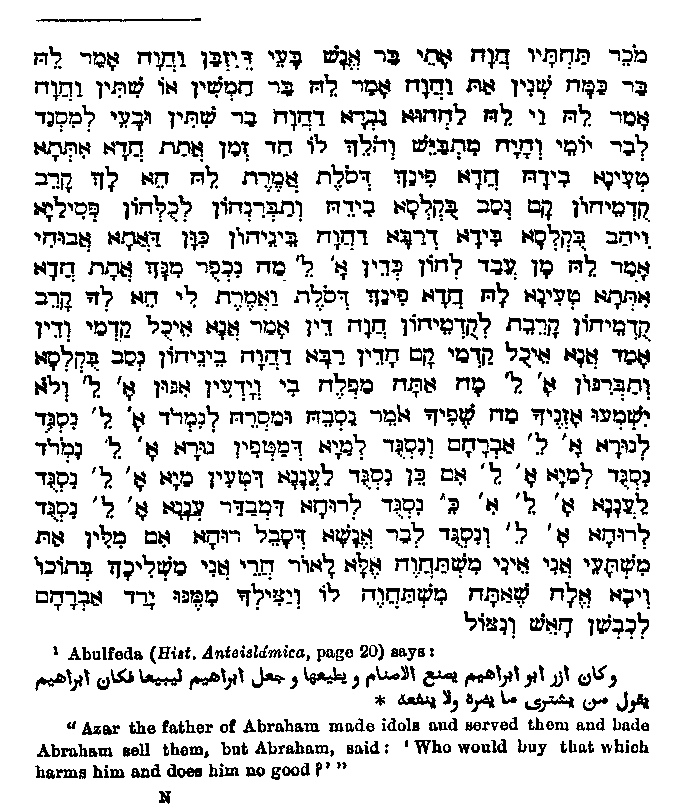
The whole story is taken from the Rabbinical writings, where we read
as follows.9
"Terah was an idolator once

page 97
he went away and left Abraham to sell his idols. Whenever a buyer came,
Abraham asked him his age. If he replied, I am fifty, or sixty years
old, Abraham said 'Woe to the man of sixty who desires to worship
the work of a day, so that the buyer went away ashamed.'1
Once a woman came, with a dish of wheat and said, 'Here, put this
before them;' but Abraham took a stick and beat down all the
page 98
idols, and put the stick into the hands of the largest idol when
his father returned, he said, 'Who has done this?' On which Abraham
replied, 'Why should I deny it?, A woman came with a dish of wheat
and bade me set it in front of them. I had scarcely done so when each
wanted to eat before the other, and the greatest beat them all down
with the stick which he had in his hand. Terah said: 'What art thou
inventing for me? Have they then understanding?' Abraham replied,
'Do thine ears not hear what thy month says?' Then Terah took him
and gave him over to Nimrod, who said: 'We will worship fire.'
Abraham said: 'Rather water, which extinguishes.'
Nimrod replied: 'Water then.' 'Rather the cloud which carries water.'
'The cloud then.'
'Rather the wind which scatters the cloud.'
'The wind then.'
'Rather men, who endure the wind.'
Nimrod at this became angry and said: 'Thou art only making a speech.
I worship fire and will throw thee into it. The God whom thou dost
worship may come and save thee out of it.' Abraham was then thrown
into a glowing furnace, but was saved from it." The intercession
for his father is not mentioned in Jewish writings; and that this
was fruitless, yea that Abraham, arriving at a clearer understanding,
desisted from his attempt,1
seems to directly contradict the Jewish view as expressed in the
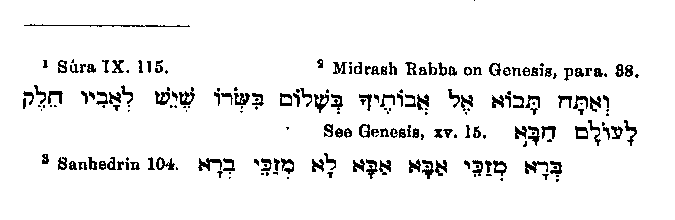
following passage.2
"By the words, thou shalt go to thy fathers in peace, it was shown
to Abraham that his father was a partaker in eternal life." Farther,
a Rabbinical saying3
declares as a general rule that "the son makes the father clean,
but not the father the son." But Muhammad very often combats
page 99
this view and the similar one that the merits of ancestors count
for good to their posterity.1
For example he says "That people (the Patriarchs) are now passed away;
they have what they gained and ye shall have what ye gain, and ye shall
not be questioned concerning that which they have done."2
That Muhammad brings forward a dialogue between Abraham and the people,
where the Midrash has one with his father only, is explained by the
fact that Abraham is intended to be a type of Muhammad, and so it
is necessary that he should be represented as a public preacher.
Another circumstance which is mentioned in the Quran, is, that Lot
became a believer with and through Abraham,3
may possibly have arisen from a passage in the Midrash immediately
following that quoted above, which says that Haran the father of Lot
was at first irresolute, but turned to Abraham's opinion after the
deliverance of the latter. Haran however failed in the ordeal of fire
to which he was then subjected. The idea of Lot's conversion, however,
is chiefly derived from the account given of his subsequent life, in
which he shows himself to be a pious man; and it is probably for this
reason that Muhammad connects him with the event just related. Muhammad
appears sometimes to have so confounded himself with Abraham that,
in the middle of speeches ascribed to the latter, he indulges in
digressions unsuitable to any but himself, and thus falls from
the part of narrator into that of admonisher. In one
passage4 a long description
of Hell and Paradise is found, and in another,5
the declaration that those who came before had also been charged
with imposture. No doubt Abraham might have said this with reference
to Noah, Hud and Salih; still the words here seem rather forced into
his speech, and indeed, in one verse we find the word 'say' which is
to be regarded in the Quran as the standing

page 100
address of God (or Gabriel) to Muhammad.1
This view renders it unnecessary to adopt the desperate expedient of Wahl,
who supposes a transposition of verses, or an interpolation. The true
explanation is rather Muhammad's entire identification of Abraham
with himself. Further, he is not content with making Abraham preach
against idolatry, he represents him also as teaching the doctrine
of the Resurrection of the dead.2
The lack however of full certainty abont this doctrine3
caused Abraham, according to the Muhammadan view, to pray for a tangible
proof of it, and then was vouchsafed to him what the Rabbis called
the "covenant between the divided pieces."5
He was convinced throngh the fact that the divided birds came together
again and became living,6
a view which is foreign to Judaism. How Muhammad came to call Abraham's
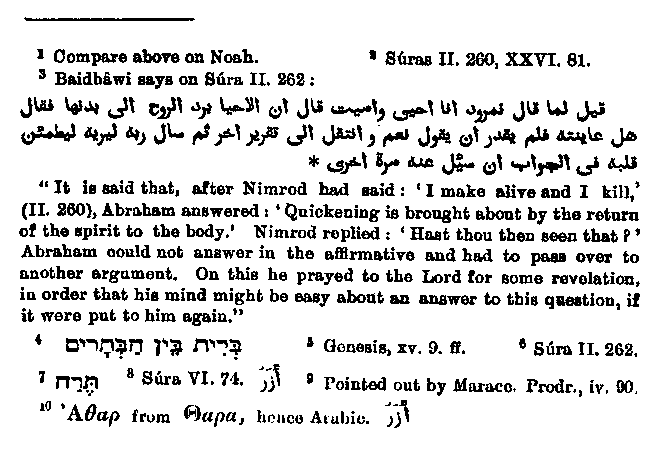
father, (whose name is given in the Bible as Terah7)
Azar8 is at first sight
not clear, but is completely explained when we consider the
source9 of his information,
namely Eusebius. In his Church History, Eusebius calls him
Athar10 which is an easy
transition from Thara,
page 101
and then the Greek Athar was easily converted into the Arabic
Azar.1 The reason which
is given by some Arabic commentators2
is ridiculous. They maintain that Azar is like
Yaszar3 and that this
means:4 "O, perverted one,
O, erring one;" and Abraham is supposed to have thus addressed his
idolatrous father.5
We now pass on to the more mature married life of Abraham and come
to him meeting with the angels,6
whom he receives as guests.7
Abraham took them for Arabs, was much surprised that they did not eat and
stepped back in fear, whereupon they announced to him that he would
have a son and told him also of the coming destruction of Sodom. In
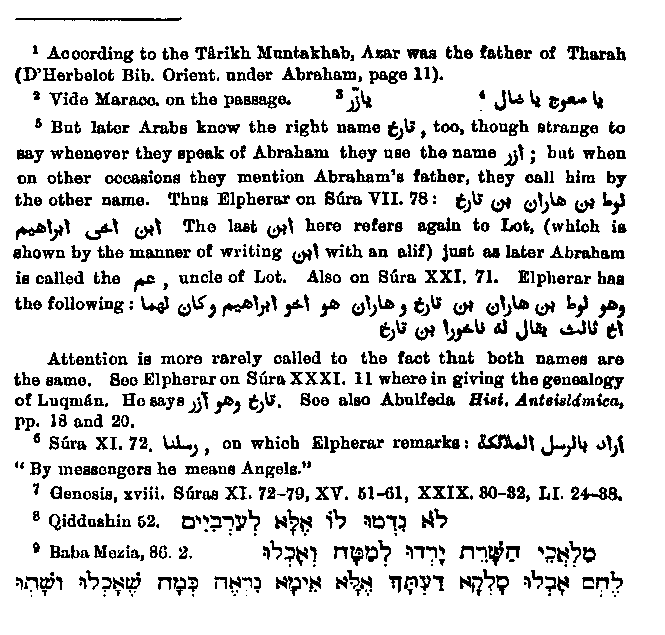
one passage of the Talmud8
we read: "They appeared to him nothing else but Arabs;" and in another
passage9 it is said
page 102
"The angels descended and ate. They ate? No, but it appeared as though
they ate and drank." There is only one error to be found in the account
as given in the Quran. The doubt as to whether in the advanced age of
the pair a son could come into the world (which in other passages and
in the Bible is put into the month of Sarah) is here uttered by Abraham,
but in very mild words.1
It is true that in the other Biblical account of the promise to Abraham,
he himself is represented as doubting God's word.2
In other passages the position of words and clauses might give rise
to many errors, if we did not know the story better beforehand from
the Bible. Thus in one passage3
the laughter of Abraham's wife is given before the announcement is made,
which leads the Arabic commentators to manifold absurd guesses. Elpherar
by the side of these explanations (many of them quite wanting in truth)
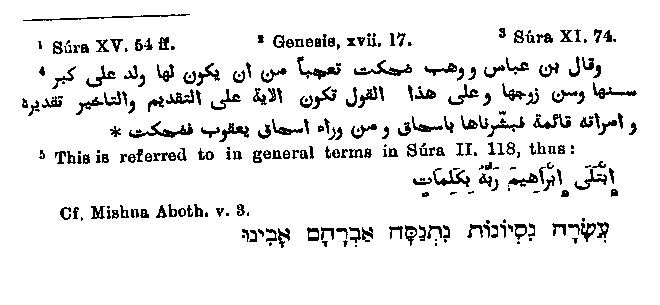
gives the right one in the following words:4
"Bin 'Abbas and Wahib say: 'she laughed from astonishment that she should
have a child, for both she and her husband were of a great age. Then the
verse was transposed, but it ought to run thus: 'And his wife stood
while We promised him Isaac, and after Isaac, Jacob, and then she
laughed.'" It might seem that this son who was promised to Abraham
was with deliberate forgery identified with Ishmael, because he is
regarded as the ancestor of the Arabs; and so too the ensuing
temptation5 connected with
the sacrifice of his son is made to refer to Ishmael.
page 103
Ground for this acceptation is given in another passage,1
when after the dispute about the idols has been related, we read from
v.99 as follows: "Wherefore We acquainted him that he should have a son
who should be a meek youth, and when he had attained to years of discretion
Abraham said unto him: 'O, my son! I saw in a dream that I should offer
thee in sacrifice.'" He declared himself ready, on which Abraham heard
a voice telling him that he had already verified the vision; and a noble
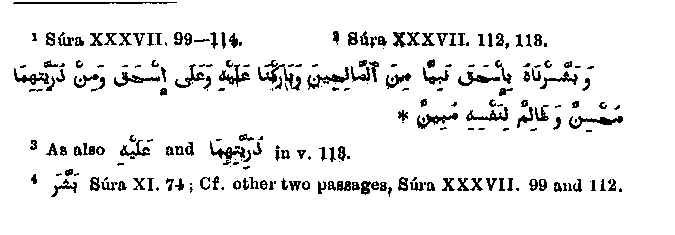
victim ransomed him. And then the passage continues2
"And We rejoiced him with the promise of Isaac, a righteous prophet;
and We blessed him and Isaac; and of their offspring were some righteous
doers, and others who manifestly injured their own souls." That the
announcement of Isaac first appears here is a proof that the preceding
context3, refers to Ishmael.
It is therefore evident that according to Muhammad's representation the
sacrificial action was performed on Ishmael, and further on this will be
shown more in detail. But it is not clear that the announcement of the
angels refers to him, seeing that in one of the three places where the
same word4 is used of this
angelic announcement, it is explicitly applied to Isaac. That the angels
had a two-fold mission - (1) to Abraham, in order to show him his
fatherhood and the destruction of Sodom, and (2) to Lot, in order to
remove him from Sodom before the destruction was accomplished, is
Biblical and Muhammad follows the Bible narrative. We have already
mentioned that Lot is supposed to have
page 104
become a believer through Abraham. The visitation of the angels,
which is related in Genesis, xix. 1-27, is mentioned in several
passages in the Quran.1
On the whole the narrative is fairly true, but the details are not
entirely free from embellishment. For example, in some
passages2 the warning
addressed to the people of Sodom on account of their unchaste use
of men is treated quite separately from the narrative of the angels,
and Muhammad makes out that the angels told Lot3
and even Abraham4
beforehand that Lot's wife should not be saved. The unbelief of
Lot's wife receives particular notice in one passage,5
while the destruction of the cities is mentioned in many
passages.6 Muhammad
especially attributes to Lot the distinguishing mark common to
all preachers, viz., that they ask for no reward.7
It has already been remarked that, according to Muhammad’s showing,
Ishmael* was the son whom Abraham was
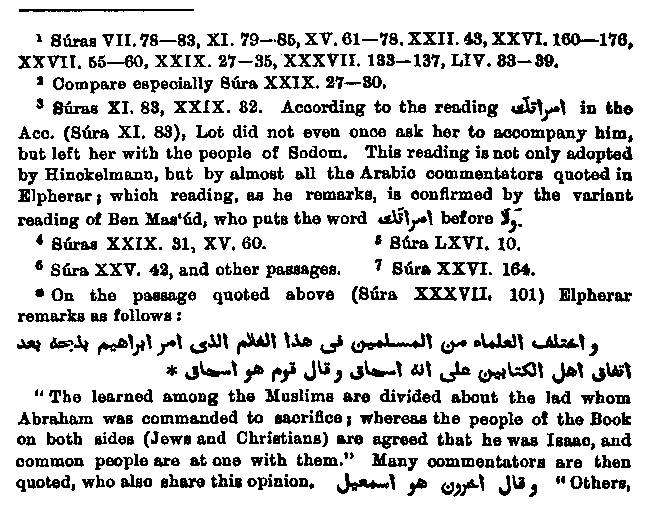
page 105
commanded to sacrifices , and the reasons have been given which
persuaded Muhammad to represent Ishmael as a
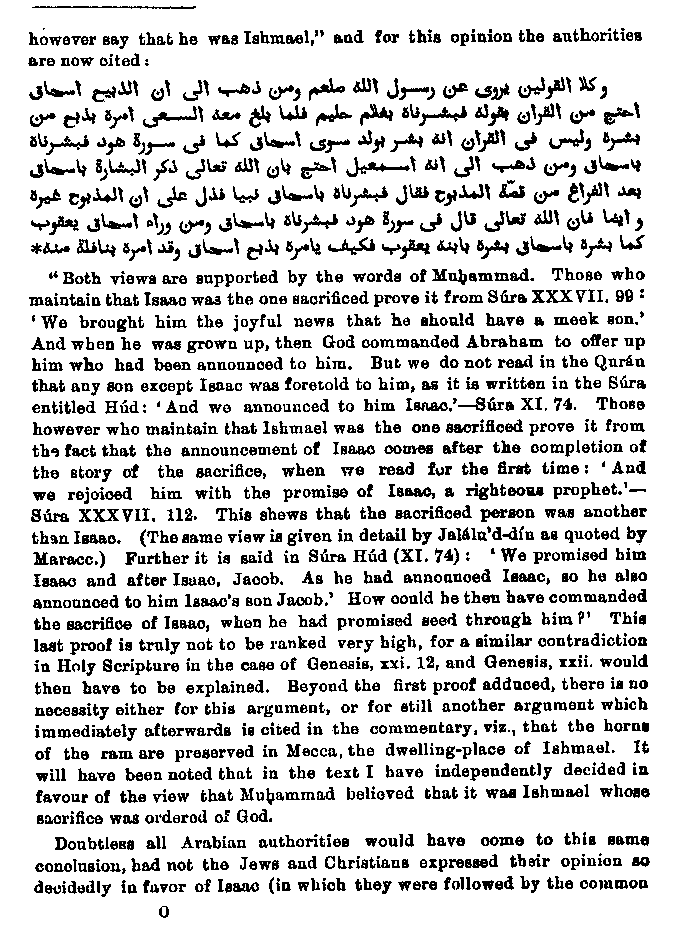
page 106
very righteous man,1
to include him in the ranks of the patriarchs and
prophets,2 to mention
him as the righteous son of Abraham,3
and to make out that he laid the foundation stone of the Ka'bah in
connection with his father.4
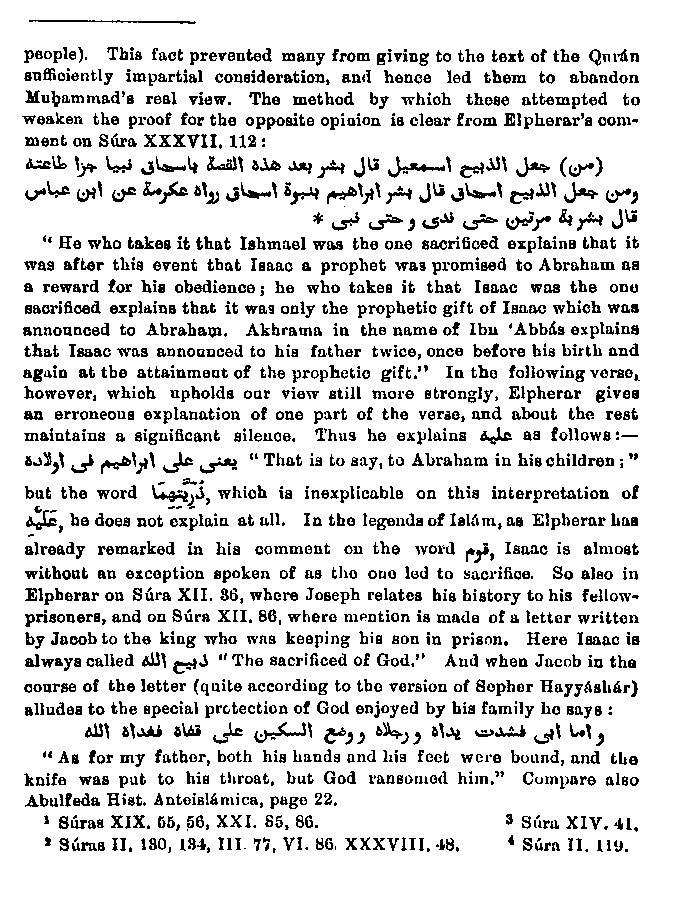
page 107
This view is certainly not Jewish, but at the same time it is not
contrary to Judaism, for the Rabbis tell us1
that by the utterance "Thou shalt be buried in a good old age (Genesis, xv. 15.)
God showed Abraham that Ishmael would repent." And in the Talmud
it is said2 that Ishmael
repented during his father's life-time. From his habit of reckoning
Ishmael among the patriarchs, Muhammad fell into the error of
counting him as an ancestor of Jacob. Thus in one passage3
he says: "The God of thy fathers, Abraham and Ishmael and Isaac,"
which Baidhawi attempts to explain in the following
manner;4 "He counts
Ishmael among his ancestors, connecting him with the father -
the grand-father also is the same as the father - and as Muhammad says,
The uncle is a part of the father. Then pointing to 'Abbas, his uncle,
he said, This is the survivor of my forefathers."
As he hereby transfers to Ishmael the action, which as the most
worthy, is attributed by the Jews to Isaac, viz., readiness to be
sacrificed, the latter remains simply a pious man, about whom there
is little to relate and who is quite destitute of all legendary
adornment. In consequence of this, Isaac appears only in the lists
of the patriarchs, and almost always in those passages where
Abraham's deliverance from the fire is mentioned and also his
reward for his piety. In these passages Muhammad following more
the popular tradition mentions Isaac and Jacob but not Ishmael.

page 108
We are now struck by the strange confusion which seems to have
existed in Muhammad's mind about Jacob.1
He seems to have been uncertain whether he was Abraham's son,
or his grandson, the son of Isaac. While there is no passage
which says explicitly that he was Abraham's son, yet this idea
is conveyed to all who have not learned differently from the
Biblical history. In the angel's announcement2
it is said, "after Isaac, Jacob;3
and in other passages4
we read: "We gave to him (i.e. to Abraham) Isaac and Jacob. In the
Sunna, however, Joseph is called clearly the grandson and Jacob
the son of Abraham.5
Although these passages do not prove the point absolutely, yet
those passages which can be brought forward in support of the
opposite view are much less powerful. For if it must be allowed
that in two passages6
Abraham and Isaac, and in one of these Jacob also, are mentioned
as the forefathers of Joseph we can also shew another passage
where Ishmael is mentioned as a forefather of Jacob without any
continuous genealogy having been given. And farther, since in
the passage last cited Abraham, Ishmael and Isaac are counted
as the fathers of Jacob, it is clear from the mention of Ishmael
among the others how great was the confusion which reigned in
Muhammad's mind about Jacob's parentage.
We by no means assert that Muhammad took Jacob for the son of
Abraham, but it is evident that the relationship
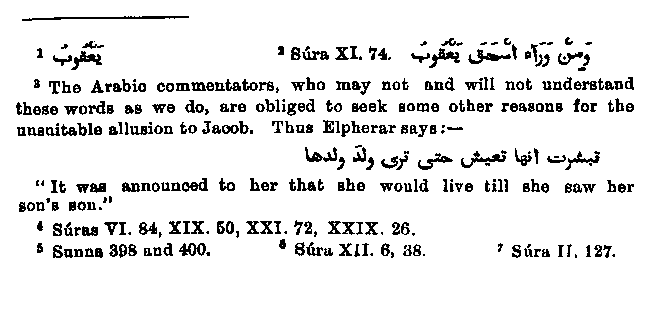
page 109
between the two was not clear to him. This error did not spread;
on the contrary, the later Arabs were better acquainted with these
relationships. Thus, e.g., Zamakhshari1
says: "It is related of the prophet that he said, If you are asked,
who is the noble one?' answer: 'The noble one, the son of the
noble one, the son of the noble one, the son of the noble one
is Joseph, the son of Jacob, the son of Isaac, the son of
Abraham.'"2 But this
is no testimony to the fall certainty of Muhammad himself,
for often the traditions spread among the later Arabs are more
correct than those given in the Quran, as we said before in the
case of the sacrifice of Isaac. Only a little is given of Jacob's
life. There is an allusion to his wrestling with the Angel in the
following words3
"All food was allowed to the children of Israel before the
revelation of the Law, except what Israel (as he is here
called)4 forbade himself."
This is evidently an allusion to the Biblical passage where the
prohibition against eating the sinew of the thigh5
is mentioned,6 which
Baidhawi7 also gives,
but assigns a wrong reason for it. Beyond this allusion and the
history of Joseph, in which he is also involved and which we will
give later on, the only other thing told about Jacob is his
admonition before his death. This is

page 110
given in accordance with rabbinical sources follows1
"And Abraham commanded this to his sons,2
even to Jacob: 'My children, verily God hath chosen this religion
for you, therefore die not unless ye also be resigned.' Were ye
present when Jacob was at the point of death? When he said to his
sons, 'Whom will ye worship after me?' they answered: 'We will
worship thy God and the God of thy fathers Abraham and Ishmael
and Isaac, one God, and to him will we be resigned.'" We find
something similar in the Rabbinical writings:3
"At the time when Jacob was leaving the world, he called his twelve
sons and said to them: 'Hear your father Israel,4
is there any doubt in your hearts about God?' they said: 'Hear
Israel our father, as in thy heart there is no doubt about God,
so also there is in ours; but the Lord is our God, the Lord is
one.'5 Then he spoke out
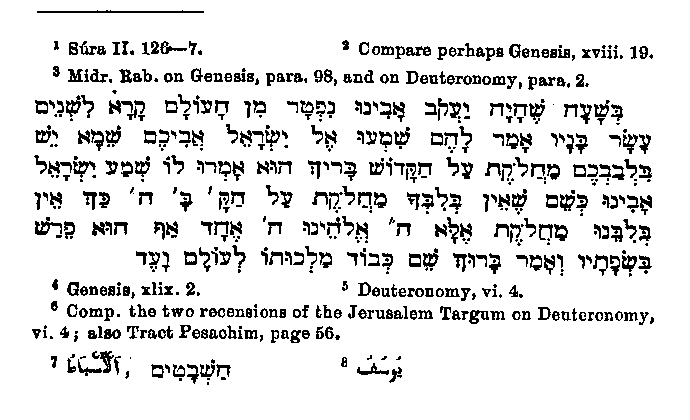
and said: 'Praised be the name of his glorious kingdom, for
ever.'"6 The sons of
Jacob are not individually mentioned, but they appear in the list
of the Patriarchs as "the tribes,"7
so called because of the subsequent division into tribes;
Joseph8 alone enjoying
an honorable exception.
page 111
being alluded to in one other passage,1
Joseph forms the theme of almost the whole of the twelfth
Sura,2 which is named
after him. This Sura contains the narrative given us in
Genesis,3 with many
abbreviations it is true, but also with many additions and alterations,
which must be pointed out. We must first mention the additions which
are derived from Jewish legend. Among these is the statement that
Joseph was inclined towards Potiphar's wife, but that a sign warned
him from her.4 The Rabbinical
comment on the words "He went into the house to do his
work"5 runs as
follows:6 "Both intended
to commit sin;" and on the words "She caught him by his garment
saying, 'Lie with me,'" Rabbi Yohanan remarks, "Both had got on to
the bed, when the form of his father appeared to Joseph at the
window and said: "Joseph, Joseph, one day the names of thy brethren
will be graven on the stones of the Ephod, also thine; wilt thou
that it shall be effaced?"7
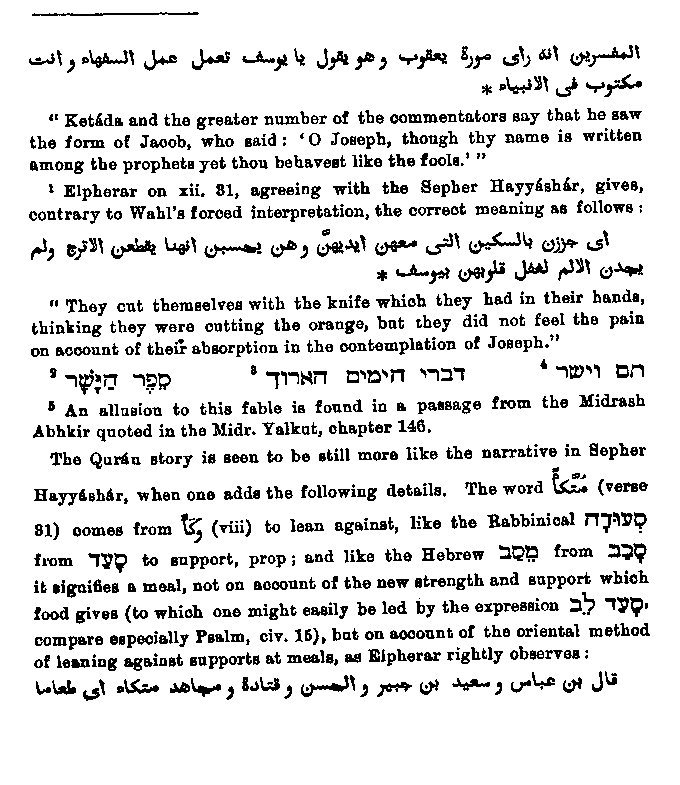
The fable that the Egyptian women

page 112
mocked at Potiphar's wife, were invited in by her, and in contemplating
Joseph's beauty1 were so
absorbed that they cut their own hands, is found in an old Jewish
writing2 which, though not
genuine, is certainly very ancient, and is written in very pure Hebrew.
This work is sometimes referred to in the Midrash Yalkut under the
name of "The Great Chronicle."3
In an old Jewish German translation however, it bears another
title.4 It is this
translation which I have before me as I write, and for this reason
I will not quote the actual words.5
Also the discussion about the
page 113
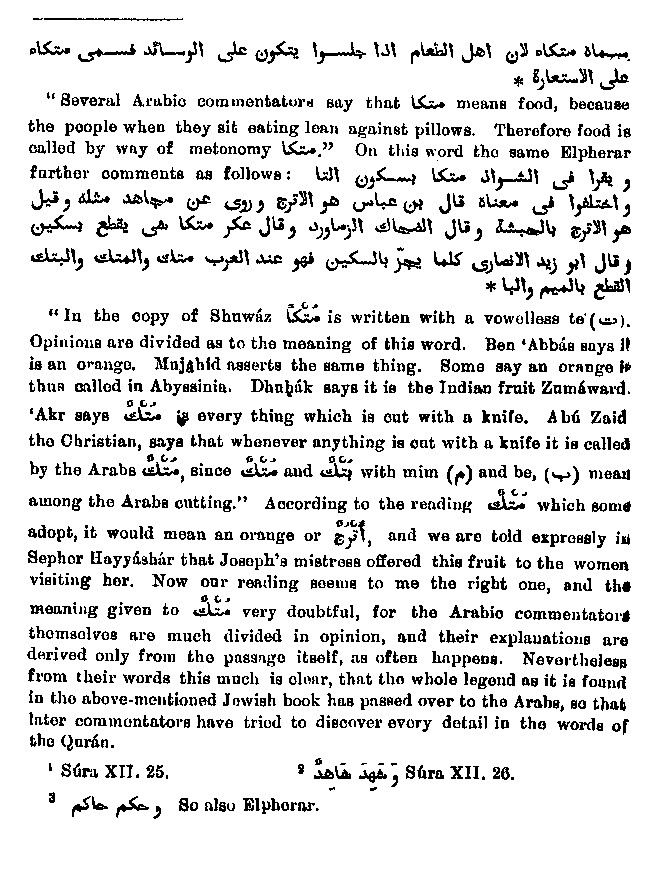
tearing of the clothes, whether they were torn in front or at the
back1 is found in the
same way in the Sepher Hayyashar. In the words, "and a witness
bore witness,"2 which
we here do not take strictly according to the meaning of the
context, but rather in the sense of an "arbitrator
decided,"3 others
see an allusion to a witness
page 114
who was present at what occurred between Joseph and the woman,
and some of the commentators quoted in Elpherar express
themselves quite in harmony with the Sepher Hayyashar as
follows:1
"Sa'id Ben Jabair and Dhubak say it was a child in the cradle
which God permitted to speak. This is the tradition of the Uphite
commentator according to 'Abba's." In the Sepher Hayyasbar it
is also asserted that there was present a child of eleven months
who till then could not talk, but then attained to speech. But
there is a difference in that the Jewish book makes the child
confirm the utterance of Joseph, while the Arabic commentator
puts into its mouth the decision about the rent clothing, while
other Arabic writers reject as highly unsuitable. Many
commentators say that this was no child,2
but rather a wise man full of penetration. It follows from this
that Muhammad either mired the two legends inappropriately, or
else that the second one came later into Arabic tradition and
was read by the Arabs into the words of the Quran. The
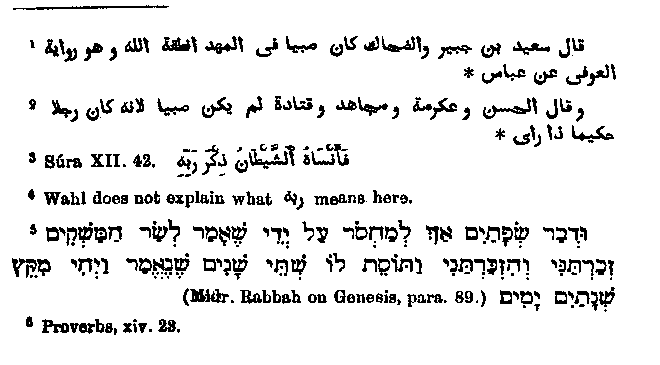
words3 which Wahl
translates: "But the devil would not allow it4
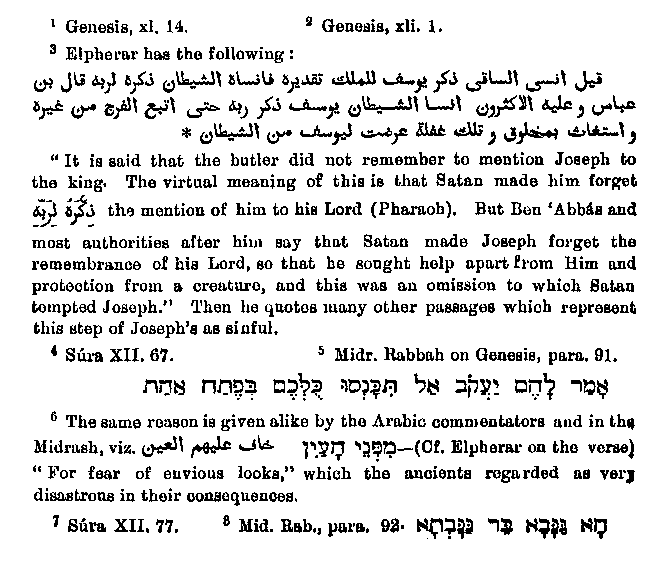
that he (the cap-bearer) thought of him (Joseph)," are explained
by the following passage:5
"The talk of the lips tendeth only to penury,6
because although Joseph reminded the
page 115
cup-bearer twice1 that
he should remember him, yet he hail to remain two more years in
prison; for it is written, 'And it was after two
years.'"2
The seeking of protection from the butler is here regarded
as sinful, and therefore Muhammad says: "And Satan made him
(Joseph) forget the remembrance of his Lord (God)," in that he
trusted not in God but in man.3
In the same Sura,4
Jacob recommends his sons to enter by different gates in like
manner we read in the Rabbinical writings5
that Jacob said to them: "Do not enter by the same
door."6
The statement7 that the
brothers said, when they found the cup in Benjamin's sack:
"If he be guilty of theft his brother hath also been guilty,"
is evidently an erroneous change in the words of a passage found
in the Midrash quoted above,8
according to which they said, "See a
page 116
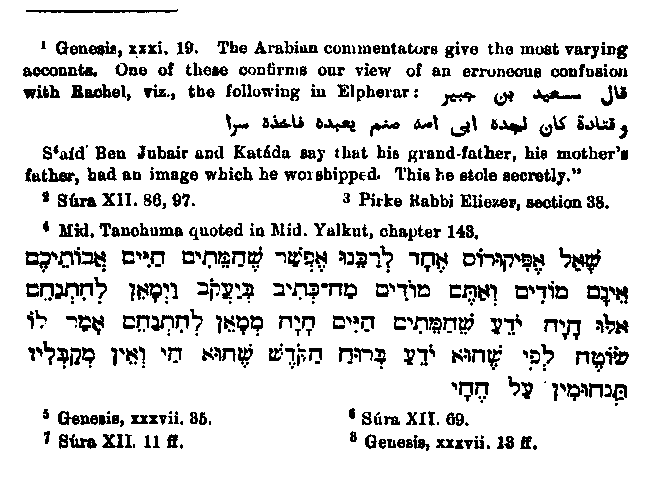
thief, son of a thief," with reference to Rachel's having stolen
the Teraphim.1
From the Quran it appears2
that Jacob knew by divine communication that Joseph still lived,
which is opposed to one Jewish view3
but agrees with another,4 which
runs as follows: "An unbeliever asked our teacher 'Do the dead live on?
Your fathers did not accept this, and will you accept it? It is said of
Jacob, that he refused to be comforted.5
If he had believed that the dead live on, would he have refused comfort?'
Then he answered him. 'Foolish one he knew through the Holy Ghost that
he still lived (in the flesh), and one does not take comfort concerning
the living.'" The story that Joseph told Benjamin beforehand who he was,
is common to the Quran6 and
the Sepher Hayyashar. Besides those additions from Jewish legends there
is also other matter which owes its origin to error, or possibly to
traditions unknown to us. Muhammad's statement7
that the brothers asked their father to send Joseph with then, contradicts
the Biblical account;8 and
the statement that one of the
page117
Ishmaelites who went to draw water found Joseph in the pit is
against the clear word of the Scripture that the pit was
dry.1 Muhammad makes
Joseph expound Pharaoh's dream and only afterwards does he have
him fetched from prison,2
in contradiction to the Bible narrative.3
He asserts that Jacob became blind from grief, but that he recovered
his sight by the application of a shirt to his eyes. He was perhaps
thinking of Jacob's loss of sight4
later on, or possibly the idea is based on some legend unknown to me.
According to the Quran Joseph's parents5
came to him in Egypt, in spite of the fact that according to the
testimony of the Scriptures6
Rachel was long since dead. Muhammad's idea probably was to bring
about a complete fulfilment of the dream, which mentions both
parents.7
On this, however, some of the Rabbis remark that this is a sign that
no dream is without a mingling of some vain matter, while others say
that Bilhah, Joseph's subsequent foster mother, is alluded to.
Something like this is quoted by Zamakhshari, to the effect that
"this meaning his father and his aunt;"8
while Elpherar has9 still
more clearly: "Katada and Sada say that by the moon is meant his aunt
because his mother Rachel was already dead." Thus it is possible that
Muhammad means this aunt here, even as Elpherar remarks on another
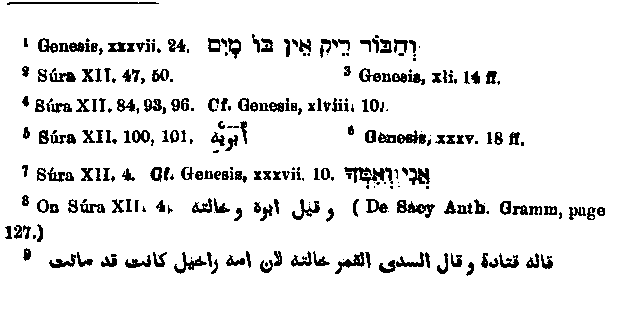
page 118
passage,1 to wit,
that "Most commentators say that by these are meant his father
and his aunt Leah, his mother having died at the birth of Benjamin."
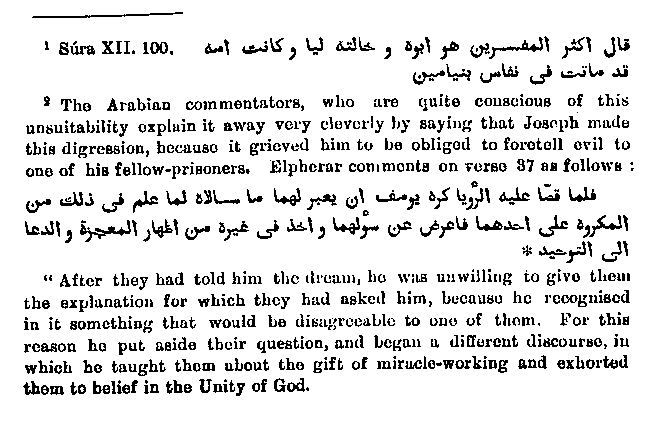
It is quite in accordance with Muhammad's usual procedure to put
into Joseph's mouth a long discourse on the unity of God and the
doctrine of a future life. This is given before tho interpretation
of the dreams of his two fellow prisoners.2
With Joseph we finish the first period, for between Joseph and
Moses Muhammad mentionss no one else. It almost seems as if,
with Justin, Muhammad regarded Moses as Joseph's son, although
of course we cannot seriously attribute such an opinion to him.
JUDAISM AND ISLAM [Table of Contents]
Answering Islam Home Page