返回总目录
The Origins of the Qur'an, An Enquiry into the Sources of Islam [Chapter 2]
CHAPTER II
JEWISH BELIEFS AND PRACTICES INCORPORATED INTO THE QUR'AN
WHILST a study of the Qur'an makes it abundantly clear what
Muhammad borrowed from the idolatrous Arabs of his time, and
also incorporated into his system not a little of Christian
truth, yet an investigation into the sources of the Qur'an
reveals the fact that Islam is, in the main, little more than
Talmudic Judaism, plus the assertion of the apostleship of
Muhammad. We purpose in this chapter to prove the truth of
this assertion.
It need scarcely be said that Muhammad had ample opportunity
for intercourse with Jews, from whom he could learn the stories
current amongst them relating to the early patriarchs and
others.1 Any comparison of the stories as given in the Qur'an with the Talmudic perversions of scripture histories will make it clear that the Jews of Mecca and Madina communicated their legends to Muhammad, who then recast them and gave them out to the ignorant Arabs as 'revelations' from heaven. It should be remembered that the Talmud was completed a century previous to the era of Muhammad, and cannot fail to have extensively influenced the religious creed of all the Jews of the Arabian Peninsula. In one passage of the Qur'an Muhammad speaks
page 13
of a certain Jew as a witness to his mission; in many places his
disputes and arguments with them are mentioned, and it is clear
that at one time, at least, his relations with them were those
of friendship and intimacy. Hence it can easily be understood
how easy it was for Muhammad to take the Jewish fables, to which
he so frequently listened, and then to work them up in a form
such as would commend itself to Arabian ears. There is no doubt
that Muhammad was in the habit of questioning the Jews concerning
their religion, and the great Traditionist Muslim has preserved
for us a Tradition to that effect as follows:-
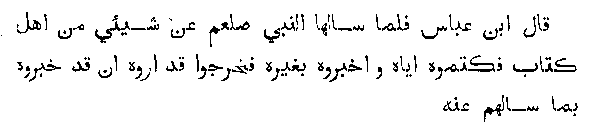
"Ibn 'Abbas records that, when the Prophet asked any question of
the people of the Book, they suppressed the matter, and in place
of it told him something else, and went away letting him think
that they had told him what he asked."
More significant still is the fact that Muhammad excused himself
for thus obtaining his materials for his stories, by pretending
that he had received a revelation commanding him to do so. Thus
in Suratu Yunas (x. 94) we read:-

"(O Muhammad) ask those who are reading the book before thee."
The Muslim historian Tabari further tells us Khadija (the first
wife of the Prophet) read the former scriptures and knew the
stories of the prophets." Now Muhammad lived with Khadija for
some fifteen years before he began to announce his mission,
and when it is remembered that during that period he must also
have had close and
page 14
frequent intercourse with Waraqa, the cousin of his wife, who
was in turn both Hanif and Christian, and was the translator
of the Christian scriptures into Arabic, the reader is at no
difficulty to understand whence the Prophet obtained his
knowledge of the Jewish Rabbinical fables.
We now propose to give examples of the way in which Muhammad
adopted the stories of Jewish history which were current amongst
his contemporaries; but before doing so, it will be necessary
to clear the ground somewhat by reminding the reader of the
state of Jewish thought in Arabia at this time. The Jews,
especially in the neighbourhood of Madina, were both powerful
and numerous; but the study of the Old Testament scriptures
had largely given place to that of the Talmud. The latter was
a chaotic arrangement of Rabbinical speculations, comments,
and traditions connected with the Hebrew Bible. This encyclopaedia
of laws and traditions records the thoughts of a thousand years
of the national life of the Jewish people, and in it the oral
traditions of the race have been carefully preserved. Yet it
is "a literary wilderness," without order or arrangement, often
grossly unhistorical, and abounding in puerile fancies and
absurd stories. This made up the mental pabulum of the Jews
of Muhammad's time, and it was the apocryphal stories of the
Talmud which delighted the ears of Jewish audiences, and
furnished the basis of instruction in Jewish schools. Thus it
was the stories of the Talmud, rather than of the Bible, which
Muhammad would learn in his intercourse with the Jews; and we
will now proceed to show that the stories of the Patriarchs
and others detailed in the Qur'an agree with the, often unhistorical,
legends of the Hagadah rather than with the Bible.
In Suratu'l-Ma'ida (v.30-35) there is a curious story connected
with Cain and Abel. It is there (verse 34) related that, after
Cain had killed his brother,
page 15

"God sent a raven which scratched the earth to show him (Cain)
how he should hide his brother's body." Every student of the
Taurat knows that this story is not to be found in the revelation
given to Moses; but we are not left in doubt as to where Muhammad
learned the legend; for in a Rabbinical work known as the Targum
of Jonathan, Pirke Rabbi Eliezer, Chapter XXI, we read, "Adam and
his companion sat weeping and mourning for him (Abel), and did
not know what to do with him, as burial was unknown to them.
Then came a raven, whose companion was dead, took its body,
scratched in the earth, and hid it before their eyes. Then said
Adam, 'I shall do as this raven has done,' and at once be took
Abel's corpse, dug in the earth and hid it."1
From a comparison of these two passages it is clear that Muhammad
had heard from the Jews the fable of the burial of Abel as related
in the Rabbinical books, and thinking it derived from the scriptures,
repeated it, with slight alterations, as if revealed to him from heaven.
The Qur'an abounds with stories of the Patriarch Abraham. These
in many instances flagrantly contradict the Biblical narrative;
but a comparison of them with the Rabbinical legends of the Jews,
leaves no room for doubt that Muhammad learnt them from the latter
during his close intercourse with them. Thus in several places of
the Qur'an the story is told of Abraham's being cast into a fiery
furnace by order of a king (whom the commentators name Nimrod)
because of the Patriarch's refusal to worship idols. It is said
in Suratu'l-Anbiya' (xxi. 69, 71) that when Abraham was cast into
the fire, God said:-

page 16
"O fire, be thou cold, and a preservation unto Abraham, and we saved him."
Now it is a curious fact that this legend, which has no basis in scripture,
is found in its entirety in a Jewish book called the Midrash Rabba.1
From the Taurat we learn that the Patriarch Abraham before his entrance
into the land of Canaan resided in the city named Ur in the land of Chaldea;
but God brought him out of that city and took him to the land of promise.
Thus in Genesis XV. 7, we read, "I am the Lord that brought thee out of Ur
of the Chaldees." This city was evidently unknown to the ignorant Jewish
author of the Midrash mentioned above; for in his comment on the verse
quoted he took the word "Ur," which also means fire, in its bare literal
sense, and supposed that God had delivered Abraham out of a fire. So, to
explain the verse "I am the Lord that brought thee out of Ur of the Chaldees,"
a story was invented of Abraham's being cast into fire by Nimrod, whence he
was miraculously saved by God. The whole story is given at length in the
Midrash Rabba referred to above, and was well known to the Arabian Jews
of Muhammad's time. It is there written, " Now this happened at the time
when Nimrod cast Abraham into the oven of fire, because he would not worship
the idols, that leave was withheld from the fire to hurt him."
The reader is now in a position to understand the source of the story
as it appears in the Qur'an, the author of which was evidently as ignorant
of the real meaning of the words the Jewish commentator referred to above.
If any further proof were needed to show the utterly unhistorical nature
of the whole narrative, it may be found in the fact that Nimrod was not
a contemporary of Abraham at all, but preceded him by many years.
page 17
Another Qur'anic story which has an undoubted Jewish origin is that found
in Su'ratu Ta Ha (xx. 90) in connection with the calf which was worshipped
by the Israelites during Moses' absence on Mount Sinai. We are there told
that the people brought their ornaments of gold and silver and cast them
into the fire, after which

in like manner Samiri also cast them in and he brought out to them
a corporeal, lowing calf." It is well known that the Taurat contains
no mention of the golden calf having lowed; but Rabbinical fables are
not wanting in which the story as reproduced by Muhammad is clearly
traced. Thus in the Pirke Rabbi Eleazar we read, "The calf having
cried aloud, came forth, and the children of Israel saw it." Rabbi
Yahuda further preserves a fable to the effect that a man named
Sammael secreted himself inside the image and made a cry like a calf
in order to lead the Israelites astray.1
Such is the story which was current amongst the Jews of Arabia in
the time of Muhammad. Let it be compared with the narrative of the
Qur'an and the reader will easily see that Muhammad, thinking the
story which he heard upon the lips of his Jewish contemporaries to
be a part of the scripture record, adopted and later gave it out to
the ignorant Arabs as though revealed from heaven.
Unfortunately Muhammad failed to rightly understand the allusion to
the man Sammael, and, confounding his name with the name of the
Samaritans, whom he probably knew to be enemies of the Jews, makes
the Samaritan  to have a part in the matter.
Since, however, the Samaritans
to have a part in the matter.
Since, however, the Samaritans
page 18
did not come into existence as a people until some centuries after the
event recorded here, it must require a wide stretch of credulity indeed
to enable one to believe that this Qur'anic tale also was handed down
from heaven by the angel Gabriel.
In the Suratu'n-Naml (xxvii. 44), we find a long story of Solomon and
the Queen of Sheba in which it is stated that the former sent a letter
to the Queen by a bird which he called for the purpose. The story goes
on to say that the letter resulted in the determination of the Queen
to visit Solomon. When she at length arrived at the palace of the King,

"It was said to her, 'Enter the palace,' and when she saw it she imagined
that it was a great lake of water, and she uncovered her legs. He said
'verily it is a palace paved with glass.'" Hearing this the Queen replied
like any good Muslim, "I resign myself unto God the Lord of all creatures."
Every reader of the Holy Bible knows that all this is mere fable, and has
no place in the word of God; hence the question naturally arises as to
the source of the story. In the Targum of the Book of Esther, a Rabbinical
work full of fables and mythical stories, may be found, often in the very
same words, practically the whole story as told by Muhammad. In this
Targum we read, "Solomon, know that she (the Queen) was come, arose and
sat down in the palace of glass. When the Queen of Sheba saw it, she
thought that the glass floor was water, and so, in crossing over lifted up
her garments." Much more might be quoted from the same book, including
the whole incident of the bird-messenger; but enough has been written to
show that
page 19
the story as found in the Qur'an is nothing more than a Rabbinical tale
which Muhammad had learned from the Jews. Let the reader study the real
history as found in the Holy Bible (1 Kings X) and he will see what
a vast distance separates truth from fiction.
Another fable which Muhammad learned from the Jews and incorporated into
the Qur'an, is a fanciful story of God's holding a mountain over the
Israelites in order to frighten them. In Su'ratu'l-A'ara'f (vii. 170)
we read: -

"And when we shook the mountain over them as though it had been a shadow;
and they imagined it was falling upon them." This story has no foundation
in fact; but it is to be found in a Jewish tract called the Abodah Sarah.
The Taurat relates nothing of the kind, but simply states that, while God
was giving Moses the Law on mount Sinai, all the people stood beneath,
i.e., at the foot of, the Mount. The Jewish commentators, however, soon
turned this into a fanciful story of God's holding the mountain over
the people; and in the story as found in the Abodah Sarah God is
represented as saying to the Israelites, "I covered you over with the
mountain like a lid." In another Rabbinical version of the story we
read that God "inverted the holy mountain above them like a pot, and
said unto them, 'if ye receive the Law, well; but if not, there will
your grave be.'" This legend, which was current amongst the Jews of
Arabia, must have reached the ears of Muhammad, who, imagining it to
be a part of the Biblical story, soon incorporated it into his Qur'an
and bade Muslims for all time to believe in it as a part of the word
of God, preserved from all eternity near the throne of God in heaven,
and finally sent down to Muhammad by the agency of the angel Gabriel.
page 20
The story quoted above is only equalled for absurdity by that of
the fallen angels which is found in Su'ratu'l-Hijr (xv. 16-18)
where it is gravely stated that the devils endeavour to hear
what is going on in heaven, and are then driven away by meteors
which are cast at them by the angels. Thus we read:-

"We have placed signs of zodiac in the heaven, and have adorned
them for the spectators; and We guard them from every stoned Satan
except such as steal a hearing; and him doth a visible flame consume;"
and again, in Suratu'l-Mulk (lxvii. 5) we read:-
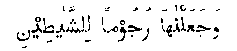
"We have placed them (the stars) there to be darted at the Satans."
So much for Muhammad's explanation of shooting stars! His ideas
of the devils attempting to 'steal a hearing' in the courts of
heaven, however, are not original, but are simply echoes of
a Jewish fable preserved in the Hagigah, where it is said that
the demons "listen from behind a curtain" in order to obtain
a knowledge of future events. Further comment upon these mythical
tales is needless. No intelligent Muslim, we are convinced, can
accept them as of divine origin; and their very presence in the
Qur'an bears eloquent testimony to the human origin of the book.
Much more might be written to show how much Muhammad was indebted
to the Jews for the ideas which he afterwards embodied in the
Qur'an; but the limits of this little book compel us to be
content with one or two more examples.
page 21
As both the Jews and Sabians observed a month's fast in the year,
it is not easy to determine which of these sects furnished Muhammad
with the similar injunction now found in the Qur'an; but in connection
with this fast there is a rule enjoined in the Qur'an which is
undoubtedly of Jewish origin. In Suratu'l-Baqarah (ii. 183), we read:-

"Eat and drink until ye can discern a white thread from a black thread
by the daybreak then fast strictly till night." This ingenious method
of determining when the night ended and the day began was not original,
however, but was copied by Muhammad from the Jews who, long before,
had adopted a similar practice; and in the Mishnah Berakhoth we read
that the fast began, "when one can distinguish between a blue thread
and a white one." Yet Muslims are asked to believe that Muhammad
had no part in the composition of the Qur'an:- that the whole was
revealed from heaven where it had been kept from all eternity upon
the "preserved table." On the contrary, we will now proceed to prove
that the very idea of a scripture preserved on a table is itself
a plagiarism from the Jews.
In Su'ratu'l-Buruj (lxxxv. 21) we read:-

"Yet it is a glorious Qur'an in a preserved table." This wonderful
table is much spoken of in Muhammadan tradition. A sample of the
fanciful and extravagant stories there found is given below from
the Qisau'l-Anbiya'. It is there related that in the beginning,
"Beneath the throne God created a pearl, and from the pearl He
created the preserved table.
page 22
Its height was seven hundred years journey and its breadth three
hundred years journey." Then after describing the creation of
a pen the author proceeds, "accordingly, the pen wrote down God's
knowledge in God's most high creation of everything that He wished
unto the resurrection day; the extent that the leaf of a tree moveth
or descendeth or ascendeth, and it wrote every such thing by the
power of God most High."
This notion of a table upon which the words of God are preserved
is an obvious parody of the inspired narrative of the Taurat where
we read that God said to Moses, "How thee two tables of stone like
unto the first, and come up unto Me into the mount, and make thee
an ark of wood. And I will write on the tables the words that were
on the first tables which thou brakest, and though shalt put them
in the ark."1
It is specially significant that the very Hebrew word
"luach"2 used for these
tables in the Taurat is that adopted by Muhammad in describing his
imaginary table. He had doubtless, often heard from the Jews the
story of the tables of stone which were preserved in the ark, and,
not wishing for his Qur'an a less distinguished origin, adopted and
elaborated the idea of a book written and preserved in heaven itself.
The Prophet, however, over-reached himself; and in an unguarded
moment made God to say, "We have, since the Law was given, written
in the Psalms that my servants, the righteous, shall inherit the
earth;"3 so that, for
all time, the faith of Muslims is staggered by the spectacle of
a Qur'an which claims to have been written in the beginning of
creation, quoting from a book not then two thousand years old.
Most intelligent people will regard this as a proof that the
Qur'an was written after the Psalms.
page 23
If further proof were needed to show that the Qur'an is largely based
upon Talmudic Judaism, it may surely be found in the large number of
words of Hebrew origin which are found therein. The following words
amongst others, are of Hebrew origin, Tabut  ;
Taurat
;
Taurat  ; 'Adn
  ;
Jahannam
;
Jahannam  ; Ahbar
  ;
Sabt
;
Sabt  ; Sakinat
  ;
Taghut
;
Taghut  ; Furqan
  ;
Ma'un
;
Ma'un  ; Mathani
  ; and
Malakut
; and
Malakut  .1
The curious will find in Dr. Imadu'd-Din's famous
"Hidayatu'l-Muslimin,"2
a list of no less than one hundred and fourteen non-Arabic words,
together with their original significations, which are to be found
in the Qur'an.
.1
The curious will find in Dr. Imadu'd-Din's famous
"Hidayatu'l-Muslimin,"2
a list of no less than one hundred and fourteen non-Arabic words,
together with their original significations, which are to be found
in the Qur'an.
The Origins of the Qur'an [Table of Contents]
Answering Islam Home Page