返回总目录
JUDAISM AND ISLAM [Chapter 1, Part 2]
page 45
Second Part.
Views borrowed from Judaism.
While in the foregoing section we were content to consider it certain
that a conception was derived from Judaism, if the word expressing
that conception could be shown to be of Jewish origin, we must now
pass on from this method of judging and adopt a new test. We must
prove first in detail that the idea in question springs from a Jewish
root; then to attain to greater certainty we must further shew that
the idea is in harmony with the spirit of Judaism, that apart from
Judaism the conception would lose in importance and value, that it
is in fact only an off-shoot of a great tree. To this argument may
be added the opposition, alluded to in the Quran itself, which this
foreign graft met with from both Arabs and Christians. For the better
arrangement of these views we must divide them into three groups:
A. Matters of Creed or Doctrinal views, B. Moral and legal rules,
and C. Views of Life.
A. Doctrinal Views
We must here set a distinct limit for ourselves, in order on the one
hand that we may not drift away into an endless undertaking and attempt
to expound the whole Quran; and on the other that we may not go off
into another subject altogether and try to set forth the theology
of the Quran; an undertaking which was begun with considerable success
in the Tübingen Zeitschrift für Evang. Theol. 1881, 3tes Heft.
Furthermore, certain general points of belief are so common to all
mankind that the existence of any one of them in one religion must
not be considered as
page 46
proving a borrowing from another. Other views again are so well-known
and so fully worked out that we need not discuss them in detail, but
shall find a mere mention of them sufficient. Of this kind is that of
the idea of the unity of God, the fundamental doctrine of Israel and
Islam. At the time of the rise of the latter, this view was to be found
in Judaism alone,1 and
therefore Muhammad must have borrowed it from that religion. This may
be considered as proved without any unnecessary display of learning on
the point. The idea of future reward and punishment is common to all
religions, but it is held in so many different ways that we shall be
obliged to consider it in our argument. Cardinal points of faith have
also passed from Judaism into Christianity. To decide whether these
points as adopted in the Quran have come from the Jews or from the
Christians, we must direct our special attention to a comparison
between the forms in which the beliefs are held in both those religions,
and the form in which they are presented to us by Muhammad. This is to
answer the objection, that in the following discussion so little is to
be found about the cardinal dogmas, for even the enumeration of them
is foreign to our purpose.
Every religion which conceives God as an active working providence must
have some distinct teaching on the creation, and this Muhammad gives in
accordance with the Bible, viz., that God created heaven and earth and
all that therein is in six days;2
although in another place he diverges somewhat and says that the earth
was created in two days, the mountains and the green herbs in four days,
and the heavens with all their divisions in two days more.3
Though this passage is nothing but a flight of poetic fancy, still it
shows how little Muhammad knew of the Bible, inasmuch as he is aware
of nothing but the general fact

page 47
that the creation took place in six days, and that he has not any
knowledge of each day's separate work. We have already remarked
that he calls the seventh day sabt, but does not recognise its
sanctity. It remains here to be added that Muhammad appears to allude
to and reject the Jewish belief that God rested on the seventh
day.1 He evidently thought
that a necessity for rest after hard labour was implied, for after
mentioning the creation as having taken place in six days, he adds
"and no weariness affected Us." On this Jalalu'd-din comments as
follows:2 "This was revealed
as an answer to the Jews who said that God had rested thoroughly on
the sabbath and therefore weariness left Him." The same thing is to
be found in Elpherar's commentary but not so clearly expressed.
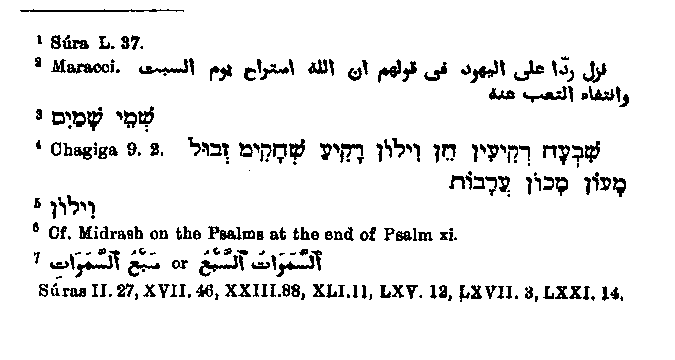
The idea of several heavens, which is indicated by the Biblical expression
"heaven of heavens,"3 came
to Muhammad probably from the Jews, also the notion that they were seven
in number, a notion due to the different names applied to heaven. In
Chagiga4 we find the assertion
that there are seven heavens, and then the names are given. All these
names occur in the Scripture except the first, viz. vilon, from the Latin
velum.5 This name in which
heaven is compared to a curtain, which veils the glory of God, is
a very important one in the Talmud. Muhammad speaks often of the seven
heavens,7 and in one passage
he
page 48
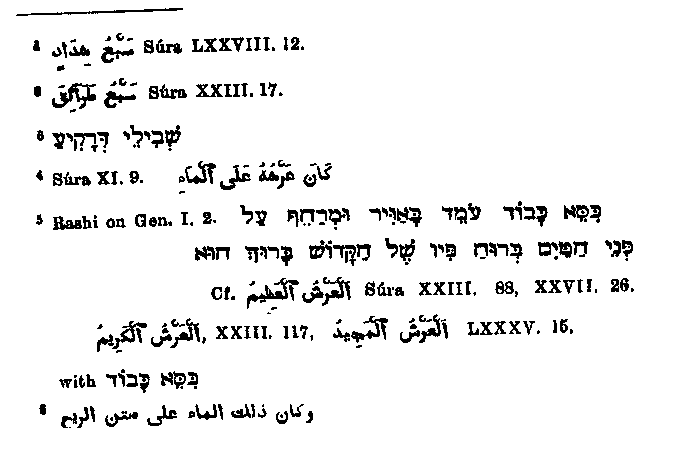
calls the heavens the seven strongholds1
and in another the seven paths.2
This last expression occurs also in the Talmud.3
During the creation, however, His throne was upon the
waters.4 This idea also is borrowed
from the Jews, who say:5 "The throne
of glory then stood in the air, and hovered over the waters by the command
of God." This is somewhat more clearly expressed by Elpherar who says:
"And this water was in the middle of the air."6
A second pivot of every revealed religion is the belief in a judgment after
death; for while the fact of the creation sets forth the omnipotence of
the Creator, the doctrine of a final account teaches that it is God's will
that His revealed laws shall be obeyed. This, then, in Judaism developed
into a local Paradise and Hell, and both conceptions have, as we have
already shown, into Islam. These localities, although at first were symbols,
mere embodiments of the spiritual ideas of a state, afterwards became
crystallised, and suffered the fate of every symbol, i.e., they were
taken for the thing symbolised, and the places were more definitely indicated.
Thus the Jews
page 49
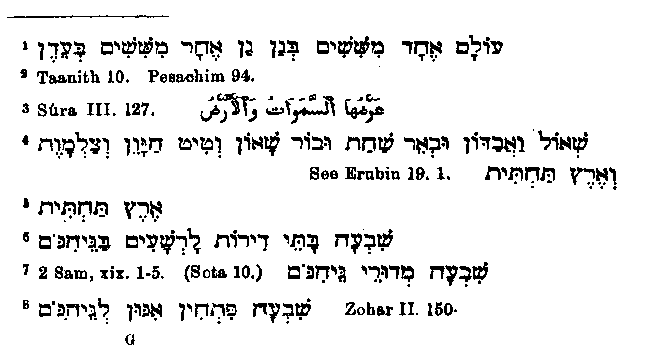
have a saying:1 "The world is
the sixtieth part of the garden, the garden is the sixtieth part of
Eden;"2 and in the Quran we find
a similar expression, viz., "paradise whose breadth equalleth the heavens
and the earth:3
Generally speaking, fear is stronger than hope, and the dread of a terrible
condemnation appeals far more powerfully than the hope of eternal happiness
to a nature which pure religions feeling does not impel to piety of life.
This is probably the reason for describing hell in a more detailed and
particular manner than Paradise.
Seven hells are pictured as forming different grades of punishment, and
these have been developed out of the seven different names mentioned in
the Talmud.4 These names with
one exception5 (Erets tahtith,
subterranean realm, which is clearly adopted from the Roman ideas at the
time of their ascendancy) are Biblical. Later on these names came to be
construed as seven hells, e.g. in the Midrash on the Psalms at
the end of the eleventh Psalm where6
it is said, "there are seven abodes of the wicked in hell," after which
the above mentioned names are cited with a few variations. It is also said
that David by a sevenfold reiterated cry of "my son" rescued Absalom from
the seven habitations of hell7
furthermore hell is said to have seven portals.8
Muhammad is not
page 50
behind hand, for we read in one passage that1
"it (hell) hath seven gates, unto every gate a distinct company of them shall
be assigned." According to the Jews, a tree stands at the entrance to
hell:2 Two date palms grow in
the valley of Ben Hinnom, smoke issues from between them and this is the
entrance to hell"; but Muhammad knows a tree of hell called
Al Zaqqum3 which serves
sinners for food, about which he has much to relate. The step from such
a definite idea of hell to the notion of a personality connected with it
is an easy one, and we find such an individual mentioned by the Rabbis
as the "prince of Gehinnom";4
he is called however in the Quran simply Jahannam. In one Rabbinical
book5 we find the following:
"That the prince of hell says daily, Give me food to satisfy me, comes
from Isaiah, v. 14." Muhammad says similarly:6
"On that day We will say unto hell, 'Art thou full?' and it shall say
'Are there more'?"
When the conceptions of Paradise and hell became so definite, and their
names were no longer general terms for reward and punishment, a third
destination had to be provided for those whose conduct had not been
such as to

page 51
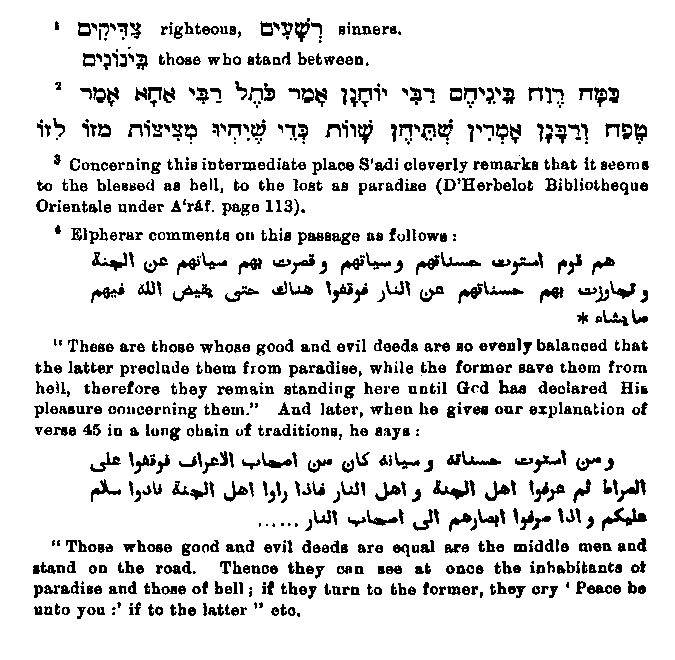
entitle them to the former nor condemn them to the latter place. Thus
while the righteous1 found
their place in Paradise, and the sinners had their portion in hell,
those who belonged to neither class were placed in a space between
Paradise and Hell, of which it is said in the Midrash on Ecclesiastes,
vii. 14:2 How much room is
there between them? Rabbi Jochanan says a wall; R. Acha says a span;
other teachers however hold that they are so close together that people
can see from one into the other."3
The idea just touched upon in this passage is most poetically worked
out in Sura VII. 44,4
"And between the blessed and the damned there shall be a veil;
page 52
and men shall stand on Al-Araf who shall know thorn by their marks
and shall call unto the inhabitants of Paradise saying, Peace be
upon you; yet they shall not enter therein, though they earnestly
desire it. And when they1
shall turn their eyes towards the companions of hell fire, they
rejoice that they are not among them and shew them the folly of
their earthly walk and hopes.
It is interesting to compare this view of a threefold dealing with
the dead with the very similar Platonic idea.2
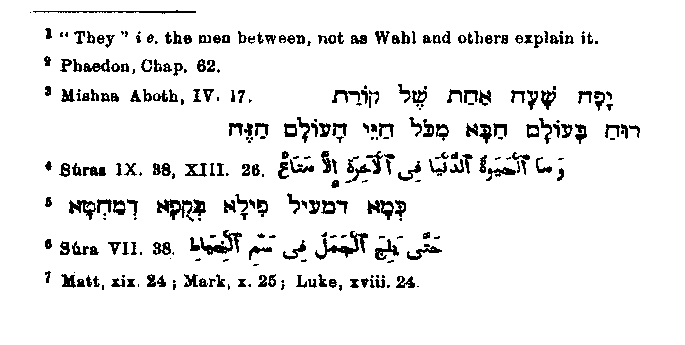
The idea of the bliss of eternal life, as well as the metaphor
which expresses the difficulty of attaining it, is common to the
Quran and Judaism. There is a Rabbinical saying3
to the effect that "one hour of rapture in that world is better
than a whole life-time in this." With this we may compare the
Quran:4 "And what is this
life in comparison with the life to come except a passing amusement?"
Then for the difficulty of attaining Paradise we may compare the
Rabbinical picture5
of the elephant entering the needle's eye with the words in
Sura VII. 88 6
Neither shall they enter into paradise until a camel pass through
the eye of a needle." This last metaphor seems to be borrowed
from Christianity, partly because of the similarity of the figure,
in that "camel" is the metaphor used in the Gospels, and partly
because of the frequent mention of the same by the
Evangelists7, and is
only
page53
deserving of mention here, because the fact that in the Talmud
elephant is used seems to confirm the ordinary translation of the
Greek word in the Gospels, and the Arabic word in the Quran, and
to remove the doubt as to whether they might not be better rendered
"cable."
Given the pure conception of immortality viz., that the life of
the soul never ceases, it becomes unnecessary to for a time at
which the judgment shall take place; and so in most Talmudic passages
a future world is pictured1
in which every thing earthly is stripped away and pious souls enjoy
the brightness of God's Presence.2
Echoes of this teaching are to be found in the Quran. In one
passage3 we read of a soul
gazing on its Lord and in another4
the condition of a perfectly peaceful soul is beautifully described.
But this entirely spiritual idea was not thoroughly carried out.
Rather by the side of the pure conception of a continued life of
the soul after the death of the body,5
there existed that of the quickening of the dead.6
Thus because the man cannot receive the requital
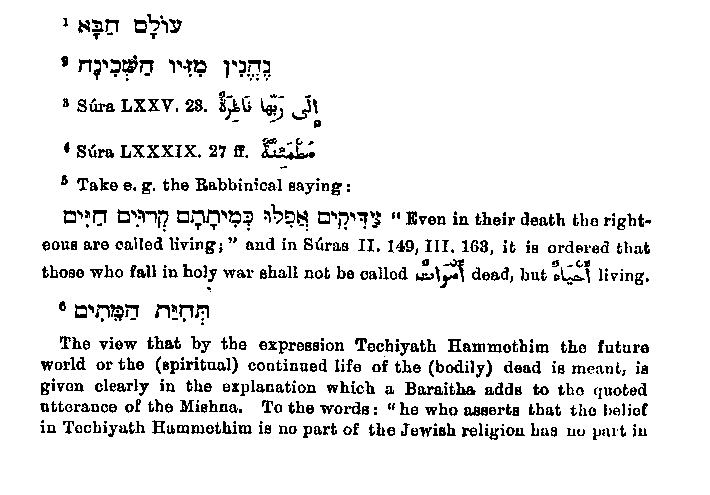
page 54
of his deeds while he is still in a state of death, the time of
resurrection must be the time for the judgment.1
These two views of the resurrection and the judgment day, though different
in themselves, are both closely connected in Judaism and more especially
in Islam.2 In Judaism there
is a third period the advent of a Messiah, which it is not easy to separate
from the other two. Naturally this time, which is to bring forth two such
important events as judgment and resurrection, will be ushered in by
terrible signs. In Judaism statements to this effect are to be found
only about the third period, which is generally connected with the other
two, viz., the earthly period of the Messiah; in Islam on the contrary
everything is attributed to the last day. The utterance most in accord
with the Talmud is that in Sannas 41 and 141, which says that learning
shall vanish, ignorance shall take root, drunkenness and immorality
shall increase. With this we must compare the passage in
Sanhedrin 97:3 "At the time
when David's son comes the learned diminish, and the place of learned
meetings serves for immorality." The descriptions in the Quran refer
more to the last day itself, and remind us of many passages in Holy
Scripture, where it is also said of those days that the world will
bow itself before God, the heavens will be rolled
together4 and

page 55
vanish in smoke,1 all
cities will be destroyed,2
and men will be drunken and yet not drunken3.
Another very distinct sign of the advent of a Messiah, which is
remotely alluded to in the Bible but which attained to an extraordinary
development in the Talmud and especially in later writings, is the
battle of Gog, Prince of Magog.4
Gog and Magog are, however, named by the Rabbis as two princes, and this
view has taken root in the Quran in the Rabbinical
form,5 since two persons,
Gog and Magog, are mentioned as dwellers in the uttermost parts of
the earth.6
In the details of the idea of future retribution many resemblances
are to be found, which, by virtue of the unity of the Jewish view and
its derivation from the Scriptures, show themselves as borrowings
from Judaism. Thus according to the Talmud, a man's limbs themselves
shall give testimony against him;7
in one passage we find those words: "The very members
of8 a man bear witness
against him, for it is said: 'Ye yourselves are my witnesses saith the Lord.'"
With this we may compare Sura XXIV. 24 9
"Their own tongues, and hands, and feet, shall one day be witness
against them of their own doings.10
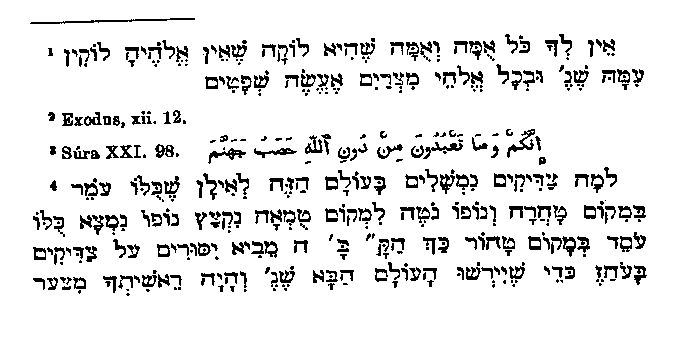
The judgment

page 56
day gains also a greater importance from the fact that not only
individuals and nations appear at it, but also those beings who
have been honoured as gods by the nations, and they too receive
punishment with their worshippers. In Sukkah XXIX we find this
statement:1 "As often
as a nation (on account of idolatry) receives its punishment, those
beings honoured by it as gods shall also be punished for, it is
written:2 'Against all
the gods of Egypt I will execute judgment.'" That this general
sentence admits of a reference to the punishment of the last day
is not expressly stated, but it is worthy of acceptation. Muhammad
expresses himself still more clearly about it:3
"Verily both ye and the idols which ye worship besides God shall
be cast as fuel into hell fire."
A view closely interwoven with Judaism and Islam is that retributive
punishment is entirely confined to the state after death, and that
any single merit which a sinner has gained will be rewarded in
this world, to the end that nothing may impede the course of
judgment in the next. The same view, only reversed, holds good
in the case of the righteous. It is a view which was thought to
explain the course of destiny upon earth, which so often seems
to run contrary to the merits and demerits of men.
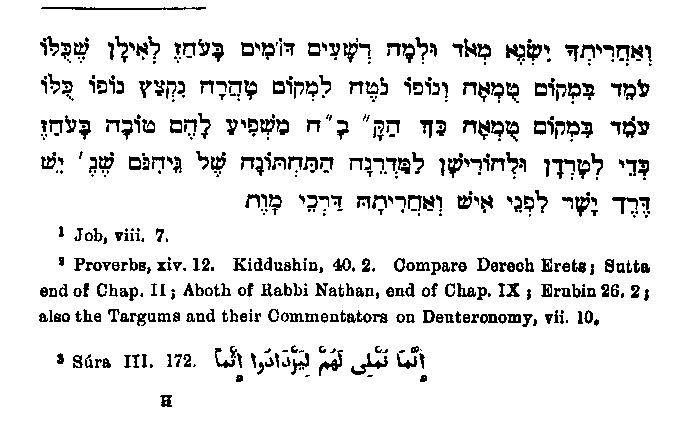
The Rabbinical view is expressed in the following
passage:4
"Whereunto are the pious in this world to be
page 57
compared? To a tree which stands entirely in a clean place;
and when a branch bends to an unclean place, it is cut off
and the tree itself stands there quite clean. Thus God sends
afflictions in this world to the righteous, that they may possess
that which is to come, as it is written 'Though thy beginning was
small, yet thy latter end showed greatly increase.'1
Sinners are like a tree which stands in an altogether unclean
place; if a branch bends over to a clean place, it is cut of
and the tree itself stands there quite unclean. Thus God allows
the ungodly to prosper, in order to plunge them into the lowest
depth of hell, as it is written: 'There is a way which seemeth
right unto a man, but the end thereof are the ways of
death.'2"
Muhammad expresses this same view in several passages, but
restricts himself to the latter part which refers to the prosperity
of sinners, partly because his own ideas were too unspiritual
for him to be able to imagine the righteous as truly happy
without earthly goods, partly because in so doing his teaching
would have lost in acceptability to his very degraded contemporaries.
Thus in one passage3
we read: "We grant them long and prosperous lives only
page 58
that their iniquity may be increased,"1
still the second view is to be found among the Arabians
also, e.g., Elpherar in his comments on
Quran XII. 42 2 says
"It is said that the righteous are punished and tried, in order
that the day of resurrection may be perfect in light and power,
as the contumacy of the righteous has been already expiated."
Muhammad naturally avoided specifying any time at which the judgment
should take place, though he was much pressed to do so. He excused
himself with the Jewish saying that with God a thousand years are
as one day,3 which was
divested of its poetic adornment and taken by the Rabbis in a purely
literal sense.4 Muhamnad
says:5 "Verily one day
with thy Lord is as a thousand years of those which ye compute";
and again6 "On the day
whose length shall be a thousand years of those which ye compute."
As has been already shown, with the establishment of

page 59
the doctrine of the day of judgment, the view of the resurrection
and of the quickening of the dead was also formed; and this the more
readily, because it found support in expressions in the Scripture,
as e.g those in Ezekiel, xxxvii.:1
"I have opened your graves, and caused you to come up out of your graves,
ye shall live," etc.; and those in other passages referring partly
to the metaphorical quickening of the dead land of Israel. Of this
doctrine it is said that it is such a fundamental teaching of the
Jewish faith that the declaration that it did not belong to the law
entailed the exclusion of him who thus spoke from eternal
life.2 The Quran is,
so to speak, founded upon this doctrine along with that of the unity
of God, and there is scarcely a page in it where this doctrine is
not mentioned. To adduce proofs here would be as easy as it would
be useless; and indeed it is not required by our purpose, since
Christianity also has inherited this view from Judaism, as is shown
in the argument of Jesus in refutation of the Sadducees. Only one
point deserves particular mention, because on the one hand it
contains a detail adopted from Judaism, and on the other it shows
the low level of thought at that time.
As soon as it becomes a question not merely of the immortality of
the soul, but also of the resurrection of the body, then the soul
without its body is no longer regarded as the same person, and the
question naturally presents itself to the ordinary understanding:
"How can this body which we have seen decay rise again, so that
the same personality shall reappear?" Neither the soul alone nor
the body alone is the person, but the union of the two. Now one
part of this union is dissolved; another body can indeed be given
to this soul, but by this means he who died

page 60
does not reappear, but a new man, another personality, another
consciousness comes into being. This question dimly anticipated
obtrudes itself, and can only be set at rest by proving that the
very same personality can appear again. Instead of showing this
Muhammad contents himself with the parable, used also occasionally
in the Talmud, of the renewal of the dried up earth by fertilising
rain. He found however that be could not silence the common
convictions of men thereby,1
and so he was compelled to come back to it again and again. The
Jews also sought to give prominence to this resemblance, and they
put the eulogium2
"who sendeth down the rain" into the second benediction which
treats of the resurrection.3
The fact that the righteous rise actually in their
clothes4 (which after all
is not more wonderful than in their bodies) is explained by the
parable of the grain of wheat, which is laid in the earth without
covering, but springs up again with many coverings. The passage
in Quran VI. 96 contains a similar statement. This view is not
strange to Islam, for a saying which is attributed to Muhammad
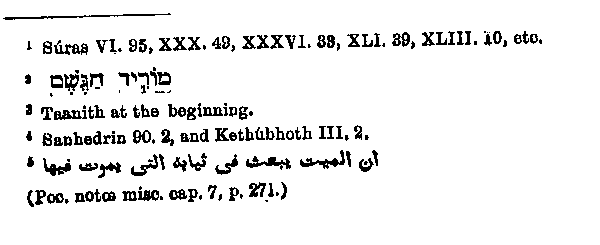
runs thus: 5 "The dead
man shall be raised in the clothes in which he died."
That from the standpoint of revealed religion the brief in the
possibility of revelation is fundamental needs of course no proof,
and in this the views of all revealed religions are alike; yet
differences can be found in the manner of conceiving of the revelation,
and here we recognise again that Muhammad derived his view of it
from Judaism, of course with some modification.
page 61
The Jews have a saying that "all tbe prophets saw through a dark
glass, but Moses through a clear one,"1
and Muhammad says:2
It was not granted to a man that God should speak unto him otherwise
than in a vision or from behind a veil;3
and then he adds4 "or by
the sending of a messenger to reveal by His permission that which
He pleaseth." This messenger is the Holy Spirit,5
or simply the spirit,6
like the spirit in the story of Micaiah's vision.7
The Arabic commentators take this holy spirit to mean Gabriel, a view
which is not unknown to the Jews, for

page 62
the Jewish commentators understand the words1
"the definitely speaking Spirit" to refer to Gabriel. One of Muhammad's
own utterances, one which is fully exaimined only by the 52nd Sunna,
is much more striking:2
"And they will ask thee of the spirit, say the spirit (proceedeth) at
my Lord's command."
With this the teaching about angels is closely connected, and it also
had its beginning in Scripture, but appears to have been developed in
later days especially through Parseeism. Muhammad is unwearied in
his descriptions of angels; so too are the later Jews in their many
prayers on the day of atonement, but these are of rather late
origin.3 The angel of
death4 is specially
mentioned in Sura XXXII. 11.
While angels were regarded as purely spiritual beings who execute
God's commands, a class of beings was imagined who stood between
man and the purest spirits; these were mixed spirits, who were made
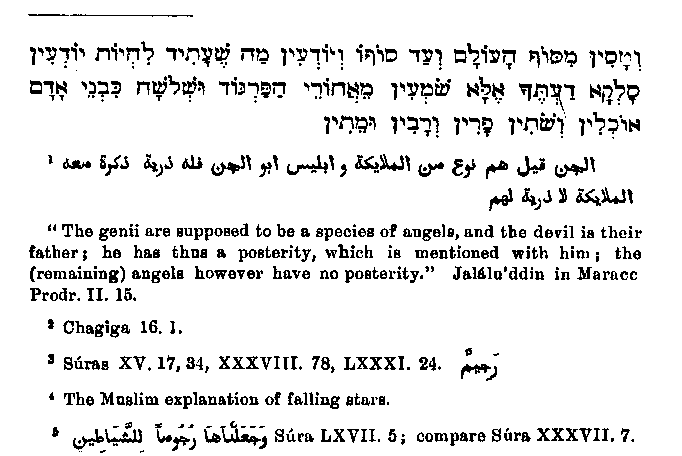
out of fire,5 who
possessed superior mental powers, but who were mostly inclined
to evil, they were called6
demons, but there are numerous other names for them in Arabic.
The Talmud has the following statement about them:7
"Demons

page 62
are declared to possess six qualities, three of which are angelic
and three human. The three which pertain to angels are that they
have wings, that they can fly from one end of the earth to the other
(i.e. they are bound by no space), and that they know the future
beforehand. They know the future beforehand? No! but they listen
behind the curtain. The three human qualitites are that they eat
and drink, increase and multiply,1
and die."2 Muslim
tradition cannot do enough in their description, but there is
but little about them in the Quran. The fact that they listened
at the canopy of heaven gained for them in the Quran the nickname
of the stoned,3 for,
say the commentators, the angels threw stones to drive them away
when they found them listening.4
Thus it is said expressly5
We have appointed thorn (the lamps of heaven) to be darted at the
devils." The seventy-second Sura treats of them in detail, and
seeks especially to set forth their assent to the new doctrine.
The Talmud also states that they are present at the giving of
instruction. The following
page 64
passage from the Berachoth shows this "The press in the school
is caused by them, the demons."1
With this we may compare the Quran "When the servant of God stood
up to invoke Him, it wanted little but that the genii had pressed
on him in crowds."2
It cannot be maintained that the greater part of the teaching
about genii was adopted from Judaism, it must rather be said
to have come from the same dark source whence the Jews of those
times drew these conceptions, viz., Parseeism.
Still here, as in the case of any point which is of inaccessible
origin, a reference to a mere similarity is not without use.
Under these four heads then, viz., (1) Creation, (2) Retribution
including the Last Judgment and the Resurrection, (3) Mode of Revelation,
and (4) Doctrine of Spirits, details are found, the adoption of which
from Judaism we may regard as sufficiently proved. The precaution
against representing, out of love for our theme, that which is common
either to the general religious feelings of mankind, or to all revealed
religions, or at least that which belonged to other known religious
parties in Muhammad's time as peculiar only to Judaism, compels as
to fix these limits. We have found much of interest especially under
the second head, so that the demands of our theme might seem to be
fairly well satisfied.
B. Moral and Legal Rules
It is obvious that in a revealed religion all individual commands
form part of the religion, and therefore one cannot draw any sharp
line of distinction between the "religious" and the "moral."
We have accordingly

page 65
considered nothing which has to do with conduct under the heading A,
even thongh it might be immediately connected with the points of
belief under discussion and so we are able to bring together here
all commands as to conduct. From the fact that every individual
command is Divine, a conflict of duties may easily arise, which
cannot be readily decided by private judgement, seeing that all the
commandments are equal,1
so far as their Author is concerned. Rules for such cases must
therefore be laid down. For instance, we find the following statement
in the Rabbinical writings2
"If a father saith (to his son if be is a priest), 'defile thyself';
or if he saith, 'Make not restitution (of the thing found
to the owner)', shall he obey him? Therefore, it is
written3 'Let every man
reverence his father and mother, but keep my Sabbaths all of you,
ye are all bound to honour me'" And Muhammad
says:4 "We have commanded
man to show kindness towards his parents, but if they endeavour to
prevail with thee to associate with me that concerning which thou
hast no knowledge, obey them not."

page 66
Judaism is known to be very rich in single precepts, and Mubammad
has borrowed from it much that seemed to him suitable.
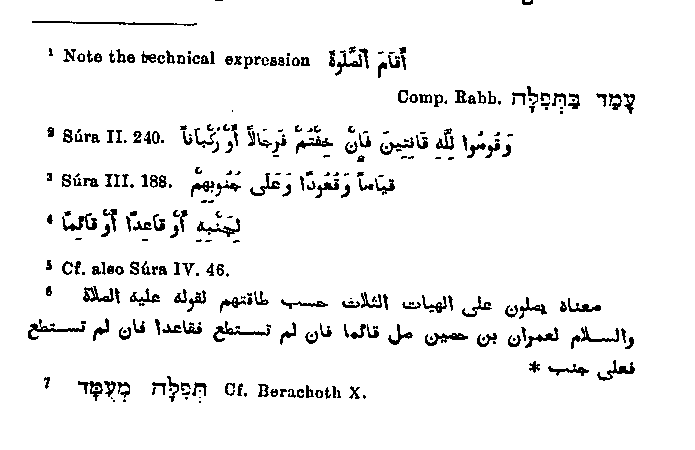
I. Prayer. Muhammad like the Rabbis prescribes the standing
position1 for prayer.
Thus: "Stand obedient to the Lord; but if ye fear any danger, then
pray while walking or riding";2
and also: "Who standing, and sitting, and reclining, bear God in
mind."3
These three positions are mentioned again in Sura X. 13 4
"When evil befalleth a man he prayeth unto Us, lying on his side
or sitting or standing," where with a true perception of the right
order, the least worthy position is the first spoken
of.5
Baidhawi comments thus on Sura III. 188, the passage alluded to above:
"The meaning is that the man may take any of the three positions
according to his strength, as Muhammad said to Amran Ibn Husain:
"Pray standing if thou art able; if not, sitting; and if thou canst
not sit up, then leaning on tho side."6
The Jews were not so strict in this matter, yet they too have the rule
that prayer should be offered standing;7
and in Rabbinical writings it is also
page 67
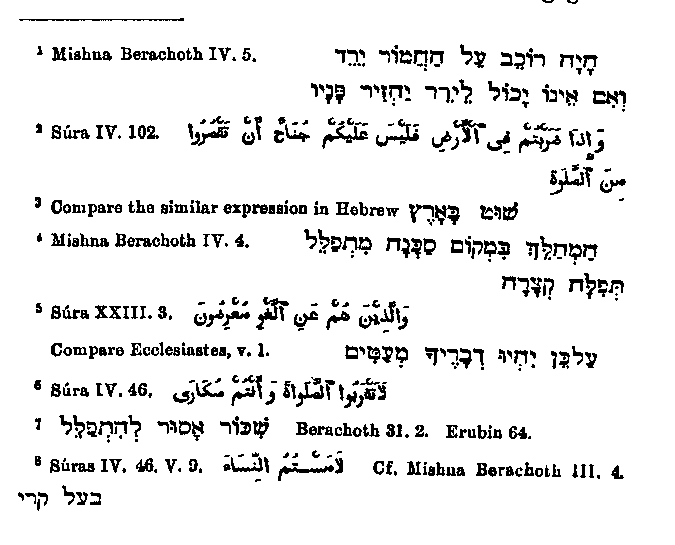
said that he who rides on an ass is to dismount but the addition is
made that, if he cannot dismount he is to turn his face (towards
Jerusalem).1 As the bodily
position may be altered in urgent cases, so the prayer itself may be
shortened on similar occasions.2
So we find the permission to shorten prayer in time of war: "When ye march
to war in the earth,3 it
shall be no crime in you if ye shorten your prayers." The Jews also
were permitted to pray a short prayer when in a dangerous
place.4 Muhammad is
quite opposed to senseless chattering, for he counts it a merit
in believers to "eschew all vain discourse".5
Therefore because attention and pious concentration of thought are
to be aimed at, he enjoins6
on believers not to draw near to prayer when they are drunk. This is
in accordance with the Talmudic rule: "Prayer is forbidden to the
drunken."7 It is also
forbidden to those who have touched women.8
These persons may not engage in
page 68
prayer before washing with water, which cleansing is recommended
as a general rule before prayer both in the Quran1
and in the Talmud. Instead of water, purification with sand may
take place.2 So in the
Talmud: "He cleanses himself with sand and has then done enough."
As concentrated thought is urged as a duty, it follows that prayer
though audible must not be noisy,3
and so Muhammad says: "Pronounce not thy prayer aloud, neither
pronounce it with too low a voice, but follow a middle way between
these;" and in the Talmud we find:4
"From the behaviour of Hannah who in prayer moved her lips we learn
that he who prays must pronounce the words, and also as her voice
was not heard we learn that he must not raise his voice loudly."
But because our mood does not at all times move us to fervency of
prayer, outward ceremony is necessary, and indeed prayer in a great
congregation, whose devotion will stir up our own.5
"The prayer in the congregation"6
is greatly praised also by the Jews. Daybreak, which is mentioned
in the Talmud in connection with the Shema prayer, as the time
when "one can distinguish between a blue and a white
thread,"7 is not mentioned
in this connection in the
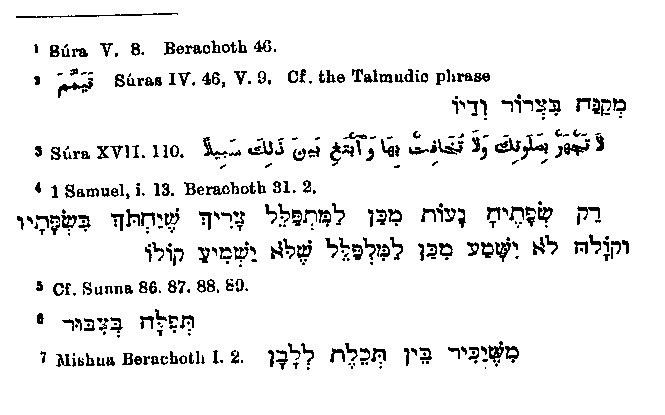
page 69
Quran it is true, for the Quran knows nothing of a Shema prayer,
but it appears in connection with the beginning of the Fast
Day:1 "Until ye can
discern a white thread from a black thread by the daybreak."
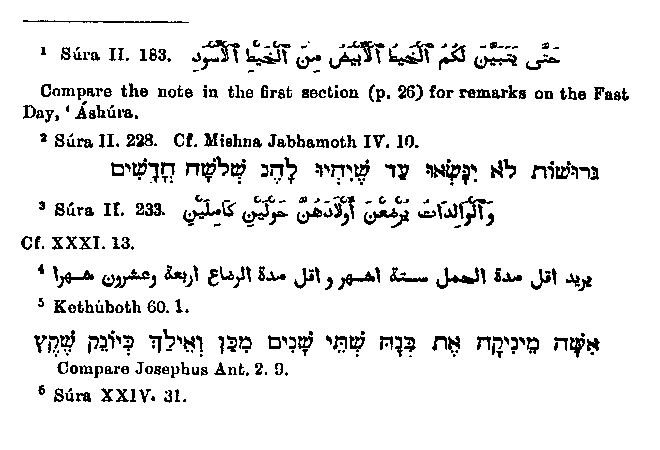
2. Some rulings in respect of women tally with Judaism; e.g.,
the waiting of divorced woman for three months before they may marry
again.2 The time of suckling
is given in both as two years3
"Mothers shall give suck unto their children two full years." Similarly
in Sura XLVI 14 we find: "His bearing and his weaning is thirty months,"
which is explained by Elpherar as follows4
"He takes the shortest duration of pregnancy, Viz., six months, and the
shortest of suckling, viz., twenty-four months." Compare the Talmudic
saying:5 "A woman is to
suckle her child two years, after that it is as though a worm sucked."
That those relatives to whom inter-marriage is forbidden in the Scripture
are precisely those whom Muhammad permits6
to see their near relations unveiled has been already noticed by Michaelis
in the Mosaic system, and he has shown the connection between these
two laws.
page 70
As Muhammad had very little intention of imposing a new code of individual
laws, since his aim was much more the spread of new purified religious
opinions, and as in the matter of practice he was far too much of an
Arab to deviate from inherited usages, unless they came directly into
opposition to these higher religious views, it is easily to be explained
how so few borrowings are to be found in this part and much even of
what is adduced might perhaps be claimed to be general oriental custom.
We shall find moreover in the Appendix that Muhammad mentions many
Jewish laws which were known to him; he alludes to these sometimes as
binding on the Jews, sometimes merely for the sake of disputing them,
and hence we see that it was not want of knowledge of them that kept
him back from using them, but his totally different purpose. This
remark must apply also to our third heading, under which isolated
instances of adaptation only will be found, except in cases where
the view is directly connected with the higher articles of Faith
adopted from Judaism, which have been already mentioned.
C. Views of Life.
In putting together these single fragmentary utterances, it is
scarcely worth while to arrange them according to any new system,
and we will therefore follow the order of the Quran.
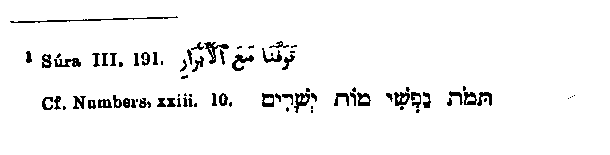
Death with the righteous is to be prized, hence the request in the
Quran: "Make us to die with the righteous,"1
which corresponds with that of Balaam, "Let me die the death of
the righteous.
page 71
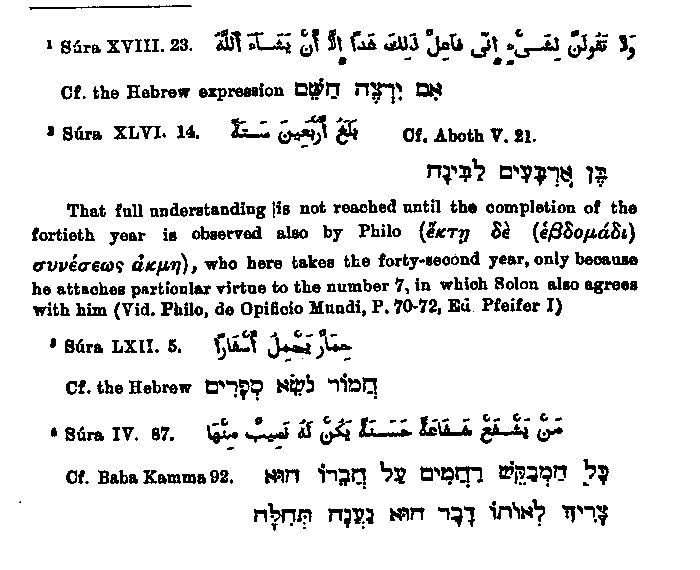
"Say not of any matter, 'I will, surely do this tomorrow,' unless
then add, 'If God please.'"1
Full understanding is first imputed to a man when he is forty years
old,2 and it is said in
the Mishna: "At forty years of age a man comes to intelligence."
So the hunting for some particular persons, to whom this sentence
of the Quran shall apply, as the Arabic Commentators do, appears
altogether unnecessary; it is also rendered very dubious by the wide
differences between the various opinions.
In the Quran a comparison is found between those who bear a burden
without understanding the nature of it and who thus carry without
profit, and an ass carrying books.3
"He who intercedeth (between men) with a good intercession shall
have a portion thereof."4
This saying is very similar to the Hebrew one: "He who asks for mercy
for another while he needs the same thing himself obtains help
page 72
first." In Sunna 689 it is said "Three things follow the dead, but
two of them turn back; his family, his goods, and his works follow
him; his family and his goods forsake him again, and only his works
remain with him." This is also found in great detail in Rabbinical
Hebrew:1 "Man has three
friends in his life time, - his family, his property, and his good
works. At the time of his departure from earth he collects the
members of his family, and says to them, 'I beg you, come and
free me from this evil death.' They answer: 'Hast thou not
heard2 that no one has
power over the day of death.' It is also written:3
'None of them can by any means redeem his brother, even his

page 73
wealth which he loves avails not, he cannot give to God a ransom
for him, for the redemption of their soul is costly and must be
let alone for ever; but enter thou into peace, rest in thy lot till
the end of days.1
May thy part be with the righteous.' When the man sees this, he
collects his treasures and says to them: 'I have laboured for you
day and night, and I pray you redeem and deliver me from this death'
but they answer: 'Hast thou not heard that riches profit not in
the day of wrath?2
So then he collects his good works and says to them 'Then you come
and deliver me from this death, support me, let me not go out of
this world, for you still have hope in me if I am delivered.'
They answer: 'Enter into peace! but before thou departest we will
hasten before thee; as it is written, Thy righteousness shall go
before thee, the glory of the Lord shall be thy reward.'"

JUDAISM AND ISLAM [Table of Contents]
Answering Islam Home Page