返回总目录
Life of Mahomet [Volume III Chapter 10]
page 39
THE BIOGRAPHY OF MAHOMET, AND RISE OF ISLAM.
CHAPTER TENTH.
Religious Institutions, and Miscellaneous Events during the
First and Second Years of Hegira. A.D. 623.
The five daily prayers.
THE observance of prayer at five stated times in
the day, though these times are nowhere enumerated
in the Coran, was probably practised by Mahomet
and his followers before they left Mecca. At all
events, it was now an essential part, and the most
noticeable perhaps and characteristic feature, of
Islam. These services were ordinarily performed
by Mahomet and some others in the Mosque, but
might optionally be performed anywhere. The
prayers were invariably led by Mahomet himself
when present; in his absence, by the chief person in
the assembly, or by any one else charged by the
Prophet with the duty1.
page 40
Lustration preliminary to prayer
At what period lustration was introduced as a
necessary preliminary to prayer, is not certain. This
ceremony also may have been adopted at Mecca2;
but, however that may be, it was evidently borrowed
from the Jews, with whose Law and Tradition the
ordinances established by Mahomet respecting the
causes and degrees of legal impurity, and the cor-
responding ablutions, very closely correspond3.
A formal service
The Believer's life was thus a dafly round of
religious observances, which, practised by all at
first, and maintained perhaps by some, with zeal and
spiritual aspiration, soon declined, for the mass, into
barren forms. At earliest dawn the Moslem begins
the day with lustration, preliminary to the prescribed
genuflexions and formularies of prayer; at midday he
is called aside from his business for the same duty:
in the afternoon, and again when the sun has set,
the ceremonies are repeated; and the day is closed
in darkness by the same rites with which it opened.
Saints and sinners joined (and still join equally) in
the stereotyped form; the most heinous crime, just
committed or in immediate contemplation, in no
respect interferes with the performance of these
prayers; and the neglect to observe them is an abnegation
page 41
of the faith, an insult to the majesty of Islam, which demands
the interposition of the temporal arm.
The Friday, or public and general service
The daily prayers were not necessarily congregational.
They might be offered up by the worshippers singly or in companies,
in the Mosque or at home. But at mid-day of Friday there was
appointed a public service in the Mosque, at which the Believers
generally, unless detained by sufficient cause, were expected
to attend. The usual prayers were on that occasion followed by
an address or sermon pronounced by Mahomet.
The sermon
This weekly oration was skilfully adapted to the circumstances
and feelings of the audience. It allowed full scope to the
eloquence of the Prophet, and by its frequent recurrence
helped to confirm his influence and rivet the claims of Islam.
Motive for the selection of Friday
No religious antagonism is to be supposed in the
selection of Friday for the public service. Because
when he fixed upon it, Mahomet was still on friendly
terms with the Jews, and inclined to adopt their institutions.
In the Christian Sunday he had a precedent for change, and
he may have desired in a similar
more devout Moslems, the ceremonial is not often a channel for
spiritual worship. I speak of the general effect, as gathered
from the impression of tradition on my mind, and (as regards modern
Mahometans) from personal observation.
I may observe that the ritual is said originally to have consisted
of two "Rakaats," or series of genuflexions and formularies;
but a month after his arrival at Medina, Mahomet increased them
to four, excepting in case of a journey. Tabari, 223.
page 42
manner to distinguish the sacred day of Islam from
the Jewish Sabbath4.
He may likewise have hoped
thus to secure the attendance of the Jews at his public
service, which was composed, like theirs, of prayer,
reading of the scripture, and a sermon. As a Jew
(according to the doctrine of Mahomet at this time)
might follow all the precepts of Moses, and yet be a
good Mussulman, it is by no means improbable that
some Jews may at the first have attended both the
Mosque and the Synagogue. We have instances
of Rabbins being expelled with ignominy from
the Mosque5;
and the Synagogue was visited by Mahomet himself, and
by his followers6.
Jerusalem the first Kibla
Jerusalem was the first Kibla of Mahomet; that
is to say, after the fashion of the Jews, he and his
followers prayed with their faces turned always towards
the Temple of Solomon7.
When there was
page 43
no longer any hope of gaining over the Jews, or fusing
Judaism and Islam into one religion, the ceremony
lost its value. It opened a vulnerable point: ---
"This Prophet of yours," said the Jews tauntingly,
knew not where to, find his Kibla, till we pointed
it out to him8.
It was now the object of Mahomet to transfer the homage
of his people from Jerusalem, and to concentrate it upon
Mecca. His system would receive a fresh accession of
strength and local influence if he thus magnified the
Kaaba by making it the Kibla of his people.
The Kibla changed to Mecca
Tradition admits unanimously that Mahomet
greatly desired the change. How it was effected is
thus told by Wackidi, with the usual supernatural
colouring9.
Rajab, A.H. II, Nov. A.D. 623
It was the middle of Rajab, sixteen
or seventeen months after his arrival in Medina,
that Mahomet, longing for the Kibla to be transferred
to the Kaaba, thus addressed his guardian
angel:-"O Gabriel I would that the Lord might
change the direction of my face at prayer away
from the Kibla of the Jews!" I am but a
servant," replied Gabriel. "Address thy prayer
to God." So Mahomet made his petition to the
Lord. It came to pass, on a certain day, that as
page 44
he prayed in the Assembly towards the Temple
of Jerusalem, and was raising his face upwards,
unexpectedly the following message was revealed to
him -- Verily We have seen thee turning about thy
face towards the Heavens10;
wherefore We shall cause
thee to turn toward a Kibla that shall please thee.
Turn now thy face toward the Holy Temple of Mecca.
Wheresoever ye are, when ye pray, turn toward it.
He had already performed two prostrations in the
direction of Jerusalem, when, suddenly giving forth
this order, he turned towards the south, and all the
congregation turned round also. Thenceforward
Jerusalem was abandoned, and the Kaaba became
the Kibla of Islam11.
The Jews, knowing full well the motives which led to this
alteration, were mortified, and still further estranged.
Mahomet had cut, as it were, the last link binding him
ostensibly to
The incident is one which has elicited a great mass of discrepant
tradition. Many different spots are mentioned as the
theatre or the occurrence, and many different companies claim
the honour of being its witnesses. Tradition delights to tell how,
as the rumour spread abroad, one and another was startled by
the strange intelligence. Some say it happened in the morning,
others in the evening. The most probable account gives the
great Mosque as the scene, and the time that of the mid-day
prayer. Wackidi has a tradition that it happened at the house of
Omm Bishr (of the B. Salma), with whom he had gone to dine:
others say, in the Mosque of Coba. See Burton, ii. 820.
page 45
their creed. They charged him with fickleness, and
with worshipping towards an idolatrous Temple.
These charges he endeavoured to meet in the Coran;
but it was the victory at Badr, one or two months
after, and the subsequent hostilities against the
Jews, which furnished the only effective means for
silencing their objections12.
"The Fools from amongst the people will say, - What hath
turned them from their Kiblah, towards which they used to pray?
SAY, - Unto God belongeth the East and the West: he guideth
whom he chooseth into the right way.
"Thus have WE made you an intermediate People, that ye
should be Witnesses for mankind; and the Prophet shall be
Witness for you. We appointed the Kiblah, towards which thou
usedst to pray, only that We might know him who followeth the
Apostle from him that turneth back on his heels, although it be
a stumbling block, excepting unto those whom God hath directed.
And God will not render your faith without effect; for God Is
gracious and merciful to mankind." [Here follows the verse
quoted in the text; after which the passage proceeds:—]
"Truly those who have received the Scriptures* know that this is
the truth from their Lord; and God is not regardless of what they
are doing.
"And verily, if thou wert to show unto those who have received the
Scriptures every kind of sign, they would not follow thy Kiblah;
and thou shalt not follow their Kiblah. Neither doth one part of
them follow the Kiblah of the other part+. And if
* The Jews; though a clause in the following verse (noticed in
the next note) refers also to Christians.
+ That is, each religion has it. own (appointed) Kibla; he
refers, apparently, to Christians turning towards the east, and Jews towards
Jerusalem: whence Mahomet would argue a propriety in his having a peculiar
and distinctive Kibla for Islam.
page 46
Circumcision
The rite of circumcision is hardly to be mentioned as an institution
of Islam. It was current among
thou wert to follow their desire., after the knowledge that math
reached thee, then verily thou wert amongst the Transgressors.
"They to whom We have given the Scriptures know this*, even
as they know their own children; but verily, a party amongst
them hideth the truth designedly.
"The truth is from thy Lord: wherefore be not thou among
the Doubters.
"And every (people) hath a direction to which it turneth
(in prayer). Wherefore press forward in good works: wheresoever
ye may be, God will bring you back together: surely God's power
is over all things.
"Now, therefore, from whatsoever place thou comest forth,
turn thy face toward the Holy Temple; for it is the truth from
thy Lord, and God is not regardless of that which ye are doing.
"From what place soever thou comest forth, turn thy face
towards the holy Temple; anti wherever ye be, turn your faces
towards it; that men may have no cause of dispute against
you, excepting them that transgress. Fear them not; but fear
ME, that I may fulfil my grace upon you, and that ye may be
rightly directed." Sura, ii. 148-152.
Shortly after occurs the following passage (addressed probably
also to the Jews) in justification of the pilgrim ceremony at
Safa and Merwa, alleged to be, or to have been,
the sites where two idols stood:-
"Verily Safa and Merwa are of the monuments of God.
Whosoever, therefore, performeth the greater pilgrimage, of
the holy house, or the lesser, it shall be no crime in him if he
perform the circuit of them both. And whoever worketh that
which is good of a willing heart, verily God is grateful and
knowing." Sura, ii. 160.
The defence of the Meccan rites, which I have quoted at length
in the Supplement to the sixth Chapter (vol. ii. 268), probably
belongs to this period. It is in a late Meccan Sura, and the late
Meccan Suras are full of passages added at Medina. Ibid. p.260, note.
* i.e. the rightness or the things; others read, "this Apostle,"
i.e., they recognize Mahomet.
page 47
the Arabs as an Abrahamic ceremony13,
and continued (without any command in the Coran) to be practised
among the followers of Mahomet.
Mahomet at first observes the Feast of the Atonement,
2nd Jumad, A.H. II, Sept. A.D. 622.
Two or three months after his arrival in Medina,
Mahomet observed the Jews, on the tenth day of the
their seventh month, keeping the great Fast of
the Atonement14;
and he readily adopted it for his own people. Prior to this,
fasting does not appear to have been a prescribed ordinance of
Islam15.
It was established at a period when the great
The tradition referred to is that, on Mahomet asking the Jews
the origin of the Fast, he was informed that it was in memory
of the delivery of Moses out of the hands of Pharoah, and
the drowning of the tyrant in the Red Sea: - " We have
a greater right in Moses than they," said Mahomet; so he
fasted with the Jews, and commanded his people to fast also.
And when the Fast of Ramadan was imposed, he did not command
the Fast of Ashor (i.e. or the Tenth) to be observed, nor did
he forbid it, i.e. he left it optional to keep it up
as well as the other. Tabari, 248.
page 48
object of Mahomet was to symbolize with the Jews in all their
rules and ceremonies.
The Fast of Ramadan Substituted
But when it became his endeavour to cast off Judaism and
its customs, this fast was superseded by another.
Shaban, A.H. II, Dec. A.D. 623.
Eighteen months after his arrival in Medina, Mahomet
promulgated, as a Divine command, that the following month,
or Ramadan, was to be henceforth observed as an Annual Fast.
Although the new ordinance was professedly similar in
principle to that of the Jews16,
the mode of its observance was entirely different. At first
the Moslems (following the Jews, who fasted for four-and-twenty
hours, from sunset to sunset) thought themselves bound to
abstain night and day from all enjoyments throughout the
month. But Mahomet checked this ascetic spirit. His followers
were to fast rigorously by day, but from sunset till dawn
they might eat and drink and indulge in any pleasures otherwise
lawful17.
"O ye that believe! A Fast is ordained for you, as it was
ordained for those before you, that haply ye may observe Piety;-
"For the computed number of days. The sick amongst you,
and the traveller, (shall fast) an equal number of other days; but
he that is able to keep it (and neglecteth) shall make atonement
by feeding a poor man. And whoever worketh that which is
good, of a willing heart, it shall be well for him. And if ye fast
it will be well for you, if ye comprehend: -
"In the month of Ramadan; -- wherein the Coran was sent
page 49
Its unequal pressure and rigour
It was winter when this fast was ordained, and
Mahomet probably then contemplated its being
always kept at the same season, when the prohibition
to eat or drink during the day did not involve
any extreme hardship18.
In the course of time, however, by the introduction of the
lunar year, the month of Ramadan gradually shifted backward
to the summer season; and then the prohibition to
down; a direction unto mankind, and plain rules of guidance,
and a discerner (between good and evil).
"Wherefore let him that is present in this month fast during
the same; but he that is sick, or on a journey, shall fast an
equal number of other days.
"God willeth that which is easy for your he willeth not for
you that which is difficult; and that ye may fulfil the number of
days, and magnify God, for that he hath directed you, and may
give thanks.
"It is lawful unto you, during the nights of the Fast, to consort
with your wives. They are a garment unto you, and ye are a
garment unto them. God knoweth that ye are defrauding yourselves,
wherefore he hath turned unto you, and forgiven you.
Now, therefore, sleep with them, and earnestly desire that which
God hath ordained for you; and eat and drink until ye can
distinguish a white thread from a black thread, by the daybreak.
Then keep the fast again until night, and consort not with them
(during the day); but be in attendance in the places of worship.
These are the limits prescribed by God; wherefore draw not near
unto them. Thus God declareth his signs unto mankind, that
they may observe Piety." Sura, ii. 184-l88.
page 50
taste water from morning till evening became a
burden heavy to bear. The strictness of the fast,
as thus instituted by Mahomet, has nevertheless
been maintained unrelaxed; and to this day, in
the parched plains of India, during the month of
Ramadan, however burning the sun and scorching
the wind, the follower of Mahomet may not suffer
a drop of water, during the long summer day, to
pass his lips; be looks forward with indescribable
longing for the sunset, when, without compromising
his faith, he may slake his thirst and refresh with
food his drooping frame. The trial, though thus
unequally severe in different climes and at different
terms of the lunar cycle, is no doubt a wholesome
exercise of faith and self-denial. But in so far as
the fast was intended to be a restraint upon licentiousness,
its limitation to the daytime. necessarily
deprives it of all salutary influence.
"Eid al Fitr", or Festival of "breaking of the Fast",
Shawwal A.H. II, Feb. A.D. 624
At the conclusion of the fast, a festival was
appointed, called the EED AL FITR, or "breaking of
the fast." A day or two before the expiration of
Ramadhan, Mahomet assembled the people, and
instructed them in the ceremonies to be then observed.
On the first day of the following month
they were early in the morning to bring together
their offering's for the poor; each one - young or
old, bond or free, male or female - a measure of
dates, of barley, or of raisins, or a smaller
measure19.
page 51
of wheat. "See," said he, "that ye make the
poor independent this day, so that they need not
to go about and beg." Having presented their
alms, all went forth with the Prophet to his
Musalla, or place of prayer, outside the city on
the Meccan road20.
A short spear or iron-shod
staff, brought by Zobeir from Abyssinia, was carried
before him, and planted on the spot. Taking his
stand there, the Prophet recited the usual prayers,
and then addressed the assembled multitude. The
service over, all returned to their homes, and
Mahomet distributed at the Mosque the accumulated alms
amongst the poor21.
Edd al Zoha combined in the first year with
the Fast of the Atonement
Another great Festival was established by Mahomet - the EED AL ZOHA,
or "day of sacrifice." The slaying of victims formed the concluding
scene in the pilgrimage to Mecca, and in that ceremony went:
the Festival was eventually merged.
Dzul Hijj, A.D. I, Mar. A.D. 623
But in the first year of the Prophet's residence at Medina
the season of pilgrimage passed unnoticed. In its stead,
as mentioned above, Mahomet kept the great Day of Atonement
with its sacrifice of victims, in conformity with the
practice of the Jews;
page 52
and had he continued on a friendly footing with
them, he would probably have maintained this rite.
shifted in the second year to correspond with
the Meccan Pilgrimage
In the following year, however, it was in keeping with his
altered relations to abandon altogether the Jewish ritual
of sacrifice, and to substitute for it another somewhat
similar in character, but grounded on the ceremonies at
Mecca22.
April. 624 A.D.
Accordingly, on the tenth day of Dzul Hijj, while the tribes
of Arabia, after making the circuit of Arafat, were engaged
in the closing solemnities of the Pilgrimage, Mahomet went
forth with his followers to the place of prayer. After
a service resembling that on the breaking of the Fast, two
fatted sucking kids, with budding horns, were placed before
the Prophet. Seizing a knife, he sacrificed one with
his own hand, saying: "O Lord! I sacrifice this
for my whole people, all those that bear testimony
to thy Unity, and to my Mission." Then he called
for the other, and slaying it likewise, said "O Lord!
this is for Mahomet, and for the family of Mahomet."
Of the latter kid both he and his family partook, and
what was over he gave to the poor 23.
The double sacrifice seems in its main
page 53
features to have been founded on the practice of
the Jewish priest at the Fast of the Atonement,
when he sacrificed "first for his own sins, and then
for the peoples."24
This ceremony was repeated by Mahomet every year of his
residence at Medina; and it was kept up there after his
decease25.
The Adzan, of Call to Prayer
The summons to prayer was at first the simple
cry, "To public prayer!"26
After the Kibla was changed Mahomet bethought himself of
a more formal call. Some suggested the Jewish trumpet,
others the Christian bell; but neither was grateful
to the Prophet's ear27.
The ADZAN, or call to prayer, was then established. Tradition claims
for it a supernatural origin, thus:-- While the matter
There is a passage in Sura ii. (v.179) which provides for the
sending of victims to Mecca by those unable to perform the
pilgrimage themselves; but this I take to be a much later passage -
probably not earlier than A.H. VI., when Mahomet was hindered
at Hodeibia from approaching Mecca.
page 54
was under discussion, Abdallah, a Khazrajite,
dreamed that he met a man clad in green raiment
carrying a bell28.
Abdallah sought to buy it, saying that it would do well for
bringing together the assembly of the faithful. "I will show
thee;" replied the stranger, "a better way than that;
let a crier call aloud, GREAT IS THE LORD! GREAT
IS THE LORD! I bear witness that there is no
God but the Lord: I bear witness that Mahomet is
the Prophet of God. Come unto Prayer: Come
unto Happiness. God is Great: God is Great!
There is no God but the Lord!" Awaking from
sleep, Abdallah proceeded to Mahomet, and told
him his dream. The Prophet perceived that it was
a vision from on high, and forthwith commanded
Bilal, his negro servant, to carry out the Divine
behest. Ascending the top of a lofty house beside
the Mosque29
while it was yet dark, Bilal watched for the break of day;
and on the first glimmer of light, with his far-sounding voice,
he startled all around from their slumbers, adding to the divinely
page 55
appointed call, -- " Prayer is better than Sleep!
Prayer is better than Sleep!" Every day, at the
five appointed times, the well-known cry summoned
the people to their devotions. And the successors
of Bilal, from a myriad minarets, to this day follow
his example.
Call used for convening a general assembly
The old cry, "To public prayer," was still maintained
whenever an assembly was summoned for general
the announcement of important intelligence, as that
of a victory; or for the proclamation of a general
order, as the going forth to war. The people
hurried to the Mosque at the call, but it had no
longer any connection with their devotions30.
The Pulpit
On the spot where Mahomet used to stand in the
Mosque at public prayers, the branch of a date-tree
was planted as a post for him to hold by. When
the Kibla was changed, the post was taken up from
the northern end of the Mosque and fixed near the
southern wall. In process of time Mahomet, now
beyond the prime of life, began to feel fatigue at
standing throughout the long Friday service. So he
consulted with his followers; and one said, "Shall
I make for thee a Pulpit such as I have seen them
make in Syria?" The suggestion pleased Mahomet,
both for the relief to himself and the advantage of
being better seen and heard at public worship.
Accordingly one or two tamarisk-trees were felled
at Al Ghaba, and fashioned into a Pulpit, having a place
page 56
to sit on, and three steps leading up to it31.
It was placed near the southern wall, on the spot which
it continued to occupy, and which the Pulpit, or
Mimbar, occupies at the present day.
Manner of the daily service
Mahomet ascended the pulpit for the first time
on a Friday. As he mounted, turning towards the
Kaaba, he uttered a loud Takbir, "Great is the
Lord!" and the whole assembly from behind burst
forth into the same exclamation. Then he bowed
himself in prayer32,
still standing in the pulpit with his face averted from
the people; after which he descended, walking backwards,
and at the foot of the pulpit prostrated himself33
towards the Kaaba. This he did twice, and having ended
the prayers, he turned to the congregation, and told them he
and of the had done this that they might know and imitate
his manner of prayer34.
and of the Friday service
The fashion of the Friday
The wood of which the Pulpit was constructed is variously
stated as 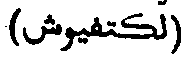 It was either Tamarisk, Lote
(wild plum), or some sort or Yew.
It was either Tamarisk, Lote
(wild plum), or some sort or Yew.
page 57
Service is thus described35.
As the Prophet mounted the steps of the pulpit he greeted the
assembly with the Salutation of Peace. Then he sat down, and
Bilal sounded forth the call to prayer. After the
prescribed prostrations and reciting, of the Coran,
he delivered two discourses, twice sitting down;
and he would point with his fingers, enforcing
his instructions: the people raised their faces towards
him, listening attentively with their ears,
and fixing their eyes upon him: when he ended,
they joined in a universal Amen. As he discoursed
he leant upon a staff36.
His dress on these occasions was a mantle37
of striped Yemen stuff, six cubits in length, thrown over his
shoulders; the lower garment38
was a girdle of fine cloth from Oman, but of smaller dimensions
than the other. These robes were worn only on Friday, and on the
two great Festivals; at the conclusion of each service, they
were folded up and put carefully away.
The Pulpit was invested with extraordinary sanctity
The Pulpit was invested by Mahomet with great sanctity.
All oaths regarding disputed rights were to be taken close
to it39. Any one
who should swear falsely by it, "even if the subject of the oath
page 58
were as insignificant as a tooth-pick," was hopelessly
condemned to Hell. The blessedness of the
spot was shadowed forth by the saying of the
Prophet that the space between his house and the
Pulpit was "as one of the gardens of Paradise."
Credulous tradition asserts that it is literally so;
and the fond conceit has been perpetuated by a
wretched endeavour to adorn the place with the
painted figures of shrubs and flowers. It is a
space," says Burton, "of about eighty feet in length,
tawdrily decorated, so as to resemble a garden.
The carpets are flowered, and the pediments of the
columns are cased with bright green tiles, and
adorned to the height of a man with gaudy and
unnatural vegetation in arabesque40."
The morning post
When Mahomet left the post by which he had
so long prayed, he expressed his regret at parting
with it in affectionate terms, and commanded it to
be buried under the Pulpit. Traditionists have
coloured this incident with the romantic addition
that the post moaned loudly at its desertion, and
page 59
would not cease until the Prophet placed his hand upon it, and
soothed its grief.41
Death of Kolthum, and of Asad ibn Zorara
During the first year of his residence at Medina, Mahomet
lost two of his chief adherents among the men of Medina.
Kolthum, with whom he lodged on his arrival at Coba, died
shortly after that visit. And the Mosque was hardly completed,
when Asad, son of Zorara, was seized with a virulent sore
throat42.
Asad was one of the earliest converts of Medina. He belonged
to the famous Six who first met Mahomet, three or four years
before, at Mina43.
He was elected the "Leader" of the Bani Najjar, when
they pledged their faith to the Prophet at the "second
Acaba,"44 and had
ever since taken a prominent part in spreading the faith.
Musab, the teacher sent from Mecca to instruct the inquirers
at Medina, lodged with him, and together they had openly
established Mussulman prayers in
One tradition says that Mahomet embraced the post and then
it stopped moaning; on which the Prophet said, that "had he not
done so, it would not hare ceased to moan till the Day of Judgment."
page 60
the city. His house was hard by the Mosque, where, it will
be remembered, he welcomed Mahomet on his arrival, and took
charge of his favourite camel. The Prophet was deeply grieved
at his illness; but most of all, he was troubled by the
insinuations of the Jews and the disaffected citizens,
who said, "If this man be a prophet, can he not ward
off sickness even from his friend?" -- "And yet;"
said Mahomet, "I have no power from my Lord over
even mine own life, or over that of any of my
followers. The Lord destroy the Jews that speak
thus!" He visited him frequently, and twice caused
his neck to be cauterized all round. But the remedies were
of no avail; he sank rapidly and died.
Mahomet headed the funeral procession to the spot
which had been selected for a burial-ground. It
was a large enclosure, studded with thorny shrubs,
without the city, on its eastern side45.
Asad was the first of the illustrious band of early
heroes who were buried in the cemetery of Backi, and
whose tombs are still visited by the pilgrim.
Barrenness of the Moslem women after Mahomet’s arrival
For many months after the arrival of Mahomet,
it so happened that no children were born to the
The Refugees, wishing to claim the honour and glory of the first
person buried there being of their own party, assign it to Othman
ibn Matzun. But he did not die till the end of the second year
of the Hegira.
see K. Wackidi, 297 ½; Hishami, 180; Tabari 220;
Burton, ii. 300.
page 61
Moslem women; and the rumour began to spread
abroad that their barrenness was occasioned by
Jewish sorcery. More than a year of the Hegira
had elapsed when the first infant was born to the
Refugees, --- the wife of Zobeir presenting him with
a son; and shortly after, the same good fortune
happened to Bishr, one of the Medina citizens.
These births, dispelling their apprehensions, caused
great joy among the believers46.
One of the two last Suras possibly then revealed
It may possibly have been, as charms to counteract
these supposed enchantments, that Mahomet composed
one or other of the two short Suras now
standing at the close of the Coran; though a later
occasion, which will be hereafter mentioned, is
assigned to them by tradition.
Instances of Mahomet’s superstition
The Prophet was in many respects very superstitious.
So afraid was he of darkness, that on entering a room
at night, he would not sit down till a lamp had been
lighted for him47.
When cupped, he had the operation performed an odd number
of times,
page 62
believing that the virtue was greater than with an even
number. He also fancied that cupping on any Tuesday which
fell on the 17th of the month was peculiarly efficacious,
and proved a remedy for all the disorders of the coming
year48.
If the heavens were overcast with heavy clouds, he would
change colour and betray a mysterious apprehension till
they cleared away. He was also superstitiously anxious
about the effect of the winds49.
Such traditions, which, from their number and agreement,
must be more or less founded on fact, illustrate the
weakness, nervous sensibility, and apprehension of
unseen and supernatural influences for good and for
evil, which affected the mind of Mahomet.
* See above, vol. I. p. cxxxviii.
The Life of Mahomet, Volume III [Table of Contents]