返回总目录
JUDAISM AND ISLAM [Appendix]
page 157
APPENDIX.
STATEMENTS IN THE QURAN HOSTILE TO JUDAISM.
Just as we tried before to show from the personality of Muhammad and
from the spirit of his time that borrowing from Judaism had taken
place, even so we wish here to show that statements hostile to Judaism
are to be found in the Quran. Muhammad's aim was to bring about a union
of all creeds, and no religious community stood more in the way of the
attainment of this end than the Jews with their many cumbersome laws,
unknown to other religions. Further, Muhammad's aim was to establish
in and through this union such religious doctrines only as were in
his opinion purified. The observance of individual laws did not seem
to him of great importance, except in so far as such laws resulted
immediately from those special doctrines; moreover, he loved the old
Arabian customs and kept to them. The Jews on the contrary laid the
greatest stress upon the punctilious fulfilment of the revealed law,
and showed not the slightest desire to depart from it. While these
two causes of mutual separation were founded upon the difference in
the fundamental opinions of Muhammad and the Jews, another may be
added which arose more from an external difference. As we have already
remarked, the Jews pressed Muhammad very hard, and often annoyed him
with repartee and evasions, thus rousing in him an inextinguishable
hatred. Governed by this he misunderstood their religious doctrines,
putting false constructions upon them, and so justifying his own
deviation from them. He wished therefore to make a final separation
from these hateful Jews, and to this end he established entirely
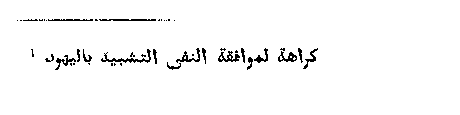
different customs. Later Arabians confess that he made
charges1 from the
page 158
necessity of abolishing resemblances to the Jews."1
Thus, Muhammad asserts that the Jews are the enemies of the
Muslims,2 that they slew
prophets,3 a probable
reference to Jesus; further, that they in common with Christians
thought themselves specially favoured by God,4
that they believed that they alone should possess Paradise,5
that they held Ezra to be the son of God,6
that they trusted in the intercession of their self-pious
predecessors,7 that they
had perverted the Bible8
because in its existing form that Book contained no allusions to him,
and that the Jews built temples on the graves of the
prophets.9 Such accusations
and the reasons given earlier supplied Muhammad with grounds on
which to justify his departure from Jewish laws.
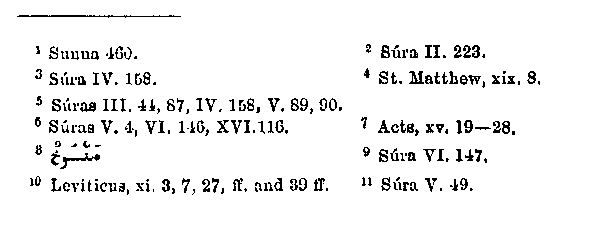
A. Prayer. - Supper precedes prayer.10
This is in direct opposition to the Talmud, which lays down exactly
how long before prayer one may eat that the hour of prayer may not
be let slip. Truly in this Muhammad wished to live so as to please
his Arabs.
B. Laws about women - Muhammad says:11
It is lawful for you on the night of the fast to go in unto your wives."
This is clearly prescribed in opposition to the directly contrary ruling
in the Talmudic Law prohibiting cohabitation on the night before the fast
day in Abh, that being counted as part of the fast day itself.
The laws of divorce12 are probably
identical with those of the ancient Arabs. There is a remarkable passage
in the Quran,13 which says that
the man after he has put away his wife for the second time cannot marry
her again until she has married another man, and been divorced by him, too.
This is directly contrary to the teaching of the Bible.14

page 159
The Muslims assert1 that the Jews
of that period laid down that cohabitation was to take place in the usual
way. On this Muhammad to please himself and his Arabs
says:2 "Your wives are your
tillage, go in therefore unto your tillage in what manner soever ye will," etc.
C. The most important and prominent change to be considered in this connection
is the removal of the prohibition about food, concerning which Muhammad
asserts that it "as imposed upon the Jews only on account of their
iniquity.3 (It is interesting
that Jesus states just the converse when he speaks of the abolition of
divorce.4) Muhammad abolishes
the law about meat in several passages,5,
but holds to part of it in others,6
following it would seem the precedent of the apostles, to whom almost the same
utterance is attributed in the New Testament.7
Thus he forbids carrion, blood, swine's flesh, and that which had been
slain for an idol; to which he adds in the first passage, that which is
not properly killed, viz., that slain by strangling, or by a blow from
an axe, that killed by a fall from a mountain, that is gored, and that
torn by wild beasts. These last rules, considering the total silence
about them in other later passages, may be regarded as
"abolished."8 In another
passage9 Muhammad mentions
particular meats which were forbidden to the Jews.10
D. Lastly, the following utterance11
of Muhammad is decidedly combative: "We have therein commanded them that they
should give life for life, and eye for eye, and nose for nose and ear for ear;
and tooth for tooth; and that wounds should also be punished by retaliation
but whoever should remit it as alms it should be accepted as an atonement
for him. And whoso
page 160
judgeth not according to what God hath revealed they are unjust?"
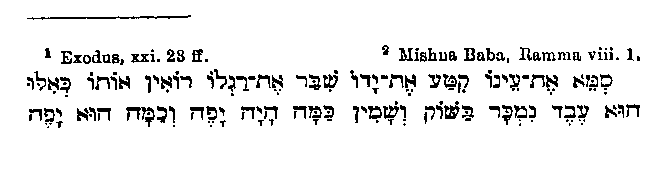
The passage of Scripture which Muhammad here has in mind is in
Exodus;1 and those who do not
observe it are the Jews, in that they extend to all cases the permission
to make atonement with money, which is given only when the injured party
agrees to it. The Mishna2 runs
as follows: "If a man has blinded another, or cut off his hand, or broken
his foot, one must regard the injured person as though he were a slave
sold in the market, and put a price upon him and reckon how much he was
worth before the injury and how much now, etc."
These are about all the chief points showing a consideration of Judaism,
and the collecting of them gives us another proof that Muhammad had
a personal knowledge of Judaism through acquaintance with the Jewish
manner of life and through intercourse with the Jews.
If we now once more consider this treatise as a whole, we shall find
that by the establishment of the fact which was to be demonstrated, viz.,
that Muhammad borrowed from Judaism, we come to a clear understanding of
the Quran in general as well as of individual passages in it. Furthermore,
the state of culture of the Arabians of that day, and especially of the
Arabian Jews, is to some extent made clear, and light is thrown upon the
plan of Muhammad and upon his intellectual power and knowledge by many
authentic documents. Then in collecting the passages which serve as
proofs we are compelled to dismiss at once the ill-considered confidence
with which people are apt to speak of each legend as a dream of the
rabbinical Talmudists; for although the author neither can nor will
maintain that no passage bearing on his thesis has escaped him in the
Rabbinical literature, still this must be accepted as a fact until it
can be proved that this
page 161
or that has been omitted, and thus for the present we must attribute
to some other source everything of which the Jewish origin has not
been proved. By this, however, I do not intend to say that everything
which, according to our ideas, is mythical and for which a Jewish
source appears to be forthcoming, may be laid upon Judaism; for, on
the one hand, the opinion or legend may originally have had a different
signification and it may have reached its present extravagant development
in the mouth of the people, and, on the other hand, the source itself
may have had no obligatory importance, and therefore does not hold the
same place with regard to Judaism as the Quran holds with regard to
Islam. We must distinguish between Judaism and views derived from the
Jews; this distinction, however is unfortunately either from ill-will
or ignorance often not made.
And now I submit this treatise to you, honoured readers, and your
judgment will convince me of the correctness or falsity of my opinions,
and as to whether my work fulfils its end or has failed in its purpose.
JUDAISM AND ISLAM [Table of Contents]
Answering Islam Home Page