返回总目录
Dictionary of Islam : Letter A
page 1
DICTIONARY OF ISLAM.
A
AARON Arabic Harun  .
.
The account given of Aaron in the Qur'an will
be found in the article on Moses. In Surah
xix. 29, the Virgin Mary is addressed as "the
Sister of Aaron." [Mary, Moses.]
ABAD  .
.
Eternity; without end, as distinguished from Azal
 without beginning.
ABASA  .
.
"He frowned." The title of the lxxxth chapter of the Qur'an.
It is said that a blind man, named Abdu'llah ibn Umm Maktum,
once interrupted Muhammad in conversation with certain chiefs
of Quraish. The Prophet, however, took no notice of him,
but frowned and turned away; and in the first verse of this
Surah, he is represented as reproved by God for having done so
- "He frowned and turned his back, for that the blind man came
unto him."
ABBAS  .
.
The son of 'Abdu l-Muttalib, and consequently the paternal
uncle of Muhammad. The, most celebrated of the "Companions,"
and the founder of the Abbaside dynasty, which held the
Khalifate for a period of 509 years, namely, from A.D. 749
to 1258. He died in A.H. 82. His son Ibn-'Abbas was also
a celebrated authority on Islamic traditions and law.
[IBN ABBAS, ABBASIDES]
ABBASIDES Arabic al Abbasiyah

The name of a dynasty of
Kalifahs descended from al-'Abbas, the son
of 'Abdu 'l-Muttalib, and a paternal uncle of
Muhammad. On account of their descent
from so near a relation of the Prophet, - the
Abbasides had, ever since the introduction of
Islam, been very high in esteem amongst the
Arabs, and had at an early period begun to
excite the jealousy of the Umaiyade Khalifahs,
who after the defeat of 'Ali occupied the
throne of the Arabian Empire, The Abbasides
had for some time asserted their claims
to the Khalifate, and in A.D. 746 they commenced
open hostilities. In 749 the Abbaside
Khalifah Abu 'l-'Abbas, surnamed as-Saffah,
"the blood-shedder," was recognized as Khalifah
at al-Kalifah, and Marwin II., the last of
the Umaiyade Khalifahs, was defeated and
slain.
Thirty-seven Khalifahs of the Abbaside dynasty
reigned over the Muhammadan empire,
extending over the period from A.H. 132 (A.D.
749-50) to A.H. 656 (A.D. 1258).
The names of the Abbaside Khalifahs are:--
Adu 'l-Abbas as-Saffah (A.D. 749), al-Mansur
(A.D.754), al-Mahdi (A.D. 775), al-Hadi (A.D.
785), Harun ar-Rashid (A.D. 786), al-Amin
(A.D. 809), al-Mamun (A.D.. 815), al-Mu'tasm
(A.D. 883), al-Wasiq (A.D. 842), al-Mutawakkil
(A.D. 847), al-Mutasir (A.D.861), al-Musta'in
(A.D. 862), al-Mu'taaz (A.D. 866), al-Mabtadi
(A.D. 869), al-Mu'tamid (A.D. 870), al-Mu'tazid
(A.D. 892) al-Muktafi (A.D. 902), al-Muqtadir,
(A.D. 908), al-Qahir (A.D. 932), ar-Razi (A.D.
934), al-Muttaqi (A.D. 940), al-Mustaqfi (A.D.
944), al-Muti' (A.D. 945), at-Tai (A.D.974).
al-Qadir (A.D.. 994), al-Qaim (A.D. 1081), al
Muqtadi (A.D. 1075), al-Mustazhir (A.D. 1094).
al-Mustarshid (A.D. 1118), ar-Rishid (A.D.
1135), al-Muqtafi (A.D. 1136), al-Mustanjid
(A.D. 1160), al-Mustazi, (A.D. 1170), an-Nasir
(A.D. 1180), az-Zahir (A.D. 1225), al-Mustanair
(A.D. 1226), al-Musta'sim (A.D. 1242 to A.D.
1258).
In the reign of al-Musta'sim Hulaku, grandson
of Jingiz Khan, entered Persia and
became Sultan A.D. 1266. In 1258 he took
Baghdad and put the Kahlifah al Musta'sim to
death. [KHALIFAH]
ABDAL  .
.
"Substitutes, pl. of Badal. Certain persons by whom,
it is said, God continues the world in existence. Their
number is seventy, of whom forty reside in Syria, and thirty
elsewhere. When one dies another takes his place, being so
page 2
appointed by God. It is one of the signs of
the last day that the Abdal will come from
Syria. (Mishkat xxiii c. 3.) No one pretends
to be able to identify these eminent
persons in the world. God alone knows who
they are and where they are.
'ABDU 'LLAH  . The father
of Muhammad. He was the youngest son of
'Abdul'l-Mattalib. During the pregnancy of
his wife Aminah, he set out on a mercantile
expedition to Gaza in the south of Palestine,
and on his way back he sickened and died at
al-Madinah, before the birth of his son Muhammad
(Katibu'l-Wackidi, p. 18; Muir's
Life of Mahomet, vol. i. p. 11.)
. The father
of Muhammad. He was the youngest son of
'Abdul'l-Mattalib. During the pregnancy of
his wife Aminah, he set out on a mercantile
expedition to Gaza in the south of Palestine,
and on his way back he sickened and died at
al-Madinah, before the birth of his son Muhammad
(Katibu'l-Wackidi, p. 18; Muir's
Life of Mahomet, vol. i. p. 11.)
'ABDU 'LLAH IBN SA'D 
 .
.
One of Muhammad's secretaries. It is related that, when Muhammad
instructed 'Abdu 'llah to write down the
words (Surah xxiii. 12-l4), "We (God) have
created man from an extract of clay
then we produced it another creation;'
'Abdu 'llah exclaimed, "And blessed be God,
the best of creators"; and Muhammad told
him to write that down also. Whereupon
'Abdu 'llah boasted that he had been inspired
with a sentence which the Prophet had acknowledged
to be part of the Qur'an. It is of him that it
is written in the Qur'an, Surah vi. 93,
"Who is more unjust than he who devises
against God a lie, or says - 'I am inspired,'
when he is not inspired at all."
'ABDU'L-MUTTALIB  .
.
Muhammad's grandfather and his guardian
for two years. He died, aged 82, A.D. 578.
His sons were 'Abdu 'llah (Muhammad's
father), al-Haris az-Zuhair, Abu Talib, Abu
Labab, al-'Abbas, and Hamza.
'ABDU 'L-QADIR AL-JILANI .
.
The celebrated
founder of the Qadiriyah order of darweshes,
surnamed Pir-Dastagir. He died and was
buried at Baghdad, AH. 561.
'ABDU 'R-RAHMAN IBN'AUF .
.
One of the Companions who embraced Islam at a very early
period, and was one of those who fled to
Ethiopia. He also accompanied Muhammad
in all his battles, and received twenty wounds
at Uhud. He died A.H. 32, aged 72 or 75,
and was buried at Baqi'u 'l-Gharqad the
graveyard of al-Madinah.
ABEL. Arabic Habil  .
.
Heb.  In the Qur'an "the two
sons of Adam" are called Habil wa Qabil,
and the following is the account given of
them in that book (Surah V.30-35), together
with the remarks of the commentators in
italics (as rendered in Mr. Lane's Selections,
2nd ed., p. 53), "Recite unto them the history
of the two sons of Adam, namely, Abel
and Cain, with truth. When they offered
[their] offering to God (Abel's being a ram, and
Cain's being produce of the earth), and it was
accepted from one of them (that is, from Abel;
for fire descended from heaven, and devoured
his offering), and it was not accepted from the
other, Cain was enraged; but he concealed his
envy until Adam performed a pilgrimage, when
he said unto his brother, I will assuredly slay
thee. Abel said, Wherefore? Cain answered,
Because of the acceptance of thine offering to
the exclusion of mine. Abel replied, God only
accepteth from the pious. If thou stretch
forth to me thy hand to slay me, I will not
stretch forth to thee my hand to slay thee;
for I fear God, the Lord of the worlds. I
desire that thou shouldst bear the sin [which
thou intendest to commit] against me, by
slaying me, and thy sin which thou hast committed
before, and thou wilt be of the companions
of the fire. - And that is the recompense
of the offenders.- But his soul suffered him to
slay his brother go he slew him; and he
became of [the number of] those who suffer
loss. And he knew not what to do with him;
for he was the first dead person upon the face of
the earth of the sons of Adam. So he carried
him upon his back. And God sent a raven,
which scratched up the earth with its bill
and its talons and raised it over a dead raven
that was with it until it hid it, to show him
how he should hide the corpse of his brother
He said, O my disgrace! Am I unable to be
like this raven, and to hide the corpse of my
brother?-And he became of [the number
of] the repentant. And he digged [a grave]
for him and hid him.- 0n account of this
which Cain did We commanded the children
of Israel that he who should slay a soul (not
for the latter's having slain a soul or committed
wickedness in the earth, such as infidelity or
adultery, or intercepting the way, and the like.)
[should be regarded] as though he had slain
all mankind; and he who saveth it alive, by
abstaining from slaying it, as though he had
saved alive all mankind."
In the Qur'an "the two
sons of Adam" are called Habil wa Qabil,
and the following is the account given of
them in that book (Surah V.30-35), together
with the remarks of the commentators in
italics (as rendered in Mr. Lane's Selections,
2nd ed., p. 53), "Recite unto them the history
of the two sons of Adam, namely, Abel
and Cain, with truth. When they offered
[their] offering to God (Abel's being a ram, and
Cain's being produce of the earth), and it was
accepted from one of them (that is, from Abel;
for fire descended from heaven, and devoured
his offering), and it was not accepted from the
other, Cain was enraged; but he concealed his
envy until Adam performed a pilgrimage, when
he said unto his brother, I will assuredly slay
thee. Abel said, Wherefore? Cain answered,
Because of the acceptance of thine offering to
the exclusion of mine. Abel replied, God only
accepteth from the pious. If thou stretch
forth to me thy hand to slay me, I will not
stretch forth to thee my hand to slay thee;
for I fear God, the Lord of the worlds. I
desire that thou shouldst bear the sin [which
thou intendest to commit] against me, by
slaying me, and thy sin which thou hast committed
before, and thou wilt be of the companions
of the fire. - And that is the recompense
of the offenders.- But his soul suffered him to
slay his brother go he slew him; and he
became of [the number of] those who suffer
loss. And he knew not what to do with him;
for he was the first dead person upon the face of
the earth of the sons of Adam. So he carried
him upon his back. And God sent a raven,
which scratched up the earth with its bill
and its talons and raised it over a dead raven
that was with it until it hid it, to show him
how he should hide the corpse of his brother
He said, O my disgrace! Am I unable to be
like this raven, and to hide the corpse of my
brother?-And he became of [the number
of] the repentant. And he digged [a grave]
for him and hid him.- 0n account of this
which Cain did We commanded the children
of Israel that he who should slay a soul (not
for the latter's having slain a soul or committed
wickedness in the earth, such as infidelity or
adultery, or intercepting the way, and the like.)
[should be regarded] as though he had slain
all mankind; and he who saveth it alive, by
abstaining from slaying it, as though he had
saved alive all mankind."
"The occasion of their making this offering
is thus related, according to the common
tradition in the East. Each of them being
born with a twin-sister, when they were
grown up, Adam, by God's direction, ordered
Cain to marry Abel's twin-sister, and Abel to
marry Cain's; (for it being the common
opinion that marriages ought not to be had
in the nearest degrees of consanguinity, since
they must necessarily marry their sisters, it
seemed reasonable to suppose they ought to
take those of the remoter degree;) but this
Cain refusing to agree to, because his own
sister was the handsomest, Adam ordered
them to make their offerings to God, thereby
referring the dispute to His determination.
The commentators say Cain's offering was a
sheaf of the very worst of his corn, but
Abel's a fat lamb of the best of his flock."-
Sale's Koran, 1., p. 122.
'ABID  .
.
"A worshipper [of God]." A term generally used
for a devout person. The word frequently occurs
in the Qur'an: e.g. Surah ii. 132: "The
baptism (sibghah) of God! And who is better
than God at baptizing? We are the worshippers
('abidun) of God" The word sibghah
is translated
page 3
by Professor Palmer "dye" and "dyeing",
but Sale, following the Muslim commentators,
al-Baizawi, Jalalu'd-din, aud Husaini, who
say it refers to tho Christian rite, translates it
"baptism." Others say that it means fitrah
or din, the religion of God, with an adaptation
to which mankind are created. See Lane's Lexicon.
[BAPTISM.]
ABIQ  .
.
A runaway slave.
[ABSCONDING OF SLAVES.]
ABJAD  .
.
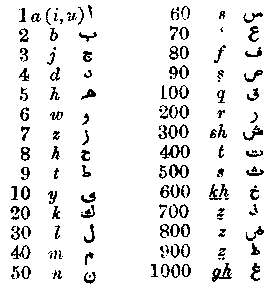
The name of an
arithmetical arrangement of the alphabet, the
letters of which have different powers from
one to one thousand. It is in the order of
the alphabet as used by the Jews as far as
400, the six remaining letters being added
by the Arabians. The letters spell the
words-
abjad hawwaz hutti kalaman
sa'fas qarashut sakhaz zazigh
The author of the Arabic Lexicon, al-Qamus,
says that the first six words are the names
of celebrated kings of Madyan (Midian), and
that the last two words were added by the
Arabians. Some say they are the names of
the eight sons of the inventor of the Arabic
character, Muramir ibn Murra.
The following is a list of the letters with
their English equivalents, and the power of
each in numbers:-
[EXORCISM.]
ABLUTION. Arabic, wazu, wuzu, 
Persian,  .
.
Ablution is described by Muhammad as "the half of
faith and the key of prayer" (Mishcat, iii. 3c),
and is founded on the authority of tho Qur'an,
surah v. 8, "O Believers! when ye prepare
yourselves for prayer, wash your faces and
hands up to the elbows, and wipe your heads
and your feet to the ankles."
These ablutions are absolutely necessary as
a preparation for the recital of the liturgical
form of prayer, and are performed as follows:
The worshipper, having tucked up his sleeves
a little higher than his elbows, washes his
hands three times; then he rinses his mouth
three times, throwing the water into it with
his right hand. After this, he, with his right
hand, throws water up his nostrils, snuffing
it up at the same time, and then blows it out,
compressing his nostrils with the thumb and
finger of the left hand--this being also performed
three times. He then washes his
face three times, throwing up the water with
both hands. He next washes his right hand
and arm, as high as the elbow, as many times,
causing the water to run along his arm from
the palm of the hand to the elbow, and in
the same manner he washes the left. Then
he draws his wetted right hand over the
upper part of his head, raising his turban
or cap with his left. If he has a beard, he
then combs it with the wetted fingers of his
right hand, holding his hand with the palm
forwards, and passing the fingers through his
beard from the throat upwards. He then
puts the tips of his fore-fingers into his ears
and twists them round, passing his thumbs at
the same time round the back of the ears
from the bottom upwards. Next, he wipes
his neck with the back of the fingers of both
hands, making the ends of his fingers meet
behind his neck, and then drawing them forward.
Lastly, he washes his feet, an high as
the ankles, and passes his fingers between the
toes. During this ceremony, which is generally
performed in less than three minutes,
the intending worshipper usually recites some
pious ejaculations or prayers. For example :-
Before commencing the wazu' :- "I am
going to purify myself from all bodily uncleanness,
preparatory to commencing prayer,
that holy act of duty, which will draw my
soul near to the throne of the Most High.
In the name of God, the Great and Mighty.
Praise be to God who has given us grace to
be Muslims. Islam is a truth and infidelity
a falsehood."
When washing the nostrils :- "O my God, if
I am pleasing in Thy sight, perfume me with
the odours of Paradise."
When washing the right hand :- "O my
God, on the day of judgment, place the book
of my actions in my right hand, and examine
my account with favour."
When washing the left hand :- "O my God,
place not at the resurrection the book of my
actions in my left hand."
The Shiya' is, acting more in accordance
with the text of the Qur'an quoted above,
only wipe, or rub (masah) the feet, instead of
washing them, as do the Sunnis.
The ablution need not be performed before
each of the five stated periods of prayer,
when the person is conscious of having
avoided every kind of impurity since the last
performance of the ablution. The private
parts of the body must also be purified when
necessary. When water cannot be procured,
or would be injurious to health, the ablution
may be performed with dust or sand. This
ceremony is called Tayammum (q.v.). The
washing of the whole body is necessary after
certain periods of impurity. [GHUSL.] The
brushing of the teeth is also a religious duty.
[MLSWAK.] The benefits of ablution are
highly extolled in the sayings of Muhammad.
e.g., "He who performs the wazu'
thoroughly will extract all sin from his body,
even though it may be lurking under his finger
nails." "In
page 4
the day of resurrection people shall come
with bright faces, hands and feet and there
will be jewels in every place where the waters
of the wazu' have reached. (Mishkat, iii. 1)

In all the principal mosques there are
tanks, or wells, which supply water for the
purpose of legal purification. [PURIFICATION.]
ABORTION. Arabic Isqat There
is no mention of the subject in the Qur'an,
but according to the Fatawi 'Alamgiri,
(vol. iv. P. 238), it is forbidden after the
child is formed in the womb. Muhammad is related
to have ordered prayers to be said over an
abortion, when supplication should be made
for the father and mother, for forgiveness and
mercy (Mishkat, v. c. 2.)
ABRAHAM. Arabic Ibrahim 
One of the six great prophets to whom God delivered special laws.
The "Friend of God;' Khalilu'illah, to whom
were revealed twenty portions (sahifah) of
Scripture.
Abraham is very frequently mentioned in
the Qur'an, together with Ishmael and Isaac.
The following are - Mr. Lane's selections (giving
in italics the remarks of Muslim commentators) -
"Remember when Abraham said to his
father Azar (This was the surname of Terah),
Dost thouu take images as deities? Verily I
see thee and thy people to be in a manifest
error. - (And thus, as We showed him the error
of his father and his people, did We shew
Abraham the kingdom of the heaven and the
earth, and [We did so] that he might be of [the
number of] those who firmly believe.) And
when the night overshadowed him, he saw a
star (it is said that it was Venus), [and] he said
unto his people who were astrologers, This is
my Lord, according to your assertion. - But
when it set, he said, I like not those that set.
to take them as Lords, since it is not meet for a
Lord to experience alteration and change of
place, as they are of the nature of accidents.
Yet this had no effect upon them. And when
he saw the moon rising, he said unto them,
This is my Lord.---But when it set, he said
Verily it my Lord direct me not (if he confirm
me not in the right way), I shall
be of the string people --- This was a hint to
his people that they were in error; but it had no
effect upon them". And when he saw the sun
rising, he said. This is my Lord. This is
greater than the star and Moon -- But when
it set, and the proof, had been rendered more
strong to them, yet they desisted not, he said O
my people, verily I am clear of the (things)
which ye associate with God;
namely the
images and the heavenly bodies. So they said
unto him, What dost thou worship? He
answered, Verily I direct my face unto Him
who hath created the heavens and the earth
following the right religion, and I am not of
the polytheists. - And his people argued with
him [but] he said, Do ye argue with me
respecting God, when He hath directed me,
and I fear not what ye associate with Him
unless my Lord will that aught displeasing
should befall me? My Lord comprehendeth
everything by His knowledge. Will ye not
therefore consider? And wherefore should
I fear what ye bare associated with God
when ye fear not for your having associated
with God that of which He hath not sent
down unto you a proof? Then which of the
two parties is the more worthy of safety;
Are we, or you? If ye know who is more
worthy of it, follow him. - God saith, They
who have believed, and not mixed their belief
with injustice (that is, polytheism), for these
shall be safety from punishment; and they are
rightly directed." (Surah vi. 74-82.)
"Relate unto them, in the book (that is, the
Qur'an). the history of Abraham. Verily, he
was a person of great veracity, a prophet.
When he said unto his father Azar, who worshipped
idols, O my father, wherfore dost
thou worship that which heareth not, nor
seeth, nor averteth from thee aught,whether
of advantage or of injury? O my father;
verily [a degree] of knowledge hath come
unto me, that hath not came unto thee
therefore follow me: [I will direct thee
into a right way. O my father, serve not the devil,
page 5
by obeying him in serving idols; for the devil
is very rebellious unto the Compassionate. O
my father, verily I fear that a punishment will
betide thee from the Compassionate, if thou
repent not, and that thou wilt be unto the
devil an aider, and a companion in hell-fire.-
He replied, Art thou a rejector of my Gods,
O Abraham, and dost thou revile them? If
thou abstain not, I will assuredly assail thee
with stones or with ill words; therefore
beware of me, and leave me for a long time. -
Abraham said, Peace from me be on thee! I will
ask pardon for thee of my Lord; for He
is gracious unto me: and I will separate
myself from you and from what ye invoke,
instead of God; and I will call upon my
Lord: perhaps I shall not be unsuccessful in
calling upon my Lord , as ye are in calling
upon idols, and when he had separated himself
from them, and from what they worshipped
instead of God, by going to the Holy
Land, We gave him two icons, that be might
cheer himself thereby, namely, Isaac and Jacob;
and each [of them] We made a prophet; and
We bestowed upon them (namely, the three).
of our mercy, wealth and children; and We
caused them to receive high commendation."
(Surah xix. 42-51.)
"We gave unto Abraham his direction formerly,
before he had attained to manhood; and
We know him to be worthy of it. When he
said unto his father and his people, What are
these images; to - the worship of which
ye are devoted? - they answered, We found our
fathers worshipping them and we have followed
their example. He said unto them.
Verily ye and your fathers have been in a
manifest error. They said, Hast, thou come
unto us with truth in saying this, or art thou
of those who jest? He answered, Nay, your
Lord (the being who deserved to be worshipped)
is the Lord of the heavens and the earth,
who created them, not after the similitude of
anything pre-existing; and I am of those who
bear witness thereof. And, by God, I will
assuredly devise a plot against your idols
after ye shall have retired, turning your
backs. - So, after they had gone to their place
of assembly, on a day when they held a festival,
he break them in pieces with an axe except
the chief of them , upon whose neck he hung the
axe; that they might return unto it (namely
the thief) and see what 'he had done with the
others. They said, after they had returned
and what he had done, Who hath done
this unto our gods? Verily he is of the
unjust - And some of them said, We heard a
young man mention them reproachfully: he
is called Abraham. They said, Then bring
him before the eyes of the people, that they
may bear witness against him of his having
done it. They said unto him, when he had
been brought, Hast thou done this unto our
gods, O Abraham? He answered, Nay, this
their chief did it and ask ye theme if they
[can) speak find they returned unto themselves,
upon reflection, and said unto themselves,
Verily, ye are the unjust, in worshipping
that which speaketh not. Then they reverted
to their obstinacy and said, Verily
thou knowest that these speak not: then
wherefore dost thou order us to ask them? He
said, Do ye then worship, instead of God,
that which doth not profit you at all, nor
injure you if ye worship it not? Fire on you,
and on that which ye worship instead of God!
Do ye not then understand? - They said,
Burn ye him, and avenge your gods, if ye
will do so. So they collected abundance of firewood
for him, and set fire to it; and they bound
Abraham, and put him into an engine, and cast
him into the fire. But, saith God, We said, O
fire, be thou cold, and a security unto Abraham!
So nought of him was burned save his
bonds: the heat of the fire ceased, but its
light remained and by God's saying, Security, -
Abraham was saved from dying by reason of
its cold. And they intended against him a
plot; but he caused them to be the sufferers.
And we delivered him and Lot, the son of his
brother Haran, from El-'Eraq, [bringing
them] unto the land which We blessed for the
peoples, by the abundance of its river: and
trees, namely, Syria. Abraham took up his abode
in Palestine, and Lot in Et-Mutefikeh, between
which is a day's journey. And when
Abraham had asked a son, We gave unto him
Isaac, and Jacob as an additional gift, beyond
what he had asked, being a son's son; and
all of them We made righteous persons and
prophets. And We made them models of religious
who directed men by Our command unto
Our religion and We commanded them by
inspiration to do good works and to perform
prayer and to give the appointed alms; and
they served Us. And unto Lot We gave
judgment and knowledge; and We delivered
him from the city which committed filthy
actions; for they were a people of evil,
shameful doers; and We admitted him into
our mercy; for he wan [one] of the righteous."
(Surah xxi. 52-75.)
"Hast thou not considered him who disputed
with Abraham concerning his Lord, because
God had, given him the kingdom? And he
was Nimrod. When Abraham said, (upon his
saying unto him, Who is thy Lord, unto whom
thou invitest us?), My Lord is He who giveth
life and causeth to die, - he replied, I give
life and cause to die - And he summoned two
men, ,and slew one of them, and left the other.
So when he saw that he understood not, Abraham
said, And verily God bringeth the sun
from the east: now do thou bring it from the
west. -- And he who disbelieved was confounded;
and God directeth not the offending people."
(Surah ii. 260).
"And Our messengers came formerly unto
Abraham with good tidings of Isaac and
Jacob, who should be after him. They said
Peace. He replied, Peace be unto you. And he
tarried not, but brought a roasted calf. And
when he saw that their hands touched it not,
he disliked them and conceived a fear of
them. They said, Fear not: for we are sent
unto the people of Lot, that we may destroy
them. And his wife Sarah was standing
serving them, and she laughed, rejoicing at the
tidings of their destruction. And we gave her
good tidings of Isaac; and after, Isaac , Jacob
page 6
She said, Alas! shall I bear a child when I
am an old woman of nine and ninety years,
and when this my husband is an old man of
a hundred or a hundred and twenty years?
Verity this [would be] a wonderful thing.-
They said Dost thou wonder at the command
of God? The mercy of God and His
blessings be on you, O people of the house (of
Abraham)! for He is praiseworthy, glorious.
-And when the terror bad departed from
Abraham, and the good tidings had come
unto him, he disputed with Us (that is, with
Our messengers) respecting the people of
Lot; for Abraham was gentle, compassionate,
repentant. And he said unto them, Will ye
destroy a city wherein are three hundred believers?
They answered, No. He said, And
till ye destroy a city wherein are two
hundred believers? They answered. No. He
said, And will ye destroy a city wherein are
forty believers? They answered, No. He said,
And will ye destroy a city wherein are fourteen
believers? They answered, No. He said, And
tell me, if there be in it one believer? They
answered, No. He said, Verily in it is Lot.
They replied, We know best who is in it. And
when their dispute had become tedious, they
said, O Abraham, abstain from this disputation;
for the command of thy Lord hath come
for their destruction, and a punishment not [to
be] averted is coming upon them." (Surah xi.
72-78.)
"And when Our decree for the destruction of
the people of Lot came [to be executed], We
turned their (that is, their cities) upside-
down; for Gabriel raised them to heaven, and
let them fall upside-down to the earth; and
We rained upon them stones of baked clay,
sent one after another, marked with thy Lord.
each with the name of him upon whom it should
be cast: and they [are] not far distant from
the offenders; that is, the stones are nor, or the
cities of the people of Lot were not, far distant
from the people of Mekkeh." (Surah xi. 84.)
"And [Abraham] said [after his escape
from Nimrod], Verily I am going unto my
Lord, who will direct me unto the place
whither He hath commanded me to go, namely,
Syria. And when he had arrived at the Holy
Land, he said, O my Lord, give me a son
[who shall be one] of the righteous. Where-
upon We gave him the glad tidings of a mild
youth. And when be bad attained to the
ago when he could work with him (as some
say, seven years; and some, thirteen), he said,
O my child, verily I have seen in a dream that
I should sacrifice thee (and the dreams of prophets
are true; and their actions, by the command
of God); therefore consider what thou
seest advisable for me to do. He replied, O
my father, do what thou art commanded:
thou shalt find me, if God please, [of the
number] of the patient. And when they had
resigned themselves, and he had laid him
down on his temple, in [the valley of] Mina,
and had drawn the knife across his throat (but
it produced no effect, by reason of an obstacle
interposed by the divine power), We called unto
him, O Abraham, thou hast verified the
vision. Verily thus do We reward the well-doers.
Verily this was the manifest trial.
And We ransomed him whom he had been
commanded to sacrifice (and he was Ishmael or
Isaac; for there are two opinions) with an
excellent victim, a ram from Paradise, the
same that Abel had offered: Gabriel (on whom
be peace!) brought it, and the lord Abraham
sacrificed it, saying, God is most great! And
We left this salutation [to be bestowed] on
him by the latter generations, Peace [be] O
Abraham! Thus do We reward the well
doers: for be was of Our believing servants
(Surah xxxvii. 97-111.)
"Remember when Abraham said, O my Lord
show me how Thou will raise to life the
dead. He said, Hast thou not believed? He
answered, Yea: but I have asked Thee that
my heart may be at ease. He replied, Then
take four birds and draw them towards thee
and cut them in pieces and mingle together their
flesh and their feathers; then place upon each
mountain of thy land a portion of them, then
call them unto them: they shall come unto
thee quickly; and know thou that God is
mighty [and] wise. - And he took a peacock
and a vulture and a raven and a rock, and did
with them as hath been described, and kept their
heads with him, and called them ; whereupon
the portions flew about, one to another until
they became complete: then they came to their
heads." (Surah ii. 262.)
"Remember, when his Lord had tried Abraham
by [certain] words, commands and prohibitions,
and he fulfilled them, God said unto
him, I constitute thee a model of religion unto
men. He replied, And of my offspring constitute
models of religion. [God] said, My
covenant doth not apply to the offenders, the
unbelievers among them. - And when We appointed
the house (that is, the Ka'bah) to be
a place for the resort of men, and a place a
security (a man who would meet the slayer of his
father there and he would not provoke him [to
revenge]) and [said], Take, O men, the station
of Abraham (the stone upon which he stood
at the time of building the House) as a
place of prayer. that ye may perform behind it
the prayers of the two rak'ahs [which are ordained
to be performed after the ceremony]
of the circuiting [of the Ka'bah]. -- And We
commanded Abraham and Ishmael, [saying],
Purify my House (rid it of the idols) for those
who shall compass [it], and those who
shall abide there, and those who shall bow down
and prostrate themselves. - And when Abraham
said, O my Lord, make this place a
secure territory (and God hath answered his
prayer, and made it a sacred place, wherein the
blood of man is not shed, nor is anyone oppressed
in it, nor is its game hunted [or shot],
nor are its plants cut or pulled up), and supply
its inhabitants with fruits (which hath been
done by the transporting of at-Taif from Syria
thither, when it [that is, the territory of
Makkah] was desert, without sown land or
water such of them as shall believe in God
and the last day. --- He mentioned them peculiarly
in the prayer agreeably with the saying of God,
My covenant doth not apply to the offenders.
- God replied, And I will supply
page 7
him who disbelieveth: I will make him to
enjoy a supply of-food in this world, a little
while: then I will force him, in the world to
come to the punishment of the fire; and evil
shall be the transit." (Surah ii, 118-120.)
"And remember when Abraham was raising
the foundations of the House (that is, building
it), together with Ishmael, and they said
O our Lord, accept of us our building; for
Thou art the Hearer of what is said, the
Knower of what is done. O our Lord, also
make us resigned unto Thee, and make from
among our offspring a people resigned unto
Thee, and show us our rites (the ordinances
of our worship, or our pilgrimage), and be
propitious towards us; for Thou art the Very
Propitious, the Merciful. (They begged Him
to be propitious to them, notwithstanding their
honesty, from a motive of humility, and by way
of instruction to their offspring.) O our Lord
also send unto them (that is, the people of the
House) an apostle from among them (and God
hath answered their prayer by sending Muhammad)
who shall recite unto thorn Thy signs
(the Qur'an), and shall teach them the book
(the Qur'an), and the knowledge that it containeth,
and shall purify them from polytheism;
for Thou art the Mighty, the Wise. -- And
who will be averse from the religion of
Abraham, but he who maketh his soul foolish,
who is ignorant that it is God's creation, and
that the worship of Him is incumbent On it; or
who lightly esteemeth it and applieth it to vile
purposes; when We have chosen him in this
world as an apostle and a friend, and be shall be
in the world to come one of the righteous for
whom are high ranks ? -- And remember when
his Lord said unto him, Resign thyself : - he
replied, I resign myself unto the Lord of the
worlds.--And Abraham commanded his children
to follow it (namely, the religion); and
Jacob, his children; saying, 0 my children,
verily God hath chosen for you the religion
of al-Islam: therefore die not without your
being Muslims. - It was a prohibition from
abandoning Islam and a command to persevere
therein unto death." (Surah ii. 121-126.)
When the Jews said, Abraham was a Jew,
and we are of his religion , and the Christians
said the like, [the following] was revealed : --
O people of the Scripture, wherefore do ye
argue respecting Abraham, asserting that he
was of your religion, when the Pentateuch - and
the Gospel were not sent down but after him
a long time? Do ye not then understand the
falsity of your saying? So ye, 0 people, have
argued respecting that of which ye have
knowledge, concerning Moses and Jesus, and
have asserted that ye are of their religion:
then wherefore do ye argue respecting that
of which ye have no knowledge, concerning
Abraham? But God knoweth his case, and
ye know it not. Abraham was not a Jew nor
a Christian; but he was orthodox, a Muslim
[or one resigned], a Unitarian, and he was
not of the polytheists." (Surah iii., 58-60.)
ABSCONDING OF SLAVES Arabic Ibaq  .
An absconded male or female slave is called
Abiq, but an
infant slave who leaves his home is termed
zall a word which is also used for an
adult slave who has strayed. The apprehension
of a fugitive slave is a laudable act, and the
person who seizes him should bring him before
the magistrate and receive a reward of
forty dirhams. (Hamilton's Hidayah, vol. ii.
p 278.)
.
An absconded male or female slave is called
Abiq, but an
infant slave who leaves his home is termed
zall a word which is also used for an
adult slave who has strayed. The apprehension
of a fugitive slave is a laudable act, and the
person who seizes him should bring him before
the magistrate and receive a reward of
forty dirhams. (Hamilton's Hidayah, vol. ii.
p 278.)
ABSTINENCE. Arabic Taqwa  Is very frequently enjoined in
the Qur'an. The word generally applies to
abstinence from idolatry in the first instance
but it is used to express a life of piety. An
excessive abstinence and a life of asceticism
are condemned in the Qur'an, and the Christians
are charged with the invention of the
monastic life. (Surah lvii. 27.) "As for the
monastic life, they invented it themselves."
[MONASTICISM, FASTING.]
Is very frequently enjoined in
the Qur'an. The word generally applies to
abstinence from idolatry in the first instance
but it is used to express a life of piety. An
excessive abstinence and a life of asceticism
are condemned in the Qur'an, and the Christians
are charged with the invention of the
monastic life. (Surah lvii. 27.) "As for the
monastic life, they invented it themselves."
[MONASTICISM, FASTING.]
ABU 'ABDI 'LLAH.  .
.
Muhammad ibn Isma'il al-Bukhari, the author
of the well-known collection of traditions received
by the Sunnis. [BUKHARI.]
ABU' ABDI 'LLAH AHMAD IBN HANBAL 
[HANBAL.]
ABU 'ABDI 'LLAH IBN ANAS  . [MALIK]
ABU 'ABDI 'LLAH MUHAMMAD IBN AL-HASAN


Known as Imam Muhummad. Born at Wasit, a city
in Arabian Iraq, A.H. 132. He studied under
the great Imam Abu Hanifah, and had also studied
under Imam Malik for three years. He is
celebrated as one of the disciples of the
Imam Abu Hanifah, from whom he occasionally
differs, as is seen in the Hidiyah. He
died at Rai, in Khurasan, where his tomb is
still to be seen, A.H. 189.
ABU BAKR  . Of the
origin of his name, there are various explanations.
Some think that it means "the father
of the maiden," and that he received this
title because he was the father of 'Ayishah,
whom Muhammad married when she was only nine years
old. His original name was 'Abd 'l-Ka'bah
(which the Prophet changed into 'Abdu 'llah)
Ibn Abi Quhafah. He was the first Khalifah, or
successor of Muhammad. [SHI'AH] Muhammadan writers
praise him for the purity of his life, and call him
as-Siddiq, the Veracious. He only reigned two
years, and died August 22nd, A.D. 634.
. Of the
origin of his name, there are various explanations.
Some think that it means "the father
of the maiden," and that he received this
title because he was the father of 'Ayishah,
whom Muhammad married when she was only nine years
old. His original name was 'Abd 'l-Ka'bah
(which the Prophet changed into 'Abdu 'llah)
Ibn Abi Quhafah. He was the first Khalifah, or
successor of Muhammad. [SHI'AH] Muhammadan writers
praise him for the purity of his life, and call him
as-Siddiq, the Veracious. He only reigned two
years, and died August 22nd, A.D. 634.
ABU DA'UD  . Sulaiman
Ibn al-Ash'as al-Sijistani; born at al-Basrah A.H. 202,
and died A.H. 275. The compiler of one of the six
correct books of the Sunni traditions, called Sunnan
Abi Da'ud, which contains 4,008 traditions, said to
have been carefully collated from 500,000. [TRADITIONS.]
. Sulaiman
Ibn al-Ash'as al-Sijistani; born at al-Basrah A.H. 202,
and died A.H. 275. The compiler of one of the six
correct books of the Sunni traditions, called Sunnan
Abi Da'ud, which contains 4,008 traditions, said to
have been carefully collated from 500,000. [TRADITIONS.]
ABU HANIFAH  .
.
Abu Hanifah an-Nu'man is the great Sunni Imam and
jurisconsult, and the founder of
page 8
the Hanifi sect. His father, Sibit, was a
silk dealer in the city of al-Kufah, and
it is said his grandfather, Zuta, was a native
of Kabul. He was born at al-Kafuh, A.H. 80
(A.D. 700), and died at Baghdad, A.H. 150.
He is regarded as the great oracle of Sunni
jurisprudence, and his doctrines, with those of
his disciples, the Imam Abu Yusuf and the Imam
Muhammad, are generally received throughout Turkey,
Tartary, and Hindustan. It is
related that Imam Malik said that the Imam
Abu Hanifah was such a logician that, if he
were to assert a wooden pillar was made of
gold, he would prove it by argument.
ABU HURAIRAH  . One
of the most constant attendants of Muhammad,
who from his peculiar intimacy has
related more traditions of the sayings and
doings of the Prophet than any other individual.
His real name is doubtful, but he
was nicknamed Aba Hurairah on account of
his fondness for a kitten. He embraced Islam
In the year of the expedition to Khaibar, A.H.
7, and died in al-Madinah, A.H. 57 or 59,
aged 78.
. One
of the most constant attendants of Muhammad,
who from his peculiar intimacy has
related more traditions of the sayings and
doings of the Prophet than any other individual.
His real name is doubtful, but he
was nicknamed Aba Hurairah on account of
his fondness for a kitten. He embraced Islam
In the year of the expedition to Khaibar, A.H.
7, and died in al-Madinah, A.H. 57 or 59,
aged 78.
ABU JAHL  . An implacable
adversary of Muhammad. His real name was 'Amr ibn
Hisham, but he was surnamed by the Muslims, Abu Jahl,
or the "Father of Folly." He is supposed to be
alluded to in the Qur'an, Surah xxii. 8: -
"There is a man who disputeth concerning
God without either knowledge or direction."
He was a boastful and debauched man, and
was killed in the battle of Badr.
. An implacable
adversary of Muhammad. His real name was 'Amr ibn
Hisham, but he was surnamed by the Muslims, Abu Jahl,
or the "Father of Folly." He is supposed to be
alluded to in the Qur'an, Surah xxii. 8: -
"There is a man who disputeth concerning
God without either knowledge or direction."
He was a boastful and debauched man, and
was killed in the battle of Badr.
ABU LAHAB  . One of
the sons of Abu Muttalib, and an uncle to
Muhammad. He was a most bitter enemy to
the Prophet, and opposed the establishment
of Islam to the utmost of his power. His
name was 'Abdu '1- Uzza, but he was surnamed
by Muhammad, Abu Lahab, "The Father of
the Flame." When Muhammad received the
command to admonish his relations, he called
them all together, and told them he was a
warner sent unto them before a grievous
chastisement. Abu Lahab rejected his mission,
and cried out, "Mayest thou perish!
Hast thou called its together for this?" and
took up a stone to cast at him; whereupon the
cxith Surah of the Qur'an was produced
. One of
the sons of Abu Muttalib, and an uncle to
Muhammad. He was a most bitter enemy to
the Prophet, and opposed the establishment
of Islam to the utmost of his power. His
name was 'Abdu '1- Uzza, but he was surnamed
by Muhammad, Abu Lahab, "The Father of
the Flame." When Muhammad received the
command to admonish his relations, he called
them all together, and told them he was a
warner sent unto them before a grievous
chastisement. Abu Lahab rejected his mission,
and cried out, "Mayest thou perish!
Hast thou called its together for this?" and
took up a stone to cast at him; whereupon the
cxith Surah of the Qur'an was produced
"Let the hands of Abu Lahab perish, and let himself perish!
His wealth and his gains shall avail him naught.
Burned shall he be at a fiery flame,
And his wife laden with fire wood,
On her neck a rope of palm fibre."
Abu Lahab is said to have died of grief and
vexation at the defeat which his friends had
received at the battle of Badr, surviving that
misfortune only seven days. His body was
left unburied for several days.
Zaid and Abu Lahab are the only relatives
or friends of Muhammad mentioned by name
in the Qur'an.
ABU 'L-HUZAIL ZUFAR IBN AL-HUZAIL  .
Celebrated as the Imam Zufar, and as a contemporary
and intimate friend of the great
Imam Abu Hanifah. He died at al-Basrah, A.H. 158.
.
Celebrated as the Imam Zufar, and as a contemporary
and intimate friend of the great
Imam Abu Hanifah. He died at al-Basrah, A.H. 158.
ABU 'L-QASIM  "The
father of Qasim." One of the names of Muhammad,
assumed on the birth of his born
Qasim, who died in infancy [MUHAMMAD.]
"The
father of Qasim." One of the names of Muhammad,
assumed on the birth of his born
Qasim, who died in infancy [MUHAMMAD.]
ABUSIVE LANGUAGE is forbidden
by the Muslim law, and the offender
must be punished according to the discretion
of the Qazi. Abu Hanifah says: "If a person
abuse a Musalman by calling him an ass or
a hog, punishment is not incurred, because
these expressions are in no respect defamatory
of the person to whom they are used,
it being evident that he is neither an ass
nor a hog. But some allege that in our
times chastisement is inflicted, since, in the
modern acceptation, calling a man an ass
or a hog is hold to be abuse. Others, again,
allege that it is esteemed only to be abuse
when the person of whom it is said occupies a
dignified position. According to Abu Hanifah,
the greatest number of stripes that can be
inflicted for abusive language is thirty-nine.
(Hamilton's Hidayah, vol. ii., 78.)
Muhammad is related to have said
"Abusing a Muslim is disobedience to God,
and it is infidelity for anyone to join such an
one in religious warfare." (Mishkat, xxii. 2.)
ABU TALIB  . Muhammad's
uncle and guardian; the father of
Ali. He is believed to have died as he had lived,
an unbeliever in the Prophet's mission;
for forty years he had been his faithful
friend and guardian. He died in the third
year before the Hijrah.
. Muhammad's
uncle and guardian; the father of
Ali. He is believed to have died as he had lived,
an unbeliever in the Prophet's mission;
for forty years he had been his faithful
friend and guardian. He died in the third
year before the Hijrah.
ABU 'UBAIDAH  IBN AL-JARRAH
One of the Companions, who was with the Prophet in all
his wars, and distinguished himself at the battle of Uhud.
He was highly esteemed by Muhammad, who made him one of
the 'Asharah al-Mubashsharah, or ten patriarchs of the
Muslim faith. He died A.H.18, aged 58.
IBN AL-JARRAH
One of the Companions, who was with the Prophet in all
his wars, and distinguished himself at the battle of Uhud.
He was highly esteemed by Muhammad, who made him one of
the 'Asharah al-Mubashsharah, or ten patriarchs of the
Muslim faith. He died A.H.18, aged 58.
ABU YUSUF  Known
also an Ya'qub ibn Ibrahim. Born at Baghdad, A.H. 113.
Studied under the Imam Abu
Hanifah, and is celebrated, together with the
Imam Muhammad and the Imam Zufar, as
disciples of the great Imam; from whose
opinions, however, the three disciples not
unfrequently differ as will be seen upon reference
to the Hidayah He died in A.H. 182.
Known
also an Ya'qub ibn Ibrahim. Born at Baghdad, A.H. 113.
Studied under the Imam Abu
Hanifah, and is celebrated, together with the
Imam Muhammad and the Imam Zufar, as
disciples of the great Imam; from whose
opinions, however, the three disciples not
unfrequently differ as will be seen upon reference
to the Hidayah He died in A.H. 182.
AD  . A tribe located to
the south of Arabia, to which the prophet Hud is
said to have been sent. See Qur'an, vii., 63:
. A tribe located to
the south of Arabia, to which the prophet Hud is
said to have been sent. See Qur'an, vii., 63:
"And to 'Ad we sent our brother Hud,
'O my people' said he, 'worship God: ye
have no other god than Him': Will ye not
then fear him?"
"Said the unbelieving chiefs among his
page 9
people; We certainly perceive that thou
art unsound of mind; and we surely deem thee
an impostor.'
"He said, 'O my people! It is not unsoundness of mind in me,
but I am an Apostle from the Lord of the Worlds.
"The messages of my Lord do I announce
to you, and I am your faithful counsellor.
Marvel ye that a warning hath come to
you from your Lord through one of yourselves
that He may warn you? Remember how he
hath made you the successors of the people
of Noah, and increased you in tallness of
stature. Remember then the favours, of God
that it may haply be well with you."
"They said, 'Art thou come to us in order
that we may worship one God alone, and
leave what our fathers worshipped? Then
bring that upon us with which thou threatenest
us, if thou be a man of truth."
"He said, 'Vengeance and wrath shall suddenly
light on you from your Lord. Do ye
dispute with We about names that you and
your fathers have given your idols, and for
which, God hath sent you down no warranty?
Wait ye then, and I too will wait with you."
"And we delivered him, and those who
were ,on his side by our mercy, and we cut
off, to the last man, those who had treated
our signs as lies, and who wore not believers."
Also, Surah lxxxix., 5 : "Hast thou not seen
how thy Lord dealt with 'Ad at Iram.
adorned with pillars, whose like have not
been reared in these lands" [HUD, IRAM.]
'ADA  . Payment; satisfaction
completing (prayers, &c.).
. Payment; satisfaction
completing (prayers, &c.).
ADAM. Arabic, Adam  . The
first man. Reckoned by Muslim writters as the
first prophet, to whom ten portions of scripture
(sahifah) are said to have been revealed.
He is distinguished by the title of Safiyu'llab,
or, the "chosen one of God." He is mentioned
in the Qur'an in in the following Surahs, which
are taken from Mr. Lane's Selections
(new edition, by Mr. Stanley Lane-Poole; Trübnor,
1879) with the commentary in italics
. The
first man. Reckoned by Muslim writters as the
first prophet, to whom ten portions of scripture
(sahifah) are said to have been revealed.
He is distinguished by the title of Safiyu'llab,
or, the "chosen one of God." He is mentioned
in the Qur'an in in the following Surahs, which
are taken from Mr. Lane's Selections
(new edition, by Mr. Stanley Lane-Poole; Trübnor,
1879) with the commentary in italics
"Remember, O Muhammad, when thy Lord
said unto the angels, I am about to place in
the earth a vicegerent to act for me in the
execution of my ordinances therein, namely,
Adam, they said, Wilt Thou place in it one
who will corrupt in it by disobediences, and
will shed blood (as did the sons of El-Jann,
who were in it; where ore, when the acted
corruptly, God sent to then, the angles, who
drove them away to the islands and the mountains),
when we [on the contrary] celebrate
the divine protection, occupying, ourselves with
Thy praise, and extol Thy holiness? Therefore
we are more worthy of the vicegerency.- God replied,
Verily I know that which ye know not, as to the affair
of appointing Adam vicegerent, and that among his posterity
will be the obedient and the rebellious, and the just will
be manifest among them. And he created Adam from the surface
of the earth, taking a handful of every colour that it comprised,
which was kneaded with various waters; and he completely formed
into it the soul so it became an animated sentient being.
And he taught Adam the names of, all things, infusing
the knowledge of them into his heart.
Then He showed them (namely, the things) to
the angels, and said, Declare unto me the
names of these things, if ye say truth in your
assertion that I will not create any more knowing
than ye, and that ye are more worthy of the vicegerency.
They replied, [We extol] Thy
perfection! We have no knowledge excepting
what Thou hast taught us; for Thou art the
Knowing, the Wise. - God said, O Adam, tell
them their names. And when he had told
them their names, God said, Did I not say
unto you that I know the secrets of the
heavens. and the earth; and know what ye
reveal of your words, saying, Wilt thou place
in it, etc., and what ye did conceal of your
words, saying, He will not create, any more
generous towards Him, than we, nor any more
knowing?" (Surah ii. 28-31.)
We created you ; that is, your father Adam:
then We formed you; we formed him, and you
in him: then We said unto the angels, Prostrate
yourselves unto Adam, by way of salutation;
whereupon they prostrated themselves,
except Iblees, the father of the ginn
who, was amid the angels; he was not of those
who; prostrated themselves. God said, 'What
hath hindered, thee from prostrating thyself,
when I commanded thee?', He answered, I
am better than he: Thou hast created me of
fire, and Thou hast created him of earth
[God] said, Then descend thou from it; that
is, from Paradise; or, as some say, from the
heavens; for it is not fit for thee that thou
behave thyself so proudly therein: so go thou
forth: verily thou shalt ne of the contemptible.
He replied, Grant me respite until the
day when they (that is, mankind) shall be
raised from the dead. He said ,Thou shalt
be of those [who are] respited and, in another
verse [in xv. 38; it is said], until the day of
the known period; that is, until the period of the
first blast [of the trumpet]. [And the devil]
said, Now, as Thou hast led me into error, I
will surely lay wait for them (that is, for the
sons of Adam) in Thy right Way, the way that
leadeth to Thee: then I will surely come upon
them; from before them, and from behind
them, and from their right hands, and from
their left, and hinder them from pursuing the
way (but, saith Ibn 'Abbas, he cannot come
upon them above, lest he should intervene between
the servant and God's mercy), and Thou
shalt not find the great number of them
grateful, or believing. [God] said, Go forth
from it, despised and driven away from
mercy. Whosoever of them (that is, of mankind)
shall follow thee, I will surely fill
hell with you all; with thee and they offspring,
and with men (Surah vii. 10-17).
And we said O Adam, swell thou and they wife (Houwa
[or Eve] whom God created from a rib of his left side)
in the garden, and eat ye therefrom plentifully,
wherever ye will, but approach ye not this tree,
to eat thereof; (and it was wheat, or the grape-vine,
or some other tree) for if ye do so, ye will be
page 10
of the number of the offenders. But the devil
Iblees, caused them to slip from it, that is
from the garden, by his saying unto them, Shall
I show you the way to the tree of eternity?
And he swore to them by God that he was one
of the faithful advisors to them; so they ate
of it and He ejected them from that
state of delight in which they were. And We
said, Descend ye to the earth, ye with the
offspring that ye comprise [yet unborn], one
of you (that is, of your offspring) an enemy
to another; and there shall be for you, in the
earth, a place of abode, and a provision, of
it's vegetable produce, for a time, until the
period of the expiration of your terms of life.
And Adam learned, from his Lord, words
which were these: - O Lord, we have acted
unjustly to our own souls, and if Thou do not
forgive us, and be merciful unto us, we shall
surely be of those who suffer loss. And he
prayed in these words; and He became propitious
towards him, accepting his repentance;
for He is the Very Propitious, the merciful.
We said, Descend ye from it (from the garden)
altogether; and if - there come unto you from
Me a direction (a book and an apostle), those
who follow my direction, there shall come no
fear on them, nor shall they grieve in the
world to come; for they shall enter paradise:
but they who disbelieve and accuse our signs
of falsehood, these shall be the Companions
of the fire: they shall remain therein for
ever. (Surah ii., 33-37.)
The Muhammadans say, that when they
were cast down from Paradise [which is in
the seventh heaven], Adam fell on the isle of
Ceylon, or Sarandib, and Eve near Jiddah
(the port of Makkah) in Arabia; and that,
after a separation of two hundred years,
Adam was, on his repentance, conducted by
the angel Gabriel to a mountain near Makkah,
where he found and knew his wife, the
mountain being then named 'Arafat; and that
he afterwards retired with her to Ceylon. -
Sale.
ADAB  . Discipline of the
mind and manners; good education and good
breeding; politeness; deportment; a mode
of conduct or behaviour. A very long section
of the Traditions is devoted to the sayings
of Muhammad regarding rules of conduct,
and is found in the Mishkatu '1-Masabih under
the title Babu 'l-Adab (book lxii. Matthew's
Mishkat It includes - (l) Salutations, (2)
Asking permission to enter houses, (3) Shaking hands
and embracing, (4) Rising up, (5)
Sitting, sleeping and walking, (6) Sneezing
and yawning, (7) Laughing, (8) Names, (9)
Poetry and eloquence, (10) Backbiting and
abuse, (11) Promises, (12) Joking, (13) Boasting
and party spirit. The traditional sayings
of these subjects will be found under their
respective titles. 'Ilmu 'l-Adab is the science
of Philology.
. Discipline of the
mind and manners; good education and good
breeding; politeness; deportment; a mode
of conduct or behaviour. A very long section
of the Traditions is devoted to the sayings
of Muhammad regarding rules of conduct,
and is found in the Mishkatu '1-Masabih under
the title Babu 'l-Adab (book lxii. Matthew's
Mishkat It includes - (l) Salutations, (2)
Asking permission to enter houses, (3) Shaking hands
and embracing, (4) Rising up, (5)
Sitting, sleeping and walking, (6) Sneezing
and yawning, (7) Laughing, (8) Names, (9)
Poetry and eloquence, (10) Backbiting and
abuse, (11) Promises, (12) Joking, (13) Boasting
and party spirit. The traditional sayings
of these subjects will be found under their
respective titles. 'Ilmu 'l-Adab is the science
of Philology.
'ADIYAT  . "Swift horses."
The title of the 100th Surah of the Qur'an, the
second verse of which is, "By the swift
chargers and those who strike fire with their
hoofs." Professor Palmer translates it
"snorting chargers".
. "Swift horses."
The title of the 100th Surah of the Qur'an, the
second verse of which is, "By the swift
chargers and those who strike fire with their
hoofs." Professor Palmer translates it
"snorting chargers".
AD'IYATU 'L-MASURAH.

 "The prayers handed down
by tradition." Those prayers which were
said by Muhammad in addition to the regular
liturgical prayers. They are found in different
sections of the traditions or Ahadis.
"The prayers handed down
by tradition." Those prayers which were
said by Muhammad in addition to the regular
liturgical prayers. They are found in different
sections of the traditions or Ahadis.
'ADL . Justice. Appointing
what is just; equalising; making of the
same weight. Ransom. The word occurs
twelve times in the Qur'an, e.g., Surah iv. 128.
"Ye are not able, it may be, to act equitably
to your wives, even though ye covet it."
Surah ii. 44, "Fear the day wherein no soul
shall pay any ransom for another soul." Surah
ii. 123, " And fear the day when no soul shall
pay any ransom for a soul, nor shall an equivalent
be received there from, nor any intercession
avail; and they shall not be helped."
Surah ii. 282. "Write it down faithfully
then let his agent dictate faithfully." Surah v.
105, "Let there be a testimony between you
when any one of you is at the point of death-
at the time he makes his will - two equitable
persons from amongst you." Surah vi. 69,
"And though it (soul) compensate with the
fullest compensation it would not be accepted."
Surah v.115, "The words of thy Lord are
fulfilled in truth and justice." Surah xvi., 78,
"Is he to be hold equal with him who bids
what is just, and who is on the right way?"
Surah xvi. 92, "Verily God bids you do
justice." Surah xlix. 8, "Make peace with
them with equity and be just." Surah lxxxii.
8, " Thy generous Lord, who created thee and
moulded thee and disposed thee aright."
. Justice. Appointing
what is just; equalising; making of the
same weight. Ransom. The word occurs
twelve times in the Qur'an, e.g., Surah iv. 128.
"Ye are not able, it may be, to act equitably
to your wives, even though ye covet it."
Surah ii. 44, "Fear the day wherein no soul
shall pay any ransom for another soul." Surah
ii. 123, " And fear the day when no soul shall
pay any ransom for a soul, nor shall an equivalent
be received there from, nor any intercession
avail; and they shall not be helped."
Surah ii. 282. "Write it down faithfully
then let his agent dictate faithfully." Surah v.
105, "Let there be a testimony between you
when any one of you is at the point of death-
at the time he makes his will - two equitable
persons from amongst you." Surah vi. 69,
"And though it (soul) compensate with the
fullest compensation it would not be accepted."
Surah v.115, "The words of thy Lord are
fulfilled in truth and justice." Surah xvi., 78,
"Is he to be hold equal with him who bids
what is just, and who is on the right way?"
Surah xvi. 92, "Verily God bids you do
justice." Surah xlix. 8, "Make peace with
them with equity and be just." Surah lxxxii.
8, " Thy generous Lord, who created thee and
moulded thee and disposed thee aright."
AL- 'ADL . One of the
ninety-nine special names of God. It signifies
"the Just." It does not occur in the
Qur'an as an attribute of the Divine Being,
but it is in the list of attributes given in the
Traditions. (Mishkat, book x.)
. One of the
ninety-nine special names of God. It signifies
"the Just." It does not occur in the
Qur'an as an attribute of the Divine Being,
but it is in the list of attributes given in the
Traditions. (Mishkat, book x.)
'ADN  . The garden of Eden.
Jannatu 'Adu. The garden of perpetual
abode. The term is used both for the garden
of Eden, in which our first, parents dwelt,
and also for a place in celestial bliss. [JANNATU 'AND.]
. The garden of Eden.
Jannatu 'Adu. The garden of perpetual
abode. The term is used both for the garden
of Eden, in which our first, parents dwelt,
and also for a place in celestial bliss. [JANNATU 'AND.]
ADOPTION. Arabic Tabanni
 . An adopted son, or daughter,
of known descent, has no right to inherit
from his or her, adoptive parents and their
relatives, - the filiation of this description
being neither recommended nor recognised by
Muhammadan law. Such son or daughter is,
however, entitled to what may be given under
a valid deed in gift or will. In this particular
the Muhammadan agrees with the English,
and the Hindu with the Roman law. (Tagore
Law Lectures, 1873, p.124.)
. An adopted son, or daughter,
of known descent, has no right to inherit
from his or her, adoptive parents and their
relatives, - the filiation of this description
being neither recommended nor recognised by
Muhammadan law. Such son or daughter is,
however, entitled to what may be given under
a valid deed in gift or will. In this particular
the Muhammadan agrees with the English,
and the Hindu with the Roman law. (Tagore
Law Lectures, 1873, p.124.)
ADORATION. The acts and
postures by which the Muslims express
adoration at the time of prayer are similar to
those used by the ancient Jews (vide Smith's
Dictionary of the Bible, in loco), and consist of
page 11
Ruku or the inclination of the body, the
hands being placed on the knees; and Sujud,
or prostration upon the earth, the forehead
touching the ground. [PRAYER] The adoration
of the black stone at Makkah forms
an important feature in the ceremonies of the
pilgrimage. [HAJJ.]
ADULTERY. Arabic zina'  .
The term zina' includes both adultery and
fornication, but there is a difference in the
punishment for these offences. [FORNICATION.]
.
The term zina' includes both adultery and
fornication, but there is a difference in the
punishment for these offences. [FORNICATION.]
Adultery is established before a Qazi, either
by proof or confession. To establish it upon
proof, four witnesses are required. (Qur'an
Surah iv, 1.) When witnesses come forward, it
is necessary that they should be examined
particularly concerning the nature of the
offence. When the witnesses shall have borne
testimony completely, declaring that "they
have seen the parties in the very act of carnal
conjunction," the Qazi passes sentence.
A confession of adultery must be made by
the person who has committed the sin, at
four different times, although, according to the
Imam ash-Shifi'i, one confession is sufficient.
Some of the doctors hold that if a person
retract his confession, his retraction must be
credited, and he must be forthwith released.
At the commencement of Muhammad's mission,
women found guilty of adultery and fornication
were punished by being literally
immured - Suratu 'n nisa (iv.) 19, "Shut them
up within their houses till death release
them, or God makes some way for them.
This, however, was cancelled, and lapidation
was substituted as the punishment for adultery,
and 100 stripes and one year's banishment for fornication.
When an adulterer is to be stoned to death:
he should be carried to some barren place
and the lapidation should be executed, first
by the witnesses, then by the Qazi, and afterwards
by the bystanders. When a woman
is stoned, a hole or excavation should be dug
to receive her, as deep as her waist, because
Muhammad ordered such a hole to be dug
for Ghandia.
It is lawful for a husband to slay his wife
and her paramour, if he shall find them in
the very act. If a supreme ruler, such as
a Khalifah, commit adultery, he is not subject
to such punishment.
The state of marriage which subjects a
whoremonger to lapidation, requires that he
be free (i.e. not a slave), a Muslim, and one
who has consummated a lawful marriage.
It will be seen that Muhammadan law is
almost identical with the divine law of the Jews
with regard to adultery (Deut. xxiii. 22, Lev.
xix. 20); but the Mosaic penalty applied as
well to the betrothed as to the married
woman.
AFFINITY. Arabic Qurabah  .
The prohibited degrees hurmah with regards to
marriages are as follows: - Mother, daughter, paternal
aunt, maternal aunt, brother's or sister's daughter,
grandmother, granddaughter, mother-in-law, step mother,
daughter-in-law, granddaughter-in-law. Nor
can any man marry any who stand in any of
these relationships from fosterage. The marriage of
two sisters at the same time is forbidden, but the
marriage of a deceased wife's
sister is allowed. Marriage with a deceased
brother's wife is very common in Muslim
countries, such marriages being held to be a
very honourable means of providing for a
brother's widow. The marriage of cousins is
also considered most desirable, as being the
means of keeping families and tribes together.
The passage of the Qur'an on the subject of
affinity, is as follows (Surah v.27)
.
The prohibited degrees hurmah with regards to
marriages are as follows: - Mother, daughter, paternal
aunt, maternal aunt, brother's or sister's daughter,
grandmother, granddaughter, mother-in-law, step mother,
daughter-in-law, granddaughter-in-law. Nor
can any man marry any who stand in any of
these relationships from fosterage. The marriage of
two sisters at the same time is forbidden, but the
marriage of a deceased wife's
sister is allowed. Marriage with a deceased
brother's wife is very common in Muslim
countries, such marriages being held to be a
very honourable means of providing for a
brother's widow. The marriage of cousins is
also considered most desirable, as being the
means of keeping families and tribes together.
The passage of the Qur'an on the subject of
affinity, is as follows (Surah v.27)
"Marry not women whom your fathers
have married: for this is a shame, and hateful,
and an evil way :-though what is past
(i.e. in times of ignorance) may be allowed.
"Forbidden to you are your mothers, and
your daughters, and your sisters, and your
aunts, both on the father and mother's
side, and your nieces on the brother and
sister's side, and your foster-mothers, and
your foster-sisters, and the mothers of your
wives, and your step-daughters who are your
wards, born of your wives to whom ye have
gone in: (but if ye have not gone in unto
them, it shall be no sin in you to marry
them;) and the wives of your sons who proceed
out of your loins; and ye may not have
two sisters; except where it is already done.
Verily, God is Indulgent, Merciful!
"Forbidden to you also are married women,
except those who are in your hands as
slaves: This is the law of God for you. And
it is allowed you, beside this, to seek out
wives by means of your wealth, with immodest
conduct, and without fornication. And we give
those with whom ye have cohabited their
dowry. This is the law. But it shall be no
crime in you to make agreements over and
above the law. Verily, God is Knowing,
Wise!"
AFFLICTION. Arabic huzn  ghamm
ghamm  . The benefits of affliction
are frequently expressed in both the Qur'an
and Traditions. For example : Surah ii., 150,
"We will try you with something of fear, and
hunger, and loss of wealth, and souls and
fruit; but give good tidings to the patient who,
when there falls on them a calamity, say,
'Verily we are God's and verily to Him we
return'." This formula is always used by
Muhmmadans in any danger or sudden calamity,
especially in the presence of death.
. The benefits of affliction
are frequently expressed in both the Qur'an
and Traditions. For example : Surah ii., 150,
"We will try you with something of fear, and
hunger, and loss of wealth, and souls and
fruit; but give good tidings to the patient who,
when there falls on them a calamity, say,
'Verily we are God's and verily to Him we
return'." This formula is always used by
Muhmmadans in any danger or sudden calamity,
especially in the presence of death.
In the traditions (see Miskatu 'l-Masabih),
Muhammad is related to have said, "A
Muslim is like unto standing green corn,
which sometimes stands erect, but is sometimes
cast down by the wind." "No affliction
befalls a servant of God but on account of the
which he commits."
AFSUN  The Persian
term for Da'wah or exorcism. [EXORCISM.]
The Persian
term for Da'wah or exorcism. [EXORCISM.]
AFU  Lit. "erasing, canceling.
The word is generally used in Muhammadan books
for pardon and forgiveness. It
Lit. "erasing, canceling.
The word is generally used in Muhammadan books
for pardon and forgiveness. It
page 12
occurs eight times in the Qur'an. e.g Surah
ii. 286, "Lord, make us not to carry what we
have not strength for, but forgive us and pardon
us and have mercy on us." Surah iv
46, "Verily God pardons and forgives.
Al' Afu is one of the ninety-nine special
names. of God. It means "one who erases or
cancles;" "The Eraser (of sins)." See Qur'an.
Surah iv. 51.
AGENT. Arabic wakil  . One
legally appointed to act for another. For the
Muhammadan law regarding the appointment
of agents to transact business, or to negotiate
marriages, see Hamilton's Hidiyah, vol. iii.
p. 1; Baillie's Digest Hanifi Code, p. 75:
Imamiyah Code, p. 29. The author of the
Hidayah says, "It is lawful for a person to
appoint another his agent for the settlement,
in his behalf, of every contract which he
might lawfully have concluded himself, such
as sale, marriage, and so forth ; and he then
proceeds to lay down rates for guidance in
such matters at great length. A woman who
remains in privacy and is not accustomed to
go into Court, ought, according to the saying
of Abu Bakr, to appoint an agent and not
appear herself. A slave or a minor may be
appointed agent for a free man.
. One
legally appointed to act for another. For the
Muhammadan law regarding the appointment
of agents to transact business, or to negotiate
marriages, see Hamilton's Hidiyah, vol. iii.
p. 1; Baillie's Digest Hanifi Code, p. 75:
Imamiyah Code, p. 29. The author of the
Hidayah says, "It is lawful for a person to
appoint another his agent for the settlement,
in his behalf, of every contract which he
might lawfully have concluded himself, such
as sale, marriage, and so forth ; and he then
proceeds to lay down rates for guidance in
such matters at great length. A woman who
remains in privacy and is not accustomed to
go into Court, ought, according to the saying
of Abu Bakr, to appoint an agent and not
appear herself. A slave or a minor may be
appointed agent for a free man.
AL-AHAD  . "The One." A
title given to God. [NAMES OF GOD.]
. "The One." A
title given to God. [NAMES OF GOD.]
AHADIYA  . Unity, concord.
Al-Ahadiyah is a term used by Sufi
mystics to express a condition of the mind.
completely absorbed in a meditation on the
Divine Unity. (See 'Abda 'r-Razzaq's; Dictionary
of the Technical Terms of the Sufis.
Sprenger's edition)
. Unity, concord.
Al-Ahadiyah is a term used by Sufi
mystics to express a condition of the mind.
completely absorbed in a meditation on the
Divine Unity. (See 'Abda 'r-Razzaq's; Dictionary
of the Technical Terms of the Sufis.
Sprenger's edition)
AHQAF  . The name of a
tract of land in Sihr in Yaman. The title of
the xlvith Surah of the Qur'an.
. The name of a
tract of land in Sihr in Yaman. The title of
the xlvith Surah of the Qur'an.
AHLU'L-BAIT  . "The
people of the house." A term used in the
Qur'an (Surah xxxiii. 33), and in the Hadis
(Mishkat, xxiv. 21), for Muhammad's house
hold.
. "The
people of the house." A term used in the
Qur'an (Surah xxxiii. 33), and in the Hadis
(Mishkat, xxiv. 21), for Muhammad's house
hold.
AHLU 'L -HAWA  . A
visionary person; a libertine.
. A
visionary person; a libertine.
AHLU' L-KITAB  . Lit.
"The people of the book." A term used
in the Qur'an for Jews and Christians, as believers
in a revealed religion. Some Sects of
the Shi'ahs include the Majusi (Magi) under
this term.
. Lit.
"The people of the book." A term used
in the Qur'an for Jews and Christians, as believers
in a revealed religion. Some Sects of
the Shi'ahs include the Majusi (Magi) under
this term.
AHMAD  . The name under
which Muhammad professes that Jesus Christ
foretold his coming. Vide Qur'an, Surah lxi. 6,
"And remember when Jesus the son of
Mary said 'O children of Israel! of a truth I
am God's Apostle to you to confirming the law
which was given before me, and to announce
an apostle that shall come after me, whose
name shall be Ahmad."' Muhammad had, no
doubt, heard that Our Lord had promised a
Paraclatos
. The name under
which Muhammad professes that Jesus Christ
foretold his coming. Vide Qur'an, Surah lxi. 6,
"And remember when Jesus the son of
Mary said 'O children of Israel! of a truth I
am God's Apostle to you to confirming the law
which was given before me, and to announce
an apostle that shall come after me, whose
name shall be Ahmad."' Muhammad had, no
doubt, heard that Our Lord had promised a
Paraclatos  , John xvi.7. This
title, understood by him, probably from the
similarity of Sound, as equivalent to Periclytos
, John xvi.7. This
title, understood by him, probably from the
similarity of Sound, as equivalent to Periclytos
 , he applied to himself with
reference to his own name Muhammad, the
praised or glorified one. Muir thinks that in
some imperfect Arabic translation of the
Gospel of St. John, the word
, he applied to himself with
reference to his own name Muhammad, the
praised or glorified one. Muir thinks that in
some imperfect Arabic translation of the
Gospel of St. John, the word  may have been translated Ahmad, or praised.
(Life of Mahomet, vol. i., 17.)
may have been translated Ahmad, or praised.
(Life of Mahomet, vol. i., 17.)
AHZAB  . "Confederates."
The title of the xxxiiird Surah of the Qur'an
which is said to hare been written when
al-Madinah was besieged by a confederation of
the Jewish tribes with the Arabs of Makkah.
A.H. 5.
. "Confederates."
The title of the xxxiiird Surah of the Qur'an
which is said to hare been written when
al-Madinah was besieged by a confederation of
the Jewish tribes with the Arabs of Makkah.
A.H. 5.
AIYUB  . [JOB.]
AJAL  . The appointed
time of death, said to be ordained by God from
the first. Qur'an, Surah. xxxv. 44, "He
respites them until the appointed time.
When their appointed time comes, verily God
looks upon His servants." [DEATH.]
. The appointed
time of death, said to be ordained by God from
the first. Qur'an, Surah. xxxv. 44, "He
respites them until the appointed time.
When their appointed time comes, verily God
looks upon His servants." [DEATH.]
AJIR  . A term used in
Muhammadan law for a person hired for service.
[IJARAH.]
. A term used in
Muhammadan law for a person hired for service.
[IJARAH.]
AJNABI  . A foreigner;
any person not of Arabia.
. A foreigner;
any person not of Arabia.
AKHIR- I -CHAHAR - I - SHAMBAM
 . The last Wednesday
of the month of Safar. It is observed as a
feast in commemoration of Muhammad's
having experienced some mitigation of his
last illness, and having bathed. It was the
last time he performed the legal bathing, for
he died on the twelfth day of the next
month. In some parts of Islam it is customary,
in the early morning of this day to
write verses of the Qur'an known as the
Seven Solams (q.v.), and then wash off
the ink and drink it as a charm against evil. It is
not observed by the Wahhabis nor is its observance
universal in Islam.
. The last Wednesday
of the month of Safar. It is observed as a
feast in commemoration of Muhammad's
having experienced some mitigation of his
last illness, and having bathed. It was the
last time he performed the legal bathing, for
he died on the twelfth day of the next
month. In some parts of Islam it is customary,
in the early morning of this day to
write verses of the Qur'an known as the
Seven Solams (q.v.), and then wash off
the ink and drink it as a charm against evil. It is
not observed by the Wahhabis nor is its observance
universal in Islam.
AKHLAQ  . The plural of
Khulq. Natures, dispositions, habits, manners
The general term for books on morality,
e.g. Akhlaq-i-Jalali, Akhlaq-i-Mushini, the
name of a dissertation on Ethics by Husain
Wa 'iz Kashifi, A.H. 910, which has been translated
into English by the Rev. H.G. Keene (WH Allen & Co).
. The plural of
Khulq. Natures, dispositions, habits, manners
The general term for books on morality,
e.g. Akhlaq-i-Jalali, Akhlaq-i-Mushini, the
name of a dissertation on Ethics by Husain
Wa 'iz Kashifi, A.H. 910, which has been translated
into English by the Rev. H.G. Keene (WH Allen & Co).
AKHUND  . A maulawi; a
teacher. A title of respect given to eminent
religious teachers. One of the most celebrated
Muhammadan teachers of modem
times was the "Akhund of Swat," who died
A.D. 1875. This great religious leader resided
in the village of Saidu, in the district of
Swat, on the northwest frontier of India.
. A maulawi; a
teacher. A title of respect given to eminent
religious teachers. One of the most celebrated
Muhammadan teachers of modem
times was the "Akhund of Swat," who died
A.D. 1875. This great religious leader resided
in the village of Saidu, in the district of
Swat, on the northwest frontier of India.
AKHUNDZADAH  The son of Akhund. A title of respect given
to the sons or descendants of celebrated
religious teachers. [AKHUND.]
The son of Akhund. A title of respect given
to the sons or descendants of celebrated
religious teachers. [AKHUND.]
AL  Lit. "offspring, or posterity." Used in
Muslim works for the offspring of Muhammad.
Lit. "offspring, or posterity." Used in
Muslim works for the offspring of Muhammad.
page 13
AL-A'LA  . "The Most
High." The title of the lxxxviith Surah of
the Qur'an, in the second verse of which
the word occurs: "The name of thy Lord the
most high is celebrated."
. "The Most
High." The title of the lxxxviith Surah of
the Qur'an, in the second verse of which
the word occurs: "The name of thy Lord the
most high is celebrated."
'ALAM  A standard or
ensign. A term used for the flags and standards
paraded during the Muharram. [MUHARRAM, STANDARDS.]
A standard or
ensign. A term used for the flags and standards
paraded during the Muharram. [MUHARRAM, STANDARDS.]
'ALAM  . The universe;
world; condition, state of being.
. The universe;
world; condition, state of being.
'Alamu 'l-arwh The world of spirits
'Alamu 'l-khalq The world; this life
'Alamu 'I-baqi The future state
'Alamu 'I-a'zamah The highest heaven
'Alamu 'sh-shahadah The visible world
'Alamu 'l-ghaib The invisible world
'Alamu 'l-ma' qul The rationale world
The four mystic stages of the Sufis are
'Alamu 'n-nasut The present world
'Alamu 'l-malakut The state of angels
'Alamu 'l jabarut The state of power
'Alamu 'l-lahut The state of absorption into the Divinity
[SUFIISM.]
'ALAMAT  The greatest
signs of the resurrection. ['ALAMATU
'S SA'AH, RESURRECTION.]
The greatest
signs of the resurrection. ['ALAMATU
'S SA'AH, RESURRECTION.]
'ALAMATU 'N-NUBUWAH  "The signs of Prophecy."
A term used for the supposed miracles and other proofs of the mission of
Muhammad. The title of a chapter in the Traditions. (Mishkat, xxi. c. vi.)
"The signs of Prophecy."
A term used for the supposed miracles and other proofs of the mission of
Muhammad. The title of a chapter in the Traditions. (Mishkat, xxi. c. vi.)
'ALAMATU 'S-SA'AH 
 .
"The signs of the hour,
i.e. the signs of the time of the Resurrection
and of the Day of Judgment. The title of
a section of the Traditions. (Mishkat, xxiii.,
c. 3.) [RESURRECTION.]
.
"The signs of the hour,
i.e. the signs of the time of the Resurrection
and of the Day of Judgment. The title of
a section of the Traditions. (Mishkat, xxiii.,
c. 3.) [RESURRECTION.]
'ALAQ  . "Congealed blood."
The title of the xcvith Surah, the first first five verses
of which are generally allowed to be
the earliest portion of the Qur'an.
. "Congealed blood."
The title of the xcvith Surah, the first first five verses
of which are generally allowed to be
the earliest portion of the Qur'an.
AL-BALDAH  . "The City."
A name sometimes used in the Hadis for Makkah.
. "The City."
A name sometimes used in the Hadis for Makkah.
ALCHEMY. Arabic Kimiya  .
According to the Kashfu z-zunu, in loco,
learned Muslims are not agreed an to the existence
of this occult science, nor are they of one opinion
as to its lawfulness, even if it should exist.
.
According to the Kashfu z-zunu, in loco,
learned Muslims are not agreed an to the existence
of this occult science, nor are they of one opinion
as to its lawfulness, even if it should exist.
ALEXANDER THE GREAT
Mentioned in the Qur'an as Zu' l-Qarnain i.e.
a "He of the two horns" with which he is
represented on his coins. (Surah xviii., 82.)
He seems to have been regarded by Muhammad
as one invested with a divine commission:
"Verily we established his power
upon earth"; but commentators are not agreed
whether to assign to him the position of a Prophet.
[ZU' L-QARNAIN]
AL-HAMD  "Praise" A
title given to the first Surah, so called because
its first word is Al-Hamd. This chapter is
also called Fatihah, which terms is used by
modern Muslims for the Surah when it is said
for the benefit of the dead. Al-hamd
its more usual title. [FATIHAD.]
"Praise" A
title given to the first Surah, so called because
its first word is Al-Hamd. This chapter is
also called Fatihah, which terms is used by
modern Muslims for the Surah when it is said
for the benefit of the dead. Al-hamd
its more usual title. [FATIHAD.]
AL-HAMDIU-LI'LLAH  .
"Praise belongs to God." An ejaculation which
is called Tahmul and which occurs at the
commencement of the first chapter of the Qur'an.
It is used as an ejaculation of thanksgiving -
"Thank God!" It is very often recited with
the addition of Rabbi 'l-'alamin.
"Lord of the universe." [TAHMID.]
.
"Praise belongs to God." An ejaculation which
is called Tahmul and which occurs at the
commencement of the first chapter of the Qur'an.
It is used as an ejaculation of thanksgiving -
"Thank God!" It is very often recited with
the addition of Rabbi 'l-'alamin.
"Lord of the universe." [TAHMID.]
AL-'ALI  , One of the
ninety-nine special names of God. It means
"The Exalted One".
, One of the
ninety-nine special names of God. It means
"The Exalted One".
ALI  . The son of Abu
Talib, and a cousin - gorman to Muhammad
who adopted him as his son. He married
Fatimah, the daughter of Muhammad, and
had by her three sons, Hasan, Hussein, and
Muhassin. He was the fourth Khalifah, and
reigned from A.H. 25 to A.H. 40. He was
struck with a poisoned sword by Ibn Muljam,
at al-Kufab, and died after three days
aged fifty-nine years. The Shi'ahs hold that,
on the death of Muhammad, 'Ali was entitled
to the Khalifate, and the respective claims of
Abu Bakr, 'Umar, and 'Usman on the one hand,
and of 'Ali on the other, gave rise to the
Shi'ah schism. 'Ali is surnamed by the Arabs
Asadu 'llah, and by the Persians Sher-i-
Khuda, i.e. "The Lion of God." {SHI'AH.]
. The son of Abu
Talib, and a cousin - gorman to Muhammad
who adopted him as his son. He married
Fatimah, the daughter of Muhammad, and
had by her three sons, Hasan, Hussein, and
Muhassin. He was the fourth Khalifah, and
reigned from A.H. 25 to A.H. 40. He was
struck with a poisoned sword by Ibn Muljam,
at al-Kufab, and died after three days
aged fifty-nine years. The Shi'ahs hold that,
on the death of Muhammad, 'Ali was entitled
to the Khalifate, and the respective claims of
Abu Bakr, 'Umar, and 'Usman on the one hand,
and of 'Ali on the other, gave rise to the
Shi'ah schism. 'Ali is surnamed by the Arabs
Asadu 'llah, and by the Persians Sher-i-
Khuda, i.e. "The Lion of God." {SHI'AH.]
ALIF. The letter Alif  is a monogram frequently placed at the head of
letters, prescriptions, &C. It is the initial
letter of the word Allah
is a monogram frequently placed at the head of
letters, prescriptions, &C. It is the initial
letter of the word Allah  , "God."
ALIF LAM MIM. The Arabic
letters  , corresponding to A. L. M.
which occur at the commencement of six
Surahs, namely Su'ratu 'l-Baqarah (ii), Suratu
'Ali 'Imran (iii.), Suratu 'l-'Ankabut (xxix.),
Suratu 't-Rum (xxx.), Suratu Luqman (xxxi),
and Suratu 's-Sijdah (xxxii.). Muhammad
never explained the meaning of these mysterious
letters, and consequently they are a
fruitful scarce of perplexity to learned
commentators. Jalalu 'd-din gives an exhaustive
summary of the different views in his Itqan
(p. 470). Some suppose they stand for the
words Allah "God"; Latif, "gracious";
Majid, "glorious." Others say they stand for
Ana 'llu a'lamu, "I am the God who knoweth."
Others maintain that they were not meant to
be understood, and that they were inserted
by the Divine command without explanation
in order to remind the reader that there were
mysteries which his intellect would never
fathom.
, corresponding to A. L. M.
which occur at the commencement of six
Surahs, namely Su'ratu 'l-Baqarah (ii), Suratu
'Ali 'Imran (iii.), Suratu 'l-'Ankabut (xxix.),
Suratu 't-Rum (xxx.), Suratu Luqman (xxxi),
and Suratu 's-Sijdah (xxxii.). Muhammad
never explained the meaning of these mysterious
letters, and consequently they are a
fruitful scarce of perplexity to learned
commentators. Jalalu 'd-din gives an exhaustive
summary of the different views in his Itqan
(p. 470). Some suppose they stand for the
words Allah "God"; Latif, "gracious";
Majid, "glorious." Others say they stand for
Ana 'llu a'lamu, "I am the God who knoweth."
Others maintain that they were not meant to
be understood, and that they were inserted
by the Divine command without explanation
in order to remind the reader that there were
mysteries which his intellect would never
fathom.
ALU 'IMRAN  . "The
family of Imran." The title of the third
chapter of the Qur'an.
. "The
family of Imran." The title of the third
chapter of the Qur'an.
'ALIM  pl. 'ulama'
A learned
pl. 'ulama'
A learned
page 14
man. The term usually includes all religious
teachers, such as Imams, Muftis, Qazis, and
Maulawies; and in Turkey it denotes their political
party led by the religious teachers.
AL - 'ALIM  One of the
ninety-nine special names of God. It frequently
occurs in the Qur'an, and means "The Wise One."
One of the
ninety-nine special names of God. It frequently
occurs in the Qur'an, and means "The Wise One."
ALLAH . [GOD.]
ALLAHU AKBAR  .
"God is great," or "God is most great." An
ejaculation which is called the Takbir.
It occurs frequently in the liturgical forms,
and is used when slaying an animal for food.
[TAKBIR.]
.
"God is great," or "God is most great." An
ejaculation which is called the Takbir.
It occurs frequently in the liturgical forms,
and is used when slaying an animal for food.
[TAKBIR.]
ALMSGIVING. The word generally used for
alms is Sadaqah, or that which manifests
righteousness; the word zakat, or
purification, being specially restricted to the
legal alms. [ZAKAT.] Sadaqatu 'l-Fitr
are the offerings given on the Lesser Festival.
The duty of alnisgiving is very frequently
enjoined in the Qur'an, e.g. Surah ii. 274-5,
"What ye expend of good (i.e. of well-
gotten wealth), it shall be paid to you
again, and ye shall not be wronged. (Give
your alms) unto the poor who are straitened
in God's way and cannot traverse the earth.
... Those who expend their wealth by night
and by day, secretly and openly, they shall
have their hire with their Lord."
The following are some of the sayings of
Muhammad on the subject of almsgiving, as
they occur in the Traditions;- "The upper
hand is better than the lower one. The
upper hand is the giver of alms, and the
lower hand is the poor beggar." "The best
of alms are those given by a man of small
means, who gives of that which he has earned
by labour, and gives as much as he is able."
"Begin by giving alms to your own relatives."
"Doing justice between two people is alms;
assisting a man on his beast is alms; good
words are alms." "A camel lent out for
milk is alms ; a cup of milk every morning and
evening is alms." "Your smiling in your
brother's face is alms; assisting the blind is
alms." "God says, Be thou liberal, thou child
of Adam that I may be liberal to thee."
(See Mishkat; Matthew's edition, vol. i. p. 429.)
ALWAH  pl. of Lauh
"The tables (of the Law). Mentioned in the
Qur'an, Surah vii. 142, "We wrote for him
(Moses) upon the Tables (al-Alwah) a monition
concerning every matter."
pl. of Lauh
"The tables (of the Law). Mentioned in the
Qur'an, Surah vii. 142, "We wrote for him
(Moses) upon the Tables (al-Alwah) a monition
concerning every matter."
Muslim divines are not agreed as to the
number either of the tables, or of the Commandments.
The commentators Jalalain say they were either
seven or ten. [TEN COMMANDMENTS.]
'AMAL-NAMAH..  .
Persian word for Sahifatu '1-A 'mal or record
of actions kept by the recording angels.
[SAHIFATU 'L-A-AMAL KIRAMU 'L-KATIBIN.]
.
Persian word for Sahifatu '1-A 'mal or record
of actions kept by the recording angels.
[SAHIFATU 'L-A-AMAL KIRAMU 'L-KATIBIN.]
AMAN  . Protection given
by a Muslim Conqueror to those who pay
Jizyah, or poll tax. [JIHAD.]
. Protection given
by a Muslim Conqueror to those who pay
Jizyah, or poll tax. [JIHAD.]
AMBIYA  , pl. of Nabi
"Prophets." The title of the xxist Surah.
[PROPHETS.]
, pl. of Nabi
"Prophets." The title of the xxist Surah.
[PROPHETS.]
AMIN  , Hebrew
  .
An expression of assent said at the conclusion of
prayers, very much as in our Christian worship.
It is always used at the conclusion of
the Suratu 'l-Fatihah, or first chapter of the
Qur'an.
.
An expression of assent said at the conclusion of
prayers, very much as in our Christian worship.
It is always used at the conclusion of
the Suratu 'l-Fatihah, or first chapter of the
Qur'an.
Amin,"Faithful." Al-Amin is the title which
it is said was given to Muhammad when
a youth, on account of his fair and honourable
bearing, which won the confidence of the
people.
Aminu 'l-Bait, one who wishes to perform
the pilgrimage to Makkah.
AMINAH  . Muhammad's
mother. She was the wife of 'Abdu 'llah, and
the daughter of Wabh ibn 'Abdi Manaf.
She died and was buried at al-Abwa, a place
midway between Makkah and al-Madinah,
before her son claimed the position of a Prophet.
. Muhammad's
mother. She was the wife of 'Abdu 'llah, and
the daughter of Wabh ibn 'Abdi Manaf.
She died and was buried at al-Abwa, a place
midway between Makkah and al-Madinah,
before her son claimed the position of a Prophet.
AMIR  , Anylicé Emir. "A
ruler; a commander; a chief: a nobleman."
It includes the various high offices in a Muslim
state; the Imam, or Khalifah, being styled
Amiru 'l Umara', the ruler of rulers; and
Amiru 'l-Mu'minun, the commander, of the
believers.
, Anylicé Emir. "A
ruler; a commander; a chief: a nobleman."
It includes the various high offices in a Muslim
state; the Imam, or Khalifah, being styled
Amiru 'l Umara', the ruler of rulers; and
Amiru 'l-Mu'minun, the commander, of the
believers.
AMIRU 'L-HAJJ  . The
chief of the pilgrimage. "The officer in charge
of the pilgrims to Makkah. [HAJJ.]
. The
chief of the pilgrimage. "The officer in charge
of the pilgrims to Makkah. [HAJJ.]
AMIRU 'L-MU'MININ 
 .
"The Commander of the
Believers." A title which was first given to
Abdu 'llah ibn Jahsh after his expedition to
Nakhlah and which was afterwards assumed
by the Khalifahs (first by 'Umar) and the
Sultans of Turkey. [KHALIFAH.]
.
"The Commander of the
Believers." A title which was first given to
Abdu 'llah ibn Jahsh after his expedition to
Nakhlah and which was afterwards assumed
by the Khalifahs (first by 'Umar) and the
Sultans of Turkey. [KHALIFAH.]
AMRIBN AL-'ASI  .
One of the Companions, celebrated for his
conquest of Syria, Palestine and Egypt, in the
reigns of Abu Bakr and 'Umar. He died
(according to an Nawawi) A.H. 43.
.
One of the Companions, celebrated for his
conquest of Syria, Palestine and Egypt, in the
reigns of Abu Bakr and 'Umar. He died
(according to an Nawawi) A.H. 43.
AMULETS. Arabic Hama'il
 , "anything suspended";
Ta'wiz, "a refuge"; Hijab, "a cover."
, "anything suspended";
Ta'wiz, "a refuge"; Hijab, "a cover."
Amulets, although of heathen origin, are very
common in Muhammadan countries. The following are
used as amulets: (1) a small Qur'an, encased in silk
or leather, and suspended from the shoulder; (2) a
chapter or verse of the Qur'an, written on paper
and folded in leather or velvet; (3) some of the
names or God, or the numerical power (see
ABJAD) of those names; (4) the names of prophets,
celebrated saints, or the numerical power
of the same; (5) the Muhammadan creed,
engraven on stone or silver. The chapters
of the Qur'an generally selected for Amulets
are: Surahs i., v., xviii., xxxvi., xliv., lv.,
page 15
lxvii., lxxviii. Five verses known as the
Ayatu 'l-Hifz, or "verses of protection,"
are also frequently inscribed on Amulets.
They are Surahs ii. 256; xii. 64; xiii. 12; xv. 17;
xxxvii. 7. [AYATU 'L-HIFZ.]
These charms are fastened on the arm or leg,
or suspended round the neck as a protection
against evil. They are also put on houses
and animals, and, in fact, upon anything
from which evil is to be averted.
Strictly, according to the principles of Islam,
only the names of God, or verses from the
Qur'an, should he used for amulets. Information
regarding the formation of magic squares
and amulets will be found in the article on
Exorcism. [EXORCISM, DA'WAH.]
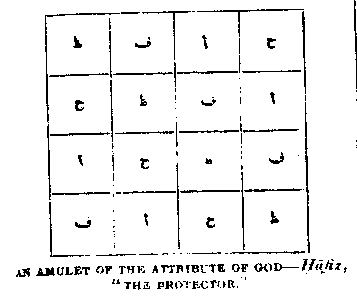

AL-AN'AM  . "The Cattle."
The title of the vith Surah, in verse 137 of
which some superstitious customs of the
Meccans, as to certain cattle, are incidentally
mentioned.
. "The Cattle."
The title of the vith Surah, in verse 137 of
which some superstitious customs of the
Meccans, as to certain cattle, are incidentally
mentioned.
ANANIYAH  . From ana,
"I" "Egotism" Al-ananiyah is a term used
by the Sufis to express the existence of man.
. From ana,
"I" "Egotism" Al-ananiyah is a term used
by the Sufis to express the existence of man.
ANAS IBN MALIK 
 .
The last of the Companions
of Muhammad, and the founder of the sect of
the Malikis He died at al-Basrah, A.H. 93
aged 103.
.
The last of the Companions
of Muhammad, and the founder of the sect of
the Malikis He died at al-Basrah, A.H. 93
aged 103.
AL-ANFAL  "The Spoils."
The title of the viiith Surah which was
occasioned by a dispute regarding the spoils
taken at the battle of Badr, between the young
men who had fought and the old men who
had stayed with the ensigns.
"The Spoils."
The title of the viiith Surah which was
occasioned by a dispute regarding the spoils
taken at the battle of Badr, between the young
men who had fought and the old men who
had stayed with the ensigns.
ANGEL. Arabic mal'ak or
malak  ,
Persian Firishtah
,
Persian Firishtah  "It is believed," says Ibn Majah, "that the
angels are of a simple substance (created of
light), endowed with life, and speech, and
reason; and that the difference between them,
the Jinn, and Shaittans is a difference of
species. Know," he adds, "that the angels
are sanctified from carnal desire and the disturbance
of anger: they disobey not God in
what He hath commanded them, but do what
they are commanded. Their food is the celebrating
of His glory; their drink, the proclaiming
of His holiness; their conversation,
the commemoration of God, Whose name be
exalted; their pleasure, His worship, and
they are created in different forms and with
different powers." (Arabian Nights, Lane's
edition, Notes to the Introduction, p.27.)
"It is believed," says Ibn Majah, "that the
angels are of a simple substance (created of
light), endowed with life, and speech, and
reason; and that the difference between them,
the Jinn, and Shaittans is a difference of
species. Know," he adds, "that the angels
are sanctified from carnal desire and the disturbance
of anger: they disobey not God in
what He hath commanded them, but do what
they are commanded. Their food is the celebrating
of His glory; their drink, the proclaiming
of His holiness; their conversation,
the commemoration of God, Whose name be
exalted; their pleasure, His worship, and
they are created in different forms and with
different powers." (Arabian Nights, Lane's
edition, Notes to the Introduction, p.27.)
Four of them are archangels, or, as they
are called in Arabic Karubiyun (Cherubim),
namely, Jabra'il or Jibril, (Gabriel), the
angel of revelations; Mika'il or Mikal,
(Michael), the patron of the Israelites; Israfil,
the angel who will sound the trumpet
at the last day; and 'Izra il, or 'Azrai il
the angel of death. Angels are said to be
inferior in dignity to human prophets, because
all the angels were commanded to
prostrate themselves before Adam (Surah ii. 32).
Every believer is attended by two recording
angels, called the Kiramu 'l-katibin, one of
whom records his good actions, and the other
his evil actions. There are also two angels,
called Munkar and Nakir, who examine all
the dead in their graves. The chief angel who
has charge of hell is called Malik, and his
subordinates are named Zabaniyah, or guards.
A more extended account of these angels will
be found under their particular titles.
The angels intercede for man: "The
angels celebrate the praise of their Lord, and,
ask forgiveness for the dwellers on earth."
(Surah xlii. 3.) They also act as guardian
angels: "Each hath a succession of angels
before him and behind him, who watch over
him by God's behest." (Surah xiii. 12.) "Is
it not enough for you that your Lord aideth
you with three thousand angels sent down
from on high)?" (Surah iii. 120.) "He
is the Supreme over His servants, and sendeth
forth guardians who watch over you, until,
when death overtaketh any one of you, our
messengers receive him and fail not." (Surah
ii. 61.)
There are eight angels who support the
throne of God, "And the angels shall be on
its sides, and over them on that day eight
shall bear up the throne of thy Lord." (Surah
lxix. 17). Nineteen have charge of hell.
"Over it are nineteen. None but angels have I
made guardians of the fire." (Surah lxiv 30, 31.)
The names of the guardian angels given in
the book on Exorcism (da'wah), entitled the
Jawahiru 'l-Khamsah, are Israfil, Jibra'il,
Kalkail, Darda il, Durba 'il, Raftma'il, Sharka'il,
Tankafil, Isma'il, Sarakika'il, Kharura'il, Tata'il,
Ruva'il, Hula'il, Hamwakil, 'Itra'il,
page 16
Amwakil, 'Amra'll, 'Azra'il, Mika'il, Mahka'il,
Harta'il, 'Ata'il, Nura'il, Nukha'il. [EXORCISM.]
ANIMALS. Arabic Hayawan  .
According, to the Qur'an,
Surah xxiv., 44, "God hath created every
animal of water." "An idea," says Rodwell,
"perhaps derived from Gen. i. 20, 21."
.
According, to the Qur'an,
Surah xxiv., 44, "God hath created every
animal of water." "An idea," says Rodwell,
"perhaps derived from Gen. i. 20, 21."
It is believed that at the Resurrection the
irrational animals will be restored to life, that
they may be brought to judgment, and then be
annihilated. See Qur'an, Surah vi 38, "No
kind of beast is there on the earth, nor fowl
that flieth with its wings, but is a community
like you: nothing have We passed over in the
book (of the Eternal decrees): then unto their
Lord shall they be gathered."
AL-'ANKABUT  . "The
Spider The title of the xxixth Surah,
in which there is a passing reference to
this insect in the 40th verse : "The likeness
for those who take to themselves guardians
besides God is the likeness of the spider
who but buildeth her a house; but truly the
frailest of all houses surely is the house of
the spider."
. "The
Spider The title of the xxixth Surah,
in which there is a passing reference to
this insect in the 40th verse : "The likeness
for those who take to themselves guardians
besides God is the likeness of the spider
who but buildeth her a house; but truly the
frailest of all houses surely is the house of
the spider."
AL-ANSAR  . "The Helpers,"
a term used for the, early converts of al-Madinah,
but when all the citizens of al-Madinah were
ostensibly converted to Islam,
they were all named Ansar, while those
Muslims who accompanied the Prophet from
Makkah to al-Madinah were called Muhajirun,
or exiles. (Muir's Life of Mahomet. vol iii.
p.26.) [MUHAMMAD.]
. "The Helpers,"
a term used for the, early converts of al-Madinah,
but when all the citizens of al-Madinah were
ostensibly converted to Islam,
they were all named Ansar, while those
Muslims who accompanied the Prophet from
Makkah to al-Madinah were called Muhajirun,
or exiles. (Muir's Life of Mahomet. vol iii.
p.26.) [MUHAMMAD.]
ANTICHRIST. [MASIHU D'DAJ-JAL]
AP0STASY FROM ISLAM Arabic irtidad
 . According to Muslim law, a male
apostate, or Murtadd, is liable to be put
to death if he continue obstinate
in his error; a female apostate is not
subject to capital punishment, but she may
be kept in confinement until she recants.
(Hamilton's Hidayah, vol. ii. p. 227.) If
either the husband or wife apostatize from
the faith of Islam, a divorce takes place ipso
facto; the wife is entitled to her whole dower,
but no sentence of divorce is necessary. If
the husband and wife both apostatize together, their
marriage is generally allowed to continue, although
Imam Zufar says it is annulled. But if after their
joint apostasy, either husband or wife were simply
to return to Islam, then the marriage would be dissolved.
(Hamilton's Hidayah, vol. ii, p. 188)
. According to Muslim law, a male
apostate, or Murtadd, is liable to be put
to death if he continue obstinate
in his error; a female apostate is not
subject to capital punishment, but she may
be kept in confinement until she recants.
(Hamilton's Hidayah, vol. ii. p. 227.) If
either the husband or wife apostatize from
the faith of Islam, a divorce takes place ipso
facto; the wife is entitled to her whole dower,
but no sentence of divorce is necessary. If
the husband and wife both apostatize together, their
marriage is generally allowed to continue, although
Imam Zufar says it is annulled. But if after their
joint apostasy, either husband or wife were simply
to return to Islam, then the marriage would be dissolved.
(Hamilton's Hidayah, vol. ii, p. 188)
According to Abu Hanifah, a male apostate is disabled
from selling or otherwise disposing of his property.
But Abu Yusuf and Imam Muhammad differ from their master
up to this point, and consider a male apostate to be as
competent to exercise every right as if he were still
in the faith (Hidayah, vol ii., p. 235).
If a boy under age apostatize, he is not to be put to
death, but will be imprisoned until he came to full age,
when, if he continue in the state of unbelief, he must
be put to death. Neither lunatics nor drunkards are
held to be responsible for their apostasy from Islam.
(Hidayah, vol. ii. 246.). If a person upon
compulsion becomes an apostate, his wife is not
divorced, nor are his lands forfeited. If a
person become a Musalman upon compulsion,
and afterwards apostatize, he is not to
be put to death. (Hiddyah, vol. iii., 467.)
The will of a male apostate is not valid, but
that of a fema1e apostate is valid. (Hidayah,
vol. iii., 537.)
'Ikrimah relates that some apostates were
brought to the Khalifah 'Ali, and he burnt them
alive, but Ibn 'Abbas heard of it and said
that the Khalifah had not acted rightly for
the Prophet had said, "Punish not with God's
punishment (i.e. fire), but whosoever changes
his religion, kill him with the sword." (Sahihu l'-Bukhari).
APOSTLE. Arabic rasul  .
hawari
.
hawari  . The term rasul
(apostle or messenger) is applied to Muhammad,
that of hawari being used in tho Qur'an
(Surah iii. 4,5; Surah iv. 111, 112; Surah lxi., 14) for the Apostles of Jesus.
The word hawari seems to be derived from the Ethiopic
hara, "to go"; hawarya; "apostle"; although,
according to al-Baiziwi, the commentator, it is
derived from hawira, "to be white," in Syriac,
hawar,was given to the disciples of Jesus,
be says, on account of their purity of life and
sincerity, or because they were respectable
men and wore white garments. In the Traditions
(Mishkat, book i.e. vi part 2) hawari
is used for the followers of all the prophets.
[PROPHETS.]
. The term rasul
(apostle or messenger) is applied to Muhammad,
that of hawari being used in tho Qur'an
(Surah iii. 4,5; Surah iv. 111, 112; Surah lxi., 14) for the Apostles of Jesus.
The word hawari seems to be derived from the Ethiopic
hara, "to go"; hawarya; "apostle"; although,
according to al-Baiziwi, the commentator, it is
derived from hawira, "to be white," in Syriac,
hawar,was given to the disciples of Jesus,
be says, on account of their purity of life and
sincerity, or because they were respectable
men and wore white garments. In the Traditions
(Mishkat, book i.e. vi part 2) hawari
is used for the followers of all the prophets.
[PROPHETS.]
AL-'AQABAH  A sheltered
glen hear Mini, celebrated as the scene of the
two pledges, the first and second pledge of
al-'Aqabah. The first pledge was made by ten
men of the tribe of Khazraj and ten of Aus
when they plighted their faith to Muhammad
thus: -- "We will not worship, any but one
God; we will hot steal; nor commit adultery;
nor kill our children; nor will we slander
our neighbors; and we will obey the
Prophet of God." The date assigned to this
pledge by Sir W. Muir is April 21, A.D. 621.
The second pledge was a few months afterwards
when seventy three men and two
women came forward, one by one, and took
an oath of fealty to the Prophet. Muhammad
named twelve of the chief of these men, and
said : " Moses chose from amongst his people
twelve 1eaders. Ye shall be sureties for the
rest, even as were the Apostles of Jesus; and
I am surety for my people. And the people
answered, Amin, So be it." (Muir's Life of
Mahomet, vol. ii., pp.216, 232.)
A sheltered
glen hear Mini, celebrated as the scene of the
two pledges, the first and second pledge of
al-'Aqabah. The first pledge was made by ten
men of the tribe of Khazraj and ten of Aus
when they plighted their faith to Muhammad
thus: -- "We will not worship, any but one
God; we will hot steal; nor commit adultery;
nor kill our children; nor will we slander
our neighbors; and we will obey the
Prophet of God." The date assigned to this
pledge by Sir W. Muir is April 21, A.D. 621.
The second pledge was a few months afterwards
when seventy three men and two
women came forward, one by one, and took
an oath of fealty to the Prophet. Muhammad
named twelve of the chief of these men, and
said : " Moses chose from amongst his people
twelve 1eaders. Ye shall be sureties for the
rest, even as were the Apostles of Jesus; and
I am surety for my people. And the people
answered, Amin, So be it." (Muir's Life of
Mahomet, vol. ii., pp.216, 232.)
'AQIB  "A successor or
deputy" "One who comes last." Al-Aqib is
a title given to Muhammad as being styled
"the last of the prophets."
"A successor or
deputy" "One who comes last." Al-Aqib is
a title given to Muhammad as being styled
"the last of the prophets."
'AQILAR  The relatives
who pay the expiatory mulet for
manslaughter or any other legal fine.
They must
The relatives
who pay the expiatory mulet for
manslaughter or any other legal fine.
They must
page 17
be relatives descended from one common
father. (Hamilton's Hidayah yol. iv. pages
449, 452; Baillie's Law of Sale, p. 214.)
'AQIQAH  . A custom
observed by the Arabs on the birth of a
child; namely, leaving the hair on the infant's
head until the seventh day, when it is shaved
and animals are sacrificed, namely, two sheep
for a boy and one for a girl. (Mishkat,
xviii. c. 3). It is enjoined by Muhammadan
law, and observed in all parts of Islam.
. A custom
observed by the Arabs on the birth of a
child; namely, leaving the hair on the infant's
head until the seventh day, when it is shaved
and animals are sacrificed, namely, two sheep
for a boy and one for a girl. (Mishkat,
xviii. c. 3). It is enjoined by Muhammadan
law, and observed in all parts of Islam.
ARABIA. Biladu 'l-'Arab 
 ,
Jaziratu 'l-'Arab
,
Jaziratu 'l-'Arab  ,
'Arabistan
,
'Arabistan  The peninsula
bearing, amongst the Arabs, these names is
the country situated on the east of the Red
Sea, and extending as far as the Persian Gulf.
The word probably signifies signifies a "barren
place" "desert". (Heb).
The peninsula
bearing, amongst the Arabs, these names is
the country situated on the east of the Red
Sea, and extending as far as the Persian Gulf.
The word probably signifies signifies a "barren
place" "desert". (Heb). 
Ptolemy divides Arabia into three parts,
Arabia Petraea, Arabia Felix, and Arabia
Deserta; but Arabian geographers divide it
into Tihamah, al-Hijaz, an.Najd, al 'Aruz,
and al- Yaman.
The races which have peopled Arabia are
divided into three sections, al-' Arabu 'l-Ba'i-dah,
'al-'Arabu '1-'Aribah, and al-'Arabu 'l-Musta'ribah.
I. Al-'Arabu 'l-Ba'idah, are the old "lost
Arabs," of whom tradition has preserved the
names of several tribes, as well as some memorable
particulars regarding their extinction."
This may well be called the fabulous period of
Arabian history; but, as it has the sanction of
the Qur'an, it would be sacrilege in a Muslim
to doubt its authenticity. According to
this account, the most famous of the extinct
tribes were those of 'Ad, Samud, Jadis, and
Tasm, all descended in the third or fourth
generation from Shem. 'Ad, the father of his
tribe, settled, according to tradition, in the
Great Desert of al-Ahqaf soon after the confusion
of tongues. Shaddad his son succeeded
him in the government, and greatly extended
his dominion:. He performed many fabulous
exploits; among others, he erected a magnificent
city in the desert of 'Adan, which had
been begun by his father, and adorned it with
a sumptuous palace and delightful gardens
in imitation of the celestial paradise, in order
to inspire his subjects with a superstition
veneration for him as a god. This superstructure
was built with bricks of gold and
silver alternately disposed. The roof was
gold, inlaid with precious stones and pearl
The trees and shrubs were of the same precious
materials. The fruits and flowers were
rubies, and on the branches were perched
birds of similar metals, the hollow parts
which were loaded with every species of the
richest perfumes, so that every breeze that
blew came charged with fragrance from the
bills of these golden images. To this paradise
he gave the name of Iram (see Qur'an,
Surah lxxxix. 6). On the completion of all
this grandeur, Shaddad set out with a splendid
retinue to admire its beauties. But heaven
would not suffer his pride and impiety to go
unpunished; for, when within a day's journey
of the place, they were all destroyed by a
terrible noise from the clouds. As a monument
of Divine justice, the city, we are assured,
still stands in the desert, although invisible.
Southey, in his Thalaba, has viewed this and
many of the other fable's and superstitions of
the Arabs with the eye of a poet, a philosopher,
and an antiquary. According to at-Tabari,
this legendary palace was discovered
in the time of Mu'awiyah, the first Khalifah of
Damascus, by a person in search of a stray
camel. A fanciful tradition adds, that the
Angel of death, on being asked whether, in
the discharge of his duties, an instance had
ever occurred in which he had felt some compassion
towards his wretched victims, admitted
that only twice had his sympathy
been awakened - once towards a shipwrecked
infant, which had been exposed on a solitary
plank to struggle for existence with the winds
and waves, and which he spared; and the
second time in cutting off the unhappy Shaddad
at the moment when almost within view
of the glorious fabric which he had erected
at so much expense. No sooner had the
angel spoken, than a voice from heaven
was heard to declare that the helpless
innocent on the plank was no other than
Shaddad himself; and that his punishment
was a just retribution for his ingratitude
to a merciful and kind Providence, which
had not only saved his life, but raised
him
to unrivalled wealth and splendour. The
whole fable seems to be a confused tradition
of Belus and the ancient Babylon; or, rather,
as the name would import, of Benhadad, mentioned
in Scripture as one of the most famous
of the Syrian kings, who, we are told, was
worshipped by his subjects.
Of the 'Adites and their succeeding princes,
nothing certain is known, except that they
were dispersed or destroyed in the course of a
few centuries by the sovereigns of al-Yaman.
The tribe of Samud first settled in Arabia
Felix, and on their expulsion they repaired
to al-Hijr, on the confines of Syria. Like the
'Adites, they are reported to have been of a
most gigantic stature, the tallest being a hundred
cubits high and the least sixty; and such
was their muscular power, that, with a stamp
of the foot in the driest soil, they could plant
themselves knee deep in the earth. They
dwelt the Qur'an informs us, "in the caves of
the rocks, and out the mountains into houses
which remain to this day." In this tribe it is
easy to discover the Thamudeni of Diodorus,
Pliny, and Ptolemy.
The tribes of Tasm and Jadis settled between
Makkah and al-Madinah, and occupied
the whole level country of al-Yaman, living
promiscuously under the same' government.
Their history is buried in darkness; and when
the Arabs wish to denote anything of dubious
anthority they call it a fable of Tasm.
The extinction of these tribes according
to the Qur'an, was miraculous, and a
signal example of Divine vengeance. The
posterity of 'Ad and Samud had abandoned
page 18
The worship of the true God, and lapsed into
incorrigible idolatry. They had been chastised
with a three years' drought, but their hearts
remained hardened. To the former was sent
the Prophet Hud, to reclaim them and preach
the unity of the Godhead. "O my people!"
exclaimed the prophet, "ask pardon of your
Lord; then turn unto Him with penitence,
(and) He will send down the heavens upon
you with copious rains, and with strength in
addition to your strength will He increase
you." Few believed, and the overthrow of
the idolaters was effected by a hot and
suffocating wind, that blew seven nights and
eight days without intermission, accompanied
with a terrible earthquake, by which their
idols were broken to pieces, and their houses
thrown to the ground (See Surah vii.
63, xi. 63.) Luqman, who, according to some
was a famous king of the 'Adites, and who
lived to the age of seven eagles, escaped, with
about sixty others, the common calamity.
These few survivors gave rise to a tribe
called the Latter 'Ad; but on account of their
crimes they were transformed, as the Qur'an
states, into asses or monkeys. Hud returned
to Hazramaut, and was buried in the neigbourbood,
where a small town, Qabr Hud
still bears his name. Among the Arabs, 'Ad
expresses the same remote age that Saturn or
Ogyges did among the Greeks anything of
extreme antiquity is said to be "as old as
King 'Ad.
The idolatrous tribe of Samud had the
prophet Salih sent to them, whom D'Herbefot
makes the son of Arphaxad, while Bochart
and Sale suppose him to be Peleg, the
brother of Joktan. His preaching had little
effect. The fate of the 'Adites, instead of
being a warning, only set them to dig caverns
in the rocks, where they hoped to escape the
vengeance of winds and tempests. Others
demanded a sign from the prophet in token of
his mission. As a condition of their belief,
they challenged him to a trial of power,
similar to what took place between. Elijah
and the priests of Baal, and promised to
follow the deity that should gain the triumph.
From a certain rock a camel big with young
was to come forth in their presence. The
idolaters were foiled; for on Salih's pointing
to the spot a she-camel was produced, with a
young one ready weaned. This miracle
wrought conviction in a few; but the rest, far
from believing, hamstrung the mother, killed
her miraculous progeny, and divided the
flesh among them. This act of impiety sealed
their doom. "And a violent tempest overtook
the wicked, and they wore found prostrate on
their breasts in their abodes." (Qur'an,
Surah vii., 71, xi. 64.)
The tribes of Jadis and Tasm owe their
extinction to a different cause. A certain
despot, a Tasmite, but sovereign of both tribes,
had rendered himself detested by a voluptuous
law claiming for himself at priority of right
over all the bridges of the Jadisites. This
insult was not to be tolerated. A conspiracy
was formed. The king and his chiefs were
invited to an entertainment. The avengers
had privately hidden their swords in the
sand, and in the moment of mirth and festivity
they fell upon the tyrant and his
retinue, and finally extirpated the greater
part of his subjects.
II. - The pure Arabs are those who claim
to be descended from Joktan or Qahtan, whom
the present Arabs regard as their principal
founder. The members of this genuine stock
are styled al-'Arabu 'l-Arabah, the
genuine Arabs. According to their genealogy
of this patriarch, his descendants formed two
distinct branches. Ya'rub. one of his sons
founded the kingdom of al-Yaman, and Jurhum
that of al-Hijaz. These two are the only sons
spoken of by the Arabs. Their names, do not
occur in Scripture; but it has been conjectured
that they were the Jarah and Hadoram
mentioned by Moses as among the thirteen
planters of Arabia (Gen. x., 26)
In the division of their nation into tribes
the Arabs resemble the Jews. From an early
era they have retained the distinction of separate
and independent families. This partition
was adverse to the consolidation of power or
political influence, but it furnishes our chief
guide into the dark abyss of their antiquities.
The posterity of Ya'rub spread and multiplied
into innumerable clans. New accessions
rendered new subdivisions necessary. In the
genealogical tables of Sale, Gagnier, and
Saiyid Ahmad Khan, are enumerated nearly
three-score tribes of genuine Arabs many of
whom became celebrated long before the time
of Muhammad, and some of them retain their
names even at the present day.
III. - The 'Arabu 'l-Musarribah the mixed
Arabs, claim to be descended from Ishmael
and the daughter of al-Muzaz, King of
al-Hijaz, whom he took to wife, and was of the
ninth generation fron Jurhum, the founder of
that kingdom. Of the Jurhumites, till the
time of Ishmael, little is recorded, except the
names of their princes or chiefs, and that
they had possession of the territory of al-Hijaz.
But as Muhammad traces his descent to this
alliance, the Arabs have been more than
usually careful to preserve and adorn his
genealogy. The want of a pure ancestry is,
in their estimation, more than compensated
by the dignity of so sacred a connexion; for
they boast as much as, the Jews of being
reckoned the children of Abraham. This
circumstance will account for the preference
with which they uniformly regard this branch
of their pedigree, and for the many romantic
legends they have grafted upon it. It is not
improbable that the old giants and idolaters
suffered an imaginary extinction to make way
for a more favoured race, and that Divine
chastisements always overtook those who
dared to invade their consecrated territories.
The Scriptural account of the expulsion and
destiny of this venerated progenitor of the
Arabs is brief, but simple and affecting.
Ishmael was the son of Abraham by Hagar,
an Egyptian slave. When fourteen years of
age, he was supplanted in the hopes and
affections of his father by the birth of Isaac,
page 19
through whom the promises were to descend.
This event made it necessary to remove the
unhappy female and her child, who were
accordingly sent forth to seek their fortune
in some of the surrounding unoccupied districts.
A small supply of provisions, and a
bottle of water on the shoulder, was all she
carried from the tent of her shoulder. Directing
her steps towards her native country, she
wandered with the lad in the wilderness of
Beer'sheba, which was destitute of springs.
Here her stock failed and it seemed impossible
to avoid perishing by hunger or thirst.
She resigned herself to her melancholy prospects
but the feelings of the mother were
more acute than the agonies of want and
despair. Unable to witness her son's death.
she laid him under
one of the shrubs,
took an affecting leave of him, and retired
to a distance. "And, she went, and sat
her down over against him, a good way off
as it were a bow shot; for she said, Let
me not see the death of the child. And she
sat over against him and lifted up her voice
and wept." (Gen xxi 16). At this moment
an angel directed her to a well of water
close at hand, a discovery to which they
owed the preservation of their live". A promise
forcefully given was renewed that
Ishmael was to become a great nation - that
he was to be a wild man - his hand against
every man, and every man's hand against him.
The travellers continued their journey to the
wilderness of Paran, and there took up their
residence. In due time the lad grew to manhood
and greatly distinguished himself as an
archer, and his mother took him a wife out of
her own land. Here the sacred narrative
breaks of abruptly the main object of Moses
being to follow the history of Abraham's
descendants through the line of Isaac. The
Arabs, in their version or Ishmael's history
have mixed a great deal of romance with the
narrative of Scripture. They assert that
al-Hijaz was the district where he settled, and
that Makkah, then an arid wilderness, was the
identical spot where, his life was providentially
saved, and where Hagar died and was buried.
The well pointed out by the angel, they believe,
to be the famous Zamzam of which all
pious Muslims drink to this day. They
make no allusion to his alliance with the
Egyptian woman, by whom he had twelve
sons (Gen. xxv. 12-18), the, chiefs of as many
nations, and the possessors of separate towns;
but as polygamy was common in his age and
country, it is not improbable he may have
had more wives than one.
It was, say they, to commemorate the
miraculous preservation of Ishmael that God
commanded Abraham to build the Ka'bah
and his son to furnish the necessary materials.
Muhammadan writers give the following
account of Ishmael and his descendants -
Ishmael was constituted the prince and first
high-priest of Makkah and, during half a
century he preached to the incredulous Arabs.
At has death, which happened forty-eight
years after that of Abraham; and in the 137th
of his age, he was buried in the tomb of his
mother Hagar. Between the erection of the
Ka'bah and the birth of their Prophet, the
Arabs reckon about 2740 years. Ishmael
was succeeded in the regal and sacerdotal
office by his eldest son Nebat although the
pedigree of Muhammad is traced from Kedar
a younger brother. But his family did not
long enjoy this double authority; for, in progress
of time the Jarhumites seized the government
and the guardianship of the temple,
which they maintained about 300 years.
These last, again having corrupted the true
worship, were assailed as a punishment of
their crimes, first by the scimitars of the
Ishmaelites, who drove them from Makkah,
and then by divers maladies by which
the whole race finally perished. Before
quitting Makkah, however, they committed
every kind of sacrilege and indignity. They
filled up the Zamzam well, after having
thrown into it the treasures and sacred
utensils of the temple the black stone, the
swords and cuirasses of Qala'ah, the two
golden gazelles presented by one of the
kings of Arabia, the sacred image of the ram
substituted for Isaac and all the precious
movabales, forming at once the object and
the workmanship of a superstitious devotion.
For several centuries the posterity
of Ishmael kept possession of the supreme
dignity.
The following is the list of chiefs who
are said to have ruled the Hijaz and to have
been the lineal ancestors of Muhammad as far
as 'Adnan :
A.D.
538 - Abdu'llah, the father of Muhammad.
505 - 'Abdu 'l Mutalib
472 - Hashim
439 - 'Abd Manaf
406 - Qusaiy
373 - Kitab
340 - Murrah
307 - Ka'ab
274 - Luwaiy
241 - Ghalib
208 - Fihr or Quraish
175 - Malik
142 - an-Nazr
109 - Kinanah
76 - Khuzaimah
43 - Mudrikah
10 - al-Ya's
B.C.
23 - Muzar
56 - Nizar
89 - Ma'add
122- 'Adnan
The period between Ishmael and 'Adnan is
variously estimated, some reckoning forty,
others only seven generations. The authority
of Abu 'l-Fida, who makes it ten, is that generally
followed by the Arabs, being founded on
a tradition of one of Muhammad's wives.
Making every also waiters. however, for patriarchal
longevity, even forty generations are
insufficient to extend over a space of nearly
2,500 years. From 'Adnan to Muhammad
the genealogy is considered certain, comprehending
twenty-one generations, and nearly
page 20
160 different tribes, all branching off from
the same parent stem.
(See Abu'l-Fida ; Gagnier's Vie de Mahomet;
Pocock, Specim Arab. Hist.; Saiyid
Ahmad Khan's Essays; Sale's Koran, Prelim.
Dis. ; Crichton's Histr Arabia.)
ARABIC. Lisanu -'l -'l'Arab; Lughatu
'1-'Arab. The classical language of
Arabia is held to be the language of the
Qur'an, and of the Traditions of Muhammad
and by reason of its incomparable excellence
is called  al lughah,
or "the language." See
Qur'an; Surah xvi. 105, "They say, Surely
a person teacheth him [i.e. Muhammad]. But
the tongue of him at whom they hint is
foreign, while this [i.e. the Qur'an] is plain
Arabic.")
al lughah,
or "the language." See
Qur'an; Surah xvi. 105, "They say, Surely
a person teacheth him [i.e. Muhammad]. But
the tongue of him at whom they hint is
foreign, while this [i.e. the Qur'an] is plain
Arabic.")
This classical language is often termed, by
the Arabians themselves, the language of
Ma'add, and the language, of Munzar, and is
a compound of many sister dialects, very
often differing among themselves, which
were spoken throughout the whole of the
Peninsula before the religion of Muhammad
incited the nation to spread its conquering
armies over foreign Countries. Before that
period, feuds among the tribes, throughout
the whole extent of their territory, had prevented
the blending of their dialects into one
uniform language; but this effect of disunion
was counteracted in a great measure by the
institution of the sacred months, in which all
acts of hostility were most strictly interdicted,
and by the annual pilgrimage, and the yearly
fair held at 'Ukaz, at which the poets of the
rations tribes contended for the meed of
general admiration.
Qatadah says that the Quraish tribe used to
cull what was most excellent in the dialects
of Arabia, so that their dialect became the
best of all. This assertion, however, is not
altogether correct, for many of the children
of the tribe of Quraish, in the time of Muhammad,
were sent into the desert to be there
nursed, in order to acquire the utmost
chasteness of speech. Muhammad himself
was went to be brought up among the tribe of
Sa'd ibn Bakr ibn Hawazin, descendants of
Muzar, bat not in the line of Quraish; and he
is said to hare urged the facts of his being a
Quraish, and having also grown up among
the tribe of Sa'd, as the grounds of his
claim to be the most chaste in speech of the
Arabs. Certain it is that the language of
Mwadd was characterised by the highest degree
of perfection, copiousness, and uniformity, in
the time of Muhammad, although it afterwards declined.
The language of the Qur'an is universally
acknowledged to be the most perfect form of
Arabic speech. At the same time we must
not forget that the acknowledged claims of the
Qur'an to be the direct utterance of the
Divinity have made it impossible for any
Muslim to criticise the work, and it has become
the standard, by which other literary
competitions have to be judged. (See
Lane's
Introduction to his Arabic Dictionary, and
Palmer's Qur'an.)
ARABIC LEXICONS. The first
Arabic lexicon is that which is generally
ascribed to al-Khalil, and entitled Kitibu'l
'Ain. The following are the most celebrated
Arabic dictionaries composed after the 'Am.
The Jamharah, by Ibn Duraid, died A.H. 321.
The Tahzib, by al-Azhari died A.H. 370.
The Muhit, by the Sahib Ibn 'Abbad, died A.H. 885.
The Mujunal, by Ibn Faris died A.H. 306.
The Sihah, by al-Jauhari, died A.H. 398.
The Jami', by al-Qa'zzaz, died A.H. 412.
The Mu'ab, by Abu Ghalib, died A.H. 436.
The Muhkam, by Ibn Sidah, died A.H. 458.
The Asas, by ar-Zamakhshari, died A.H. 538.
The Mughrib, by al-Mutarrizi, died A.H. 610.
The 'Uhab, by as-Sighani, died A.H., 660.
The Lisanu'l-'Arab, by, Ibn Mukarram, died A.H. 711.
The Tahzibu 't-Tahzib, by Mahmud at-Tanakhi, died A.H. 723.
The Misbah, by Ahmad Ibn Muhammad al-Faiyumi, compiled A.H. 734.
The Mughni '-Labib, by Ibn Hishim, died A.H. 761.
The Qarmus, by al-Faizuzabadi, died A.H. 816.
The Sahah (says Mr. Lane in his Preface
to his Dictionary), is among the books of
lexicology like the Sahih of Bukhari
amongst the books of traditions; for the point
on which turns the title to reliance is not the
copiousness of the collection, but the condition
of genuineness and correctness.
Two well-known dictionaries, compiled in
modern times in Hindustan, are the Ghiyasu '1-
Lughat, by Maulawi Ghiyasu 'd-din of Rampur,
and the Muntaha 'l-'Arab, by 'Abdu 'r-
Rahim ibn 'Abdu '1-Karim of Safipur. These
are both Arabic and Persian lexicons.
The Arabic-Latin dictionary of Jacob
Golius, was printed at Leyden, A.D. 1658;
that of Freytag at Halle, A.D. 1830-35.
The Arabic-English and English-Arabic
dictionaries extant are ---
Richardson's Persian-Arabic-English, A.D. 1777.
Richardson's English-Persian-Arabic, A.D. 1810.
Francis Jehnson's Persian-Arabic-English, A.D. 1852.
Catafago's Arabic-English and English-Arabic, new edition, 1873.
Lane's Arabic-English, A.D. 1863 to 1885 imperfect.
Dr. Badger's English-Arabic, A.D. 1881.
Dr. Steingass's English-Arabic, A.D. 1882.
AL-A'RAF.  . (1) The
partition between heaven and hell. described
in the Qur'an, Surah vii. 44, "Betwixt the two
(heaven and hell) there is a partition; and
al-A'raf are men who know all by their marks;
and they shall cry out to the inhabitants of
Paradise, 'Peace be upon you!' (but) they
have not (yet) entered it, although they so
desire. And when their sight is turned towards
the dwellers in the Fire, they say, '0 our Lord,
. (1) The
partition between heaven and hell. described
in the Qur'an, Surah vii. 44, "Betwixt the two
(heaven and hell) there is a partition; and
al-A'raf are men who know all by their marks;
and they shall cry out to the inhabitants of
Paradise, 'Peace be upon you!' (but) they
have not (yet) entered it, although they so
desire. And when their sight is turned towards
the dwellers in the Fire, they say, '0 our Lord,
page 21
place us not with the unjust people."' According
to Sale, al-A'raf is derived from the verb
'arafa, which signifies "to distinguish between
things, or to part them"; though some commentators
give another reason for the imposition
of this name, because, say they, those who
stand on this partition will know and distinguish
the blessed from the damned by their respective
marks or characteristics: and others say
the word properly intends anything that is
elevated, as such a wall of separation must
be supposed to be. Some imagine it to
be a sort of limbo for the patriarchs and prophets,
or for the martyrs and those who have
been most eminent for sanctity. Others
place here those whose good and evil works
are so equal that they exactly counterpoise
each other, and therefore deserve neither
reward nor punishment; and these, say they,
will on the last day be admitted into Paradise,
after they shall have performed an act of
adoration, which will be imputed to them as
a merit, and will make the scale of their good
works to preponderate. Others suppose this
intermediate space will be a receptacle for
those who have gone to war, without their
parents' leave, and therein suffered martyrdom;
being excluded from Paradise for
their disobedience, and escaping hell because
they are martyrs. (2) The title of Sarah vii.
(3) A term used by Sufi mystics to express
a condition of the mind and soul when meditating
on the existence of God in all things.
'ARAFAH.  The vigil of the
'Ida 'l-Asha, or Feast of Sacrifice, when the
pilgrims proceed to Mount 'Arafat. ['IDU L-AZHA.]
The vigil of the
'Ida 'l-Asha, or Feast of Sacrifice, when the
pilgrims proceed to Mount 'Arafat. ['IDU L-AZHA.]
'ARAFAT  , or 'Arafah.
The "Mount of Recognition," situated twelve
miles from Makkah; - the place where, the
pilgrims stay on the ninth day of the pilgrimage,
and recite the mid-day and afternoon prayers,
and hear the Khutbah or
sermon. Hence it is a name given to the
ninth day of the month Zu 'l-Hijjah. Upon
the origin of the name given to this mountain,
Burton says, "The Holy Hill owes its name
to the following legend : - When our first
parents forfeited heaven for eating wheat,
which deprived them of their primeval purity,
they were cast down upon earth. The
serpent descended upon Ispahan, the peacock at
Cabul; Satan at Bilbays (others say Semnan
or Seistan), Eve upon 'Arafat, and Adam at
Ceylon (Sarandib). The latter, determining
to seek his wife, began a journey, to which
the earth owes its present mottled appearance.
Wherever our first father placed his
foot, which was large, a town afterwards
arose; and between the strides will always
be country Wandering for many years, he
came to the Mountain of Mercy, where our
common mother was continually calling upon
his name, and their recognition of each other
gave the place the name of 'Arafah."
, or 'Arafah.
The "Mount of Recognition," situated twelve
miles from Makkah; - the place where, the
pilgrims stay on the ninth day of the pilgrimage,
and recite the mid-day and afternoon prayers,
and hear the Khutbah or
sermon. Hence it is a name given to the
ninth day of the month Zu 'l-Hijjah. Upon
the origin of the name given to this mountain,
Burton says, "The Holy Hill owes its name
to the following legend : - When our first
parents forfeited heaven for eating wheat,
which deprived them of their primeval purity,
they were cast down upon earth. The
serpent descended upon Ispahan, the peacock at
Cabul; Satan at Bilbays (others say Semnan
or Seistan), Eve upon 'Arafat, and Adam at
Ceylon (Sarandib). The latter, determining
to seek his wife, began a journey, to which
the earth owes its present mottled appearance.
Wherever our first father placed his
foot, which was large, a town afterwards
arose; and between the strides will always
be country Wandering for many years, he
came to the Mountain of Mercy, where our
common mother was continually calling upon
his name, and their recognition of each other
gave the place the name of 'Arafah."
ARAZI  . Lit. "lands."; the
sale of lands. Tombs are not included in the
sale of lands. A place or station for casting
the harvest is not considered to be amongst
the rights and advantages of land, and therefore
does not enter into the sale of it.
(Baillie's Law of Sale, pages 54, 65.)
[LAND.]
. Lit. "lands."; the
sale of lands. Tombs are not included in the
sale of lands. A place or station for casting
the harvest is not considered to be amongst
the rights and advantages of land, and therefore
does not enter into the sale of it.
(Baillie's Law of Sale, pages 54, 65.)
[LAND.]
ARCHITECTURE. The term Saracenic is usually
applied by English writers to
Muhammadan architecture. But though the
style may be traced to the Arabians, they
cannot themselves be considered the inventors
of it. They had, in fact, no distinctive style
of their own when they made their rapid conquests,
but adapted existing styles of architecture to
meet the religious and national feelings of the
Muslims.
Muhammad built a mosque at al-Madinah,
but it was an exceedingly simple structure,
and he left no directions in the Qur'an or in
the Traditions on the subject.
The typical varieties of the earlier Muhammadan
architecture are those which appeared
in Spain and in Egypt; its later form
appeared in Constantinople. The oldest
specimen of Saracenic architecture in Spain is
the mosque of Cordova, which now serves as
the cathedral of the city. It was commenced
by the Khalifah 'Abdu 'r-Rahman, 786 A.D.

with the avowed intention that it should be
the finest mosque in the world, and Byzantine
architects are said to have been, specially
invited to superintend its construction.
The earliest of the Muhammadan buildings
in Egypt, of which any portions still remain, is
the Mosque of 'Amr at old Cairo, begun
about A.D. 642, but greatly altered or rebuilt
about sixty years later.
On the capture of Constantinople, St. Sophia
was converted by the Muslim conquerors into
their chief Mosque, and made their architectural
model. The older Saracenic style, as
seen at Cordova and old Cairo, continued to
be the basis of the new, but it was modified
throughout by Byzantine influence. In Persia
page 22
we may clearly trace in Muhammadan buildings
the older Persian type, and in India

the Saracenic architects showed the same
pliancy in adopting the styles of the various
peoples amongst whom they settled. It thus
happens (says Fergusson, in his History of
Indian Architecture) that we have at least
twelve or fifteen different styles of Muhammadan
architecture in Central Asia and in India.
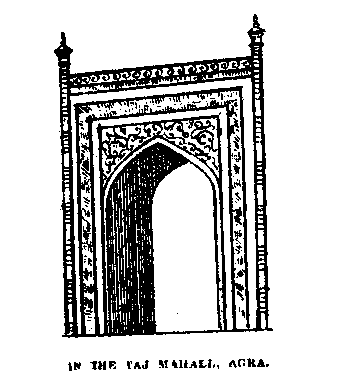
A striking and distinctive feature in early
Muhammadan architecture is the horse-shoe
arch, which in time gives way to a cusped or
scalloped arch, strictly so termed, the outline
being produced by intersecting semi-arches.
Another variety of Saracenic arch is the
circular-headed and stilted form. The pillars are
commonly or exceedingly slender proportions,
almost to apparent unsocurity; but owing to
the style of the embellishment, this lightness
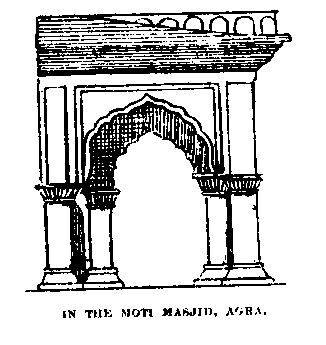
of particular forms tends to heighten the
general luxuriance Some have imagined that
this element of slenderness in regard to
pillars indicates a tent origin of the style.
This tent-like character has been further kept
up by concave ceilings and cupolas, emblazoned
with painting and gilding. Decorations
composed of animal and human figures, being
interdicted by Muhammadan law [PICTURES]
are not found in Saracenic architecture but
their geometrical patterns exhibit singular
beauty and complexity, inexhaustible
variety of combinations, and a wonderful
degree of harmonious intricacy, arising out of
very simple elements. Lattice or open trellis
work is another fertile source or embellishment,
and is similar to the tracery met with
in Gothic buildings. Another characteristic
of Saracenic style is that of the dome. For
part domes occur, in mosques and
tombs, and are of Byzantine origin. Minarets
are also a special feature in Muhammadan
mosques, and contribute much to the picture
of these buildings. They are
page 23
found in mosques of the later Saracenic style
(See Fergusson's Indian and Eastern Architecture,
Mr. Owen Jones's Alhambra Palace, Hersemer's
Arabische Bauverzierengen)
'ARIYAH  . A kind of sale
permitted in Islam, namely, when a person
computes what quantity of fruit there is on a
tree and sells it before it is plucked. (Mishkat,
xii. c. v.)
. A kind of sale
permitted in Islam, namely, when a person
computes what quantity of fruit there is on a
tree and sells it before it is plucked. (Mishkat,
xii. c. v.)
'ARIYAH  . (1) A loan for
the use of anything of which Qarz cannot be
made: e.g. the loan of a horse is Ariyah;
the loan of money is Qarz. (2) A gift of
which the following in an example : - A person
makes a gift to another of the dates of a
palm-tree in his garden; but having afterwards
some, doubt of the propriety of that
person coming daily to his garden where
his family usually are, and being at the
same time unwilling to depart from his
promise, or to retract his gift, he gives
some of the dates that have already been
pulled in lieu of those upon the tree.
(Baillie's Law of Sale. p. 300.)
. (1) A loan for
the use of anything of which Qarz cannot be
made: e.g. the loan of a horse is Ariyah;
the loan of money is Qarz. (2) A gift of
which the following in an example : - A person
makes a gift to another of the dates of a
palm-tree in his garden; but having afterwards
some, doubt of the propriety of that
person coming daily to his garden where
his family usually are, and being at the
same time unwilling to depart from his
promise, or to retract his gift, he gives
some of the dates that have already been
pulled in lieu of those upon the tree.
(Baillie's Law of Sale. p. 300.)
ARK, NOAH'S  . It is
mentioned in the history of the Deluge, as
recorded in the Qur'an, in two places - Surah
xi. 39, "Build the ark under our eye and after
our revelation," and Surah xiii 27. "There
is also supposed to be an allusion to the ark
in Surah lxxvi. 41. "And a sign to them is
that we bare their offspring in the laden ship."
. It is
mentioned in the history of the Deluge, as
recorded in the Qur'an, in two places - Surah
xi. 39, "Build the ark under our eye and after
our revelation," and Surah xiii 27. "There
is also supposed to be an allusion to the ark
in Surah lxxvi. 41. "And a sign to them is
that we bare their offspring in the laden ship."
Al- Baizawi says that Noah was two years
building the ark, which was 300 cubits long,
50 wide, and 30 bread which was made
of Indian plane-tree; that it consisted of
three storeys, the lowest for beasts, the middle
for men and women (who were separated from each other),
and the highest for birds.
The ark is said to have rested on the mountain al-Judi.
ARK OF THE COVENANT. The Hebrew word for
Ark is  (i.e. a chest, a coffer),
Chald.
(i.e. a chest, a coffer),
Chald.  Arabic
  .
See Qur'an Surah ii. 249, "The sign of his (Saul's)
kingdom is that there shall come unto you the ark
(Tabut); in it shall be security (or the Shechinah,
sakinah Heb.
.
See Qur'an Surah ii. 249, "The sign of his (Saul's)
kingdom is that there shall come unto you the ark
(Tabut); in it shall be security (or the Shechinah,
sakinah Heb.  ) from your
Lord, and the. relics of what the family
of Moses and the family of Aaron left; the
angels shall hear it." Jalalu 'd-din' says
this ark contained the images of the prophets,
and we sent down from heaven. to Adam,
and at length came to the Israelites, who put
great confidence therein, and continually carried
it in front of their army, till it was taken
by the Amalekites. But on this occasion the
angels brought it back in the sight of all the
people, and placed it at the feet of Saul
(Talut), who was thereupon unanimously
received as king.
) from your
Lord, and the. relics of what the family
of Moses and the family of Aaron left; the
angels shall hear it." Jalalu 'd-din' says
this ark contained the images of the prophets,
and we sent down from heaven. to Adam,
and at length came to the Israelites, who put
great confidence therein, and continually carried
it in front of their army, till it was taken
by the Amalekites. But on this occasion the
angels brought it back in the sight of all the
people, and placed it at the feet of Saul
(Talut), who was thereupon unanimously
received as king.
ARMS. The Sale of. The sale of
armour or warlike stores to rebels, or in their
camp, is forbidden, because selling arms into
the bands of rebels is an assistance to defection.
But it is not forbidden to sell the materials for
making arms to such persons (Hamiton's Hidayah, vol. ii. 225.)
ARSH  . (1.) A lega1 term
for compensation. (2.) A mulct; a fine; particularly
that which is paid for shedding of
blood. (3.) A gift for conciliating the favour
of a judge; a bribe. (4.) Whatever a purchaser
receives from a seller after discovering a fault
in the article bought.
. (1.) A lega1 term
for compensation. (2.) A mulct; a fine; particularly
that which is paid for shedding of
blood. (3.) A gift for conciliating the favour
of a judge; a bribe. (4.) Whatever a purchaser
receives from a seller after discovering a fault
in the article bought.
'ARSH  . The term used in
the Qur'an for the throne of God Surah ix., 131,
"He is the Lord of the mighty throne."
Husaini, the commentator, says the throne
has 8,000 pillars, and the distance between
each pillar is 3,000,000 miles.
. The term used in
the Qur'an for the throne of God Surah ix., 131,
"He is the Lord of the mighty throne."
Husaini, the commentator, says the throne
has 8,000 pillars, and the distance between
each pillar is 3,000,000 miles.
'ASABAH.  A legal term
for male relatives by the father's side
agnates.
A legal term
for male relatives by the father's side
agnates.
ASAF  The wazir or prime
minister of Solomon. Alluded to in the
Qur'an, Surah xxvii. 40, as "He with whom
was knowledge of the scripture." Muhammadan
commentators say he was the son of
Barkhiya.
The wazir or prime
minister of Solomon. Alluded to in the
Qur'an, Surah xxvii. 40, as "He with whom
was knowledge of the scripture." Muhammadan
commentators say he was the son of
Barkhiya.
ASAR  . Relating; handing
down by tradition. Generally used for a
Hadis, related by one of the Companions, as
distinguished from one of the Prophet's own.
. Relating; handing
down by tradition. Generally used for a
Hadis, related by one of the Companions, as
distinguished from one of the Prophet's own.
AL'-ASARU 'SH-SHARIF 
 The sacred relic. A hair
of either the beard or mustachios of Muhammad,
or a foot-print of the Prophet. One of
these sacred relics (a hair of his beard) is
exhibited in the great mosque at Delhi,
another in a mosque in Cashmere.
The sacred relic. A hair
of either the beard or mustachios of Muhammad,
or a foot-print of the Prophet. One of
these sacred relics (a hair of his beard) is
exhibited in the great mosque at Delhi,
another in a mosque in Cashmere.
ASHAB  pl. of Sahib.
The Companions or Associates of Muhammad.
pl. of Sahib.
The Companions or Associates of Muhammad.
page 24
The term used for a single companion is
sahabi. Concerning the title of "Companion,"
there is considerable controversy as to the
persons to whom it can be applied. Sa'id
ibn al-Musaiyab reckoned none a "Companion"
but those who had been a year or
more with Muhammad, and had gone on a
warlike expedition with him. Some say that
everyone who had attained puberty, had embraced
Islam, and had seen the Prophet, was
a "Companion" even though he had attended
Muhammad but an hour. Others, however,
affirm that none could be a "Companion"
unless Muhammad chose him and he chose
Muhammad, and he adhered to the Prophet
at all times. The general opinion is that
every one who embraced him, saw the Prophet,
and accompanied him, even for a short
time, was a "Companion".
It is related that the Prophet marched to
Makkah with 10,000 Muslims, to Hunain with
12,000, and that 40,000 accompanied him on
the farewell pilgrimage. The number of the
"Companions" at his death is said to have
been 144,000.
In point of merit, the refugees (Muhajirun)
are more worthy than the auxiliaries (Ansar);
but by way of precedence the auxiliaries are
more worthy than the later refugees.
The "Companions", have been arranged in
thirteen classes, which are given by Abu '1-Fida
as follows:- I. Those who first embraced
Islam, such as Khadijah, 'Ali, Zaid, and Abu
Bakr, and those who did not delay till be had
established his mission. II. The Companions
who believed in him after his mission had
been fully established, amongst whom was
'Umar. III. Those who fled to Abyssinia.
IV. The first companions of 'Aqabah, who
preceeded the Auxiliaries. V. The second
Companions of 'Aqabah. VI. The third Companions
of 'Aqabah, who were seventy. VII.
The refugees who went to the Prophet after
his flight, when he was at Quba, before the
erection bf the temple. VIII. The soldiers of
the great battle of Badr. IX Those who
joined Islam between Badr and Hudaibiyah.
X. Those who took the oath of fealty under
the acacia tree at Hudaibiyah. XI. Those who
Joined after the treaty of Hudaibiyah, but
before the conquest. XII. Those that embraced
Islim on the day of conquest. XIII. Those
who were children in the time of the Prophet,
and had seen him.
Muhammad frequently commended the
"Companions," and spoke of their excellences
and virtues, a chapter in the Traditions being
devoted to this subject (Mishkat, xxiv. c.
xiii.) He is related to have said, "My companions
are like stars by which roads are
found, for which ever companion you follow
you will find the right road."
AL-ASHABU 'L-FIL 
"The Companions of the Elephant." A term
used in the Chapter of the Elephant, or the
cvth Surah :- "Hast thou not seen how thy
Lord dealt with the companions of the elephant?
Did He not cause their stratagem to miscarry?
And He sent against them birds in flocks
small stones did they hurl down upon them,
and he made them like stubble eaten down!"
This refers to the army of Abrahah, the
Christian king of Abyssinia and Arabia Fe1ix,
said to have been lost, in the year of Muhammad's
birth, in an expedition against Makkah
for the purpose of destroying the Ka'bah. This
army was cut off by small pox, and there is no
doubt, as the Arabic word for small-pox also
means "small stones," in reference to the
hard gravelly feeling of the pustules, what is
the true interpretation of the fourth verse of
this Surah, which, like many other poetical
passages in the Qur'an, has formed the starting
point for the most puerile and extravagant
legends.
ASHABU 'L-KAHF  .
.
"The Companions of the Cave," i.e. the Seven
Sleepers, mentioned in the Suratu 'l-kahf, or
Chapter xviii of the Qur'an. The story, as
told by early Christian writers, is given by
Gibbon (Rise and Fall, Chapter xxxi.). When
the Emperor Decius persecuted the Christians,
seven noble youths of Ephesus are said to
have concealed themselves in a cave in the
side of a mountain, where they were doomed
to perish by the tyrant, who gave orders that
the entrance should be firmly secured with a
pile of huge stones. They immediately fell
into a deep slumber, which was miraculously.
prolonged, without injuring the powers of life,
during a period of 187 years. This popular
tale, which Muhammad must have heard
when he drove his camels to the fairs of
Syria, is introduced into the Qur'an as a
divine revelation.
ASHABU 'S-SUFFAH 

"The sitters on the bench"
of the temple at Makkah. They are thus described
by Abu l-Fida: "They were poor
strangers, without friends or place of abode,
who claimed the promises of the Apostle of
God and implored his protection. Thus the
porch of the temple became their mansion,
and thence they obtained their name.
Muhammad went to meals, he used to call
some of them to partake with him; and he
selected others to eat with his companions."
'ASHARAH MUBASHSHARAH 
"The ten who received
glad tidings." Ten of the most distinguished of
Muhammad's. followers, whose certain entrance
into Paradise he is said to have foretold.
They are Abu Bakr,' 'Umar, Usman, 'Ali,
Talhah, az-Zubair'.Abdu 'r-Rahman, Sa'd-ibn-
Abu-Waqqas, Sa'id ibn Zaid, Abu 'Ubaidah
ibn al-Jarrih. (Mishkat, book xxiv. c. xx., part
ii.) Muhammad declared it presumption for
anyone to count upon an entrance into
heaven with absolute certainty, but he made
an exception in favour of these ten distinguished persons.
AL-ASH'ARIYAH 
A sect formed by Abu l-Hasan 'Ali ibn Isma'il
al-Ash'ari. born A.H. 260 (A.D. 873-4).
page 25
They hold that the attributes of God are
distinct from His essence, yet in such a
way as to forbid any comparison being
made, between God and ins creatures. They
say they are not "'ain nor gihair:", not of His
essence, nor distinct from it: i.e. they cannot
be compared with any other things. They
also hold that God has one eternal will,
from which proceed all things, the good
and the evil, the useful and the hurtful. The
destiny of man was written on the eternal
table before the world was created. So far
they go with the Sifatis, but in order to
preserve the moral responsibility of man they
say that he has power to convert will into
action. But this power cannot create anything
new, for then God's sovereignty would
be impaired; so they say that God in His providence
so orders matters that whenever "a
man desires to do a certain thing, good or
bad, the action corresponding to the desire is,
there and then, created by God, and, as it
were, fitted on to the desire." Thus it seems
as if it can't naturally from the will of the
man whereas it does not. This action is
called Kasb (acquisition), because it is acquired
by a special creative act of God. It is an
act directed to the obtaining of profit or the
removing of injury the term is therefore in
applicable to the Deity. Abu Bakr al-Bakil'
Iani, a disciple of a1-Asli'ari, says: 'The
essence or substance of the action is the
effect of the power of God, but its being an
action of obedience, such as prayer, or an
action of disobedience, such as fornication,
are qualities of the action, which proceed
from the power of man." The Imam Al-
Haramain (A.H. 419-478) held "that the
actions of men were effected by the power
which God has created in man." Abu Ishaq
al-Isfariyini says: "That which maketh impression
or hath influence on action, is a
compound of the power of God and the power
of man." They also believe that the word of
God is eternal, though they acknowledge that
the vocal sounds used in the Qur'an, which are
the manifestation of that word, are created.
They say. in short, that the Qur'an contains
(1) the eternal word which existed in the
essence of God before time was; and (2) the
word which consists of sounds and combinations
of letters. The last they call the created
word.
Thus Al-Ash'ari traversed the main positions
of the Mutazilites, denying that man can,
by the aid of his reason alone, rise to the
knowledge of good and evil. He must exercise
no judgment, but accept all that is revealed.
He has no right to apply the moral
laws which affect men, to the actions of God.
It cannot be asserted by the human reason
that the good will he rewarded or the bad
punished in a future world. Man must always
approach God as a slave, in whom there is no
light or knowledge to judge of the actions of
the Supreme. Whether God will accept the
penitent sinner or not cannot be asserted, for
He is an absolute Sovereign, above all law.
(Sale, from Ibn Khaldun; Die Mu'taziliten
oder die Freidenker in Islam, von H. Steiner.
1865: Zur-Geschichte Abu'l-Hasan al-ash'arish,
von W. Spitta, 1876: De Strijd over het Dogma
in den Islam tot op El-ash'ari, door Dr,M. Th.
Houtsma, Leiden, 1875; and Exposen de la
Refore de l'Islamisme, by M.A.F. Mehren
Leiden, 1878.)
'ASHURA  Lit. "the
tenth" A voluntary fast day, observed on the
tenth of the month of Muharram it is related
that Muhammad observed it, and said it was
a day respected by Jews and Christians
(Mishkat. vii. vol. I.)
Lit. "the
tenth" A voluntary fast day, observed on the
tenth of the month of Muharram it is related
that Muhammad observed it, and said it was
a day respected by Jews and Christians
(Mishkat. vii. vol. I.)
It is the only day of Muharram observed
by the Sunni Muslims, being the day on which
it is said God created Adam and Eve, heaven
and hell, the tablet of decrees, the pen, life,
and death. It is kept by the Sunnis as a fast.
[MUHARRAM]
ASIYAH  . The wife of
Pharaoh. One, of the four perfect women
(the Virgin Mary, Khadijah, and Fatimah,
being the other three). See Mishkatu 'l-Masabih,
xxiv c. 22. She is mentioned in the
Qur'an (Sura lxvi. 11): "And God striketh
out a parable for those who believe: the wife
of Pharaoh, when she said, 'My Lord, build
for me a house with Thee in Paradise, and
save me from Pharaoh and his works, and
save me from the unjust people."
. The wife of
Pharaoh. One, of the four perfect women
(the Virgin Mary, Khadijah, and Fatimah,
being the other three). See Mishkatu 'l-Masabih,
xxiv c. 22. She is mentioned in the
Qur'an (Sura lxvi. 11): "And God striketh
out a parable for those who believe: the wife
of Pharaoh, when she said, 'My Lord, build
for me a house with Thee in Paradise, and
save me from Pharaoh and his works, and
save me from the unjust people."
ASL  Cause, first principle.
foundation. Asl-wafar', "Cause and effect."
"fundamental and derivative principal"
Cause, first principle.
foundation. Asl-wafar', "Cause and effect."
"fundamental and derivative principal"
ASMA'U'LLAH  . [GOD, NAMES OF.]
'ASR  . The afternoon
prayer. [PRAYERS.] The title of the CIIIrd
Surah of the Qur'an.
. The afternoon
prayer. [PRAYERS.] The title of the CIIIrd
Surah of the Qur'an.
ASS. According to the Imam
Abu Hanifah, the ass is an unclean animal, and
its flesh and milk are unlawful; nor is zakat to
be given on an ass. (Hamilton's Hidayah,
vol. i. 16, iv. 74, 86)
ASSISTANTS. [ANSAR.]
ASTROLOGY. Arabic 'Ilmu 'n-nujum.
Qatidah says, referring to the Qur'an,
'that God has created stars for three uses:
(1) as an ornament to the heavens (Surah
lxvii 5); (2) to stone the Devil with (Surah
lxvii. 5); and (3) to direct travellers through
the forests and on the sea (Surah. xv. 16).
Muhammad condemns those who study the
stars for any other purposes (Mishkat, xxi,
c iii pt. iii.), and consequently the science of
Astrology is not considered lawful in Islam.
ASWAD  . An impostor
who, in the time of Muhammad, claimed
the prophetic office. His name was 'Aihalah
ibn Ka'b, and he belonged to the tribe
of 'Aus, of which he was an influential chief
He was surnamed Zu 'l-Himar, or "The
Master of the Ass," (But another reading is
Zu 'l-Khimar or, "He with the veil.")
because he used
. An impostor
who, in the time of Muhammad, claimed
the prophetic office. His name was 'Aihalah
ibn Ka'b, and he belonged to the tribe
of 'Aus, of which he was an influential chief
He was surnamed Zu 'l-Himar, or "The
Master of the Ass," (But another reading is
Zu 'l-Khimar or, "He with the veil.")
because he used
page 26
frequently to say, "The master of the ass
is coming unto me," and pretended to receive
his revelations from two angels named Suhaik
and Shuraik: Being good hand at legeidemain,
and having a smooth tongue, he gained
mightily on the multitude by the strange
feats which he shewed them, and the eloquence
of his discourse. By these means he
greatly increased his power, and having made
himself master of Najran and the territory of
Taif, on the death of Badhan, the governor
of Yaman for Muhammad he seized that province
also, killing Shahr, the son of Hadhan,
and taking to wife his widow Azad whose
father he had also slain. The news being
brought to Muhammad, he sent to his friends
and to the tribe of Hamdan, a party of whom
conspiring with Qais ibn 'Abd Yaghuth, who
bore Aswad a grudge, and with Firuz and
Aswad's wife, broke by night into his house,
where Firuz surprised him and cut off his
head. While dying, it said that he roared
like a bull, at which his guards came to the
chamber door, but were sent away by his
wife, who told them that the prophet was
only agitated by the divine inspiration. This
was done the very night before Muhammad
died. The next morning the conspirators
caused the following proclamation to be
made viz. "I bear witness that Muhammad
is the Apostle of God, and that 'Aihala is a
liar"; and letters were immediately sent
away to Muhammad, with an account of
what had been done; but a messenger from
heaven outstripped them and acquainted the
prophet with the news, what he imparted to
his Companions a little before his death, the
letters themselves not arriving till Abu Bakr
was chosen Khalif. It is said that Muhammad
on his occasion told those who attended
him that before the Day of Judgment thirty
more imposters, besides Musailimah and Aswad,
should appear. The whole time from
the beginning of Aswad's rebellion to his
death was four months.
ATHEIST [DAHRI.]
ATIRAH .
.
The sacrifice offered by the idolatrous Arabs in
the month of Rajab. It was allowed by the Prophet
at the commencement of his mission, but was afterwards
abolished. Mishkat, book iv., c. 50, "Let there
be no Fara' nor 'Atirah".
AT-TAHIYAT
.
Lit. "the greetings." A part of the stated
prayers, recited after the Takbiru 'l-Qurud,
after every two rak'ahs. It is recited whilst
the worshipper kneels upon the ground. His left foot
bent under him, he sits upon it and places his hands
upon his knees and says: - "The adorations (i.e.
at-tahiyatu of the tongue are for God, and also
of the body and of alms giving. Peace be on thee,
O Prophet, with the mercy of God and His blessing.
Peace be upon us, and upon God's righteous servants."
(Mishkat, iv., c. xvi) [PRAYER.]
AUGURY. [FA'L]
AULIYA  , pl. of wali.
"Favourites of God." The expression occurs
in the Quran in tue following verse. "Are not
the favourites of God those on whom no fear
shall come, nor shall they be put to grief?"
(Surah x. 63).
AUTAD  . Lit.
"props or pillars." - A term used by the Sufis
for the four saints by whom the four corners of the
world are said to be supported.
. Lit.
"props or pillars." - A term used by the Sufis
for the four saints by whom the four corners of the
world are said to be supported.
A'UZU BILLAH  . Another
name for the Ta'auwuz., or the prayer
in the daily liturgy : "I seek refuge with God
from the cursed Satan." [PRAYER.]
. Another
name for the Ta'auwuz., or the prayer
in the daily liturgy : "I seek refuge with God
from the cursed Satan." [PRAYER.]
AVENGER OF BLOOD. In the Muhammadan Law, as
in the Jewish, the punishment for wilful murder is
left to the next of kin; but in the Jewish code the
avenger of blood was compelled to take the life of
the murder whilst in the Muslim code he may accept
compensation, vide Qur'an Surah ii. 173,
"O believers; retaliation (Qisas for blood-shedding
is prescribed to you; the free man for the free, and the
slave for the slave, and the woman for the woman; but
he to whom his brother shall make any remission is to
be dealt with equitably; and a payment should be made
to him with liberality. This is a relaxation (i.e. of
the stricter lex talionis) from your Lord, and
a mercy." [QISAS.]
AYAH  . Lit.
"a sign or miracle." The term used for one of the
smaller portions of the chapters of the Qur'an which
we call verses. The number of verses is often set down
after the title of the chapter, but the verses are not
marked in the text as they are in our English Bibles.
The number of verses in the Qur'an is variously estimated,
but they are generally said to be about six thousand and
two hundred. [QUR'AN.]
. Lit.
"a sign or miracle." The term used for one of the
smaller portions of the chapters of the Qur'an which
we call verses. The number of verses is often set down
after the title of the chapter, but the verses are not
marked in the text as they are in our English Bibles.
The number of verses in the Qur'an is variously estimated,
but they are generally said to be about six thousand and
two hundred. [QUR'AN.]
AL-A'YANU 'S-SABITAH 
pl. of ayn, in the sense of "the essence"
of a thing. The established essences. A term used by
the Sufi mystics to express figures emblenatic of the
names of God. ('Abdu 'r-Razzaq's Dictionary of
Technical Terms of the Sufis, Sprenger's edition.)
AYATU 'L-FATH 
Lit. "The verse of victory." The fifty-ninth
verse of the Suratu 'l-An'am (vi.) of the Qur'an.
The powers of this verse are said to be so great, that
if a person constantly recite it he will obtain his
desires. It is generally recited with this object
forty times after each season of prayer. It is as
follows: - "And with Him are the keys of the secret
things; none knoweth whatever is on the land and in
the sea; and no leaf falleth but he knoweth it; neither
is there a grain in the darkness of the earth, not
a green thing nor a dry thing, but it is noted in a
clear book."
Page 27
AYATU 'L-HINZ  .
.
"The verse of protection" Certain verses of
the Qur'an which are usually inscribed on
amulets. They are:-Surah ii, 256, "And
the preservation of both (heaven and earth) is
no burden unto Him": Surah xii. 64, "God
is the best protector". Surah xiii, 12. "They
guard him by the command of God." Surah xv, 17.
"We guard him from every devil
driven away by stones" Surah xxxvii. 7,
"A protector against every rebellious devil".
AYATU 'L-KURSI  .
.
"The verse of the throne." Verse 256 of
the Suratu 'l-Baqarah, or chap. ii. of the
Qur'an. It is related (Mishkat book iv,
c xix, part III), that 'Ali heard Muhammad say in the
pulpit. "that person who repeats the Ayatu'l-Kursi
after every prayer,
nothing prevents him entering into Paradise but life;
and whoever says it when he goes to
his bed-chamber, God will keep him in safety,
together with his house and the house of his neighbor.
The verse is as follows: -- "God!
There is no God but he; the Living, the
Abiding. Neither slumber seizeth Him, nor
sleep. To Him belongeth whatsoever is in
heaven and whatsoever is in earth. Who is
he that can intercede with Him but by His
own permission? He knoweth what hath
been before them and what shall be after
them : yet nought of his knowledge do they
comprehend, save what He willeth. His
THRONE reacheth over the heavens and the
earth, and the upholding of both burdeneth
Him not ; and He is the High the Great."
A'YATU'L-MAWARIS  .
.
"The verse of inheritances." The twelfth
verse of the Suratu 'n-nisa, or fortieth chapter
of the Qur'an. It relates to inheritance, and
is the foundation of the Muslim law on the
subject. It is given in the article on inheritance.
[INHERITANCE]
AYIMMATU'L-ASMA  .
.
"The leading names." The seven principal
names or titles of God. Namely: -
Al-Hagy - The Loving.
Al-Mim - The Knowing.
Al–Murid - The Purposer.
Al- Qache - The Powerful.
As-Samr - The Hearer.
Al-Basir - The Seer.
Al- Mutukullim - The Speaker.
AYISHAH  The daughter
of Abu Bakr, and the favorite wife at Muhammad
to whom she was married when
only nine years of age. She survived her
husbasnd many years, and died at al-Madinah
A.H. 58. (A.D. 678), aged sixty-seven, and
obtained the title of Ummu 'l-Mu'minin,
"The Mother of the Believers".
The daughter
of Abu Bakr, and the favorite wife at Muhammad
to whom she was married when
only nine years of age. She survived her
husbasnd many years, and died at al-Madinah
A.H. 58. (A.D. 678), aged sixty-seven, and
obtained the title of Ummu 'l-Mu'minin,
"The Mother of the Believers".
AYMAN  pl of Yamisn
[OATHS].
pl of Yamisn
[OATHS].
AYYAMU'L-BIZ  "The
days of the bright nights'." mentioned in the
Miskat (book vii. c.7, part 3). as days one
which Muhammad did not eat, whether halting
or marching. They are the 13th, 14th,
and 15th nights of the month. (See Lane's
Dict., p. 284).
"The
days of the bright nights'." mentioned in the
Miskat (book vii. c.7, part 3). as days one
which Muhammad did not eat, whether halting
or marching. They are the 13th, 14th,
and 15th nights of the month. (See Lane's
Dict., p. 284).
AYYAMU 'L-QARR  The day of rest after the day of sacrifice at the
Pilgrimage. [HAJJ].
The day of rest after the day of sacrifice at the
Pilgrimage. [HAJJ].
AYYAMU'N-NAHR.  The season of sacrifice at the Pilgrimage.
[HAJJ].
The season of sacrifice at the Pilgrimage.
[HAJJ].
AYYAMU'T TASHRIQ 
 The three days after the
feast of sacrifice at Mini during the Pilgrimage.
So called because the flesh of the
victim is then dried, or because they are not
slain until after sun-rise. [HAJJ, PILGRIMAGE]
The three days after the
feast of sacrifice at Mini during the Pilgrimage.
So called because the flesh of the
victim is then dried, or because they are not
slain until after sun-rise. [HAJJ, PILGRIMAGE]
AYYIM  . A legal term for
a woman having no husband, whether she be a virgin
or a widow.
. A legal term for
a woman having no husband, whether she be a virgin
or a widow.
'AZABU'L-QABR  .
The punishment of the grave. That all
persons whether believers or not, undergo
some punishment in their graves, is a fundamental
article of the Muslim belief. These
punishments are described in the following
Hadis, on the authority of Abu Hurairah
.
The punishment of the grave. That all
persons whether believers or not, undergo
some punishment in their graves, is a fundamental
article of the Muslim belief. These
punishments are described in the following
Hadis, on the authority of Abu Hurairah
"The Prophet of God said, - When a corpse
is placed in its grave, two black angels come
to it, with blue eyes. The name of the one is
Munkur and of the other Nakir,
and they interrogate the dead person concerning
the Prophet of God. If he be a Muslim, he will bear
witness to the Unity of God and the mission
of Muhammad. The angels will then say,
-We knew thou wouldst say so; and the
grave will thee; expand seventy times seventy
yards in length, and seventy times seventy in
breath. A light will then be given for the
grave, and it will be said, 'Sleep.' Then the
dead person will say,' Shall I return to my
brethren and inform them of this?' Then
the angels will say, 'Sleep like the bridegroom,
till God shall raise thee up from the
grave on the Day of Resurrection.' But if
the corpse be that of an unbeliever, it will
he asked, 'What sayest thou about the
Prophet?' and he will reply, 'I know
him not.' And then the angels will say,
'We knew thou wouldst way so.' Then the
ground will be ordered to close in upon him,
and it will break his sides, and turn the right
side to his left, and he will suffer perpetual
punishment till God raise him therefrom.'
In another tradition, recorded by 'Anas, it is
said, 'The wicked will be struck with a
rod (mitraqah), and they will roar out and
their cries will be heard by all animals that
may be near the grave exceptinsg man and the
genii." (Mishkat. book i., c.v.).
All Muhammadan doctors of the orthodox
schools (whether we apply the term orthodox
to Sunni or Shi'ah) believe in the literal interpretation
of these punishments in the grave,
which are said to take place as
soon as the
party has left the grave-yard. A
page 28
perusal of the various traditions on the subject
must convince any unprejudiced mind
that Muhammad intended to teach a literal
interpretation of his sayings on this subject.
It is related that on one occasion, when the
Prophet was riding through a grave-yard, his
mule, hearing the groans or the dead, tried to
throw his master. On that occasion, Muhammad
said, "If I were not afraid that you
would leave off burying, I would ask God to
give you the power of hearing what I hear."
Shaikh, 'Abdu 'l-Haqq, in his commentary on
the Mischkat, says, "The accounts which are
here given of the punishment of the grave
are undoubtedly true, and they are not either
imaginary or figurative." (Mishkat, book i.,
chap. v.; See Persian edition with 'Abdu 'l-
Haqq's commentary.)
AZAL  . Eternity with respect
to the past, at; distinguished from abad
. Eternity with respect
to the past, at; distinguished from abad  ,
eternity without end.
,
eternity without end.
AZAN  . Lit. "announcement."
The call or summons to public prayers proclaimed
by the Mu'azzin (or crier) - in small
mosques from the side of the building or at
the door, and in large mosques from the
minaret.
it is in Arabic as follows
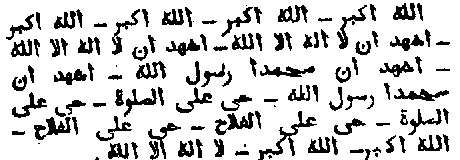
Allahu akbar! Allahu akbar! Allahu
akbar! Allahu akbar! Ashhadu an la ilaha
illa 'llah! Ashadu an la ilaha illa 'llah! Ashhadu
anna Muhammadan rasulu-llah! Ashhadu
anna Muhammadan rasulu-llah! Hayya
'ala 's-salati! Hayya 'ala 's-salati! Hayya
'ala 'l-falah! Hayya 'ala 'l-fatah.! Allahu
akbar! Allahu akbar! La ilaha illa llah!
Which is translated:-
" God is most great! God is most great!
God is most great! God is most great! I
testify that there is no god but God! I testify
that there is no god but God! I testify
that Muhammad is the Apostle of God! I
testify that Muhammad is the Apostle of God!
Come to prayer! Come to prayer! Come to
salvation! Come to salvation! God is most
great! God is most great! There is no god
but God!"
In the Azan in the early morning, after the
words, "Come to salvation!" is added

As-salatu khairun mina 'n-naumi! As-salatu khairun
mina 'n-naumi! "Prayer is better
than sleep! Prayer is better than sleep!
The Shi'ahs make a slight alteration in the
Azan, by adding the words

Haaya 'ala khairi 'l-'amali!
Haaya 'ala khairi 'l-'amali!
"Come to the best or works! Come to the
best of works!" and by repeating the last
sentence of the Azan, "There is no god but
God," twice instead of once, as in the Sunni
Azan.
When the Azan is recited, it is usual for
men of piety and religious feeling to, respond
to each call, as, for example, when the
Mu'azzin cries:
"Allahu akbar! Allahu akbar! Allahu
akbar! Allahu akbar!"
Those who hear it repeat
"Allahu akbar! Allahu akbar! Allahu
akbar! Allahu akbar!"
The Mu'azzin says-
"I testify that there is no god but God; I
testify that there is no God but God;"
They reply -
"I testify that there is no God but God;
I testify that there is no god but God."
Mu'azzin. - "I testify that, Muhammad is
the Apostle of God."
Reply-" I testify that Muhammad is the
Apostle of God."
Mu'azzin. ---" Come to prayer."
Reply.-" I have no power or strength but
from God the most High and Great."
Mu'azzin.--- "Come to salvation."
Reply.-"What God willeth will be: what
He willeth not willeth not be."
The recital of the Azan must be listened to
with great reverence. If a person be walking
at the time, he should stand still; if reclining;
sit up. Mr. Lane, in his Modern
Egyptians says, "Most of the Mu'azzins of
Cairo have harmonious and sonorous voices,
which they strain to the utmost pitch; yet
there is a simple and solemn melody in their
chants which is very striking, particularly in
the stillness of the night" But Vambery remarks
that "the Tukistanees most carefully
avoid all tune and melody. The manner in
which the Azan is cried in the west is here
(in Bokhara) declared sinful, and the beautiful
melancholy notes which, in the silent hour
of a moonlit evening, are heard from the
slender minarets on the Bosphorus fascinating
every hearer, would be listened to by the
Bokhariot with feelings only of detestation."
The summons to prayer was at first the
simple cry, "Come to public prayer." After
the Qiblah was changed, Muhammad bethought
himself of a more formal call. Some
suggested the Jewish trumpet, others the
Christian bell; but neither was grateful to the
Prophet's ear. The Azan, or call to prayer
was then established. Tradition claims for
it at supernatural origin, thus : - "While the
matter was under discussion. 'Abdu'llah, a
Kharrajite, dreamed that he met a man clad
in green raiment, carrying a bell. 'Abdu'llah
sought to buy it, saying that it would do well
for bringing together the assembly of the
faithful, I will show thee a better way,"
replied the stranger; " let a crier cry aloud,
'God. is most great,' &C" Waking from
sleep, Abdu'llah proceeded to Muhammad, and
told him his dream. (Muir, from Kutibu 'l-
Wackidi) Hishami recites the story as if
'Abdu'llah had actually met the man.
Bingham, in his Antiquities (vol.ii, book
page 29
viii. Chap. vii.), relates that, in the monastery
of virgins which Paula, the famous Roman
lady, set up and governed at Jerusalem, the
signal for prayer was given by one going
about and singing "Hallelujah!" for that
was their call to church as St. Jerome
informs us.
The Azan is proclaimed before the stated
times of prayer, either by one of the congregation,
or by the Mu'azzin or crier, who is paid
for the purpose. He must stand with his face
towards Makkah, with the points of his fore-
fingers in his ears and recite the formula
which has been given above
it must not be recited by an unclean
person, a drunkard, a madman, or a woman,
AZAR  Terah, the father
of Abraham. Surah vi. 74, "And when
Abraham said to his father Azar, Takest thou
images as gods?
Terah, the father
of Abraham. Surah vi. 74, "And when
Abraham said to his father Azar, Takest thou
images as gods?
"The Eastern authors unanimously agree
that he was a statuary, or carver of idols;
and be is represented as the first who made
images of clay, pictures only having been
in use before, and taught that they were to be
adored as gods. However, we are told his
employment was a very honourable one - and
that he was a great lord, and in high favour
with Nimrod, whose son-in-law he was, because
he made his idols for him, and was
excellent in his art. Some of the Rabbins say
Terah was a priest and chief of the order." --
(Sale.)
AL-AZARIQAH  A sect of
heretics founded by Nafi' ibn al-Azraq who
say that 'Ali was an infidel, and that his
assassin was right in killing him. (See ash
Shahrantani, ed. Cureton, p. 49, Haarbruecker's
translation, I., p. 133.
A sect of
heretics founded by Nafi' ibn al-Azraq who
say that 'Ali was an infidel, and that his
assassin was right in killing him. (See ash
Shahrantani, ed. Cureton, p. 49, Haarbruecker's
translation, I., p. 133.
AL-AZBA'  . The slit-eared;
one of Muhammad's favorite camels.
. The slit-eared;
one of Muhammad's favorite camels.
AL-AZHA  . ['IDU'L-AZHA.]
AL-'AZIM  . One of the
ninety-nine special names of God "The
great One."
. One of the
ninety-nine special names of God "The
great One."
'AZIMAH  . An incantation. [EXORCISM]
AL 'AZIZ  . One of the
ninety-nine special names of God. It
frequently occurs in the Qur-an. It means "the
powerful or the mighty One."
. One of the
ninety-nine special names of God. It
frequently occurs in the Qur-an. It means "the
powerful or the mighty One."
'AZRA'IL  . The angel of
Death. Mentioned in the Qur'an under the
title of Malaku 'l-Maut, Surah xxxii 11, "The
angel of death who is charged with you shalt
cause you to die.". [MALAHU 'L-MAUT.]
. The angel of
Death. Mentioned in the Qur'an under the
title of Malaku 'l-Maut, Surah xxxii 11, "The
angel of death who is charged with you shalt
cause you to die.". [MALAHU 'L-MAUT.]
Hughes' Dictionary of Islam
Answering Islam Home Page